Rachel Maddow kicked off her Monday night MS NOW program with a discussion of Star Wars — and specifically, how one track from the original trilogy just cost the Trump administration a big settlement payout for unlawful police conduct."The Empire Strikes Back is just as exciting as the first Star Wars movie, but it is darker, it is definitely darker, right?" said Maddow. "Our heroes aren't, you know, just plucky underdogs like they were in the first movie. It really, really feels like they are losing ... it's dark. The whole vibe of The Empire Strikes Back is this, you know, the dark dread of this tyrannical force having the upper hand, seeming like it's winning."Even if you aren't a Star Wars fan, Maddow continued, or have even seen the movies, you're likely to know one iconic piece of media from them, she continued. "This sound from The Empire Strikes Back still takes you right back to it, still puts you right back in that fear and dread of the terrible, evil Galactic Empire. John Williams' Imperial March from The Empire Strikes Back ... instant American pop culture shorthand for 'you're looking at tyranny,' right?"Enter Sam O'Hara, Maddow said — a protester who took it upon himself, during the initial Trump-mandated deployment of Washington, D.C., by the National Guard, to walk behind them blasting the Imperial March on his iPhone. She put up a clip of the incident.For that, she said, "a National Guardsman summoned the D.C. police to arrest him for it. And they put him in handcuffs. For having done that, for having played that song." As of today, however, he has gotten a $50,000 settlement for that unlawful treatment by the police. Moreover, she noted, "his lawsuit against the National Guard is still pending. So there may yet be more to come."As for O'Hara now, said Maddow, "he notes to the Washington Post today that he does still go out and do this, only now he doesn't just do it with his iPhone, now he does it louder. With a portable speaker. And now he's just been paid $50,000 for the way they overreached and handcuffed and tried to lock him up for doing it." - YouTube youtu.be
Gov. Gavin Newsom (D-CA) is deepening the state’s embrace of artificial intelligence by signing a deal with San Francisco-based Anthropic that will make Claude the first generative AI platform available across state agencies and local governments. The deal comes at a politically charged moment. While the Trump administration has moved to restrict the rollout of […]
Bloomberg Daybreak Europe is your essential morning viewing to stay ahead. Live from London, we set the agenda for your day, catching you up with overnight markets news from the US and Asia. And we'll tell you what matters for investors in Europe, giving you insight before trading begins.
South Korea unveiled an ambitious plan aimed at cementing its status as a technological powerhouse, with companies led by Samsung and SK Hynix initiating large-scale investments in memory chips, data centers and robotics.
The US and Iran agreed to stop attacking each other before peace talks resume this week over the Strait of Hormuz and other issues, paving the way to end days of tit-for-tat attacks that tested a fragile truce.
Today's guest: Fabricio Bloisi, CEO, Prosus and Naspers Group (Source: Bloomberg)
Abdul El-Sayed, a primary candidate for U.S. Senate in Michigan, released an ambitious AI policy platform Monday, joining other progressives like Senator Bernie Sanders in a push for regulation and public ownership. But El-Sayed’s proposal also goes a step further: not just public ownership, but also public governance. Earlier this month, an AI super PAC spent millions to ensure that Alex Bores, the author of a comparatively weak New York state AI accountability law, wouldn’t make it to Congress. El-Sayed’s proposed changes to the AI industry go far further than Bores’s legislation. When asked whether he was worried about industry political action committees targeting his campaign over his new proposals, El-Sayed shrugged it off. “I’m just not afraid of them or AIPAC or any of the others. What’s another hundred-million-dollar super PAC, I guess?”El-Sayed’s policy proposal, which he shared exclusively with The New Republic ahead of its release, has three key components: democratic governance of AI, public ownership of AI companies, and safety requirements. His proposal takes inspiration from Sanders’s American AI Sovereign Wealth Fund bill, proposed earlier this month—and like Sanders’s bill, calls for the creation of a sovereign wealth fund to distribute AI companies’ cash into Americans’ pockets. Sanders envisions establishing that via a one-time 50 percent tax on the country’s biggest AI companies, generating an estimated $7 trillion for social safety net programs, plus a yearly dividend for Americans. El-Sayed proposes using that money to fund education and job training, increase unemployment benefits, and boost small business loans.“I love the senator’s point that we need to own the outcomes of this, in part because it is our data and our knowledge that went into creating it,” El-Sayed said about Bernie’s proposal. They both reason that, since AI has been trained on human writing, research, and collective knowledge, it is a good that belongs to all Americans. “But I think the ownership part needs to go a step further, because we also need some control,” El-Sayed added.To get that control, he proposes democratic governance of AI companies. He proposes that frontier AI labs be chartered as public benefit corporations, legally mandating them to balance public interest with profit margins. Additionally, he suggests that a majority of board seats at these companies should be democratically elected or publicly appointed, rather than selected by shareholders. And, importantly, he calls for major tech companies like Amazon, Microsoft, Google, and Meta to divest from frontier AI companies. El-Sayed also recommends the establishment of a Food and Drug Administration–style agency to evaluate models before they’re deployed, a ban on AI-generated political media, and requiring companies to work with the Centers for Disease Control and Prevention, National Institutes of Health, and Federal Emergency Management Agency to protect against biosecurity breaches.El-Sayed’s breezy response to TNR’s question about possible industry retaliation—“What’s another hundred-million-dollar super PAC, I guess?”—references the unrelated money that the American Israel Public Affairs Committee, or AIPAC, has already spent on the race. Through United Democracy Project PAC, AIPAC has spent over $2 million to support one of El-Sayed’s opponents, Representative Haley Stevens, who is the Democratic establishment’s favored candidate. El-Sayed has repeatedly criticized both the Israeli government and AIPAC’s influence in politics. El-Sayed is also facing State Senator Mallory McMorrow, though polls suggest the race is largely between El-Sayed and Stevens. McMorrow released an AI policy proposal last month that focuses on creating a professional apprenticeship program funded by a token tax, which would charge by the number of tokens used (tokens are the basic units of data that AI models use). Stevens has not released an AI policy plan.Despite a broad consensus among voters that politicians should regulate the AI industry, few bills have actually been passed. Following AI industry super PACs’ massive spending to defeat Alex Bores in retaliation for the RAISE Act, some feared politicians might become even more reluctant to try.El-Sayed is hopeful that American voters are ready to push back against money in politics. “We live in an era right now where people are really smart to the old system of money coming in to buy elections. They see the wool being pulled over their eyes and they don’t like it,” he said.He also doesn’t think politicians have the luxury of time when it comes to regulating AI. “We need to act yesterday,” he said, “and at best, we can act tomorrow.”
A political analyst lamented the "dark moment" that is President Donald Trump's Great American State Fair, a 16-day festival at the National Mall organized by a Trump-linked entity called "Freedom 250," during a new podcast interview on Sunday. Jon Lovett, co-host of "Pod Save America" and a former speechwriter for President Barack Obama, discussed the state fair on a new episode of "The Daily Beast Podcast" with host Joanna Coles. He noted that attendance is low amid a heatwave across the East Coast and that several attractions at the event aren't working as advertised. While those issues were almost expected, Lovett noted that the event itself also casts a shadow over the nation's upcoming 250th birthday. "It’s a rare moment where you could have actually had a beautiful, like American patriotic celebration. I’ll be cringe and say that I’m sad that we don’t get to have that,” Lovett said. “But instead, we have this ridiculous, incompetent boob.”Lovett also pointed out that several attractions at the state fair were in poor condition. “The Ferris wheel isn’t working. The Reflecting Pool is green, the ice cream is melting, and nobody’s showing up. States feel like they should cancel, and they’re right to do so. Nobody wants to be associated with this guy. And it’s just a big bummer," he said. "I know it’s just a party, and we've got bigger fish to fry, but I do think it’s okay to take a moment and say, you know what? Like this is a dark moment, and it is a shame that we have fallen so low that this is what it would look like to forever, for how we marked an important milestone in the history of the country,” Lovett added.
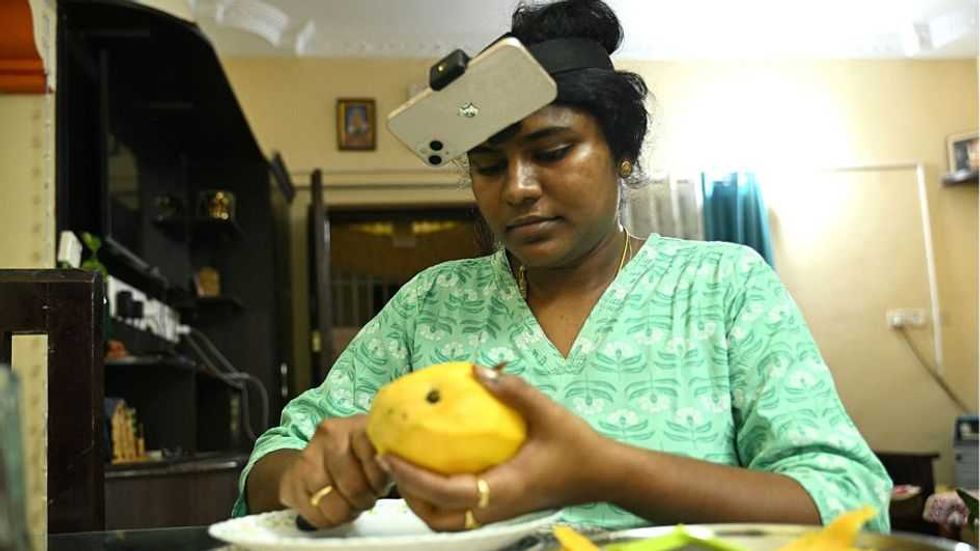
If you want to glimpse the future of artificial intelligence, don't start in Silicon Valley. Start in a South Korean factory.According to the International Federation of Robotics, South Korea now has 1,012 industrial robots for every 10,000 manufacturing workers — the highest robot density in the world. Put another way, roughly one in every 10 manufacturing "workers" is now a robot.For now, however, even the world's most advanced humanoid robots still struggle with tasks that young children perform effortlessly.That startling figure is one piece of a much larger story stretching from American AI labs to South Korean factories, Chinese assembly lines, and Indian garment workshops.For most Americans, the AI revolution is something that happens on a screen. We think of ChatGPT writing emails, Claude summarizing reports, or Google Gemini answering questions. The race appears to revolve around Silicon Valley companies building ever more capable language models.But the next phase of artificial intelligence is becoming much more physical.Instead of asking how machines can write like humans, researchers are asking how they can move like humans — how they grasp a coffee mug, fold a shirt, stitch a collar, or crack an egg without crushing it.That challenge has created an unexpected global division of labor: America builds the brains, South Korea builds the bodies, China provides the classroom, while India supplies the teachers.Together, they're revealing something surprising: the future of artificial intelligence depends on ordinary human beings.South Korea: Building the bodiesIf robotics has an epicenter, it may well be South Korea.The country's dominance in robotics didn't emerge from nowhere. It grew out of decades spent building some of the world's most advanced automobiles.The same expertise that allows South Korean companies to manufacture electric motors, precision steering systems, sensors, braking technology, and other high-performance automotive components translates remarkably well to humanoid robots. Goldman Sachs Research estimates Korean companies could account for roughly 30% of global humanoid robot production by 2035, either by manufacturing robots directly or supplying the critical components that allow them to move.Yet South Korea's embrace of automation has also exposed its tensions.This week, Hyundai workers overwhelmingly voted to authorize strike action after contract negotiations stalled, with robots emerging as a central issue for the first time.The union isn't simply demanding higher wages.It wants guarantees over how artificial intelligence and humanoid robots will be introduced onto factory floors, arguing that workers deserve a voice before machines begin performing jobs currently done by people.The dispute centers on Atlas, the humanoid robot developed by Hyundai-owned Boston Dynamics.While company executives describe Atlas as a way to perform dangerous, repetitive, and physically demanding work, union leaders see a machine that could eventually replace the people who build Hyundai's cars.The disagreement captures the paradox facing much of the developed world.Countries like South Korea desperately need automation. It has one of the world's fastest-aging populations and one of its lowest birth rates, creating labor shortages that robots may eventually help fill.Yet the workers whose jobs are most vulnerable understandably want assurances that they won't become casualties of the technological transition.Child's playFor now, however, even the world's most advanced humanoid robots still struggle with tasks that young children perform effortlessly.Finding a coffee pot, identifying its handle, lifting it correctly and pouring without spilling remains astonishingly difficult for a machine.The bottleneck is no longer the body or the brain. It is experience.Engineers can now build remarkably capable robot bodies and increasingly sophisticated AI models. What they can't manufacture is the accumulated experience that allows humans to navigate the physical world almost without thinking. Like a child learning to walk — or an apprentice learning a trade — robots improve only through repeated interaction with the real world.RELATED: Your child’s new best friend might be a Chinese surveillance device akinbostanci/Getty ImagesChina: Generating the experienceSouth Korea may lead the world in robot density, but China wins on sheer scale.According to the International Federation of Robotics, China had 2.027 million industrial robots operating in its factories in 2024. It installed another 295,000 robots that year alone, accounting for 54% of global robot demand.That scale gives Beijing an enormous advantage in the next phase of AI.Unlike ChatGPT, which learned from enormous quantities of text on the internet, humanoid robots must learn by interacting with the real world.
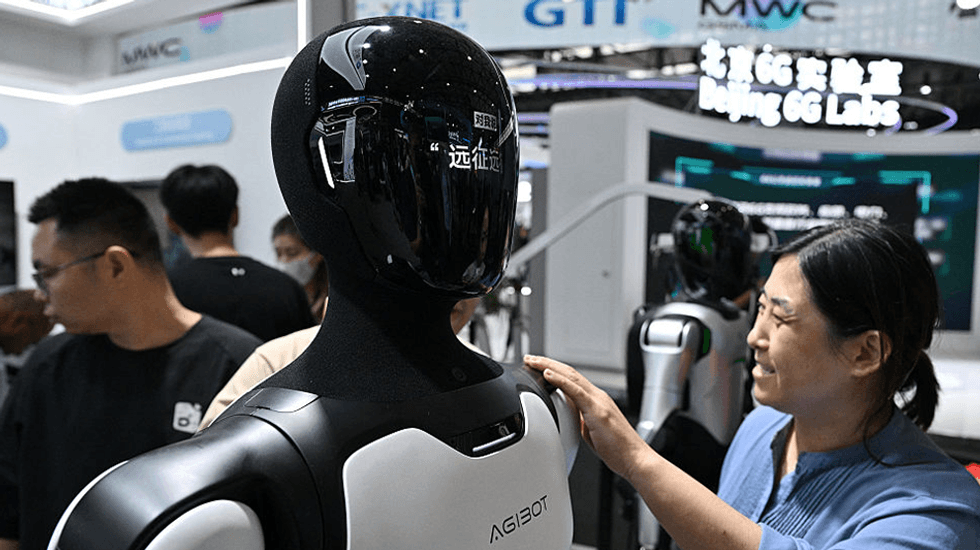
A data center already under attack from locals has announced a move that probably will only make residents more upset.American company Hyperscale Data Inc. has a data center in Dowagiac, Michigan, that residents say is too loud. A class action lawsuit filed in May says a constant hum from the facility is overwhelming.'... create a unique environment for developing and evaluating next-generation AI systems.'Neighbors said that they can hear the data center's cooling systems and fans from inside their home, limiting whatever they want to do on their property."I'm walking [my son] more than a mile away to get away from the noise," one man said, per WSBT.Piling onto this already (allegedly) burdensome data center is a recent announcement that Hyperscale Data will employ Chinese robots at the facility.Hyperscale and its subsidiary company Omnipresent Robotics are reportedly partnering with Chinese robotics firm Agibot PTE Ltd to get components for 30 OPR-R2 humanoid robots, Data Center Dynamics reported.Set for deployment in Q3 2026, the bots are intended to support the "development of embodied artificial intelligence applications, autonomous workflows, and advanced robotics systems."RELATED: The KIDS Act would turn web browsing into a TSA line Mustafa Yalcin/Anadolu/Getty Images While the OPR-R2 bots are not listed on Agibot's website, their top model of humanoid bot (the Agibot A2 Ultra) is about five-and-a-half feet tall and just over 150 pounds. It comes with three cameras — head, chest, and waist — a microphone and a speaker. The bots are described as a "rising star" in the entertainment industry, as well, and are recommended for brand ambassadors and performances.As workers, the machines will reportedly be assigned to the Omnipresent Robotics' Model Training Laboratory, where they will work "side-by-side" with data center employees to mimic their movements, also described as real-world training."The company believes the integration of humanoid robots with high-performance AI computing infrastructure will create a unique environment for developing and evaluating next-generation AI systems capable of operating in real-world environments," Hyperscale said, per DCD.RELATED: GOP bill aims to gut online censorship funds — and where the money is going will shock you Jason Alden/Bloomberg/Getty Images Hyperscale's chairman said that the company believes "physical AI" is the future of AI, with "tomorrow's AI systems" needing to be capable of understanding and interacting in the physical world.As for the data center itself, it sits at approximately 617,000 square feet and takes about 28 megawatts of power. According to DataCenters.com, there are 12 other data centers within 50 miles of the facility.Hyperscale Data is currently trading at around 17 cents per share at the time of this writing.Like Blaze News? Bypass the censors, sign up for our newsletters, and get stories like this direct to your inbox. Sign up here!
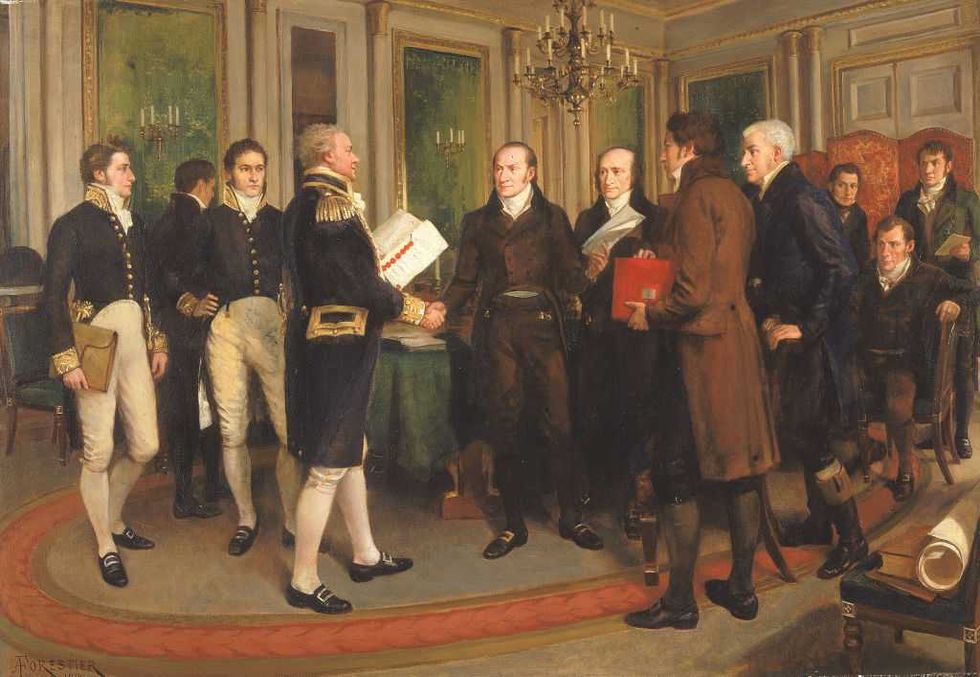
Oratory is out of fashion. The word itself sounds archaic to our ears, denoting something people used to practice in antiquity and at long length in 19th-century America. Even the more down-to-earth sounding “rhetoric” is heard to mean “mere” rhetoric — words false or deceptive by definition. Politicians talk about “messaging,” and the more significant politicians have layers of staff for “communications.”This does not bode well for the forthcoming 250th anniversary of the Declaration of Independence. Every politician in America will feel obliged to say something for the occasion. Whoever can — with perhaps some rare exceptions — will deploy a staff member or staff members to draft his remarks. The American people declared to the world and under God principles constituting not just the foundation and purpose of their political existence, but the only foundation for legitimate government.The staff members themselves, products of American universities where American history is frowned upon or given the 1619 treatment, will have to do original research to prepare for the task. A significant percentage of them will rely on artificial intelligence. Patriots have reason to wonder whether there is a politician (or comms team) in America today who understands and can articulate for his fellow citizens and the world the meaning of July 4, 1776.John Quincy Adams took July 4, 1776, with the utmost seriousness. The Declaration of Independence and the American Revolution became the north star of his politics over a 60-year career of devotion to his country and its cause. He understood that man is a political animal because he is endowed by nature with logos (speech, reason) and that in American politics, the statesman’s first task is to understand the logos — the word fitly spoken, the apple of gold — of the Declaration of Independence. He articulated his understanding of the Declaration and its principles beautifully, often, and at length in formal orations and other speeches and writings from the early to the late years of his remarkable political career. He served for a few years in his late 30s and early 40s, when he was also a United States senator, as the first Boylston Professor of Rhetoric and Oratory at Harvard. Later, in what his biographer Samuel Flagg Bemis called his “second career” of nine outspoken terms in the House of Representatives, he became known as “Old Man Eloquent,” in great part for his faithful championing of the principles of the Declaration. He was an avid, lifelong student of Cicero.Adams was born into the American Revolution to a mother and father who were revolutionaries. When he was 7 years old, the Battle of Bunker Hill took place (Saturday, June 17, 1775) within earshot of the farm in Braintree, Massachusetts, where he lived with his mother, Abigail, and three siblings. On the morning of the battle, his mother took him with her and climbed to the top of nearby Penn’s Hill. From there, the two could see fire and smell the smoke from houses burning in Charlestown. John Quincy remembered the moment vividly to the end of his life. His father, John, was 400 miles away in Philadelphia as part of the Massachusetts delegation to the Second Continental Congress. Braintree was in a war zone.RELATED: America turns 250 with a broken heart Carolyn Cole/Los Angeles Times/Getty ImagesWeeks before, as militia streamed into the area in the wake of the battles of Lexington and Concord, Abigail Adams had collected the family’s pewter dishes and melted them down to make bullets in a large kettle held over the kitchen fire. From time to time, she heard alarms, warning that the Royal Navy was about to land forces along the coast. She had good reason to fear that the British would try to seize rebel leaders and their families. The best John Adams could do at the time was to write to his wife from Connecticut: “In Case of real Danger ... fly to the Woods with our Children.” July 4, 1776, was still more than a year away, undefined in the uncertain future. But young John Quincy Adams was already learning its lessons.On July 4, 1785, less than two years after the peace settlement ending the American war for independence, 17-year-old John Quincy, who had served as his father’s private secretary during the peace negotiations, was sailing back to America after six life-forming years in Europe. He wrote in his journal, slightly misquoting James Thompson’s “Rule Britannia,” that July 4 was:The greatest day in the year, for every true American. The anniversary of our Independence.