PJ Media
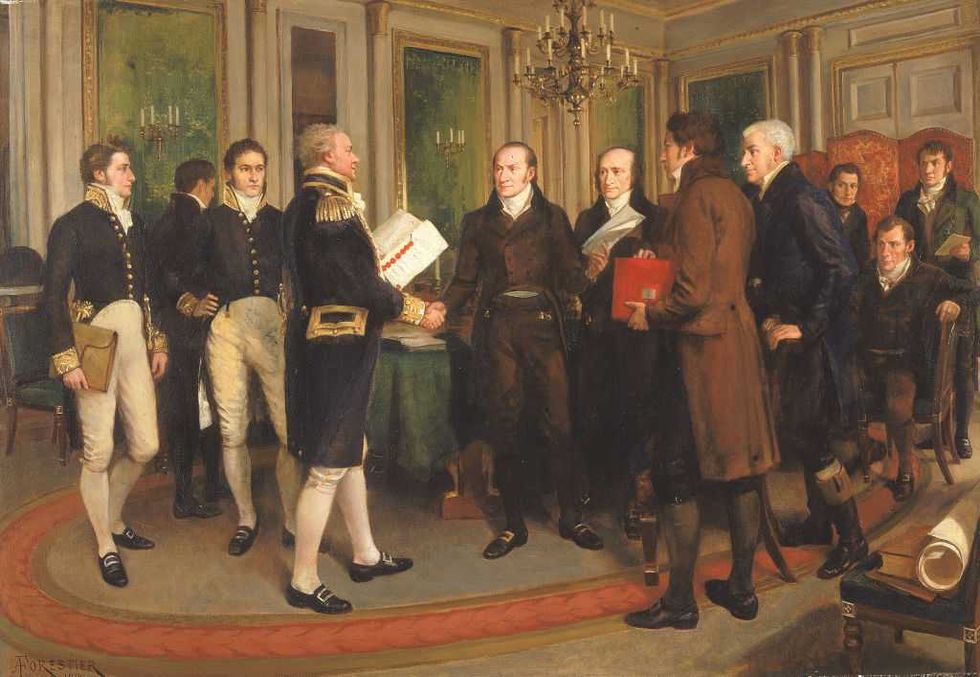
Oratory is out of fashion. The word itself sounds archaic to our ears, denoting something people used to practice in antiquity and at long length in 19th-century America. Even the more down-to-earth sounding “rhetoric” is heard to mean “mere” rhetoric — words false or deceptive by definition. Politicians talk about “messaging,” and the more significant politicians have layers of staff for “communications.”This does not bode well for the forthcoming 250th anniversary of the Declaration of Independence. Every politician in America will feel obliged to say something for the occasion. Whoever can — with perhaps some rare exceptions — will deploy a staff member or staff members to draft his remarks. The American people declared to the world and under God principles constituting not just the foundation and purpose of their political existence, but the only foundation for legitimate government.The staff members themselves, products of American universities where American history is frowned upon or given the 1619 treatment, will have to do original research to prepare for the task. A significant percentage of them will rely on artificial intelligence. Patriots have reason to wonder whether there is a politician (or comms team) in America today who understands and can articulate for his fellow citizens and the world the meaning of July 4, 1776.John Quincy Adams took July 4, 1776, with the utmost seriousness. The Declaration of Independence and the American Revolution became the north star of his politics over a 60-year career of devotion to his country and its cause. He understood that man is a political animal because he is endowed by nature with logos (speech, reason) and that in American politics, the statesman’s first task is to understand the logos — the word fitly spoken, the apple of gold — of the Declaration of Independence. He articulated his understanding of the Declaration and its principles beautifully, often, and at length in formal orations and other speeches and writings from the early to the late years of his remarkable political career. He served for a few years in his late 30s and early 40s, when he was also a United States senator, as the first Boylston Professor of Rhetoric and Oratory at Harvard. Later, in what his biographer Samuel Flagg Bemis called his “second career” of nine outspoken terms in the House of Representatives, he became known as “Old Man Eloquent,” in great part for his faithful championing of the principles of the Declaration. He was an avid, lifelong student of Cicero.Adams was born into the American Revolution to a mother and father who were revolutionaries. When he was 7 years old, the Battle of Bunker Hill took place (Saturday, June 17, 1775) within earshot of the farm in Braintree, Massachusetts, where he lived with his mother, Abigail, and three siblings. On the morning of the battle, his mother took him with her and climbed to the top of nearby Penn’s Hill. From there, the two could see fire and smell the smoke from houses burning in Charlestown. John Quincy remembered the moment vividly to the end of his life. His father, John, was 400 miles away in Philadelphia as part of the Massachusetts delegation to the Second Continental Congress. Braintree was in a war zone.RELATED: America turns 250 with a broken heart Carolyn Cole/Los Angeles Times/Getty ImagesWeeks before, as militia streamed into the area in the wake of the battles of Lexington and Concord, Abigail Adams had collected the family’s pewter dishes and melted them down to make bullets in a large kettle held over the kitchen fire. From time to time, she heard alarms, warning that the Royal Navy was about to land forces along the coast. She had good reason to fear that the British would try to seize rebel leaders and their families. The best John Adams could do at the time was to write to his wife from Connecticut: “In Case of real Danger ... fly to the Woods with our Children.” July 4, 1776, was still more than a year away, undefined in the uncertain future. But young John Quincy Adams was already learning its lessons.On July 4, 1785, less than two years after the peace settlement ending the American war for independence, 17-year-old John Quincy, who had served as his father’s private secretary during the peace negotiations, was sailing back to America after six life-forming years in Europe. He wrote in his journal, slightly misquoting James Thompson’s “Rule Britannia,” that July 4 was:The greatest day in the year, for every true American. The anniversary of our Independence.