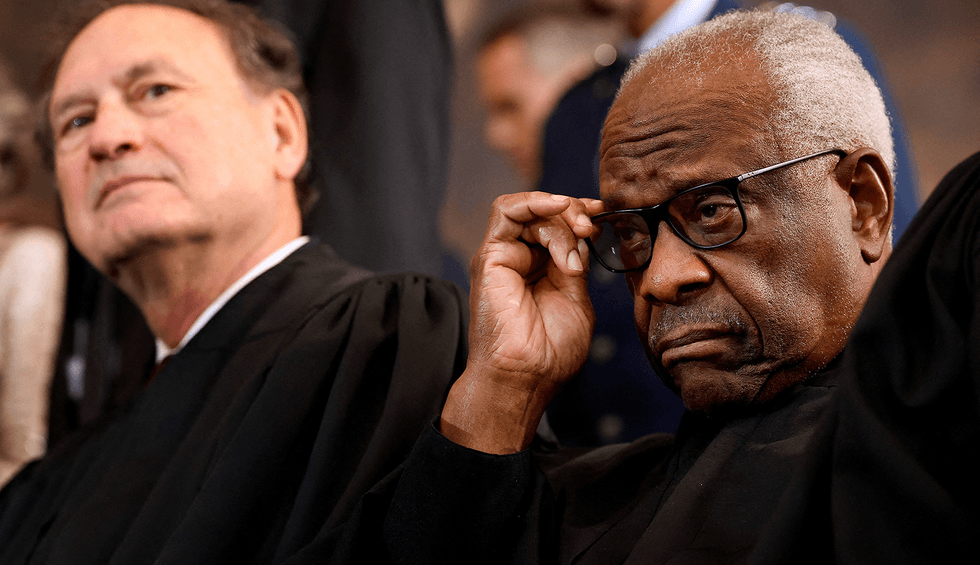
Clarence Thomas went from silent puppet to the most dangerous justice in modern history
Clarence Thomas went more than 10 years without asking a single substantive question from the bench. His silence between 2006 and 2016 prompted commentators to call his courtroom quietude embarrassing, a sign of fatigue and a lack of intellectual candlepower. Even earlier in his career, he had earned the nickname of “Scalia’s Puppet” for his habit of joining majority opinions written by Justice Antonin Scalia, the outspoken and reactionary “originalist” who shared the dais with him until his death in 2016.But the characterization of Thomas as an inattentive echo of Scalia is wrong. Thomas has always been more extreme and dangerous than Scalia, and his influence has never been greater. After his bruising 1991 confirmation hearing, Thomas set his eyes on the goal of moving American law backward to the laissez-faire era of the Gilded Age, undoing the regulatory state of the New Deal, weakening the civil rights legislation of the 1950s and ’60s and undermining many of the forward-looking precedent decisions issued by the Warren Court. As Thomas reportedly told two of his law clerks in 1993, he planned to serve until 2034, and until then would continue to make the lives of liberals “miserable.” He has already made good on that pledge: He is now the second-longest serving Supreme Court justice in history. Thomas has always been more extreme and dangerous than Scalia, and his influence has never been greater. Thomas is best known for concurrences and dissents that seemed culled from the lunatic fringe when he wrote them, but were later embraced by the majority as the court moved hard right. On affirmative action, in a 1995 case on government contracting (Adarand Constructors v. Pena), his concurrence denounced “remedial racial preferences” in federal hiring as a form of “racial paternalism.” This was an astonishing choice of words for the nation’s second Black Supreme Court justice, who overcame childhood poverty and after a brief flirtation with Black nationalism, became the beneficiary of affirmative action at Yale Law School. Twenty-eight years later, however, in a majority opinion written by Chief Justice John Roberts (Students for Fair Admissions v. Harvard), the court ended affirmative action in higher education.On abortion in a 2000 case (Stenberg v. Carhart) that invalidated Nebraska’s late-term abortion ban, Thomas dissented, arguing that the Roe v. Wade decison was “grievously wrong,” and that nothing in the Constitution “dictates that a State” must legalize abortion. Twenty-two years later, Samuel Alito’s majority opinion in Dobbs v. Jackson Women’s Health Organization adopted Thomas’ view. Ditto for the Second Amendment. In Printz v. United States, a 1997 gun-regulation case, Thomas contributed a concurrence arguing that the amendment encompassed a personal right to keep and bear arms rather than simply a right connected with service in state militias, as prior case law had clearly held. Eleven years later, in District of Columbia v. Heller, the court recognized the personal right in an opinion authored by Scalia. Thomas went on to expand the personal right in 2022 with his majority opinion in New York State Rifle & Pistol Association v. Bruen, a decision that severely handicaps state and local authorities from enforcing gun-control laws. Thomas is also on record advising the court to revisit its precedent decisions on the right to court-appointed counsel in criminal trials (Gideon v. Wainwright, 1963); the right of married persons to contraception (Griswold v. Connecticut, 1965); the right of adults to engage in private consensual sex (Lawrence v. Texas, 2003); and the right to same-sex marriage (Obergefell v. Hodges, 2015). He has also called for the court to reconsider 1964’s New York Times v. Sullivan, the landmark case establishing First Amendment protections in defamation cases involving public officials and public figures, which is widely considered the lynchpin of freedom of the press in America. In a recent column published by the influential Scotusblog website, constitutional law scholar Erwin Chemerinsky noted that “Thomas is the only justice … who has openly said that precedent deserves little weight in constitutional law.” Despite his laid-back courtroom demeanor, Thomas has also been an active and loquacious speaker out of court on the right-wing banquet and convention circuit, especially in meetings of the Federalist Society and events hosted by Hillsdale College, the Michigan-based private Christian institution long recognized as a hub for conservative thought leaders and a breeding ground for the right-wing’s ever expanding culture wars. Supreme Court justices typically attend academic, judicial and bar-related conferences, and initially, Thomas’ public remarks were fairly judge-like, focusing on time-honored topics like judicial independence.