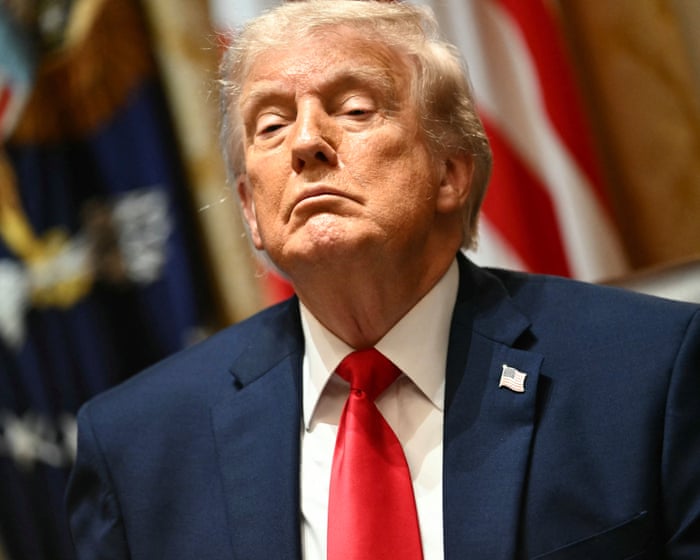
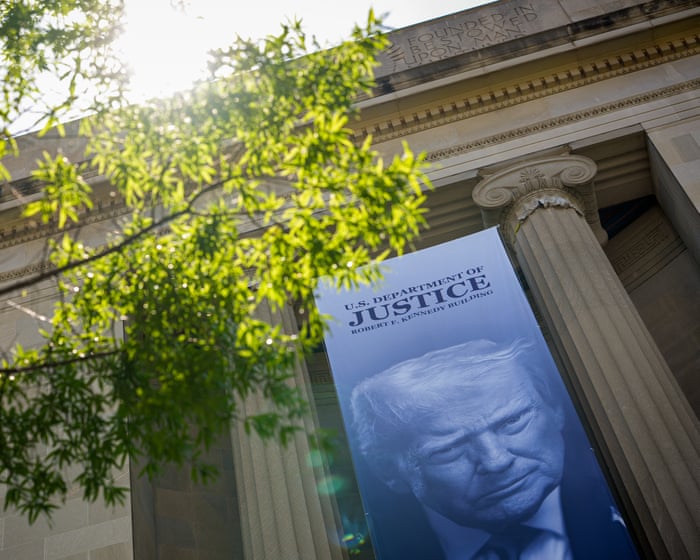
President Trump met with Speaker Mike Johnson (R-La.) at the White House on Monday to discuss the Justice Department’s controversial $1.776 billion antiweaponization fund, sources in the Speaker’s office confirmed to The Hill and to NewsNation’s Joe Khalil. The meeting comes as Republican lawmakers in the House and Senate have voiced frustration over the fund,…
President Donald Trump is expected to meet with House Speaker Mike Johnson (R-LA) on Monday at the White House to address a major obstacle to a top GOP priority – one created by the president himself, Punchbowl News’ Jake Sherman revealed.That obstacle is Trump’s taxpayer-funded $1.7 billion “anti-weaponization fund,” designed to award payouts to those who’ve alleged to have been unfairly targeted by the Biden administration’s Justice Department. Acting Attorney General Todd Blanche has admitted that even those convicted of assaulting police officers during the Jan. 6 Capitol riot would be eligible for compensation from the fund.While the fund has been temporarily blocked by a federal judge from awarding payouts, Trump has continued to support it, creating a headache for GOP lawmakers attempting to pass a reconciliation bill to fund Immigration and Customs Enforcement (ICE) and Customs and Border Patrol (CBP), which have remained unfunded since February.“Speaker Mike Johnson and President Donald Trump are meeting at the White House this morning on the weaponization fund,” Sherman wrote in a social media post on X. “This fund has completely screwed up passing reconciliation -- ICE/CBP funding.”No other details have been revealed about Trump and Johnson’s meeting, other than its focus being on the threat it poses to Republican efforts to fund ICE and CBP.SPEAKER MIKE JOHNSON and President DONALD TRUMP are meeting at the White House this morning on the weaponization fund.This fund has completely screwed up passing reconciliation -- ICE/CBP funding.Confirming the great abc team @lauren_peller and @KFaulders— Jake Sherman (@JakeSherman) June 1, 2026
Don't count on AI to solve America's inflation problem: That's the message from several Federal Reserve officials who warn that the promise of an AI-fueled productivity boom might not justify cheaper money.Why it matters: How AI shapes inflation and productivity will be a defining question for the Fed under the leadership of Kevin Warsh, who has staked out a case that the technology's supply-side benefits justify keeping rates low.Some Fed officials say they see clearer evidence of AI-related investment boosting demand for labor, equipment and infrastructure than they do of widespread productivity gains.The upshot: Inflation risks look more immediate than any AI-related productivity benefits, especially as inflation remains stubbornly above the Fed's target.What they're saying: "I believe it would be risky to rely on the prospect of higher productivity growth in the future to solve our inflation problem today," St. Louis Fed president Alberto Musalem said in a speech last week."AI shows great promise as a transformative technology, but the risks of a miscalculation about its impact on productivity and inflation are too great," Musalem said."[A]t present, I believe we should keep our guard up against persistent above-target inflation today, rather than base monetary policy on the hope that we will have higher productivity growth tomorrow."The big picture: Warsh has argued that AI will be a "significant disinflationary force, increasing productivity and bolstering American competitiveness," as he wrote in a Wall Street Journal op-ed late last year.The theory is that if AI helps workers and businesses produce more with the same resources, the economy can grow faster without generating inflation, giving the Fed more room to lower interest rates.But policymakers want evidence that the productivity gains are here to stay.By the numbers: Productivity started to take off before most companies had adopted AI, making it difficult to know how much to credit AI for the productivity lift.Over the past three years, productivity has averaged about 2.4% annually, far stronger than the 1.5% rate seen during the 2010s, according to the Bureau of Labor Statistics.Between the lines: Internet-fueled productivity gains in the 1990s were visible "everywhere except in the statistics," San Francisco Fed president Mary Daly told Neil at the Reagan Economic Forum on Friday. "We've got the productivity surge a little bit earlier this time. But what's problematic is it's hard for economists or anyone to link it directly back to the AI investments. In fact, if you talk to companies, they say they haven't seen the productivity yet," Daly said."I'm bullish, but I want to see some more evidence that this is actually picking up durable, sustained gains in productivity — but I see all the green shoots there." The intrigue: A new World Economic Forum survey shows economists think most sectors won't see notable AI-driven productivity gains for another two years, a longer timeline than they anticipated at the start of 2026.Companies and investors in recent weeks have begun to publicly question whether the enormous costs of deploying AI are translating into output and efficiency gains.What to watch: Fed governor Lisa Cook pointed to signs that AI investment demand is pushing prices higher for chips, high-tech equipment and software, as well as for construction labor, electricity and water. That comes alongside price pressures from the Iran war and tariffs."[Y]et another shock to prices could be layered on from the heightened investment demand due to AI," Cook said in a speech last week, noting that companies have announced roughly $1.5 trillion in data center investment plans."Those figures suggest that substantial AI-related investment remains in the pipeline from data centers alone. Effects of this demand on prices are apparent."
Chuck Schumer shares plans to force vote on ‘anti-weaponization’ fund and accuses Trump of ‘corruption’Democrats in the US Senate vowed to force Republicans to vote on a $1.8bn “MAGA slush fund” established as part of a resolution of Donald Trump’s long-shot lawsuit against the Internal Revenue Service.The US president has described the secretive and loosely controlled “anti-weaponization fund” as a means of paying the victims of politicized prosecutions. Members of his own party are among those who have expressed alarm. Continue reading...
In today’s newsletter: What an unprecedented scheme reveals about an increasingly uninhibited leadership – and what it might mean for American democracyGood morning. It has been two weeks since details of a settlement in the case of Trump v the Internal Revenue Service (IRS) first emerged. An out-of-court agreement with the US president created a $1.8bn fund for the Trump administration to dish out at its discretion. In response, the outrage has been unrelenting.Critics argue the result stinks of cronyism and corruption, effectively a “scheme for the Trumps to reward political friends while indirectly benefiting the family”. There has been rare pushback from within Trump’s own party: more than a dozen Republican senators have reportedly urged the administration to change course. YouGov polling found a majority of Democrats and Republicans oppose the fund.UK politics | A trove of government documents about Peter Mandelson contains no record of any measures taken to mitigate serious security concerns over his appointment as Washington ambassador, the Guardian has learned.Health news | A daily pill can double survival time in patients with the world’s deadliest cancer, according to the results of a clinical trial that experts are saying is a “gamechanger” and one of the biggest breakthroughs in decades.Lebanon | European leaders have condemned Israel’s expanding incursion into Lebanon, after its military captured the medieval Beaufort castle and Benjamin Netanyahu vowed to push even deeper into the country.Employment | An Indian citizen who came to the UK to work as a care worker through the post-Brexit visa scheme has been awarded nearly £30,000, because his employer failed to give him a single day of work for a year.UK news | Facebook whistleblower Sarah Wynn-Williams was forced to sit in silence on stage at an event at Hay festival, after lawyers advised her not to speak because of ongoing legal action brought by Meta. Continue reading...
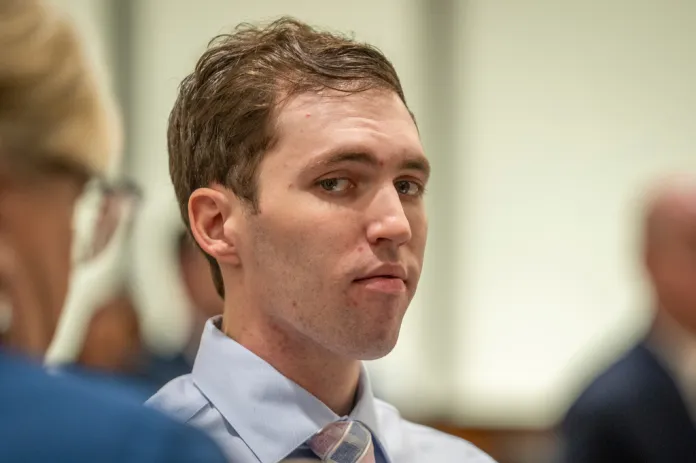
Tyler Robinson, the man charged with the assassination of Charlie Kirk, will appear in a court hearing on Monday morning at around 11 a.m. PARENTS AND BOYFRIEND OF TYLER ROBINSON TO TESTIFY FOR PROSECUTION IN CHARLIE KIRK MURDER TRIAL The judge in the case, Utah state Judge Tony Graf, is expected to decide on Monday […]
Guest post by Jonathon Moseley A fund for victims of the weaponization of government for partisan political purposes was announced on May 18, 2026, by Donald Trump and Acting Attorney General Todd Blanche.
The post What NOT to Know About the Weaponization Fund appeared first on The Gateway Pundit.