Sanders Proposes Sovereign Wealth Fund to Harness AI Profits for Public Good
The bill would impose a one-time 50 percent tax on AI giants' stock to give the US public a direct ownership stake.

Don't count on AI to solve America's inflation problem: That's the message from several Federal Reserve officials who warn that the promise of an AI-fueled productivity boom might not justify cheaper money.Why it matters: How AI shapes inflation and productivity will be a defining question for the Fed under the leadership of Kevin Warsh, who has staked out a case that the technology's supply-side benefits justify keeping rates low.Some Fed officials say they see clearer evidence of AI-related investment boosting demand for labor, equipment and infrastructure than they do of widespread productivity gains.The upshot: Inflation risks look more immediate than any AI-related productivity benefits, especially as inflation remains stubbornly above the Fed's target.What they're saying: "I believe it would be risky to rely on the prospect of higher productivity growth in the future to solve our inflation problem today," St. Louis Fed president Alberto Musalem said in a speech last week."AI shows great promise as a transformative technology, but the risks of a miscalculation about its impact on productivity and inflation are too great," Musalem said."[A]t present, I believe we should keep our guard up against persistent above-target inflation today, rather than base monetary policy on the hope that we will have higher productivity growth tomorrow."The big picture: Warsh has argued that AI will be a "significant disinflationary force, increasing productivity and bolstering American competitiveness," as he wrote in a Wall Street Journal op-ed late last year.The theory is that if AI helps workers and businesses produce more with the same resources, the economy can grow faster without generating inflation, giving the Fed more room to lower interest rates.But policymakers want evidence that the productivity gains are here to stay.By the numbers: Productivity started to take off before most companies had adopted AI, making it difficult to know how much to credit AI for the productivity lift.Over the past three years, productivity has averaged about 2.4% annually, far stronger than the 1.5% rate seen during the 2010s, according to the Bureau of Labor Statistics.Between the lines: Internet-fueled productivity gains in the 1990s were visible "everywhere except in the statistics," San Francisco Fed president Mary Daly told Neil at the Reagan Economic Forum on Friday. "We've got the productivity surge a little bit earlier this time. But what's problematic is it's hard for economists or anyone to link it directly back to the AI investments. In fact, if you talk to companies, they say they haven't seen the productivity yet," Daly said."I'm bullish, but I want to see some more evidence that this is actually picking up durable, sustained gains in productivity — but I see all the green shoots there." The intrigue: A new World Economic Forum survey shows economists think most sectors won't see notable AI-driven productivity gains for another two years, a longer timeline than they anticipated at the start of 2026.Companies and investors in recent weeks have begun to publicly question whether the enormous costs of deploying AI are translating into output and efficiency gains.What to watch: Fed governor Lisa Cook pointed to signs that AI investment demand is pushing prices higher for chips, high-tech equipment and software, as well as for construction labor, electricity and water. That comes alongside price pressures from the Iran war and tariffs."[Y]et another shock to prices could be layered on from the heightened investment demand due to AI," Cook said in a speech last week, noting that companies have announced roughly $1.5 trillion in data center investment plans."Those figures suggest that substantial AI-related investment remains in the pipeline from data centers alone. Effects of this demand on prices are apparent."

The bill would impose a one-time 50 percent tax on AI giants' stock to give the US public a direct ownership stake.
The speaker of the Lebanese parliament, Nabih Berri, told the Trump administration on Sunday that Hezbollah is ready for a full and immediate ceasefire with Israel and pledged to guarantee its implementation, Berri's top adviser Ali Hamdan told Axios. Why it matters: The fighting in Lebanon is escalating and threatening to derail the chances of a deal to end the war in Iran, particularly with Israeli Prime Minister Benjamin Netanyahu now threatening to strike Beirut.Iran's semi-official Tasnim news agency reported on Monday that Iran's negotiating team was suspending its exchange of messages with the U.S., through the mediators, in protest of Israel's actions in Lebanon.Zoom in: Berri is one of the most powerful Shia politicians in Lebanon and has close links to Hezbollah, though U.S. and Israeli officials question whether he can actually guarantee Hezbollah's compliance.If Hezbollah is indeed ready for a full ceasefire, such a truce would leave the Israeli occupation of southern Lebanon in place for now while potentially disconnecting the Lebanese arena from the war with Iran.According to a source with knowledge, though, U.S. officials told Berri they don't think Netanyahu would agree.An Israeli official confirmed Hezbollah expressed readiness for a full ceasefire without demanding an immediate Israeli withdrawal. The State Department didn't immediately respond to requests for comment.What he's saying: "I called the U.S. ambassador to Beirut, Michel Issa, on Sunday and told him on behalf of Speaker Berri that Hezbollah will be ready to totally commit to a comprehensive ceasefire and we are ready to guarantee it," Hamdan told Axios. Hamdan confirmed that the Trump administration proposed a partial ceasefire over the weekend which would require Hezbollah to stop striking northern Israel in return for Israel committing not to strike Beirut, as Axios reported.But he pushed back on a U.S. official's characterization of Berri's response as "evasive and disappointing."Friction point: "The proposal we received was no Hezbollah attacks on northern Israel and that in return Israel will not bomb Beirut and then gradually the ceasefire will expand to other areas," Hamdan said. "Speaker Berri's reply was, "Why a partial ceasefire? Let's have a full ceasefire."Berri proposed a ceasefire on the ground, air and sea under which Israel would also commit to stop demolishing houses in southern Lebanon. Hamdan claimed Berri has a channel of communication with Hezbollah that allows him to exchange messages with the group's leader, Naeem Qassem, who is in hiding."We are sure Hezbollah will commit to a total ceasefire. We think it will be more productive. We know time is running out," Hamdan said. State of play: The U.S. has urged Israel against striking Beirut for several weeks as part of a broader deescalation push, but a U.S. official hinted on Sunday that position could soften. "The U.S. does not expect Israel to absorb ongoing attacks on its civilians by a terrorist organization," the official told Axios.On Monday, Netanyahu issued a joint statement with Defense Minister Israel Katz threatening to bomb Hezbollah targets in the Dahieh District of Beirut "following repeated violations of the ceasefire" by the Shia militia. They said the district housed Hezbollah's "terrorist headquarters," which could no longer "remain off-limits." The Israel Defense Forces later issued a statement in Arabic urging "all residents of the Dahieh District in Beirut to relocate for their safety.""Should Hezbollah continue to fire toward our cities and communities, the IDF will respond by striking terrorist targets in Dahieh," the statement said.What to watch: Iranian Foreign Minister Abbas Araghchi issued his own warning on X that Israel's actions in Lebanon were a violation of the U.S.-Iran ceasefire, and the U.S. and Israel would bear "the consequences of any violation."Shortly after Araghchi's statement, Tasnim quoted Iranian officials stressing no talks with the U.S. will take place until Israel stops its attacks in Lebanon.The Tasnim report also said Iran and its "Axis of Resistance" are prepared to retaliate in the Strait of Hormuz "and activate other fronts," including the Bab el-Mandeb Strait in the Red Sea.
A former senior Trump administration official issued President Donald Trump and those around him an ominous warning on Monday about what they said were “historic consequences” they’ve yet to face, but undoubtedly will – and soon.That former official was Miles Taylor, a security expert who served as a Homeland Security senior advisor in the first Trump administration, and his warning was about the Trump administration’s ongoing operation in the Caribbean targeting suspected drug traffickers, an operation that critics have called illegal and as of Monday has killed 205 people.“More than 200 people have now been killed in Trump’s campaign against ‘drug boats’ since it began in early September,” Taylor wrote in an analysis published on his Substack Monday. “I can tell you from firsthand experience that all of them could have been arrested instead. In other words, the murders are a choice – and one that will have historic consequences.”As Trump’s deeply unpopular war against Iran continues to dominate news headlines, the administration has simultaneously begun ramping up its attacks on suspected drug traffickers in the Caribbean, and without providing evidence to the public proving that those killed were drug traffickers.And, while the Trump administration has yet to face any legal consequences for what even Republican lawmakers have described as “extrajudicial killings,” Taylor warned that consequences were, in fact, coming, and soon enough that “the people who carried this out should be calling their lawyers.”“First, Democrats are very likely to retake at least one chamber of Congress. The day they do, they get subpoena power, and the first thing a serious oversight committee will do is start pulling the thread on the obvious crimes committed by the Trump administration. This boat-strike campaign is top of the list,” Taylor wrote.“Second, congressional investigators will ask the only questions that matter in any abuse-of-power inquiry: who knew, and when did they know it? They will go looking for the paper trail, and they will undoubtedly find it.”
A conservative group is asking the federal government to criminally investigate Colorado officials for throwing 2020 election skeptic Tina Peters in prison. The state targeted the former […]
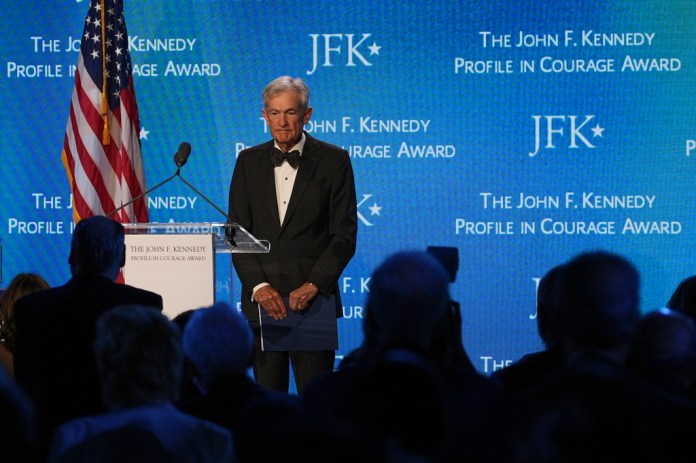
Former chair Jerome Powell on Sunday warned against political pressure on the Federal Reserve, saying that the central bank “has been undergoing a stress test.” “If any administration finds a way to remove Fed officials over policy differences, then future administrations will do so as well. The public would lose faith that the central bank…
Former Federal Reserve Chairman Jerome Powell on Sunday warned against politicizing the central bank, amid concerns President Donald Trump is undermining the institution’s prized independence. Powell’s speech while accepting the John F. Kennedy Profile in Courage Award in Boston came after he suggested that the Justice Department’s investigation into concerns he lied or misrepresented the […]
With Congress returning to session this week, Republicans are juggling several crises of President Donald Trump’s making as the party struggles over contradictory priorities. Faced with many problems that have few solutions, Punchbowl News founder Jake Sherman says the GOP is in a “very bad jam.”As Punchbowl News reports, “These are critical weeks for Trump and the GOP-controlled Congress, with just over five months left until Election Day. Trump has been bogged down in peace negotiations with Iran. The conflict remains at a stalemate somewhere between war and peace. Trump blames ‘Dumocrats, and various seemingly unpatriotic Republicans’ for not understanding that ‘it will all work out well in the end.’” Now the president faces a war powers vote in which the numbers are increasingly against him.But meanwhile, Trump and congressional Republicans are embroiled in a slew of other legislative quagmires, many of which reach an impasse this week. On Wednesday night, they hope to begin a vote-a-rama that will result in the passage of the immigration reconciliation bill Thursday morning. But this effort has been complicated by Trump’s highly controversial anti-weaponization “slush fund” as well as his demand for funding for his White House ballroom. Security funding for the wildly unpopular ballroom was already attached to the reconciliation bill, diminishing its support among lawmakers who recognize the potential for electoral blowback. An even greater obstacle, however, is the anti-weaponization fund. On one hand, some Senate Republicans have expressed an unwillingness to pass the reconciliation bill until the White House submits a plan to place guardrails around the fund, which the administration hasn’t done and shows little interest in. At the same time, Democrats are lining up for a “massive amendment blitz” that will tie the fund to the bill, forcing Republicans to vote publicly either for or against the fund, which has been condemned as “the biggest heist in history.”“Senate Democrats will launch a coordinated effort to kill the slush fund before one cent goes out the door,” Senate Minority Leader Chuck Schumer declared on Monday. “And no matter what Republicans do, we will force them to vote on it.”In the end, says Punchbowl, “The anti-weaponization fund and its impact on the reconciliation bill have been a political gift to Democrats.”Beyond that, this week Republicans hope to reauthorize FISA Section 702, which has divided the party between those who say it’s an essential security tool and those who argue it can be used as a “backdoor” for spying on Americans. After much wrangling, “The negotiated bill is expected to include a key sweetener to attract votes from privacy hawks who have long called for reforms to Section 702: a provision that narrows the definition of an electronic communications service provider. An ECSP is the type of company that would be required to provide records to the government.”And all of this is on top of several consequential votes involving the conflicts in Iran, Lebanon and Ukraine. While Republicans have been hesitant to draw Trump’s ire by opposing even broadly unpopular endeavors like the ballroom, the slush fund has drawn such universal outrage that it could derail the entire GOP agenda. According to Senator Gary Peters (R-MI), it is "a bridge too far for some of my Republican Senate colleagues. I hope they realize that what was done is simply unacceptable and that they'll stand firm."
A law enforcement document obtained by The Intercept shows police scan social media looking for posts opposing AI data centers. The post Cops Are Spying on People Who Criticize AI Data Centers Online appeared first on The Intercept.