Sanders Proposes Sovereign Wealth Fund to Harness AI Profits for Public Good
The bill would impose a one-time 50 percent tax on AI giants' stock to give the US public a direct ownership stake.
Far Left
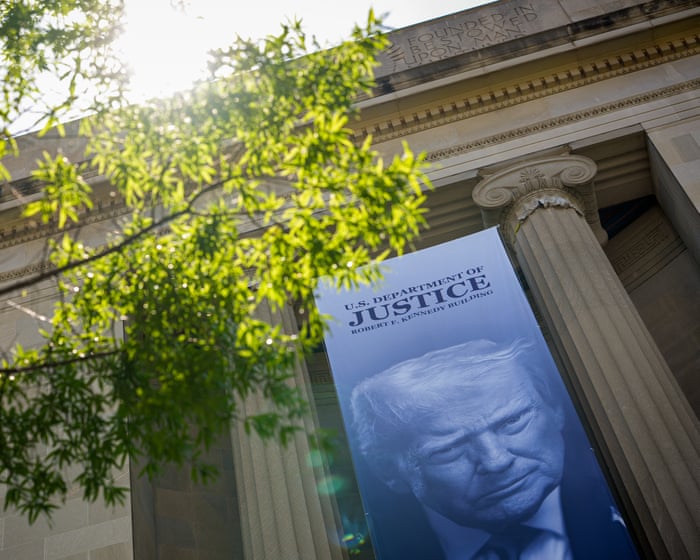
In today’s newsletter: What an unprecedented scheme reveals about an increasingly uninhibited leadership – and what it might mean for American democracyGood morning. It has been two weeks since details of a settlement in the case of Trump v the Internal Revenue Service (IRS) first emerged. An out-of-court agreement with the US president created a $1.8bn fund for the Trump administration to dish out at its discretion. In response, the outrage has been unrelenting.Critics argue the result stinks of cronyism and corruption, effectively a “scheme for the Trumps to reward political friends while indirectly benefiting the family”. There has been rare pushback from within Trump’s own party: more than a dozen Republican senators have reportedly urged the administration to change course. YouGov polling found a majority of Democrats and Republicans oppose the fund.UK politics | A trove of government documents about Peter Mandelson contains no record of any measures taken to mitigate serious security concerns over his appointment as Washington ambassador, the Guardian has learned.Health news | A daily pill can double survival time in patients with the world’s deadliest cancer, according to the results of a clinical trial that experts are saying is a “gamechanger” and one of the biggest breakthroughs in decades.Lebanon | European leaders have condemned Israel’s expanding incursion into Lebanon, after its military captured the medieval Beaufort castle and Benjamin Netanyahu vowed to push even deeper into the country.Employment | An Indian citizen who came to the UK to work as a care worker through the post-Brexit visa scheme has been awarded nearly £30,000, because his employer failed to give him a single day of work for a year.UK news | Facebook whistleblower Sarah Wynn-Williams was forced to sit in silence on stage at an event at Hay festival, after lawyers advised her not to speak because of ongoing legal action brought by Meta. Continue reading...
The bill would impose a one-time 50 percent tax on AI giants' stock to give the US public a direct ownership stake.

The author of a United Nations report that placed Israel on a “sexual violence blacklist” admitted she had no need to see evidence. The first hint that […]
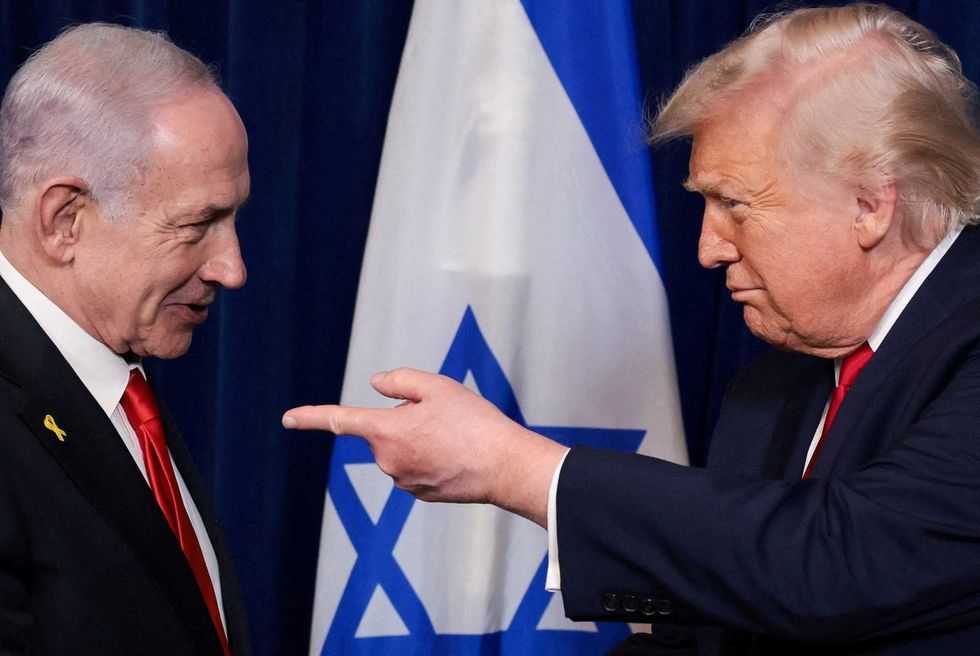
President Donald Trump announced Monday that a key obstacle standing in the way of his administration’s negotiations with Tehran to end the U.S. war against Iran had apparently been addressed, potentially clearing the path to an end to the conflict.“I had a very productive call with Prime Minister Bibi Netanyahu, of Israel, and there will be no Troops going to Beirut, [Lebanon], and any Troops that are on their way, have already been turned back,” Trump wrote on his social media platform Truth Social. “Likewise, through highly placed Representatives, I had a very good call with Hezbollah, and they agreed that all shooting will stop – That Israel will not attack them, and they will not attack Israel.”Trump’s inability to pressure Israel to halt its bombardment and invasion of Lebanon – which he explicitly demanded in April – has been a key factor in the negotiation stalemate between Washington and Tehran. Iranian officials have demanded that any agreement to end the conflict include Israel halting its bombardment of Lebanon, which since early March has killed more than 3,100 Lebanese and injured nearly 10,000.Whether Israel abides by Trump’s latest request to cease hostilities remains to be seen, with the Middle East nation having flagrantly disregarded the president’s demands in the past.
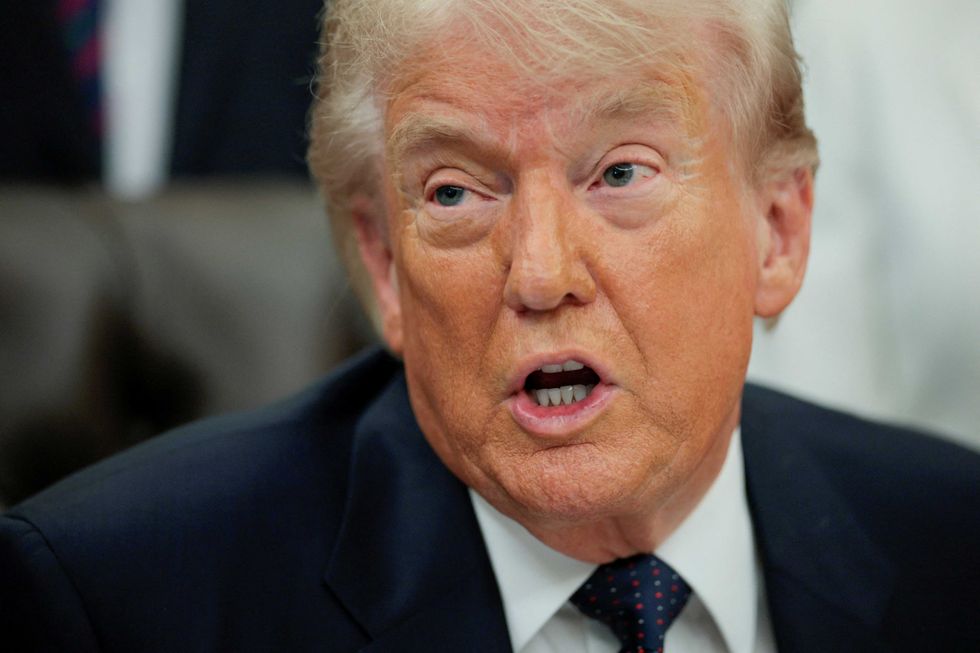
A GOP lawmaker argued on Monday that Americans who are unhappy with President Donald Trump's Iran war should leave the United States — prompting people to mock the remarks online.Rep. Sheri Biggs (R-SC) was speaking to Newsmax during a live broadcast following reports that Iran had suspended talks with the U.S. after Israeli strikes and an increased military offensive in Lebanon, which Iran had set as a condition for any ceasefire.Biggs claimed that Americans need to trust the president on what comes next with the ongoing conflict."I think we have to trust him. The American people elected President Trump for a reason, and it's because he has the backbone, the intelligence to get things done," she said."We have to put America first, and as I've said before, if you don't love this country, get out," Biggs said.People online had plenty of things to say in response to Biggs' comments."Republican Rep. says if you don't support Trump's Iran War you should leave America," Ron Filipkowski, editor in chief of MeidasNews and former Marine who has more than 782,000 followers, wrote on X."The bleaker things get, the more outrageous their bootlicking becomes," Zach Halper, Senior Media Strategist at Momentum Communications Group, wrote on Bluesky."They can't stop drinking the Kool-Aid... and people will remember," True Blue, an account that self-describes as "blue dot in the red state of Utah" and frequent progressive commentator with more than 23,000 followers, wrote on Bluesky."Historians will recall how Rep. Sheri Biggs chose to ignore her oath of office to defend against all enemies both foreign and domestic is broken by this treasonous member of Congress. Being on the wrong side of history as a loyal MAGA Nazi sycophant is definitely your grand legacy, Sheri," Dwight Miller, Navy veteran and frequent political commentator, wrote on Bluesky.Republican Rep. says if you don't support Trump's Iran War you should leave America. https://t.co/EzkgGYOcFf— Ron Filipkowski (@RonFilipkowski) June 1, 2026

President Trump met with Speaker Mike Johnson (R-La.) at the White House on Monday to discuss the Justice Department’s controversial $1.776 billion antiweaponization fund, sources in the Speaker’s office confirmed to The Hill and to NewsNation’s Joe Khalil. The meeting comes as Republican lawmakers in the House and Senate have voiced frustration over the fund,…
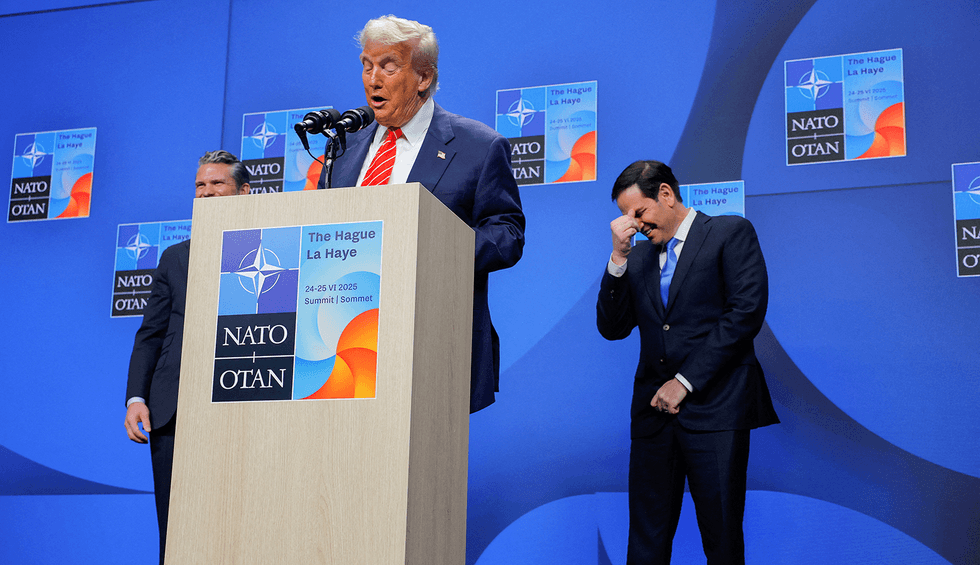
As the war with Iran has eased into something of a hot ceasefire, with the two sides exchanging occasional blows as a peace deal is negotiated, the American Conservative has a dismal assessment of President Donald Trump’s performance: the outcome he’s arriving at appears to be “beyond parody.”Citing recent reports from Axios on the state of Trump’s peace deal negotiations, the American Conservative contributor Anik Joshi notes that “the deal will have the same core ingredients as the one negotiated by President Barack Obama and signed in 2015 that the U.S. later left — some kind of financial/sanctions relief in exchange for verification of promises not to pursue a weapons program.” These two aspects are vital, but ignore many other considerations that are essential to the war, like the activities of regional proxies. But to bring these other elements into the debate risks sidelining the core nuclear issue, which could tank efforts for a deal altogether. “This was exactly what helped nearly sink the original JCPOA in Congress,” writes Joshi. “There was significant opposition to all the things the deal didn’t do. There was also much opposition to what it actually did — contempt for sunset clauses, for the fact that the deal would require some level of trust in addition to verification, and for arguments against any kind of financial relief for a regime some saw as illegitimate.”His conclusion is not optimistic: “Nearly a decade later, with oil prices sky-high, it is beyond parody that we are back to where this all began, except this time with a massive war as a kickoff rather than negotiations.”Joshi is quick to note that negotiations are still worth pursuing as “the goal remains a quick end to the war before it has a chance to become another quagmire and cause sustained economic damage.” He does warn, however, that “that window closes more with each passing day.” With that in mind, he argues that the administration should focus on the most pressing issues and be willing to leave “nice-to-haves” on the table for a later date while addressing the “must-haves” now. While Joshi does think that the US is arguing from a position of power — an assessment that many analysts do not share — he does warn that “the country is still not in a position to impose its will on the Iranian government, and any kind of agreement will need to be give-and-take. As a function of that, it will contain the same key ingredients as the JCPOA with differences of degree far more than differences of type. There has been no unconditional surrender, and as such it is effectively impossible to impose unilateral terms, especially when the Iranians have shown what they’re capable of doing to maritime passage through the Strait of Hormuz.”At the moment, Trump is walking a tightrope between Iran hawks who demand maximal concessions and Republicans who just want the war to end. To bring about the latter, says Joshi, the president will likely have to anger the former. “If the government is serious about a deal,” notes Joshi, “it will require disappointing hawkish supporters, and the administration should steel itself for that sooner rather than later.”
As the war with Iran enters its fourth month and President Donald Trump struggles to reach a peace deal to end the conflict he started, the Hill reports that Senate Republicans have become deeply divided over how to proceed. This ‘messy debate’ comes as the GOP is already at odds over several key legislative priorities. According to the Hill, several hawkish Senators led by Senate Armed Services Committee Chair Roger Wicker (R-MS), Lindsey Graham (R-SC) and Ted Cruz (R-TX) reject the deal that has been emerging with Iran, urging the president “not to agree to any deal that would allow Iran to continue its nuclear enrichment program or ease sanctions while it continues to support Hezbollah and Hamas.” American Enterprise Institute senior fellow Danielle Pletka typifies this view, “arguing that it would be even weaker than the Joint Comprehensive Plan of Action that the Obama administration negotiated with Iran in 2015 — a deal Trump abandoned in his first term.”“The reporting on it suggests that it’s a terrible deal, that the president has gotten basically nothing that he said he was getting, and that his negotiators have embarrassed him,” she said. “Anything that ends with Iran believing that it can open and close Hormuz at times of its choosing is a loss for the United States.”For the senators’ part, Wicker has warned that the deal would be a “disaster,” Graham argues that it would make Iran the region’s “dominant force,” and Cruz asserts that giving Iran billions in sanctions relief while allowing the country control over the Strait of Hormuz would be a “disastrous mistake.” According to Republican strategist and ex-Trump National Security Council spokesperson John Ullyot, however, “They will certainly make their feelings clear, and loudly, but it’s hard for the Senate to stand in the way of a deal by any president in an ongoing military operation since it’s not subject to a vote that would block it.”But the views of other GOP lawmakers have the party further divided, as “a growing number of Republican senators are losing patience with the lack of a clear plan for ending the conflict, which has caused gas prices to rise by nearly $1.40 per gallon since late February.” Four Republican senators recently voted to discharge a war powers resolution that would have directed Trump to withdraw U.S. troops from the war. These include Republican senators Rand Paul (R-KY), Susan Collins (R-ME), Lisa Murkowski (R-AK), and Bill Cassidy (R-LA), and the measure advanced because three Republicans were absent. It would have passed if just one more Republican had voted for it, “sending a loud rebuke to Trump over his handling of the conflict.”“The Senate is expected to vote this week on a motion to proceed to the resolution to end the war, but Senate Majority Leader John Thune (R-SD) and Democratic Leader Chuck Schumer (D-NY) need to work out a time agreement,” explained the Hill. “The measure is close to having enough support to pass the House as well, though Trump is certain to veto it.”According to the Hill, Republican senators on both sides of the divide will likely extend Trump some latitude as the deal is negotiated, but that once details are revealed, the backlash could be pronounced. Many are watching how Senator John Cornyn (R-TX) votes as he just lost a primary race to a Trump-endorsed opponent. Now that Cornyn knows he’s leaving office, he has little incentive to bend to Trump’s will, who has recently accused the senator of being “very disloyal.”

Iran on Monday suspended all peace talks with the U.S., just hours after President Trump claimed Iran “really wants to make a deal.”Tehran placed the blame on Israel, which it said violated the trifold ceasefire agreement when Israeli troops captured Beaufort Castle, a twelfth-century Crusader fortress in southern Lebanon, over the weekend.Israel previously used the castle, also known as Qalaat al-Shaqif, as a military base during its occupation of southern Lebanon between 1982 and 2000. The offensive marked Israel’s deepest incursion into Lebanon in more than 26 years. On Monday, Israel issued an evacuation order to residents in southern Beirut.Iranian state media reported that “there will be no dialogue” regarding U.S.-Israel-Iran peace efforts until the “aggressive and brutal operations of the Zionist regime’s army in Gaza and Lebanon” is quelled.Tehran said it would completely close the Strait of Hormuz, as well as another narrow trade route nestled between Yemen on the Arabian Peninsula—the Bab el-Mandeb Strait—as a consequence.Trump optimistically insisted on Truth Social late Sunday that Iran was eager to negotiate, and blamed his negotiating woes on Democrats and dissident Republicans. It is unclear what comes next: Trump casually revealed on Saturday that the U.S. would “finish it off militarily” if he did not reach a good deal with Tehran.The president repeated that he’s in “no hurry” to negotiate, and that—despite the war’s monumental impact on global gas prices—he believes if he’s in a hurry he’s “not going to make a good deal.”“And slowly but surely, we’re getting, I think, what we want. And if we don’t get what we want, we’re going to end it a different way,” Trump told his daughter-in-law on Fox News’s My View With Lara Trump.In the same interview, Trump referred to Venezuela as a “one-day win” and said that the situation with Iran is “a win already,” as the U.S. has “essentially defeated their military.”But it’s difficult to ascertain exactly what a “win” in the Middle East looks like when the aims of the war were never clear to begin with. While the Iranian regime has suffered major losses over the span of the conflict—including dozens of senior leaders—it has also become more extreme as a result.Rajan Menon, a senior research scholar at Columbia University’s Saltzman Institute of War and Peace Studies, argued in The Guardian late last month that Trump would—at this late stage—be “lucky” to strike a deal similar to former President Barack Obama’s 2015 Iran nuclear deal, which Trump ended during his first term.The U.S. has so far been at war with Iran for more than 13 weeks and spent an estimated $98 billion in the process. The regional conflict has damaged strategic alliances, stalled global trade, and thrust the world into an energy crisis due to the blockade on the Strait of Hormuz. It has also killed thousands of people.This story has been updated.