America remains deeply divided over whether the 2020 presidential election was stolen from Donald Trump. Millions believe the system failed them, while the media, intelligence bureaucracy, and the left have treated their doubts as something to suppress rather than investigate.The documents released this week by the Trump administration do not close the case. They reopen it — and make the “nothing to see here” narrative indefensible.Start with communist China.The released intelligence reports that approximately 220 million American voter records are in Chinese hands. Tens of millions of records across 18 states were bought, stolen, or hacked and included names, addresses, phone numbers, party preferences, and other sensitive information.A sovereign nation must know that the people selecting its government are its citizens. That does not prove China changed a single ballot, but it does prove Beijing possessed a political targeting asset. When a strategic rival aggregates enormous datasets and applies modern analytics, it gains the ability to identify, target, and influence American voters at industrial scale. The most disturbing disclosure involves the President’s Daily Brief — the president’s most sensitive and consequential intelligence product. In one released email, an official wrote: “We have deliberately massaged our one pending PDB to avoid any direct links to the election.”In a separate internal chat, a counterintelligence official boasted: “I’m basically running a shadow government across the FBI at this point.”The left has spent years ridiculing concerns about a “deep state” as conspiracy theory. These revelations make that ridicule look increasingly like camouflage.Then comes the voting-system reveal.A Cybersecurity and Infrastructure Security Agency report included in the administration’s document release identifies weak access controls, outdated operating systems, flat networks, inadequate monitoring, and legacy remote-access pathways across state and local election environments. During multiple penetration tests and red-team exercises, CISA assessors gained full control of election-office networks within hours or days.Separately, the report cites research involving one ballot-marking system showing that barcode-encoded votes could be altered without changing the human-readable selections displayed to the voter.The release also includes intelligence concerning methods allegedly developed by Venezuela’s Maduro regime to manipulate electronic totals while concealing the changes.Precision matters. A Venezuelan capability is not proof of an American operation. A demonstrated vulnerability is not proof it was exploited. The documents do not establish that American vote totals were secretly changed in 2020.But they demolish the claim that election technology is immune from manipulation. These are computer systems with software, databases, vendors, administrators, updates, and attack surfaces. Compromise must be anticipated and independently detectable.RELATED: America needs an artificial intelligence coalition, not an AI fortress Burcu demir/Getty ImagesA limited Department of Homeland Security review raises another alarm. The White House says it identified approximately 278,000 potential noncitizen registrations. DHS’ public follow-up described more than 250,000 preliminary potential matches in California, New Jersey, Nevada, and Pennsylvania — only four states.No serious person should dismiss numbers of this magnitude. Biden’s certified Georgia margin in 2020 was 11,779 votes. In 2016, Trump carried Michigan and Wisconsin by a combined 33,452 votes — and Michigan, Wisconsin, and Pennsylvania by just 77,744.The media formula — “the documents do not prove vote totals changed; therefore they prove nothing” — is analytical malpractice. Absence of final proof is not proof of institutional innocence.The proper question is whether this new information raises the probability that foreign influence, intelligence suppression, ineligible registrations, or exploitable technology played a larger role in the 2020 election environment than Americans were told — and whether future elections remain at risk.The answer to both questions is yes.That is why Congress must pass the SAVE America Act before November. The House-passed legislation requires documentary proof of citizenship for federal voter registration and photo identification for federal voting.These are basic risk controls. Pew found that 83% of Americans — including 71% of Democrats and 95% of Republicans — support government-issued photo identification. A sovereign nation must know that the people selecting its government are its citizens. A constitutional republic must demonstrate — not merely assert — that its elections are accurate.Congress should stop stalling and pass the SAVE America Act.
Filmmaker Juan Carlos Dávila’s new film for PBS, Farmers of the Sea, documents climate change’s threats to the fishing industry and food security in Vieques, Puerto Rico. For islands in the Caribbean, explains Dávila, “we are situated geographically in one of the frontlines of climate change. [We’re] not only facing stronger hurricanes now, [but] we could face food shortages, especially the islands that depend so much on the food that comes from the sea.”
Republicans are accusing California's Democrat Attorney General Rob Bonta of "rigging" the 2026 election voter ID ballot initiative after he made a sneaky change to the measure's wording.
The post Republicans Accuse California’s Democrat Attorney General Rob Bonta of “Rigging” Election After Sneaky Change Made to Voter ID Ballot Initiative appeared first on The Gateway Pundit.
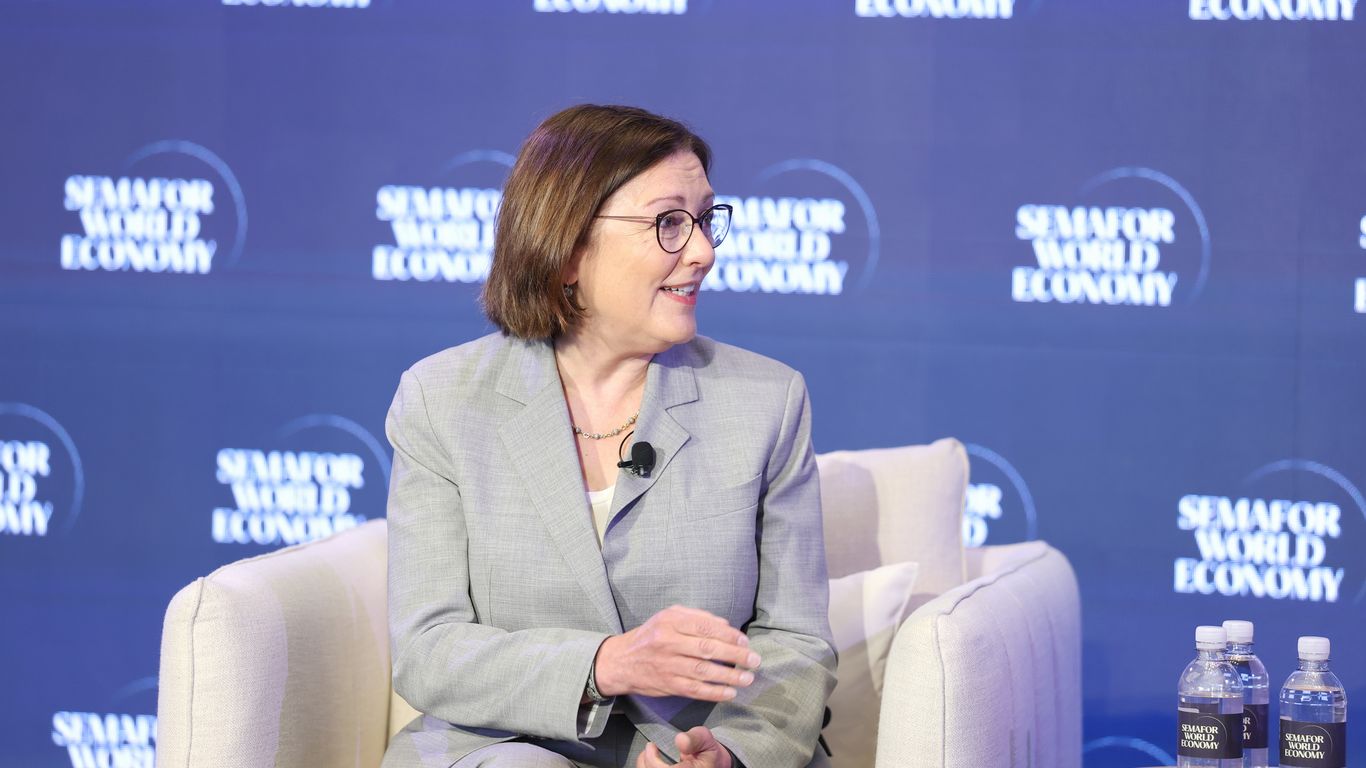
House Democrats are publicly and privately pushing for changes at the Democratic Congressional Campaign Committee after it spent more than $500,000 backing a failed primary candidate in Arizona.Why it matters: The House Democratic campaign arm has faced persistent criticism this year from its members for getting more heavily involved in primaries than in past election cycles."I don't think they should get involved in primaries — I've said that before, I've said that directly to them," said Rep. Pramila Jayapal (D-Wash.), a co-chair of the Congressional Progressive Caucus' PAC."I think we need to let voters do their thing. ... as the Democratic Party we should stay out of Democratic primaries."Driving the news: This latest bout of criticism towards the DCCC comes after the party committee spent over $500,000 in support of Marlene Galán-Woods in Arizona's 1st district, according to ad tracking firm AdImpact.Former state Rep. Amish Shah won the primary instead, according to the Associated Press.Shah's win marks the third time this year the DCCC spent six figures on their preferred candidate in a Democratic primary only to come up short.What they're saying: Several House Democrats told Axios there should be a formal body that gives rank-and-file members and House caucuses more say over where and how DCCC money is spent."I just think more input on these decisions is better in general," Rep. Adelita Grijalva (D-Ariz.), a vocal critic of the DCCC's spending in primaries, told Axios.Rep. Analilia Mejia (D-N.J.) said the DCCC should "revisit the way that things are traditionally done and make sure that we have more input."It's "a great opportunity for ... different perspectives that get us really good decisions," said Rep. Delia Ramirez (D-Ill.).Rep. Ro Khanna (D-Calif.), whose hobby horse is having more progressives added to the DCCC's "Red to Blue" program, said he thinks it would be a "good idea" for members to have more influence on the decision-making."Obviously something needs to change," another House Democrat told Axios, adding, "I don't know if decision by committee is the best route or another option, but I'm all ears."Yes, but: The DCCC isn't a black box — several members said they have had opportunities to talk to DCCC chair Suzan DelBene (D-Wash.) about her decisions even though they disagreed with them."I wanted to be frontline and wasn't able to get on, but I talked to Suzan and I certainly had input on that situation," said Rep. Suhas Subramanyam (D-Va.).Jayapal said CPC PAC leadership has "weighed in directly" with DelBene and House Minority Leader Hakeem Jeffries (D-N.Y.) in cases where the DCCC and CPC endorsements clashed."The staff, the Executive Director, and the Chair have all been incredibly accessible to both me and my boss," Hannah Spengler, a senior advisor for Rep. Don Davis (D-N.C.), told Axios.Between the lines: The DCCC regularly gives a heads up to the relevant caucus leaders, rank-and-file members and local electeds when they make a "Red to Blue" endorsement, a source familiar with the matter told Axios."They may not like the decision, but they are consulted. There is a conversation that happens ahead of each one of these decisions," the source said.The source also stressed that the DCCC only runs positive ads on behalf of the Democratic primary candidates they support and that the spending on primaries represents a small fraction of the committee's overall spending.What to watch: Much of this will fall on the shoulders of the next DCCC chair. That decision is entirely at the discretion of Jeffries, who told Axios last week he has not given any thought to who he will appoint for the 2028 cycle.House Democrats told Axios that Rep. Brad Schneider (D-Ill.) has privately expressed interest in the role and that Rep. Greg Stanton (D-Ariz.) is seen as another possible contender.A Schneider spokesperson said in a statement he is "flattered by the trust his colleagues have in him, but he is not seeking the DCCC chairmanship."Stanton told Axios: "The only person who matters on that is Hakeem Jeffries. He's going to be a great speaker, he's going to make a great choice."
President Trump announced massive new conditions to his nuclear deal with Saudi Arabia on Thursday morning, just hours after it was signed.In a Truth Social post, Trump demanded that Saudi Arabia normalize relations with Israel via the Abraham Accords before getting any U.S. nuclear technology. He also claimed “there will be no enrichment of material,” though the deal certainly opens the door to uranium enrichment in the country.“The Civil Nuclear Deal (There will be no enrichment of material!) being made between the United States Department of Energy and Saudi Arabia, which pertains only to non-military use such as the ones that Iran and UAE (and others) already have, will be approved, but is totally subject to Saudi Arabia joining the very respected and successful Abraham Accords,” Trump wrote. “The United States is not opposed to Civil (Non-Enriched) Nuclear Facilities.” Negotiating terms would make sense if the deal wasn’t already signed, or if the Saudi kingdom had at least hinted at accepting the demands Trump outlined (it hasn’t).Trump’s post created a stark messaging contradiction for the White House, which is still struggling to explain the terms of the deal. White House press secretary Karoline Leavitt was asked to explain the president’s about-face during her Thursday press conference. “What steps is the U.S. taking to get Saudi Arabia to sign the Abraham Accords?” a reporter asked.Leavitt did not answer the question. “This is a condition that the president has spoken about many times.… He wants to see these countries sign the Abraham Accord, it was one of the most historic accomplishments of his first term, and it continues to be a long-term goal of his to expand those accords to ultimately come to a place where the Middle East can be a peaceful and stable region,” Leavitt replied, providing no examples of mechanisms being used to make that happen. “Yes, this deal with Saudi Arabia … is contingent on this condition as far as the president is concerned. So we’ll continue to talk with our Saudi counterparts to get the deal finalized.” “Why was that condition not mentioned yesterday when the energy secretary announced it?” another reporter followed up.“Well, look, the president is always the final dealmaker, as you know, and this is something that he has mentioned on numerous occasions,” Leavitt replied.“So the deal is dead if Saudi Arabia doesn’t join? And have you any indication that Saudi Arabia is even considering this?” Leavitt once again failed to engage with the actual questions being raised. “The president has spoken directly with the Saudis about this in numerous conversations in the past, and the administration will continue to engage in these conversations.” White House press secretary Karoline Leavitt said President Trump wants Saudi Arabia to join the Abraham Accords before a proposed U.S.-Saudi civil nuclear energy deal moves forward, confirming the agreement is contingent on that condition.Saudi Arabia has not yet responded… pic.twitter.com/QRWk0H2b5C— CBS News (@CBSNews) July 23, 2026It’s clear that no one in the Trump administration can explain just how they plan to get the Saudis to agree to a different deal than the one they signed just a few hours ago. “On Trump seemingly adding new conditions to the US Saudi nuclear deal, including Saudi Israel normalization, a Saudi source says: ‘It was signed. So nothing to renegotiate,’” journalist Laura Rozen wrote. “‘Tweets don’t overturn signed agreements.’”
This story originally was published by Real Clear Wire By James Varney For much of its five-decade history, the Colorado Energy Office was a small department with a handful of employees who supported practical, cost-saving energy conservation measures.
The post Biden Bucks: Climate Change Funds a Bonanza for State Outfits appeared first on The Gateway Pundit.