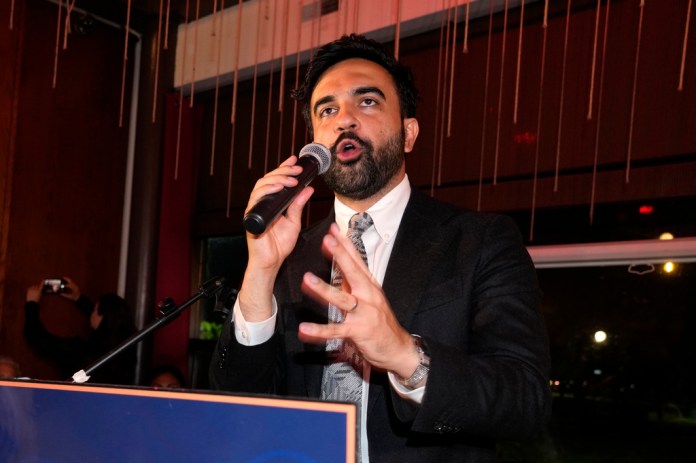
New York City Mayor Zohran Mamdani confirmed Wednesday that former Vice President Kamala Harris has been in contact with him for a few months, the latest indication that the former Democratic presidential nominee is strengthening ties with the party’s progressive wing as she weighs a possible 2028 White House bid. “Yes. That is true,” the […]
The California DMV is moving forward with plans to share driver’s license and state ID data through an outside network, which could help ID illegal immigrants.
The Supreme Court ruled Monday that the Fourth Amendment protects an individual’s right to privacy when it comes to their phone location data.The justices ruled 6–3 to send a Virginia bank robbery case back to the lower courts for review in light of its decision. In 2019, Okello Chatrie was convicted of robbing a credit union after police saw him using his phone in the security camera footage of the bank. They then used a “geofence warrant,” which compels tech companies to provide law enforcement with data from all devices at a specific place and time, to identify Chatrie.Geofence warrants are regularly used, and let the government demand location data and records from anyone near a crime scene without needing to identify an individual target.Government lawyers argued that Chatrie did not have a “reasonable expectation” of privacy, since he had willingly shared his location with Google.But the Supreme Court rejected that argument. Justice Elena Kagan wrote the opinion for the majority, with conservative Justice Brett Kavanaugh and Chief Justice John Roberts joining the court’s liberals.“A cell-phone user is not to be viewed as sharing private information with third parties—which then can be freely passed on to the government—just by doing the ordinary things cell-phone users do,” Kagan wrote.Justice Sonia Sotomayor concurred, writing, “even short-term monitoring” of a person’s physical movements can provide “a wealth of detail about [his] familial, political, professional, religious, and sexual associations.”The ruling is a win for data privacy, and will make it harder for the federal government to access personal information stored in the cloud without getting a specific warrant.
Georgia Republican Senate candidate Rep. Mike Collins (R-GA) is parroting President Donald Trump's 2020 election conspiracy theories, even though it's a "losing message," as one data analyst said. Trump's administration staged an FBI raid on the Fulton County elections offices, claiming that they needed all ballots cast to search for election fraud. Speaking to CNN on Monday, however, data analyst Harry Enten made it clear that if Collins wants to win, he should keep his mouth shut about 2020. He's in good company when it comes to the Republican Party, but the rest of America is calling it bunk. "I mean, they just believe this garbage," Enten said about the GOP. "Look at this: GOP that says that the 2020 election was stolen."In 2021, 60 percent of Republicans said that the 2020 election was stolen, and in 2026, that number has risen to 63 percent. Enten said that Collins is "starting to feel a whole lot like Herschel Walker 2.0." Walker lost his election in 2022. He explained that Collins' comments to CNN's Manu Raju make sense in the larger GOP narrative, but when it comes to reality, the rest of America isn't along for the ride. "Most Republicans, despite all of the evidence to the contrary, believe that the 2020 election was, in fact, stolen," said Enten. That's all well and good in a primary, but the general electorate doesn't embrace the sentiment. "The Republican Party [is] all the way over on the right, and the rest of the American public is in the same camp, and the actual — this is the real world we're dealing with here," an animated Enten said. In 2021, 59 percent of Americans didn't believe the election was stolen, and that number has jumped up to 64 percent who said that they don't think the election was stolen. "So what you see is the American people believe in the results, rightfully believe in the results of the 2020 election, and then you have Republicans all the way in another camp. It is a losing message!" he concluded. "That's why I say that Mike Collins is starting to sound like Herschel Walker 2.0," he concluded.
A data center already under attack from locals has announced a move that probably will only make residents more upset.American company Hyperscale Data Inc. has a data center in Dowagiac, Michigan, that residents say is too loud. A class action lawsuit filed in May says a constant hum from the facility is overwhelming.'... create a unique environment for developing and evaluating next-generation AI systems.'Neighbors said that they can hear the data center's cooling systems and fans from inside their home, limiting whatever they want to do on their property."I'm walking [my son] more than a mile away to get away from the noise," one man said, per WSBT.Piling onto this already (allegedly) burdensome data center is a recent announcement that Hyperscale Data will employ Chinese robots at the facility.Hyperscale and its subsidiary company Omnipresent Robotics are reportedly partnering with Chinese robotics firm Agibot PTE Ltd to get components for 30 OPR-R2 humanoid robots, Data Center Dynamics reported.Set for deployment in Q3 2026, the bots are intended to support the "development of embodied artificial intelligence applications, autonomous workflows, and advanced robotics systems."RELATED: The KIDS Act would turn web browsing into a TSA line Mustafa Yalcin/Anadolu/Getty Images While the OPR-R2 bots are not listed on Agibot's website, their top model of humanoid bot (the Agibot A2 Ultra) is about five-and-a-half feet tall and just over 150 pounds. It comes with three cameras — head, chest, and waist — a microphone and a speaker. The bots are described as a "rising star" in the entertainment industry, as well, and are recommended for brand ambassadors and performances.As workers, the machines will reportedly be assigned to the Omnipresent Robotics' Model Training Laboratory, where they will work "side-by-side" with data center employees to mimic their movements, also described as real-world training."The company believes the integration of humanoid robots with high-performance AI computing infrastructure will create a unique environment for developing and evaluating next-generation AI systems capable of operating in real-world environments," Hyperscale said, per DCD.RELATED: GOP bill aims to gut online censorship funds — and where the money is going will shock you Jason Alden/Bloomberg/Getty Images Hyperscale's chairman said that the company believes "physical AI" is the future of AI, with "tomorrow's AI systems" needing to be capable of understanding and interacting in the physical world.As for the data center itself, it sits at approximately 617,000 square feet and takes about 28 megawatts of power. According to DataCenters.com, there are 12 other data centers within 50 miles of the facility.Hyperscale Data is currently trading at around 17 cents per share at the time of this writing.Like Blaze News? Bypass the censors, sign up for our newsletters, and get stories like this direct to your inbox. Sign up here!
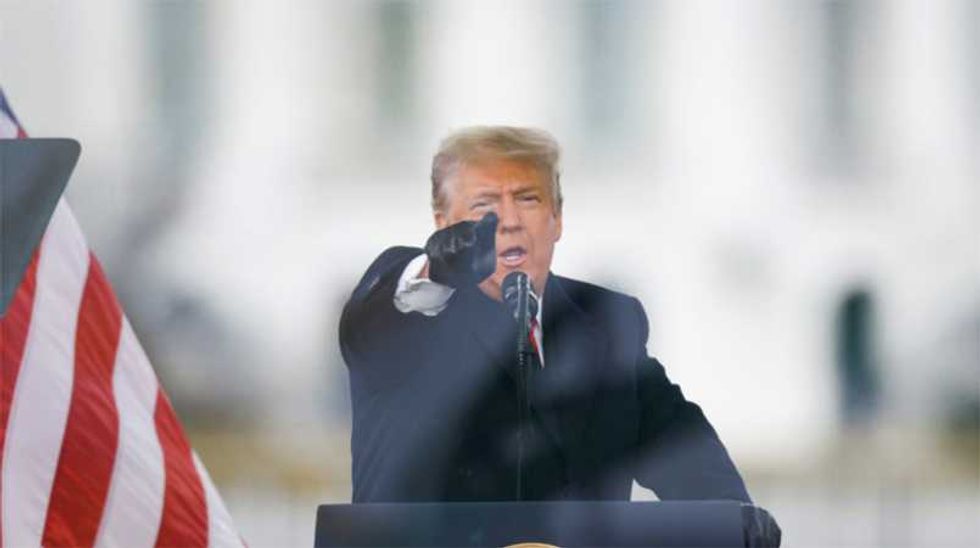
Donald Trump’s $10 billion defamation lawsuit filed against the British Broadcasting Corporation (BBC) has hit a treacherous hurdle in a new legal filing in Florida where the suit was filed.According to The Telegraph, BBC lawyers have filed discovery demands requiring Trump to disclose his "telephone logs, calendars, schedules, and diaries," spanning November 3, 2020, through January 20, 2021—the critical period encompassing the Capitol insurrection.The demand represents a calculated legal strategy by the network to force Trump to either produce damaging evidence or risk judicial sanctions for non-compliance, with the Telegraph reporting the BBC is essentially putting the president and his lawyers in the awkward position of having to lay all their cards on the table.The report notes that the American president initiated the lawsuit seeking $10 billion in damages over BBC Panorama's reporting that the network had allegedly spliced separate segments of Trump's January 6 speech in a way that misrepresented his words. The edited version suggested Trump urged supporters to "fight like hell" and storm the Capitol.Trump's legal team is fighting back aggressively, accusing the BBC of attempting to "put the president on trial for the riot" rather than defend against the specific editing allegations, according to the report."Defendants are attempting to use this action as a vehicle to conduct a trial as to the events that occurred on January 6," Trump lawyer Alejandro Brito has argued in court filings, complaining, "Defendants' attempts to defend themselves do not entitle them to carte-blanche discovery."For its part, the BBC isn't backing down and is also demanding that Trump's legal team "identify all persons with whom [Trump] had communicated regarding any aspect of the January 6, 2021 'Stop the Steal' rally, including but not limited to planning the event, your January 6 2021 speech at the event, and discussions about the event after the fact."The strategy signals what could become a "protracted legal battle," according to The Telegraph — noting that the trial date has been set for February 2027, leaving open months of legal wrangling and accusations.
Op-ed views and opinions expressed are solely those of the author. Across the country, data centers have become a flashpoint in local politics. Residents have questions about […]
Democrats hold a "secret weapon" heading into this fall's midterm elections, according to CNN's Harry Enten.Health care costs have surged past gas prices, food and housing to become Americans' single biggest financial concern, Enten said, and Democrats hold a decisive advantage over Republicans on that topic."This, to me, is the Democrats' secret weapon," he said.According to Enten's analysis of polling data, 22 percent of Americans cite healthcare as their primary financial worry, well ahead of food at 18 percent, housing at 14 percent and gas prices at just 8 percent, and highlighted the finding as particularly notable given the outsized media attention typically paid to gas prices in affordability discussions.The numbers get worse for the Trump administration from there, Enten said. Its net approval rating on healthcare costs sits 36 points underwater, with disapproval far outpacing approval. Among independents — a group already showing signs of frustration with the administration — that gap widens dramatically to 50 points underwater, a figure Enten called striking."So you see, you know Trump really struggling here, but here, even with the obvious, there's an interesting little nugget going on here," he said.Enten pointed to a substantial Democratic advantage in trust on the issue. Democrats currently hold a 21-point edge over Republicans on health care, he noted — larger than the 17-point advantage they held in 2018, when health care-driven momentum helped the party secure a net gain of 40 House seats during Trump's first midterm cycle.Much of the current frustration traces back to early 2026, when enhanced Affordable Care Act subsidies that millions of Americans relied on were not extended, according to Enten. Prediction markets have grown increasingly pessimistic about a reversal: Enten noted that betting markets gave a 43 percent chance in January that the subsidies would eventually be extended, but that figure has since collapsed to just 7 percent.Taken together, Enten argued, the data — high public anxiety over health care costs, the administration's weak approval numbers, and Democrats' growing trust advantage — closely resemble the conditions that fueled the party's strong performance in 2018."It will be interesting to see if Democrats really try to re-engage with that issue," Enten said. "They absolutely should be running on health care. It is a big win for them." - YouTube youtu.be