Trump administration makes big claims on noncitizen voting but won’t explain the math
Source: The Hill News · Bias: Center
Summary
President Trump in a primetime address earlier this month again raised the specter of large volumes of migrants voting in U.S. elections, warning there could be more than 250,000 noncitizens among four state’s voter rolls. But the Trump administration has not explained how it got that number, and correspondence sent to the four states reviewed…
Trump administration makes big claims on noncitizen voting but won’t explain the math
Center
President Trump in a primetime address earlier this month again raised the specter of large volumes of migrants voting in U.S. elections, warning there could be more than 250,000 noncitizens among four state’s voter rolls. But the Trump administration has not explained how it got that number, and correspondence sent to the four states reviewed…
Lawyers trying to mount a class action lawsuit against Elon Musk and America PAC, a super PAC he funded to support President Donald Trump and other conservatives, say the defendants aren’t cooperating in turning over key documents.“We’re getting the run-around,” said attorney Shannon Liss-Riordan, who is based in Massachusetts. “We’ve been delayed in getting discovery.”The cases against Musk and America PAC stem from a promise to pay $47 for every successful referral of a registered swing state voter to sign a petition in favor of “free speech and the right to bear arms.” The amount was later raised to $100 per signature.“Easy money,” Musk posted on the social media site X, which he owns, in October 2024.One proposed class action case was brought by an anonymous plaintiff who says, while working as an hourly canvasser for America PAC, he was encouraged to refer people to sign the petition for additional pay. The plaintiff, listed as John Doe, says he’s owed more than $20,000 and is aware of others in similar situations.Another case was brought by Lancaster man Anthony Maglietta and two other swing state voters who say they were never paid for signing the petition or referring others.Liss-Riordan, the attorney for both cases, is trying to get them approved as a class action. They’re moving forward together in the U.S. District Court in the Eastern District of Pennsylvania.She says she’s heard from dozens of people who could qualify if the court allows it.“These are generally people who are followers of Elon Musk, and believed in what he was doing and are aligned politically with a goal here,” she told the Capital-Star. “The fact that they weren’t even paid what they were told they would be paid — I don’t know if it’s surprising or not, but it’s very disappointing.”The Capital-Star reached out to lawyers for Musk and America PAC, an email associated with Musk’s family office, and a public relations firm that employs a spokesperson for America PAC. None responded.America PAC’s website says, “America PAC has already mailed the overwhelming majority of checks owed to eligible referrers and petition signers. If you haven’t received payment yet, that does not necessarily mean you won’t … We continue to review and process outstanding payments that have been flagged for mismatched information or require additional action.”Musk is reported to have spent around $290 million helping Trump and Republicans get elected in 2024, making him the largest single political donor of the election cycle. Following the election, he was made a special government employee by the Trump administration, serving as the de facto head of the Department of Government Efficiency (DOGE).“Going in circles”In a letter to U.S. District Court Judge Wendy Beetlestone, Liss-Riordan explained that her clients requested documents from the defendants in December 2025, part of the discovery process.She said her team was told by America PAC that they did not have the documents, and should seek them from third-party vendors they’d contracted. But when they went to those vendors, they were told that America PAC had them.“Plaintiffs are frustrated that they have been going in circles to obtain the discovery that is essential to their case – with Defendants claiming the vendors have the documents and the vendors claiming Defendants have the documents – and neither agreeing to produce them,” Liss-Riordan wrote.Moreover, she alleges that some of the vendors may not be as independent as they seem. She says, for example, United States of America Inc. and Group America, LLC were established by Musk. And other vendors she sought documents from had principal members who were also high-ups at America PAC.A conference has been set up between Eastern District Judge Wendy Beetlestone and lawyers for both parties on Tuesday, but it will not be streamed to the public.Both parties have requested an extension of the deadline to certify a class action case from July 31 to November 30. It would mark the third such extension.According to Liss-Riordan, class certification can’t be done until more documents are turned over in discovery.Musk and America PAC are also being sued in a Texas U.S. District Court over an alleged $1 million giveaway to swing state voters who signed a petition to support the U.S. Constitution. Plaintiffs allege that Musk and America PAC misled voters into thinking winners would be chosen randomly, but were actually predetermined.The bipartisan Wisconsin Elections Commission also agreed in a 5-1 vote in July to refer two complaints against Musk to the Brown County district attorney’s office, finding probable cause that he violated the state’s election bribery statute with another million dollar giveaway during the state’s 2025 state supreme court election.
FBI Director Kash Patel was behind threats made to stop claims about his drinking habits from becoming public, newly released documents reveal.Attorney Jesse Binnall sent a letter to The Atlantic hours before it published the story on April 17, 2026, demanding the outlet not publish. The Atlantic published anyway. Three days later, Patel filed suit in the U.S. District Court for the District of Columbia seeking $250 million. The threats emerged in court documents filed July 27.Among the demands in the letter was an ultimatum."Accordingly, should The Atlantic choose to publish this demonstrably false and defamatory article, Director Patel will have no choice but to take swift legal action to uphold his reputation," Binnall wrote."With this letter, you are also on notice of your ongoing obligations to preserve documents related to Director Patel," the letter said, also accusing The Atlantic of running "an ongoing campaign to damage his reputation."The story Patel wanted to kill reported that he was known to "drink to the point of obvious intoxication" at private clubs in Washington, D.C., and Las Vegas.The Atlantic reported that sources said his drinking had "negatively impacted various law-enforcement investigations" — including the murder of Charlie Kirk — and that his "drinking has been a recurring source of concern across the government."The documents show that behind the scenes, the Trump administration was scrambling to contain the damage.Sarah Fitzpatrick, who reported the story, had already heard from FBI assistant director Ben Williamson on publication day that the story was "…one of the most absurd things I've ever read.""He has accomplished more in 14 months than the previous administration did in four years," acting Attorney General Todd Blanche wrote in a statement to The Atlantic. "Anonymously sourced hit pieces do not constitute journalism." White House press secretary Karoline Leavitt said Patel "remains a critical player on the Administration's law and order team" — also without refuting a single claim.In court documents filed July 27, The Atlantic argued the complaint "does not allege a single fact showing that any statement in the Article is false" and called several claims "substantially true" — backed by congressional testimony, public lawsuits by fired FBI agents, and oversight letters from Democratic lawmakers.The Atlantic's attorneys noted the suit is Patel's fifth defamation action against media outlets, all of which have been dismissed or dropped.His previous suit — against an MS NOW contributor who said Patel spent more time at nightclubs than at FBI headquarters — was dismissed the day after Patel filed this one.
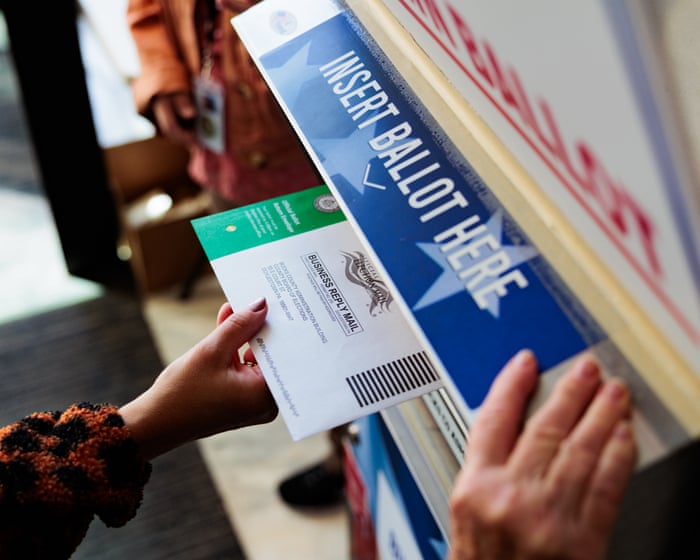
Emergency appeal comes after court upheld ruling blocking president’s order ahead of November midtermsThe Trump administration has asked the supreme court to clear the way for an executive order from Donald Trump that could dramatically change mail-in voting.The emergency appeal comes after an appeals court upheld a ruling blocking the president’s order in nearly half the country ahead of November’s midterm elections. Continue reading...
President Donald Trump's Department of Justice may be angling for a quiet victory at the Supreme Court with its latest bombshell move, according to one expert. Elie Honig, CNN's senior legal analyst and a former federal prosecutor, sounded the alarm on Monday's broadcast of "The Lead" after the DOJ appealed a lower court order blocking the administration's efforts to severely limit mail-in ballots with less than 100 days to go before the midterms. "First of all, the courts have made clear time and again that you are not supposed to mess with the rules around elections if we get too close to elections, and now we are really close to elections," Honig said. Honig noted that even though the Supreme Court is out of session, there is still a backdoor available to the Trump administration. "So, the Supreme Court is out of session now, but they are still considering cases on what we sometimes call the emergency docket or the shadow docket," Honig said. "It takes five of the nine justices to intervene in a case off of the emergency docket; no matter what the Supreme Court does, they're going to be involved because if they turn this case down, then the lower court, the Court of Appeals ruling stands, which blocks this executive order. That's option one.""Option two, if the court decides to get involved, then they might agree that this is causing chaos and [is] against the Constitution, or they might overturn it," Honig said before positing another worrisome possibility. "They might say, 'Go ahead. You can try to move forward with this.' But if that's the case, then we're going to have chaos," Honig said.
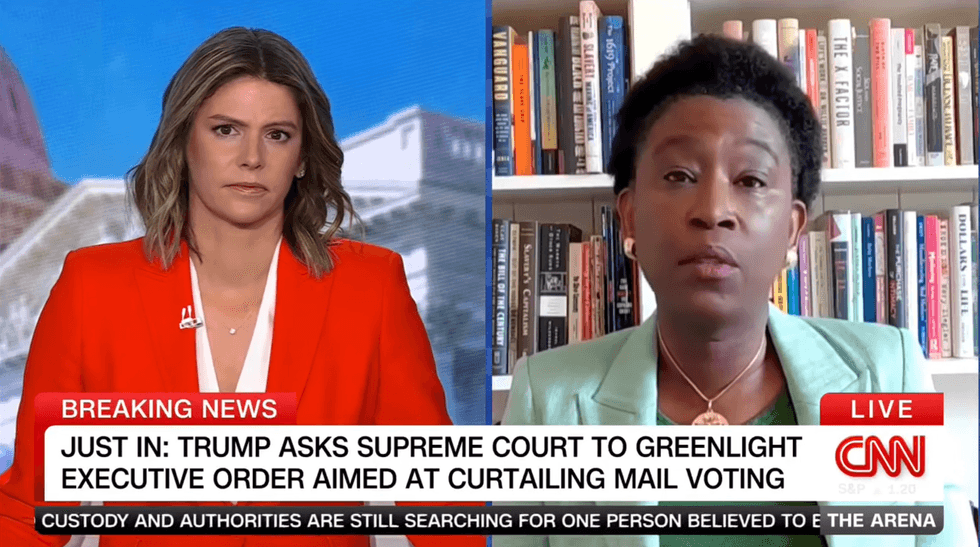
A legal expert was stunned Monday as the Trump administration urged the Supreme Court to give President Donald Trump the path forward to alter mail-in ballot voting in the United States.Michele Goodwin, professor of constitutional law at Georgetown University, told CNN that the Trump administration's move to push to restore an executive order after the Supreme Court ruled to block Trump's move to tighten rules for mail-in voting was "absolutely unprecedented.""We've never seen an executive order like this Trump order," Goodwin said."Notably, in that First Circuit Court of Appeals [decision], which upheld the injunction from a lower court, one of those three judges was Trump-appointed," Goodwin explained. "That court said that this is null and void on its face, and it is because it's extraordinary. We have known and held for centuries that the domain of elections is left to states to control and monitor. They're responsible for that. This is not something that is just of the last year or two of this administration. This is something that has been fundamental to the United States and its rule of law and politics."The Trump administration's move has reflected an ongoing pattern, she said."One of the ways of seeing this has been a longer arc of Donald Trump with suspicion about U.S. elections," Goodwin explained, referencing Trump's longtime claims that the 2020 election was "rigged" and his legal challenges to try [to] prove that unfounded theory."It's worth noting that he lost every one of those challenges except for one, which was not a matter of whether he won or not," Goodwin added. "It was just during COVID to allow for those who were overseeing, those who were handling the elections, to be able to come six feet within those that were handling it. So, it's dead on arrival, but we're not really sure what might happen with the Supreme Court."
Senate Majority Leader John Thune issued a reality check to President Donald Trump on Monday, as the president continues to demand that senators rewrite their own rules.Trump has been demanding several changes to force his agenda through, including the elimination of the legislative filibuster, which has been a consistent obstacle to his SAVE America Act package of voting restrictions, as well as eliminating "blue slips" that allow senators to unilaterally reject certain executive and judicial nominees from their home states.These rules have often frustrated presidents in both parties, although ironically, the filibuster has historically benefited Republicans more than Democrats, since a greater percentage of their agenda can be passed through federal courts and budget bills.There's still not the appetite to make those changes, said Thune — even on the GOP side.According to Semafor's Burgess Everett, Thune told reporters he has "sat down with about 20 Republicans, and on getting rid of the legislative filibuster, getting rid of blue slips, and there were 15 nos. So I mean, this is not an open question. It's just a fact, and the facts don't change."Thune added that if Trump wants these changes in the Senate to be on the table, he would have to do the heavy lifting of getting those senators to change their minds."If [Trump] can change the facts and start moving some of those senators who are no's into yeses, then we have a different conversation,” Thune told Everett.Trump's most recent rant against the filibuster came earlier in the day, when he proclaimed on his Truth Social account that Thune shouldn't allow the Senate to adjourn until the changes are made, because "the Dumocrats will do it on day one, and can’t believe how lucky they got with this Senate leadership. Remember, stupidity always brings LOSING & DEATH!"