DoJ urges supreme court to allow Trump order targeting mail-in voting
Source: US news | The Guardian · Bias: Center Left
Summary
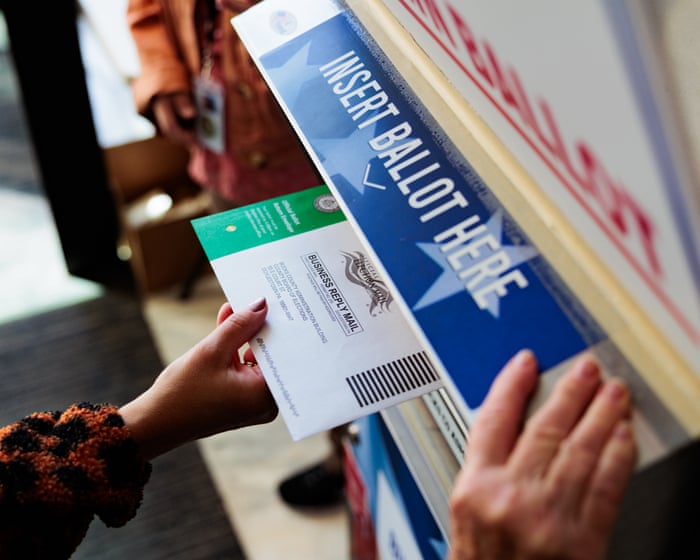
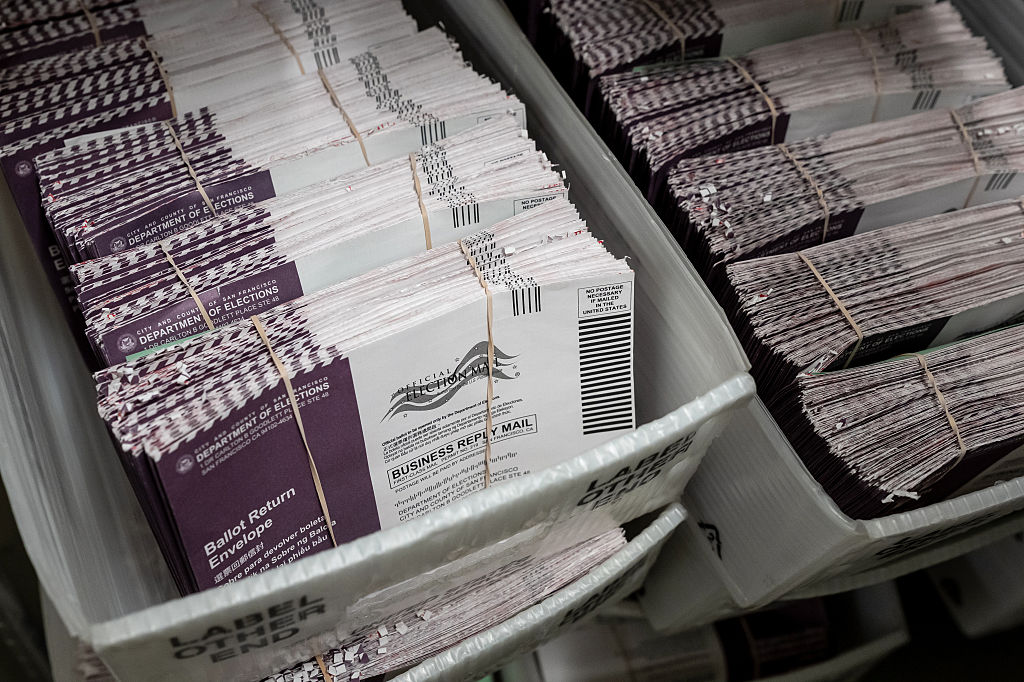
Emergency appeal comes after court upheld ruling blocking president’s order ahead of November midtermsThe Trump administration has asked the supreme court to clear the way for an executive order from Donald Trump that could dramatically change mail-in voting.The emergency appeal comes after an appeals court upheld a ruling blocking the president’s order in nearly half the country ahead of November’s midterm elections. Continue reading...
DoJ urges supreme court to allow Trump order targeting mail-in voting
Center Left
Emergency appeal comes after court upheld ruling blocking president’s order ahead of November midtermsThe Trump administration has asked the supreme court to clear the way for an executive order from Donald Trump that could dramatically change mail-in voting.The emergency appeal comes after an appeals court upheld a ruling blocking the president’s order in nearly half the country ahead of November’s midterm elections. Continue reading...
FBI Director Kash Patel was behind threats made to stop claims about his drinking habits from becoming public, newly released documents reveal.Attorney Jesse Binnall sent a letter to The Atlantic hours before it published the story on April 17, 2026, demanding the outlet not publish. The Atlantic published anyway. Three days later, Patel filed suit in the U.S. District Court for the District of Columbia seeking $250 million. The threats emerged in court documents filed July 27.Among the demands in the letter was an ultimatum."Accordingly, should The Atlantic choose to publish this demonstrably false and defamatory article, Director Patel will have no choice but to take swift legal action to uphold his reputation," Binnall wrote."With this letter, you are also on notice of your ongoing obligations to preserve documents related to Director Patel," the letter said, also accusing The Atlantic of running "an ongoing campaign to damage his reputation."The story Patel wanted to kill reported that he was known to "drink to the point of obvious intoxication" at private clubs in Washington, D.C., and Las Vegas.The Atlantic reported that sources said his drinking had "negatively impacted various law-enforcement investigations" — including the murder of Charlie Kirk — and that his "drinking has been a recurring source of concern across the government."The documents show that behind the scenes, the Trump administration was scrambling to contain the damage.Sarah Fitzpatrick, who reported the story, had already heard from FBI assistant director Ben Williamson on publication day that the story was "…one of the most absurd things I've ever read.""He has accomplished more in 14 months than the previous administration did in four years," acting Attorney General Todd Blanche wrote in a statement to The Atlantic. "Anonymously sourced hit pieces do not constitute journalism." White House press secretary Karoline Leavitt said Patel "remains a critical player on the Administration's law and order team" — also without refuting a single claim.In court documents filed July 27, The Atlantic argued the complaint "does not allege a single fact showing that any statement in the Article is false" and called several claims "substantially true" — backed by congressional testimony, public lawsuits by fired FBI agents, and oversight letters from Democratic lawmakers.The Atlantic's attorneys noted the suit is Patel's fifth defamation action against media outlets, all of which have been dismissed or dropped.His previous suit — against an MS NOW contributor who said Patel spent more time at nightclubs than at FBI headquarters — was dismissed the day after Patel filed this one.
President Trump in a primetime address earlier this month again raised the specter of large volumes of migrants voting in U.S. elections, warning there could be more than 250,000 noncitizens among four state’s voter rolls. But the Trump administration has not explained how it got that number, and correspondence sent to the four states reviewed…
President Donald Trump's Department of Justice may be angling for a quiet victory at the Supreme Court with its latest bombshell move, according to one expert. Elie Honig, CNN's senior legal analyst and a former federal prosecutor, sounded the alarm on Monday's broadcast of "The Lead" after the DOJ appealed a lower court order blocking the administration's efforts to severely limit mail-in ballots with less than 100 days to go before the midterms. "First of all, the courts have made clear time and again that you are not supposed to mess with the rules around elections if we get too close to elections, and now we are really close to elections," Honig said. Honig noted that even though the Supreme Court is out of session, there is still a backdoor available to the Trump administration. "So, the Supreme Court is out of session now, but they are still considering cases on what we sometimes call the emergency docket or the shadow docket," Honig said. "It takes five of the nine justices to intervene in a case off of the emergency docket; no matter what the Supreme Court does, they're going to be involved because if they turn this case down, then the lower court, the Court of Appeals ruling stands, which blocks this executive order. That's option one.""Option two, if the court decides to get involved, then they might agree that this is causing chaos and [is] against the Constitution, or they might overturn it," Honig said before positing another worrisome possibility. "They might say, 'Go ahead. You can try to move forward with this.' But if that's the case, then we're going to have chaos," Honig said.
A legal expert was stunned Monday as the Trump administration urged the Supreme Court to give President Donald Trump the path forward to alter mail-in ballot voting in the United States.Michele Goodwin, professor of constitutional law at Georgetown University, told CNN that the Trump administration's move to push to restore an executive order after the Supreme Court ruled to block Trump's move to tighten rules for mail-in voting was "absolutely unprecedented.""We've never seen an executive order like this Trump order," Goodwin said."Notably, in that First Circuit Court of Appeals [decision], which upheld the injunction from a lower court, one of those three judges was Trump-appointed," Goodwin explained. "That court said that this is null and void on its face, and it is because it's extraordinary. We have known and held for centuries that the domain of elections is left to states to control and monitor. They're responsible for that. This is not something that is just of the last year or two of this administration. This is something that has been fundamental to the United States and its rule of law and politics."The Trump administration's move has reflected an ongoing pattern, she said."One of the ways of seeing this has been a longer arc of Donald Trump with suspicion about U.S. elections," Goodwin explained, referencing Trump's longtime claims that the 2020 election was "rigged" and his legal challenges to try [to] prove that unfounded theory."It's worth noting that he lost every one of those challenges except for one, which was not a matter of whether he won or not," Goodwin added. "It was just during COVID to allow for those who were overseeing, those who were handling the elections, to be able to come six feet within those that were handling it. So, it's dead on arrival, but we're not really sure what might happen with the Supreme Court."
President Donald Trump has politicized America’s intelligence-gathering operations to an unprecedented degree, and a former CIA analyst who worked for Trump’s NSC is now raising the alarm.“In 2025, I watched from inside the White House and at the CIA as the intelligence community came under assault: senior officers fired in public, clearances revoked for dissent, decade-old assessments denounced by the CIA director in the press,” Julia Curlee, a former CIA analyst and an NSC director for Presidents Joe Biden and Donald Trump, wrote for Lawfare on Monday. “Earlier this month, the campaign reached the raw intelligence itself, as the White House declassified selected reporting to sustain election interference claims that the intelligence community’s own finished analysis would not support.”As one example of Trump’s politicizing intelligence, Curlee described how members of the CIA with expertise in Venezuela were fired when they did not back the administration’s position on taking over that country.“Twenty years later, days after taking office, the second Trump administration tasked the National Intelligence Council (NIC) to assess whether the Venezuelan regime had directed Tren de Aragua—a criminal gang—to invade the United States,” Curlee wrote. “The question, from Homeland Security Adviser Stephen Miller, matched nearly word for word the predicate for the Alien Enemies Act of 1798, last invoked in World War II to intern Japanese, German, and Italian nationals.”She added that she knows this firsthand because she tasked the Venezuela assessment.“I was the NSC’s acting senior director for intelligence programs across the transition—Biden’s last week, Trump’s first,” Curlee said. “I knew the NIC, the intelligence community’s most senior, most deliberate analytic body, would carefully weigh the evidence and reach a consensus position. How much rode on that judgment became clear when the administration carried out lethal strikes on alleged drug boats off Venezuela and, in January 2026, sent U.S. forces into Caracas to seize Nicolás Maduro himself.”She added, “The NIC did not give the answer the White House wanted, concluding that Tren de Aragua had not entered the country at Maduro’s direction, undercutting the administration’s case in court. Director of National Intelligence (DNI) Tulsi Gabbard denounced the finding, and her chief of staff, Joe Kent, pressed the acting NIC chair to “rethink” it. When he held firm, Gabbard had him walked out of the building, ending the career of one of the country’s most accomplished analysts.”From there, Curlee lists other ways that Trump has pushed out people in the CIA and other intelligence agencies for engaging in work that the president disliked for purely political reasons.“From its first days, the second Trump administration treated the intelligence community not as an instrument of the state but as an enemy within: a ‘deep state’ that had allegedly lain in wait for the president during his first term,” Curlee wrote. “The aim was explicit: Put career civil servants ‘in trauma’ to make them not want to come to work. At the CIA, that program arrived on schedule.”She continued, “First they came for the people. On day one, the president revoked the clearances of 51 former officers who had spoken on Russian election interference. A month later, amid the purge of trans service members, the DNI fired 100 trans intelligence officers from 15 agencies. In May 2025, she fired two senior analysts over the Tren de Aragua assessment. And in August 2025, Gabbard publicly revoked 37 more clearances—including that of one of the intelligence community’s most respected experts on Russia—seemingly without irony, for the ‘politicization or weaponization of intelligence.’”Curlee said that Trump then denounced findings that had previously been proven beyond reasonable doubt, from Russia’s meddling in the 2016 presidential election to warnings about white nationalist terrorism, violence against LGBT people and assessments about women’s reproductive health.“And the threat did not stop at termination,” Curlee pointed out. “Former CIA Director John Brennan was referred for criminal investigation and interviewed by the FBI over the same analysis the administration had set out to discredit. The lesson reached every desk—a clearance, and with it a livelihood, could be revoked with a phone call; a career could end in front of a grand jury. By mid-2026, the president was describing intelligence that contradicted his preferred reality as ‘treason.’”Curlee also warned about Trump politicizing intelligence during his July 16th speech falsely claiming that China had meddled in the 2020 presidential election, which Trump lost to Biden.“The president delivered a primetime address alleging that China had interfered in the 2020 election, built on a mass declassification of election-related intelligence assembled by the White House’s Government Transparency Task Force—a body created to comb the classified...
President Donald Trump is facing a huge problem in November, The Bulwark's Sam Stein told MS NOW's Jonathan Lemire on "The Moment" Wednesday.The problem, he noted, is compounded by Trump's inability to course-correct in a simple way that most candidates facing a huge backlash for their party would.The president is currently demanding Republicans cancel their Senate recess to force through the SAVE America Act, a voting restriction bill Trump has become obsessed with that has no path to passage in the upper chamber.Senate Majority Leader John Thune (R-SD), Stein told Lemire, is "in a weird spot" since any attempt to follow Trump's command would end in the bill failing, making him look "feckless" and earning Trump's wrath anyway.The fundamental issue, said Stein, is that "every party in power in the midterm has to deal with this type of equation. Usually you want to sort of downplay how great things are, because you don't want voters to feel like you're out of touch or leaving them behind. But Trump is incapable of doing that. He continuously talks about this being a 'golden age' and how everyone's 401k is skyrocketing. So there's crosscurrents there."It further compounds the issue, Stein said, that Trump and his MAGA allies are sitting on a war chest of hundreds of millions of dollars and are doing nothing with it to save the party that polls warn is headed for doom."What you're seeing in the polls is that Republicans are, by and large, much less enthusiastic than Democrats to vote in this midterm election," said Stein — with some even threatening to vote for Democrats. "That is real poison for the Republican Party," he said, because the turnout they enjoy whenever Trump is on the ballot is set to vanish.The upshot of all of this, he said, is that between Trump's refusal to message defensively, his lack of spending and the "general malaise," Democrats "could really run up the numbers." - YouTube www.youtube.com