Pentagon to Push AI Battlefield Integration With Focus on Maven
Source: Bloomberg Politics · Bias: Center
Summary
The Pentagon intends to accelerate AI-enabled decision-making and put it at the heart of its ambition to link up sensors and shooters for combat operations, according to a policy memo seen by Bloomberg.
Pentagon to Push AI Battlefield Integration With Focus on Maven
Center
The Pentagon intends to accelerate AI-enabled decision-making and put it at the heart of its ambition to link up sensors and shooters for combat operations, according to a policy memo seen by Bloomberg.
Billionaire technology Peter Thiel warned that AI company Anthropic could use its technological advantage to influence the 2028 presidential election in favor of Democrats.
The post Billionaire Tech Mogul Peter Thiel Warns Woke AI Company Anthropic Could Rig 2028 Election for Democrats appeared first on The Gateway Pundit.
Mamdani mentions he’s an immigrant himself, but completely ignores the fact that this country, which he says is so unwelcoming, made him the youngest mayor in the history of its largest city.
The fight that scrubbed the world's most powerful AI models from the internet featured personality clashes, industry confusion, and international backlash.Why it matters: Anthropic's models are back online, but the impact of its 20-day showdown with the Trump administration will be long lasting.Behind the scenes: It began when Amazon, Anthropic's partner and investor, sounded an alarm that was later disputed by cybersecurity experts.It warned about a "jailbreaking" issue it found with the AI lab's latest models, Mythos and Fable — meaning a technical flaw that could have caused a failure of their guardrails.Amazon flagged its concerns to the administration, triggering sweeping export controls. A U.S. official said the government conducted its own tests once it became apparent that the issue needed to be addressed.Cybersecurity experts, however, later wrote in an open letter to the administration that other leading AI models have the same issue Amazon warned about with Anthropic.On June 12, Commerce Secretary Howard Lutnick, at the direction of President Trump, called Anthropic CEO Dario Amodei. Lutnick made clear to Amodei the issue needed to be resolved fast and alerted the CEO that the company would be receiving a letter imposing sweeping export controls, the U.S. official said.Amodei called Lutnick back that night after receiving the letter, realizing it effectively meant the models would have to be taken offline — to which Lutnick responded that was indeed the goal.That decision led to a three-week, multi-agency crash course in AI safety.Anthropic deployed engineers to Washington D.C. According to a U.S. official, the company wanted to prove everything was already resolved and further changes were being fine tuned.But the federal Center for AI Standards and Innovation and the National Security Agency said those changes weren't good enough, prompting further fixes, according to the U.S. official.Gradually, various agency heads approved of the changes, and on July 1 the models were released, the official said.Out of all of the administration officials Amazon's Andy Jassy could have called, it was Treasury Secretary Scott Bessent who first heard about the jailbreaking issue found in the company report, according to a separate source familiar.Bessent was early to sound the alarm on Mythos, work with White House Chief of Staff Susie Wiles to re-engage the embattled company, and help get a cybersecurity executive order across the finish line.While technical discussions to address the jailbreaking issue took place in D.C., it was Bessent who stood next to President Trump during the G7 where allies called for global cooperation on safety standards.At the center of the showdown was Commerce Secretary Howard Lutnick, who also flanked Trump at the G7 meeting while his department's teams led technical discussions.National cyber director Sean Cairncross, the White House Office of Science and Technology Policy, Treasury Department chief information officer Sam Corcos, and the NSA also all participated in technical discussions, according to various sources.Washington mobilized faster to hold scores of meetings and pulled in far more agencies than one would expect for a single technical issue, one source said.The tension spiraled amid personality clashes and poor communication.Anthropic eventually understood that in order to be successful they needed to be on the same side as the government, the U.S. official said.As discussions turned more technical, Anthropic policy chief Sarah Heck and Anthropic co-founder Tom Brown got more involved. Brown also had multiple conversations with Lutnick and Cairncross the weekend of June 12.There was never a moment where Dario stepped offstage and someone else replaced him, one source said, adding that Brown's technical expertise allowed him to sit in a room with government specialists and go line‑by‑line through how models behave under stress.Between the lines: It remains uncertain when and how Anthropic's models will be released to ally countries around the world — which proponents say is key to beating China — or how other labs from OpenAI to Google will release their latest models.OpenAI, whose latest model GPT-5.6 is on hold, did not have visibility into discussions between Anthropic and the White House and is engaged in daily technical discussions on the release of its own model, a source said.The bottom line: There's a lot of work left to be done on a framework for approving future models with a clear inclusive process that has transparency standards and timelines, sources familiar said.
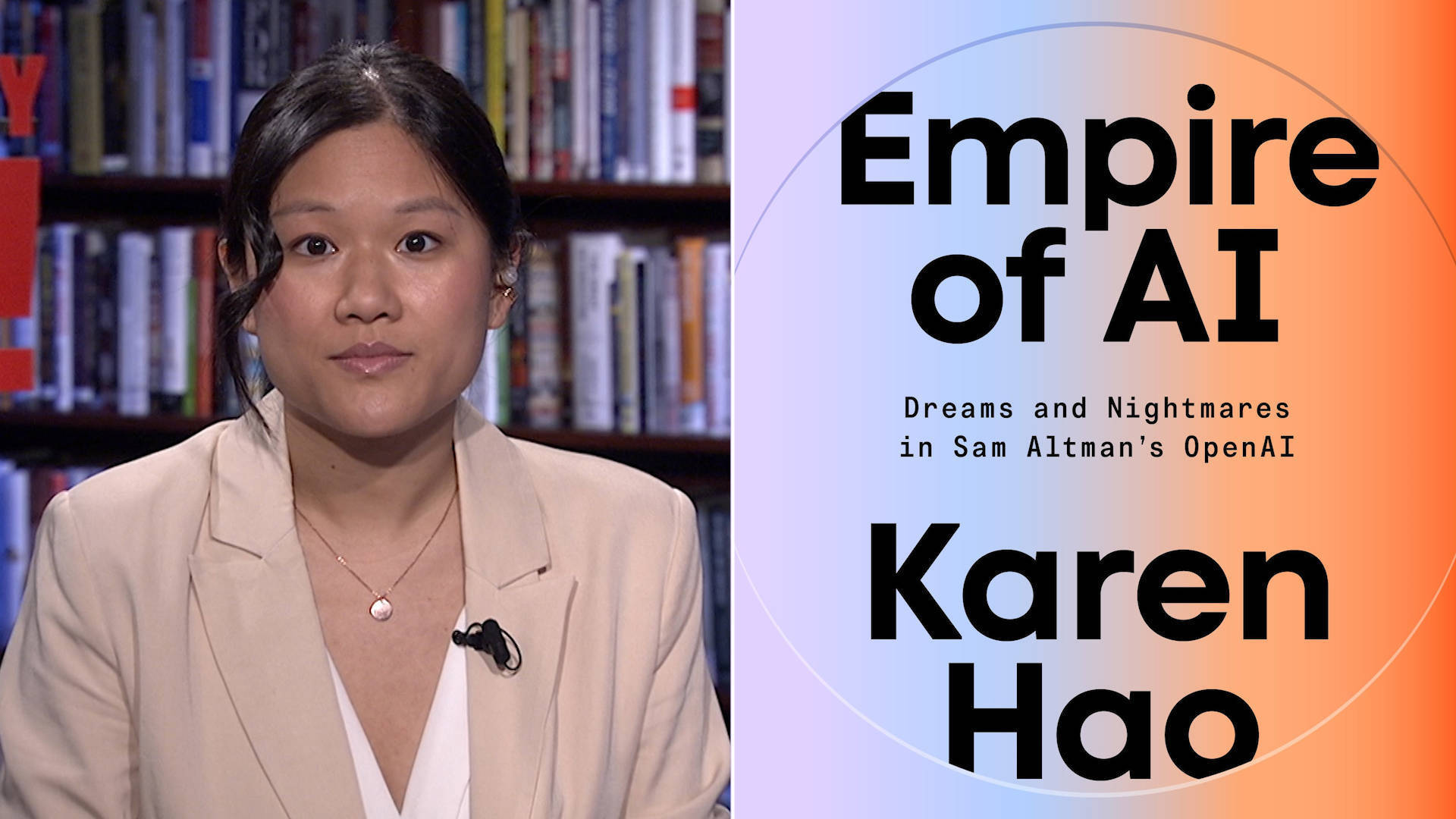
In our July Fourth special broadcast, we revisit our interview with longtime technology reporter Karen Hao, author of Empire of AI, which unveils the accruing political and economic power of artificial intelligence companies — especially Sam Altman’s OpenAI. Her reporting uncovered the exploitation of workers in Kenya, attempts to take massive amounts of freshwater from communities in Chile, along with numerous accounts of the technology’s detrimental impact on the environment. “This is an extraordinary type of AI development that is causing a lot of social, labor and environmental harms,” says Hao in an extended interview.
As part of our July Fourth special broadcast, we continue our extended interview with Karen Hao, author of Empire of AI: Dreams and Nightmares in Sam Altman’s OpenAI. The book documents the rise of OpenAI and how the AI industry is leading to a new form of colonialism. “One of the things that you really have to understand about AI development today is that there are what I call quasi-religious movements that have developed within Silicon Valley,” says Hao. “The concept of artificial general intelligence is not one that’s scientifically grounded.”
According to the renowned fascism historian Ruth Ben-Ghiat, the Supreme Court has become President Donald Trump’s “partner in corruption,” not only working to enrich those who are in on the scam, but reshaping the U.S. as an authoritarian state in which one must “fear and obey” Trump.“This is the summer of corruption,” wrote Ben-Ghiat on Thursday. “Defined as the abuse of power for private gain, corruption can happen in any kind of organization and government, but under authoritarianism it attains a new status: it is how the executive branch operates, expands its power, and recruits elite and grassroots partners. The Supreme Court is one of these partners, as we’ll see below.”The Trump administration and its enablers on the Court, argues Ben-Ghiat, “are providing Americans and the world with a lesson in how corruption can become systemic.” This, she says, is the goal of all authoritarians: they “seek to retool government and the culture to create the conditions to lie, steal and repress people with impunity. That means going after journalists, judges, investigators, opposition politicians and others who expose official wrongdoing. It also means puffing up the leader’s personality cult and inventing narratives, backed by complicit religious institutions, about his selflessness and purity.”She raises the example of Justice Clarence Thomas, who has a well-documented history of “accepting luxury gifts and travel from billionaire GOP donor Harlan Crow,” who in turn “has a garden full of statues of dictators, and collects Adolf Hitler and Nazi memorabilia.” And, according to Ben-Ghiat, “As per the sacred laws of corruption, these ‘gifts’ were likely supposed to be repaid whenever Thomas put on his robes. No matter that the Court, which has no ethical oversight mechanism, finally instituted a code of conduct in November 2023, which states that justices must ‘uphold the integrity and independence of the judiciary’ and avoid actual and apparent impropriety.”Thomas has paid no attention to this code, refusing to recuse himself in cases involving Trump’s election lies, even though Thomas’s wife Ginny was directly engaged in those lies. As Ben-Ghiat muses, “What good would Thomas be as a link in the chain of corruption if he took himself out of the game just when he was most needed?”“And here we arrive at the Supreme Court as a partner in Trump administration corruption, first by giving the President immunity for official acts, and now by upholding his right to dismiss an official on political grounds,” writes Ben-Ghiat. “A landmark ruling in July 2024 gave the president ‘the power of a king,’ as the Brennan Center termed it, conferring upon him absolute immunity (for the exercise of core constitutional powers) and presumptive immunity (for all other official acts). This created the legal space for a lawless individual such as Trump to feel even more emboldened to use corruption and violence to destroy our democracy and make money doing it.”Now, while the Supreme Court has for 100 years upheld that the president does not have the authority to fire heads of independent agencies without cause, Trump’s allies on the court have overturned that precedent, creating conditions for further “systematic corruption.”“We need to see this decision through autocratic eyes,” explains Ben-Ghiat. “Not obeying the Leader, refusing to participate in his corruption, and politicizing the practice of government are acts of negligence and malfeasance in office in the authoritarian world. Such people must be removed from public service, lest they influence others with their moral stances.”The power to fire agency officials at will is exactly what the president needs to shape government to his private agenda. According to Ben-Ghiat, proof of this intention was revealed by the words of Solicitor General John Sauer, who represented the Trump administration in the case, arguing before the court that the president needs to be able to remove officials in the agencies because “the President must have the power to control and…the one who has the power to remove is the one who…is the person that they have to fear and obey.”