RedState

English World Cup fan Ben Forrest joins "News Nation Live" to discuss his love of American culture.

'We can't allow big blue states and crooked Democrat governors try to steal elections away from us'
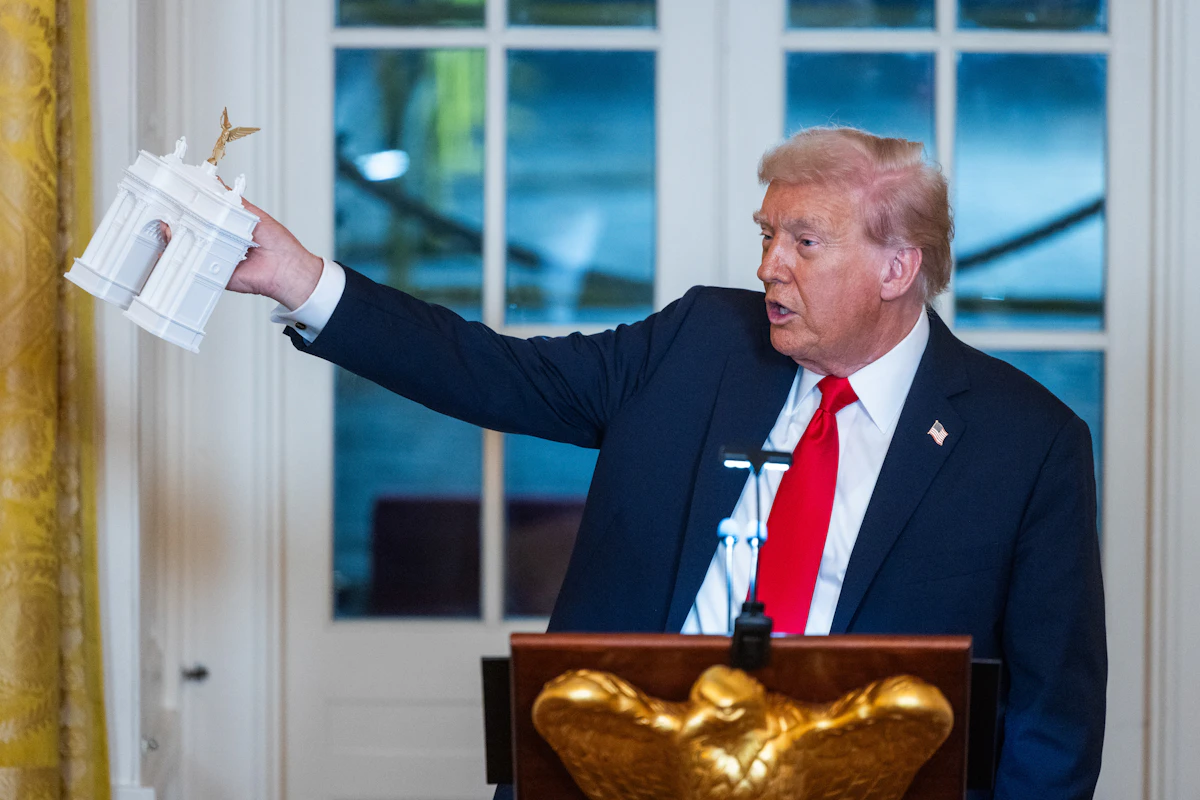
We’re closing in on July Fourth and the nation’s 250th birthday, and right on time, the all-knowing digital algorithm deposited a memory from 2015 on my screen: That year, burning the Confederate flag on Independence Day was in vogue, sparked by the mass shooting at the Emanuel African Methodist Episcopal Church in South Carolina. My fondness for desecrating rebel iconography is not restricted to either a national holiday or a national tragedy—we should have fully conquered the Confederacy when we had the chance, instead of allowing them to commemorate their traitorousness. Maybe those nine parishioners would be alive today if we’d done a better job discrediting that toxic ideology.That’s some food for thought here in 2026, as an ailing, flailing President Donald Trump sets his sight on being the ringmaster of the clown show he has planned for the Fourth. When Trump’s not losing wars or setting the economy on fire, he’s busy turning the nation’s capital into an orgy of self-aggrandizement ahead of next week’s semiquincentennial celebration. At Wednesday’s kick-off event for his “Great American State Fair,” Trump announced that “America is back.” Where had it gone? The president proclaimed that “a short time ago we were a dead country. We were dead. Now we’re the hottest country anywhere in the world. We’re respected by everybody. Nobody’s laughing at us anymore.” As a thin crowd made for the exits, he also touched on the matter of state that’s consumed most of his time lately: “The Reflecting Pool that you’ve heard so much about, which is so incredible, it’s been gruesomely vandalized by thugs, bad people, but soon will be looking as beautiful as it looked just two weeks ago,” Trump said. “In fact, I looked at it just a little while ago. It looks perfect already, but we’re fixing it.” As it happens, the Reflecting Pool is still green, still peeling, and half-assedly stashed behind some chain-link fence. It may be a federal crime for me to report this, it’s not really clear.All of this is definitely a product of ego, but it’s also highly reminiscent of Confederate kitsch. Trump’s drive to commemorate himself, which has even run afoul of some of his fellow Republicans, is animated by the same idea as the Lost Cause: to lend legitimacy to a period of betrayal and to ensure this malevolent force lives on. Allowing the Confederacy to commemorate itself was a profound failure on our part, and it seeded the earth for the weakening of our democracy. As Trump plans to sully the District of Columbia’s skyline with his triumphal arch (now with more fist!), I can see history repeating: Trumpism as the new Lost Cause.I am hardly the first to evoke this comparison. As The Atlantic’s David Graham wrote back in 2020, Trump spent his Independence Day marinating in a variety of Lost Cause grievances: the decision to remove the Confederate iconography from the Mississippi state flag and NASCAR events, the renaming of the Washington Redskins and Cleveland Indians, along with the usual suspects (“the radical left, the Marxists, the anarchists, the agitators, the looters, and people who, in many instances, have absolutely no clue what they are doing”). As Graham noted at the time, Trump’s Lost Cause fetish was his campaign schtick, the red meat he used to rally his base. In 2020, that playbook failed, in no small part because the Covid-19 pandemic was foremost on the minds of voters. But Trump played the same game in 2024 and won back the White House. And as the Southern Poverty Law Center’s Rivka Maizlish wrote last year, the “unrelenting propaganda of the Lost Cause” returned with a vengeance. The names of Confederacy luminaries stricken from U.S. military bases were restored, there was a renewed push to whitewash the sins of slavery, and the Civil War era’s insurrectionists were conflated with the nations’ Founders. It’s no accident that Trump believes our latter-day insurrectionists should be the ones to get government reparations.As Maizlish noted, ’twas ever thus:Lost Cause mythology is central to Trump’s movement. He romanticizes the gender and racial hierarchies of the Old South, valorizes Confederate leaders and symbols, and demonizes those who would remove Confederate memorials as “angry mobs” trying to “wipe out our history.” The Confederate anthem “Dixie” played at Trump’s Madison Square Garden rally on Oct. 27, 2024, an event filled with racist harangues and ridicule.Trump is now deep into his dotage (and perhaps his inexorable decline). He has no campaigns left to run and no further need to worry about uniting the American people to build some kind of sustainable electoral coalition. These days, the president is motivated entirely by thoughts of his legacy. But the Lost Cause schtick remains the same—only now it’s manifesting itself in his relentless pursuit of various vanity projects and alterations to Washington, D.C.

"In my land, hospitality is a debt," the shocked tourist wrote.
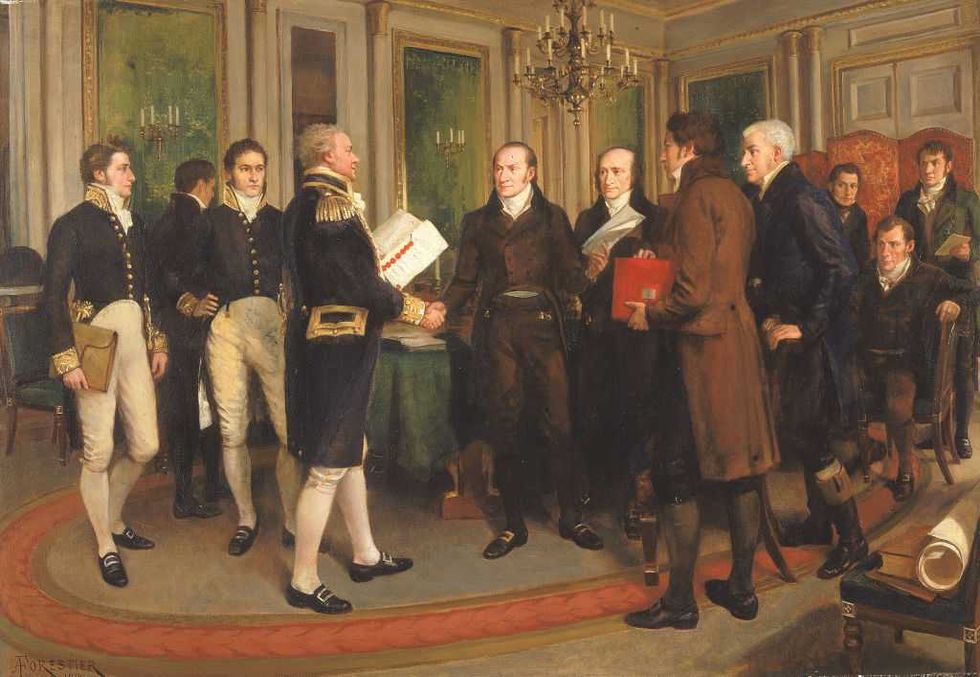
Oratory is out of fashion. The word itself sounds archaic to our ears, denoting something people used to practice in antiquity and at long length in 19th-century America. Even the more down-to-earth sounding “rhetoric” is heard to mean “mere” rhetoric — words false or deceptive by definition. Politicians talk about “messaging,” and the more significant politicians have layers of staff for “communications.”This does not bode well for the forthcoming 250th anniversary of the Declaration of Independence. Every politician in America will feel obliged to say something for the occasion. Whoever can — with perhaps some rare exceptions — will deploy a staff member or staff members to draft his remarks. The American people declared to the world and under God principles constituting not just the foundation and purpose of their political existence, but the only foundation for legitimate government.The staff members themselves, products of American universities where American history is frowned upon or given the 1619 treatment, will have to do original research to prepare for the task. A significant percentage of them will rely on artificial intelligence. Patriots have reason to wonder whether there is a politician (or comms team) in America today who understands and can articulate for his fellow citizens and the world the meaning of July 4, 1776.John Quincy Adams took July 4, 1776, with the utmost seriousness. The Declaration of Independence and the American Revolution became the north star of his politics over a 60-year career of devotion to his country and its cause. He understood that man is a political animal because he is endowed by nature with logos (speech, reason) and that in American politics, the statesman’s first task is to understand the logos — the word fitly spoken, the apple of gold — of the Declaration of Independence. He articulated his understanding of the Declaration and its principles beautifully, often, and at length in formal orations and other speeches and writings from the early to the late years of his remarkable political career. He served for a few years in his late 30s and early 40s, when he was also a United States senator, as the first Boylston Professor of Rhetoric and Oratory at Harvard. Later, in what his biographer Samuel Flagg Bemis called his “second career” of nine outspoken terms in the House of Representatives, he became known as “Old Man Eloquent,” in great part for his faithful championing of the principles of the Declaration. He was an avid, lifelong student of Cicero.Adams was born into the American Revolution to a mother and father who were revolutionaries. When he was 7 years old, the Battle of Bunker Hill took place (Saturday, June 17, 1775) within earshot of the farm in Braintree, Massachusetts, where he lived with his mother, Abigail, and three siblings. On the morning of the battle, his mother took him with her and climbed to the top of nearby Penn’s Hill. From there, the two could see fire and smell the smoke from houses burning in Charlestown. John Quincy remembered the moment vividly to the end of his life. His father, John, was 400 miles away in Philadelphia as part of the Massachusetts delegation to the Second Continental Congress. Braintree was in a war zone.RELATED: America turns 250 with a broken heart Carolyn Cole/Los Angeles Times/Getty ImagesWeeks before, as militia streamed into the area in the wake of the battles of Lexington and Concord, Abigail Adams had collected the family’s pewter dishes and melted them down to make bullets in a large kettle held over the kitchen fire. From time to time, she heard alarms, warning that the Royal Navy was about to land forces along the coast. She had good reason to fear that the British would try to seize rebel leaders and their families. The best John Adams could do at the time was to write to his wife from Connecticut: “In Case of real Danger ... fly to the Woods with our Children.” July 4, 1776, was still more than a year away, undefined in the uncertain future. But young John Quincy Adams was already learning its lessons.On July 4, 1785, less than two years after the peace settlement ending the American war for independence, 17-year-old John Quincy, who had served as his father’s private secretary during the peace negotiations, was sailing back to America after six life-forming years in Europe. He wrote in his journal, slightly misquoting James Thompson’s “Rule Britannia,” that July 4 was:The greatest day in the year, for every true American. The anniversary of our Independence.

Although it wasn’t a picture-perfect finish, the United States secured the top spot in Group D with a 2-1 record during the World Cup group stage. We’ve never seen a U.S. roster of this quality; the Americans started as the betting favorite at +125 to win Group D. Mauricio Pochettino’s team delivered on those expectations,...