No ‘lasting diplomatic solution’ for US relations with Iran: John Bolton
"I don't think he's looking at this in grand strategy terms with respect to the Middle East," John Bolton said.

The 1970s oil-shock playbook needs an update: The inflation costs remain, but the employment risks appear far smaller than they did 50 years ago.Why it matters: As the Iran war continues, there are early signs of renewed strength in the labor market.If energy disruptions pose less of a risk to jobs, the challenge for central banks shifts from managing stagflation risks to guarding against renewed price pressures.That's the takeaway from new Federal Reserve Bank of Boston research that finds an oil shock the size of what the Iran war has produced would push inflation materially higher while having essentially no effect on national employment.What they're saying: "The U.S. economy's vulnerability to oil shocks has not been eliminated, but rather reconfigured," economists wrote in the report. "Oil shocks may now pose less of a challenge for monetary policy, allowing policymakers to focus more on the greater risk to inflation."Driving the news: The researchers estimate that the U.S.-Iran conflict generated a 33% oil price shock — a magnitude that is historically significant, though not unprecedented.The U.S. economy is now structured differently than past energy crises, allowing it to absorb a shock of that magnitude with far less damage to national employment.But with a smaller hit to growth and employment, there is less downward pressure on prices to counteract rising energy costs.The Boston Fed estimates that if an oil disruption like today's hit during the mid-1970s, it would lift the Personal Consumption Expenditures Price Index by 2.2 percentage points and reduce national employment by 1.8 percentage point.What to watch: The oil shock is estimated to create relative winners and losers across the country, with oil-producing states faring better than oil-importing regions — differences that can leave an economic mark for as long as two years after the initial hit.The Boston Fed estimates that employment growth in Texas would be roughly 1.7 percentage point higher than in the average state 12 months after the shock. Massachusetts, meanwhile, would see employment growth run about 0.4 percentage point below average.Those effects extend beyond jobs: Home price growth in Texas would outpace the average state by roughly 1.8 percentage point, while Massachusetts would trail by about 0.4 percentage point.The intrigue: The inflation effects of the shock are already evident in economic data, as well as in anecdotes gathered across Fed districts.The Beige Book, a collection of anecdotes from the 12 Fed regional banks, described energy costs tied to the Middle East conflict as the "primary driver of inflationary pressures," with spillovers into shipping, groceries and fertilizer.Yet employment showed little change across 11 of the Fed's 12 districts, and most described a "low-hire, low-fire" labor market.The bottom line: Energy producers don't appear to view the price spike as durable, potentially limiting one of the channels through which oil-producing states benefit from higher energy prices.Dallas Fed contacts reported "limited appetite to increase activity even amid sharply higher oil prices," reflecting a view that the impact of the conflict is "likely to be too short-lived to spur new capital investment," according to the Beige Book. Emily Peck contributed reporting.
"I don't think he's looking at this in grand strategy terms with respect to the Middle East," John Bolton said.
Tom Barrett of Michigan, Warren Davidson of Ohio, Brian Fitzpatrick of Pennsylvania and Thomas Massie of Kentucky voted with 211 Democrats to approve the resolution.
The lower chamber of Congress passed a measure that seeks to halt further military action, in a vote seen as largely symbolic.
Iran said there had been no recent progress in talks with the US over an interim peace deal, while fighting persisted in Lebanon despite Washington’s declaration of a ceasefire between Israel and the country. Dr. Lindsay Newman, Associate Fellow at Chatham House, discusses the latest out of the Middle East as US, Iran talks continue and fighting persists in Lebanon. (Source: Bloomberg)
President Donald Trump on Thursday ripped four “bad” Republicans who joined Democrats in passing legislation that effectively forces the president to end American military operations in Iran. The House passed legislation to “remove U.S. Armed Forces from hostilities against Iran unless explicitly authorized” by Congress, delivering a high-profile foreign policy defeat to the president. The […]
Democrats historically vote by mail at higher rates than Republicans, meaning later-counted ballots can sometimes shift margins after Election Day.
THE FINAL FOUR: After repeated attempts by House Democrats to pass a war powers resolution to assert Congress’s authority to declare war, finally, a handful of Republicans were disenchanted enough with the progress of the war in Iran to cross the aisle and vote to send the legislation to the Senate, by a vote of […]
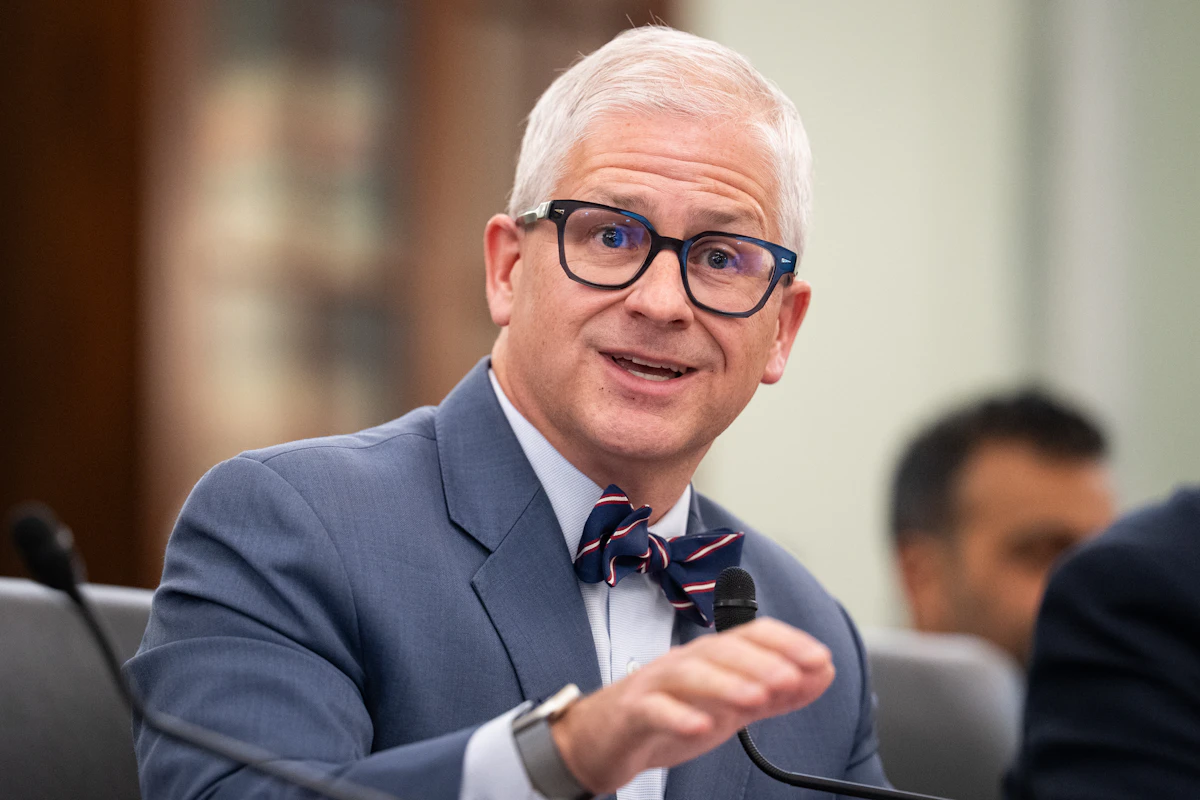
If you believe the multibillion-dollar firms behind “prediction markets” and the individuals who are handsomely paid to promote them, two things are absolutely clear: These exchanges are not gambling, and they certainly don’t prey upon young or vulnerable people. But many lawmakers, as you might suspect, don’t seem convinced. Undeterred, the industry has been furiously adding to its roster of lobbyists and advocates over the past year, hoping to build on the Trump administration’s support, which is no doubt founded partially on Donald Trump Jr.’s positions at both Kalshi and Polymarket. But support from the administration and the first family does not seem to be enough, and the prediction market industry has been mobilizing an effort to ensure incipient attempts to rein in the industry die in the cradle. Key to these efforts are prediction market advocates who cut their teeth working on behalf of addictive industries in the past. Prediction markets are bracing for a drawn-out fight, and they’ve staffed their front group with executives well versed on issues of gambling and addictive products. The Coalition for Prediction Markets, or CPM—a trade group backed by some of the largest players in the prediction market industry, including Kalshi, Coinbase, Crypto.com, Robinhood, and Underdog—has recruited a bipartisan dynamic duo of influential former congressmen to be the faces of the industry. In addition to the political firepower, CPM added an influential former gambling industry advocate and a former vaping executive to help manage the organization’s direction. Prediction markets, which offer customers a chance to wager their money on uncertain outcomes in return for payouts from correct predictions, have claimed exemption from state and local gambling laws. They’ve managed to dodge regulations despite the fact that many of the predictions made on these platforms are on the outcome of sporting events, with one measure finding that up to 90 percent of trading volume on Kalshi, the industry’s largest domestic player, comes from sports. While this might sound like gambling to you or me, in the eyes of the industry, and of the Trump-controlled Commodities Future Trading Commission, or CFTC, the products offered by these firms are not gambling but swaps—sophisticated investment products that are regulated solely by the CFTC. State and local governments disagree. Forty-one state attorneys general have challenged this claim, with Minnesota going so far as to pass a law banning them, while Arizona’s attorney general filed criminal charges against Kalshi. Despite claims that prediction markets operate as investment tools, they are not sound investments for the average person. An analysis from The Wall Street Journal recently found that just 0.1 percent of accounts on Polymarket earn 67 percent of all profits on the platform, and that there are nearly three unprofitable accounts for every one that makes money on Kalshi. In one study, users of prediction markets were worse off, on average, than customers of traditional sports books. With lawmakers, regulators, and even the general public turning against the industry due to its avoidance of state laws, the industry banded together last December to launch CPM. The organization is headed by a onetime rising star of the Democratic Party, former Congressman Sean Patrick Maloney, who had advised Coinbase prior to his 2024 assumption of the ambassadorship to the Organization of Economic Co-operation and Development. At his side is former Republican Congressman Patrick McHenry. The onetime chair of the powerful House Financial Services Committee, McHenry has turned to advising financial firms since he left office in January 2025. At last count, McHenry held seven positions at financial firms, including four where he served as a “senior adviser,” counting CPM. Together, Maloney and McHenry are the bipartisan tag team tasked with protecting prediction markets from the dreaded threat of being regulated like gambling. In its campaign to achieve the joint goals of ensuring every American has access to a prediction market and blocking states from regulating them, CPM has shared a series of misleading facts about the nature of the predictions market industry. In one graphic, the organization touts that “nearly half of all adults under 45 have participated in an online financial or prediction market.” Key to this claim is the inclusion of other online financial markets, which could presumably encompass not only cryptocurrency exchanges but also run-of-the-mill investment accounts or even retirement accounts accessed via the internet.Other claims promoted by CPM seem even more dubious.