Trump Taps Former Private Prison Executive as Interim ICE Director
David Venturella is former VP of GEO Group, whose profits soared from $32M to $254M in 2025 as ICE detention expanded.

The Trump administration repeatedly overruled internal objections from National Park Service officials as it pushed to lease a large swath of public parkland in Washington, D.C., to a private operator. Internal records obtained through a public records request reveal that Park Service employees raised repeated legal, environmental and ethical alarms about a plan to lease nearly 40 acres of Rock Creek Park, including the Rock Creek Tennis Center, home of the long-running DC Open tournament, reported the Washington Post."The park vehemently disagrees with these lease boundaries," officials wrote on draft lease documents. "This lease proposal does not meet these legal requirements."Officials warned the proposal violated federal rules protecting public access to parklands, threatened the habitat of an endangered species and exceeded the boundaries that even the expected lease winner had requested, but the documents suggest the process was shaped around the interests of a well-connected businessman before bidding even opened.Internal emails show Park Service officials were coordinating with Mark Ein, the Washington businessman who owns the DC Open and has long sought upgrades to the aging tennis facility, before the government had even formally solicited bids.One Interior official proposed lease boundaries that went well beyond what Ein himself was understood to be seeking, the Post reported, and park resources manager raised the discrepancy directly in an email, asking why officials were "being directed to include everything in Brightwood" when Ein had already indicated what he was seeking.Environmental concerns centered on the Hays Spring amphipod, a federally protected crustacean found only in Rock Creek Park. Of the seven known pools where the species exists, three fall within the proposed lease boundary. Officials warned that redevelopment could undo more than $1 million already spent on protections for the species.One senior official wrote that she could not see how the agency could determine the lease would not interfere with park protection or visitor enjoyment — and warned it could be vulnerable to legal challenge.Despite those warnings, a National Capital Region director acknowledged that "leadership has decided to go with the larger footprint."The Interior Department denied any wrongdoing, saying the lease "followed all laws and regulations," and Ein's spokeswoman declined to comment.Months after the administration said it hoped to have a lease in place by March 1, no deal has been announced and federal officials have offered no public explanation for the delay.
David Venturella is former VP of GEO Group, whose profits soared from $32M to $254M in 2025 as ICE detention expanded.
The Trump administration is suspending its $1.776 billion slush fund for alleged MAGA victims of political targeting after internal disagreement. “The Department of Justice disagrees strongly with the decision on the Anti-Weaponization Fund put forth by the United States District Court Judge in the Eastern District of Virginia, wherein the Court stated that, under no circumstances, may the Department of Justice proceed with the Anti-Weaponization Fund recently established in order to make up for the tremendous abuse, harm, and hate unfairly shown to so many people,” the Justice Department wrote on X Monday afternoon, referring to the fund’s temporary ban last Friday. “This Fund was open to anybody who was so weaponized, targeted, or persecuted, whether they were Democrat, Republican, Conservative, Independent, or otherwise. The Department will abide by the Court’s ruling.”Last week, a federal judge suspended the administration from proceeding with its slush fund for at least two weeks, scheduling a June 12 hearing to hear arguments. If Trump has truly given up on his plans, this would be a quick life and death for an enrichment fund that drew criticism from both Democrats and even some Republicans, as both sides decried it as a problematic conflict of interests at best and blatant taxpayer theft at worst. Outrage grew as the administration refused to exclude January 6 rioters convicted of assaulting police officers from getting a payout.“This has become a distraction,” an administration source told Axios. “The president believes government was weaponized against people—it wasn’t just him. But this isn’t the time and vehicle for it.”
President Donald Trump's administration pulled the plug on his $1.776 billion "Anti-Weaponization Fund" after a federal judge temporarily blocked it over the weekend — but that doesn't mean the rising confrontation it's caused between the White House and Republicans on Capitol Hill is over, Punchbowl News' Jake Sherman told MS NOW's Katy Tur on Monday."Maybe you have some information about what Speaker Mike Johnson might have said to the president when he was at the White House a little bit earlier today," Tur asked Sherman, referring to the recent meeting on the status of the reconciliation bill, which Republicans have debated updating with language limiting the fund.Sherman acknowledged he didn't know exactly what was discussed there about the fund, but that his sources tell him "the administration is going to announce through DOJ that they are going to comply with the court order ... but the administration plans to say they plan to take no further action."Despite that, he argued, this "is not going to be an immediate salve for Capitol Hill" because Trump could simply decide at a later date to restart it up again when the court order expires. "They're going to want to put language in ... the reconciliation legislation, which funds ICE and CBP, to make sure that the administration can't, at some point, return and do this again."In other words, he said, Republicans will take a "trust, but verify" attitude and "put teeth into legislation to make sure that the administration doesn't, in a couple of months, say, actually, we've changed our minds. We're going to go back and set up this $1.8 billion fund."Ultimately, though, he said, this is probably good news for Republicans because the administration's surrender means they can move forward with the broader reconciliation bill."This was the only path, Katy, to get this done," he said. "The administration would have been frozen up here for weeks, if not months ... if this weaponization fund was put in place, they would have had to deal with this on every single bill that the House and Senate were looking to pass." As a result, Trump had "no other option" but to throw in the towel on the slush fund. - YouTube youtu.be
Republicans returned to Capitol Hill on Monday facing a cascade of crises of President Donald Trump's making, and a prominent Beltway insider delivered a blunt diagnosis for the party's predicament.Punchbowl News co-founder Jake Sherman described Senate Republicans as "absolutely screwed" and stuck in a "very bad jam" over the anti-weaponization fund specifically, with the administration failing to send language that could win over GOP holdouts."These are critical weeks for Trump and the GOP-controlled Congress, with just over five months left until Election Day. Trump has been bogged down in peace negotiations with Iran. The conflict remains at a stalemate somewhere between war and peace. Trump blames ‘Dumocrats, and various seemingly unpatriotic Republicans’ for not understanding that ‘it will all work out well in the end,'" Punchbowl News wrote. Republicans hope to launch a vote-a-rama Wednesday night and muscle the immigration reconciliation bill through by Thursday morning, the outlet reported. Two provisions have badly snarled that timeline.Security funding for Trump's planned White House ballroom was already attached to the package, costing support among lawmakers worried about electoral blowback. The Senate parliamentarian ruled last month that the $1 billion provision violated the Byrd Rule, forcing Republicans to redraft.The anti-weaponization fund has proven to be an even larger hurdle, with some Senate Republicans refusing to advance the bill until the White House places guardrails around the money, which the administration has shown little interest in doing. Democrats are preparing what Punchbowl called a "massive amendment blitz" to force public votes on the fund.“Senate Democrats will launch a coordinated effort to kill the slush fund before one cent goes out the door,” Senate Minority Leader Chuck Schumer proclaimed Monday. “And no matter what Republicans do, we will force them to vote on it.”
The AI company behind Claude is set to offer the public shares of stock sometime this year.
The Trump administration intends to scrap a controversial $1.8 billion legal fund for victims of alleged government “weaponization,” according to a person familiar with the matter.
Don't count on AI to solve America's inflation problem: That's the message from several Federal Reserve officials who warn that the promise of an AI-fueled productivity boom might not justify cheaper money.Why it matters: How AI shapes inflation and productivity will be a defining question for the Fed under the leadership of Kevin Warsh, who has staked out a case that the technology's supply-side benefits justify keeping rates low.Some Fed officials say they see clearer evidence of AI-related investment boosting demand for labor, equipment and infrastructure than they do of widespread productivity gains.The upshot: Inflation risks look more immediate than any AI-related productivity benefits, especially as inflation remains stubbornly above the Fed's target.What they're saying: "I believe it would be risky to rely on the prospect of higher productivity growth in the future to solve our inflation problem today," St. Louis Fed president Alberto Musalem said in a speech last week."AI shows great promise as a transformative technology, but the risks of a miscalculation about its impact on productivity and inflation are too great," Musalem said."[A]t present, I believe we should keep our guard up against persistent above-target inflation today, rather than base monetary policy on the hope that we will have higher productivity growth tomorrow."The big picture: Warsh has argued that AI will be a "significant disinflationary force, increasing productivity and bolstering American competitiveness," as he wrote in a Wall Street Journal op-ed late last year.The theory is that if AI helps workers and businesses produce more with the same resources, the economy can grow faster without generating inflation, giving the Fed more room to lower interest rates.But policymakers want evidence that the productivity gains are here to stay.By the numbers: Productivity started to take off before most companies had adopted AI, making it difficult to know how much to credit AI for the productivity lift.Over the past three years, productivity has averaged about 2.4% annually, far stronger than the 1.5% rate seen during the 2010s, according to the Bureau of Labor Statistics.Between the lines: Internet-fueled productivity gains in the 1990s were visible "everywhere except in the statistics," San Francisco Fed president Mary Daly told Neil at the Reagan Economic Forum on Friday. "We've got the productivity surge a little bit earlier this time. But what's problematic is it's hard for economists or anyone to link it directly back to the AI investments. In fact, if you talk to companies, they say they haven't seen the productivity yet," Daly said."I'm bullish, but I want to see some more evidence that this is actually picking up durable, sustained gains in productivity — but I see all the green shoots there." The intrigue: A new World Economic Forum survey shows economists think most sectors won't see notable AI-driven productivity gains for another two years, a longer timeline than they anticipated at the start of 2026.Companies and investors in recent weeks have begun to publicly question whether the enormous costs of deploying AI are translating into output and efficiency gains.What to watch: Fed governor Lisa Cook pointed to signs that AI investment demand is pushing prices higher for chips, high-tech equipment and software, as well as for construction labor, electricity and water. That comes alongside price pressures from the Iran war and tariffs."[Y]et another shock to prices could be layered on from the heightened investment demand due to AI," Cook said in a speech last week, noting that companies have announced roughly $1.5 trillion in data center investment plans."Those figures suggest that substantial AI-related investment remains in the pipeline from data centers alone. Effects of this demand on prices are apparent."
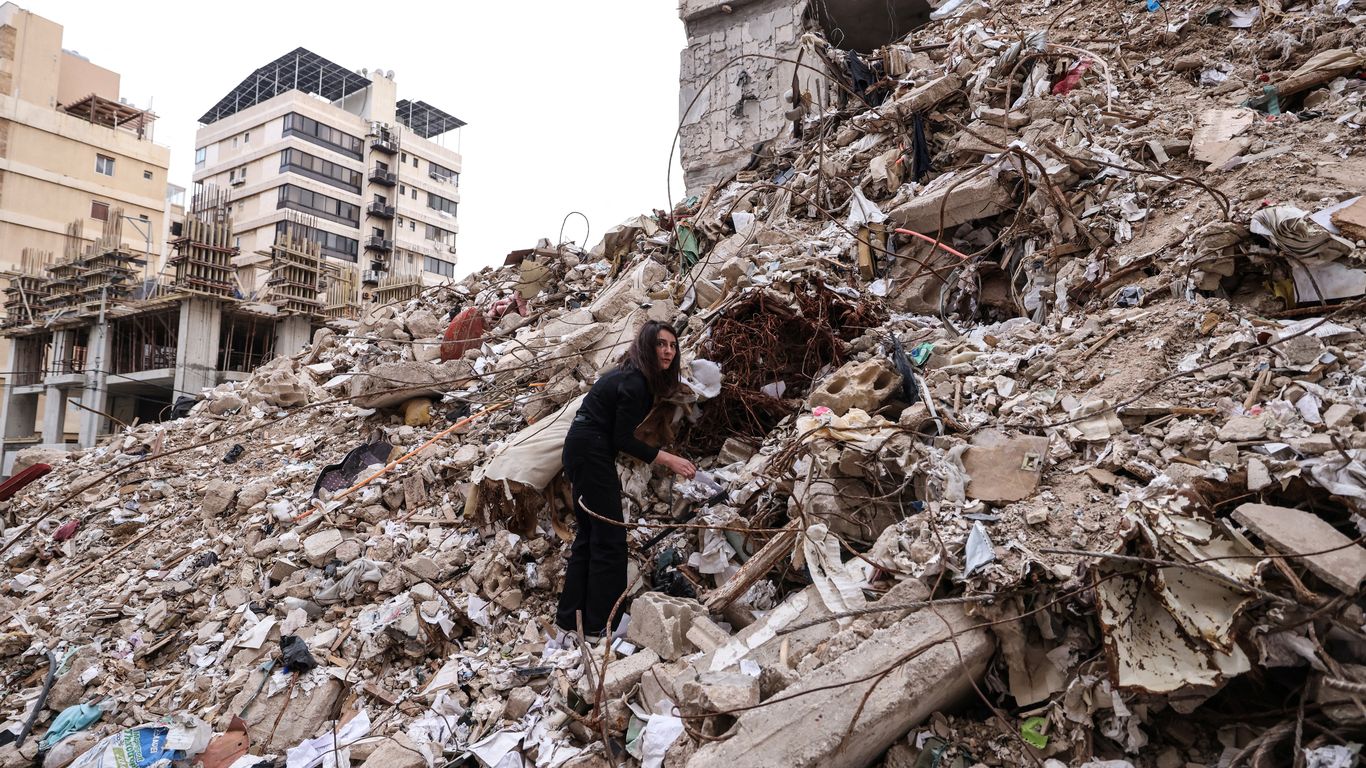
The speaker of the Lebanese parliament, Nabih Berri, told the Trump administration on Sunday that Hezbollah is ready for a full and immediate ceasefire with Israel and pledged to guarantee its implementation, Berri's top adviser Ali Hamdan told Axios. Why it matters: The fighting in Lebanon is escalating and threatening to derail the chances of a deal to end the war in Iran, particularly with Israeli Prime Minister Benjamin Netanyahu now threatening to strike Beirut.Iran's semi-official Tasnim news agency reported on Monday that Iran's negotiating team was suspending its exchange of messages with the U.S., through the mediators, in protest of Israel's actions in Lebanon.Zoom in: Berri is one of the most powerful Shia politicians in Lebanon and has close links to Hezbollah, though U.S. and Israeli officials question whether he can actually guarantee Hezbollah's compliance.If Hezbollah is indeed ready for a full ceasefire, such a truce would leave the Israeli occupation of southern Lebanon in place for now while potentially disconnecting the Lebanese arena from the war with Iran.According to a source with knowledge, though, U.S. officials told Berri they don't think Netanyahu would agree.An Israeli official confirmed Hezbollah expressed readiness for a full ceasefire without demanding an immediate Israeli withdrawal. The State Department didn't immediately respond to requests for comment.What he's saying: "I called the U.S. ambassador to Beirut, Michel Issa, on Sunday and told him on behalf of Speaker Berri that Hezbollah will be ready to totally commit to a comprehensive ceasefire and we are ready to guarantee it," Hamdan told Axios. Hamdan confirmed that the Trump administration proposed a partial ceasefire over the weekend which would require Hezbollah to stop striking northern Israel in return for Israel committing not to strike Beirut, as Axios reported.But he pushed back on a U.S. official's characterization of Berri's response as "evasive and disappointing."Friction point: "The proposal we received was no Hezbollah attacks on northern Israel and that in return Israel will not bomb Beirut and then gradually the ceasefire will expand to other areas," Hamdan said. "Speaker Berri's reply was, "Why a partial ceasefire? Let's have a full ceasefire."Berri proposed a ceasefire on the ground, air and sea under which Israel would also commit to stop demolishing houses in southern Lebanon. Hamdan claimed Berri has a channel of communication with Hezbollah that allows him to exchange messages with the group's leader, Naeem Qassem, who is in hiding."We are sure Hezbollah will commit to a total ceasefire. We think it will be more productive. We know time is running out," Hamdan said. State of play: The U.S. has urged Israel against striking Beirut for several weeks as part of a broader deescalation push, but a U.S. official hinted on Sunday that position could soften. "The U.S. does not expect Israel to absorb ongoing attacks on its civilians by a terrorist organization," the official told Axios.On Monday, Netanyahu issued a joint statement with Defense Minister Israel Katz threatening to bomb Hezbollah targets in the Dahieh District of Beirut "following repeated violations of the ceasefire" by the Shia militia. They said the district housed Hezbollah's "terrorist headquarters," which could no longer "remain off-limits." The Israel Defense Forces later issued a statement in Arabic urging "all residents of the Dahieh District in Beirut to relocate for their safety.""Should Hezbollah continue to fire toward our cities and communities, the IDF will respond by striking terrorist targets in Dahieh," the statement said.What to watch: Iranian Foreign Minister Abbas Araghchi issued his own warning on X that Israel's actions in Lebanon were a violation of the U.S.-Iran ceasefire, and the U.S. and Israel would bear "the consequences of any violation."Shortly after Araghchi's statement, Tasnim quoted Iranian officials stressing no talks with the U.S. will take place until Israel stops its attacks in Lebanon.The Tasnim report also said Iran and its "Axis of Resistance" are prepared to retaliate in the Strait of Hormuz "and activate other fronts," including the Bab el-Mandeb Strait in the Red Sea.