Trump makes eleventh-hour endorsement of Rep. Mike Collins in crucial GOP runoff for Senate
Far Right
President Donald Trump on Sunday endorsed Republican Georgia Rep. Mike Collins for the Republican runoff to challenge Democratic Sen. Jon Ossoff. Collins and former football coach Derek […]
One of Hollywood's most legendary voices is lending her star power to a Senate campaign that could help decide control of Congress, and she is sounding the alarm.In a fundraising appeal sent to supporters Monday, the entertainment icon told readers she is "deeply concerned for our country and the world," warning that the Trump administration and Republicans are "raising costs, undermining our democracy, and putting lives in danger."The voice behind the message belongs to none other than Barbra Streisand, the EGOT-winning singer and actress and a longtime Democratic megastar, who is throwing her weight behind Alex Vindman's bid for the U.S. Senate in Florida."It's Barbra Streisand," the email opens. "I am reaching out because like many of you, I am deeply concerned." She framed the contest as bigger than party, writing that protecting "the country we love" is "no longer a Republican or Democratic issue."Streisand pitched Vindman's race as potentially decisive, writing that "control of the Senate could hinge on his race." She added that "the latest polls show he can win" but that he needs supporters to "step up."Vindman is no stranger to clashing with Trump. The retired Army lieutenant colonel was a key witness in Trump's first impeachment, testifying about the 2019 call in which Trump pressured Ukraine's president, and was pushed out of his National Security Council post after the trial. He is now running as a Democrat to unseat Republican Sen. Ashley Moody, the former state attorney general appointed to fill Marco Rubio's seat after Rubio became secretary of state, and has vowed to be the president's "worst nightmare."Streisand's optimism about the polling comes with caveats. While Vindman's campaign has cited surveys showing the race within the margin of error, independent polls have given Moody healthier leads, and Florida has trended firmly Republican, with no Democrat winning a Senate race there since 2012. The Cook Political Report rates the seat "Solid R." Vindman also has to clear an Aug. 18 Democratic primary first.Still, the appeal shows his campaign is leaning on celebrity firepower to nationalize a long-shot race and juice small-dollar donations in a contest Democrats would dearly love to steal.
A well-known nemesis of Donald Trump is seizing on the president's birthday.Alex Vindman is trying to give Trump a birthday he won't enjoy.As the president marked his 80th on Sunday, the retired Army lieutenant colonel and key witness in Trump's first impeachment blasted out a fundraising appeal billing himself as the president's "worst nightmare" and urging supporters to help "make it backfire in the best way possible."The pitch leaned hard on Vindman's history with Trump. "Nothing would make Trump angrier," the email from the Alex Vindman Victory Fund argued, than being represented by Vindman in the U.S. Senate "holding him accountable."That framing draws on a well-known backstory. Vindman, a 21-year combat veteran who was wounded in Iraq and awarded a Purple Heart, was serving on the National Security Council in 2019 when he testified that he heard Trump pressure Ukraine's president — testimony that helped trigger Trump's first impeachment. He and his twin brother, Eugene, now a Virginia congressman, were pushed out of their NSC posts after the trial.Now Vindman is running as a Democrat for Florida's U.S. Senate seat, challenging Republican Sen. Ashley Moody — the former state attorney general whom Gov. Ron DeSantis appointed to fill Marco Rubio's seat after Rubio became secretary of state. Moody, who carries Trump's endorsement, faces voters for the seat for the first time in November's special election.To argue the long-shot race is winnable, the email pointed to a new poll showing the contest essentially tied: Moody 43 percent, Vindman 42 percent.That number comes with heavy caveats. It echoes a string of Vindman campaign-cited polls that have kept the race within the margin of error — but independent surveys have been far kinder to Moody, including an Emerson College poll putting her up 8 points and a University of North Florida poll showing a 7-point lead. Florida has trended firmly Republican; no Democrat has won a Senate race there since 2012, the GOP holds a voter-registration edge of roughly 1.4 million, and the Cook Political Report rates the seat "Solid R."Vindman also has to clear an Aug. 18 Democratic primary first, where state Rep. Angie Nixon is among those running.Still, his campaign is betting that nationalizing the contest — and lashing it directly to Trump — can fire up donors in a race Democrats would love to steal. As Vindman put it when he launched his bid, the last time many Americans saw him, he was "swearing an oath to tell the truth about a president who broke his."
Aggressively promoted by President Donald Trump, the Safeguard American Voter Eligibility Act (AKA the SAVE America Act or SAVE Act) is drawing strong criticism not only from Democrats, but from some GOP lawmakers as well. Four Senate Republicans, in early June, joined Democrats in voting against advancing the bill: Maine's Susan Collins, North Carolina's Thom Tillis, Alaska's Lisa Murkowski, and former Senate Majority Leader Mitch McConnell (R-Kentucky). But according to NOTUS reporter Al Weaver, the SAVE America Act refuses to die — even though some Republican lawmakers wish that it would."The SAVE America Act just won't go away for Senate Republicans, no matter how many times they think it's dead and gone," Weaver reports in NOTUS. "Republican lawmakers have been locked in a monthslong battle over the conservative voting bill as it has become evident they don't have the votes in the upper chamber to pass the bill, no matter the avenue. This has left members miffed — they want to finally turn the page, but are again faced with a zombie."If it became law, the SAVE America Act would require voters to prove that they are U.S. citizens. Regular state-issued driver's licenses would not be enough to prove citizenship; voters would have to present another document as well, such as a U.S. passport or a birth certificate. But critics of the bill are noting that many Americans don't own passports and that millions of married women would lose their right to vote, as their married names likely differ from the names on their birth certificates. A Senate Republican, interviewed NOTUS on condition of anonymity, said of the SAVE America Act, "It just keeps coming back. It's like the 'Night of the Living Dead'…. There is a frustration. It's not just the president. We have other members who keep pushing this when they know.… we don't have the votes. I don't know how you can be more clear than that. I don't know why they keep pushing something that's basically not possible."Trump, Weaver observes, "tried to resurrect the issue last week by calling for it — alongside hundreds of billions of dollars in defense priorities — to be part of a third party-line budget reconciliation package."Another Senate Republican, also interviewed on condition of anonymity, told NOTUS, "I don't know why they keep pushing something that's basically not possible. It doesn't get us votes. Literally, we lose votes with it."On February 11, the SAVE America Act passed in the U.S. House of Representatives, 218–213, along largely partisan lines. Only one House Democrat, Rep. Henry Cuellar (D-Texas), voted with Republicans. But the bill stalled after reaching the Senate. A Senate GOP aide told NOTUS, "We agree on voter ID, but the bill Trump wants is far beyond that scope…. It's taken on a life of its own. It's not rooted in reality and it’s not rooted in what we can actually achieve."
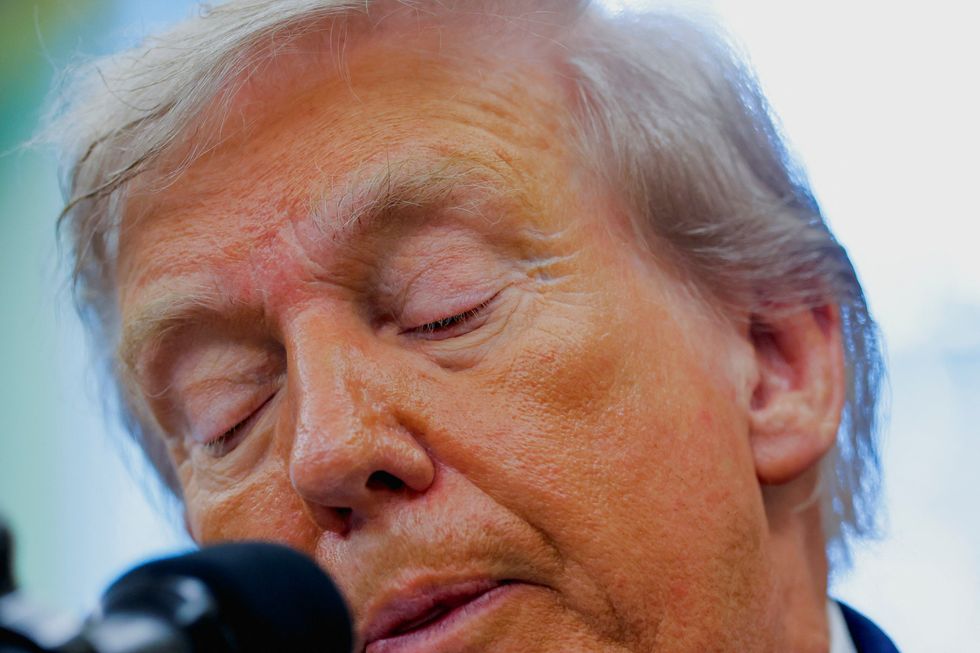
President Donald Trump appeared to doze off in the front row of his own UFC birthday celebration, handing critics fresh ammunition and reigniting calls for his removal from office.Footage circulating from UFC Freedom 250 on the White House South Lawn shows Trump, who turned 80 on Sunday, seated beside UFC chief Dana White with his eyes closed and his head slumping to one side, according to the Mirror and various observers.Anti-Trump commentator Ed Krassenstein pounced on the clip. "How does this even happen?" he wrote, sharing video of the apparent nap. "Trump appears to have fallen asleep at the UFC event at the White House? 25th Amendment Now!"The progressive account Call to Activism amplified it as "BREAKING," announcing that Trump "HAS FALLEN ASLEEP AT HIS 80TH BIRTHDAY UFC FREEDOM 250 EVENT."The moment drew notice from fight fans, too. One MMA account, MMA Joey, claimed Trump "fell asleep during the Bo Nickal fight" and that White "had to slap him" to wake him during the finish, though that version of events could not be independently confirmed.According to the Mirror, the footage set off a wave of comments questioning the president's fitness, with one user sarcastically writing, "Oh…yeah…he's fit to lead the country," and another insisting he should resign because he is "too old."The episode echoes one from a week earlier. The Mirror noted that Trump had been widely criticized for appearing to nod off during Game 3 of the NBA Finals at Madison Square Garden, prompting Rep. Alexandria Ocasio-Cortez to post "WAKE TF UP" and the Lincoln Project to mock the outing as "the most expensive taxpayer-funded nap." Detractors have since taken to calling him "Commander-in-Sleep."The White House has consistently rejected that narrative. As the Mirror reported, Secretary of State Marco Rubio told a congressional hearing this month that the opposite was true, describing Trump as working "inhumane hours" and phoning him in the dead of night. A White House spokesman has described the president's energy as "unmatched," and Trump's physician recorded a 30/30 score on a cognitive test at his late-May physical, which the White House billed as a "perfect bill of health."Whether the president was asleep or simply watching a screen with his eyes shut, as the Mirror put it, the image of Trump appearing to drift off at his own birthday party all but guaranteed the questions would keep coming.
When President Donald Trump accepted the April 2026 ceasefire, I knew he had committed the gravest political blunder of his career. America and Israel had cornered Iran, shattered its leverage, and battered its proxies. Instead of forcing permanent concessions, the White House now appears ready to rescue Tehran and rebrand retreat as a “peace crusade.” […]
On June 1st, despite a ceasefire ostensibly underway in the US-Israeli war on Iran, Israel’s prime minister launched a major escalation against Lebanon, including threatening airstrikes against the Lebanese capital. The US president called the Israeli leader, furiously demanding an end to Israel’s escalation. Six days later, Israel attacked Beirut’s southern suburbs, long understood to be a red line for Hezbollah. The Lebanese resistance organization launched a limited response, sending 11 rockets towards Israel, almost all of which were intercepted; no one was hurt or killed. Trump called Netanyahu again, telling him in a brief call that now that Iran and Israel had each “had their fun,” that Israel should stand down.Commentators across the Middle East and beyond debated whether Netanyahu would abide by Trump’s demand. What virtually none of them mentioned was that Trump had refused to even mention his most important pressure point: that if Israel resisted his order to stand down, the US would simply stop sending tons of weapons and tens of billions of dollars to the Israeli military. The close but sometimes divergent interests of the Middle East’s two powers, the global and the regional, was on full display. It’s now been 106 days since Trump launched his preemptive and illegal military attack on Iran. On February 28, 2026, the world awoke to the fury of a new war in the Middle East after the United States and Israel had launched their joint assault against Iran, with President Trump and Prime Minister Netanyahu standing shoulder to shoulder against their common foe. Claiming unbridled hegemony was on the agenda for both.The US-Israeli war on Iran is rooted in longstanding US imperialist strategy and Israel’s national goals.Today, with yet more fresh promises of a so-called “peace deal” that is nearly ready to be signed by Trump and Iranian leadership, the Israeli military is bombing the suburbs of Beirut despite ongoing claims of a “ceasefire.” Trying to understand the current doom loop, it’s vital we remember how we got here.In the opening salvo of the US-Israeli attack, Iran’s supreme leader Ali Khamenei, along with an unknown number of other top military and political leaders, was assassinated with a ballistic missile. Just an hour later, the US fired a Tomahawk missile directly at the Shajareh Tayyebeh Elementary School in the northern Iranian city of Minab—killing 156 people, 120 of them children, and destroying the school. The war’s official reasons, initially, were to eliminate the ostensible threat of Iran creating a nuclear weapon, and to destroy its conventional military capacity. The no-daylight US-Israeli partnership, Trump and Netanyahu as BFFs, the collaboration between the US and Israeli warplanes, bombers, drones, missiles… all seemed seamless and perfect.Three months later, and half a dozen or so “ceasefires” announced, renounced, ignored and denounced, headlines around the world gleefully recounted a Trump phone call with Netanyahu. Focused on Israel’s escalating bombing of Lebanon threatening to derail the latest US-Iran ceasefire, the June 1 call reportedly started with Trump telling Netanyahu “you’re f------- crazy—you’d be in prison if it weren’t for me.“ The US president then went on to his ”Everybody hates you now“ remark. ”Everybody hates Israel because of this,“ he reportedly said.Trump acknowledged saying it, and then, as is his usual style, moved on, quickly reclaiming his friendship with the Israeli prime minister. As was true with so many earlier ceasefires, Israel continued its massive bombing and its brutal occupation of south Lebanon, making a US-Iran ceasefire impossible. In the meantime, throughout the months of the war, commentators, politicians of all stripes, journalists and analysts across the globe were struggling to figure out what that war was actually being fought for. War for What?Real fear of an actual nuclear bomb was certainly not the answer. After all, US intelligence agencies have agreed for years that “Iran is not building a nuclear weapon and that [Supreme Leader Ali] Khamenei has not reauthorized the nuclear weapons program he suspended in 2003.” Despite that clear assessment, US B-2 stealth bombers still dropped 14 of their 30,000-pound “bunker-buster” bombs on Iran’s civilian centrifuges at Fordo, Isfahan and Natanz at the end of Israel’s 12-day war in June 2025. Trump and his supporters bragged of having “completely and totally obliterated” Iran’s nuclear facilities. And then, eight months after that, in the early days of the US-Israeli 2026 war, those B-2s were back in the air, dropping more 30,000-pound and some smaller versions of the bunker-busters on Iran.