RFK Jr accuses Biden admin of blocking Christian families from fostering children: ‘We’re changing that’
Source: BizPac Review · Bias: Far Right
Summary
U.S. Department of Health and Human Services Secretary Robert F. Kennedy Jr. accused the Biden administration of blocking Christian families from fostering children while testifying before Congress. […]
RFK Jr accuses Biden admin of blocking Christian families from fostering children: ‘We’re changing that’
Far Right
U.S. Department of Health and Human Services Secretary Robert F. Kennedy Jr. accused the Biden administration of blocking Christian families from fostering children while testifying before Congress. […]
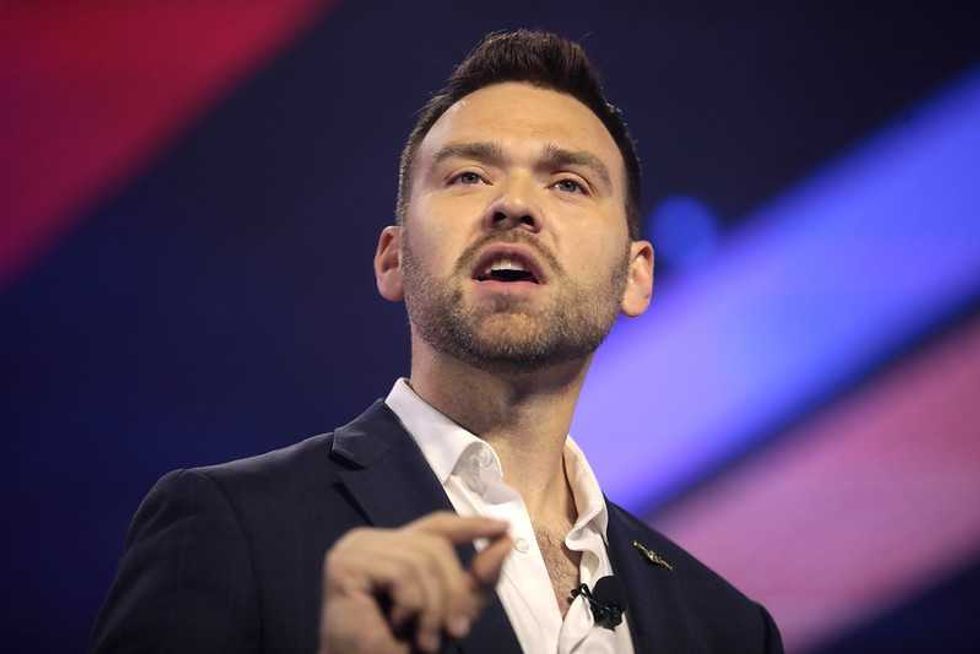
A right-wing influencer got more than he bargained for during a livestream in Philadelphia when a passerby challenged him in a heated, curse-laden exchange.Jack Posobiec was in Philadelphia on Friday outside Independence Hall as the city held its Red, White, & Blue To-Do, a citywide patriotic celebration tied to the July 4 weekend. As Posobiec was in the middle of his stream, a man in a purple shirt can be heard off-camera shouting, "You are the enemy!"Posobiec, a Turning Point USA-aligned influencer and Human Events host known for spreading the debunked "Pizzagate" hoax, has long crusaded against birthright citizenship. The clash came days after the Supreme Court upheld birthright citizenship in a 6-3 ruling, striking down Trump's executive order, a defeat that drew fury from Trump allies.Posobiec invited the angry gentleman to join him on camera as the man shouted curse words over the right trying to overturn birthright citizenship."Sir, there's no cursing. No cursing," Posobiec insisted. "Can you do no cursing?"The man delivered a blunt response."Probably not."The man informed Posobiec that his mother was English and his father was Irish."Do I get to stay in the country when you guys pass laws that kick out all the Irish and all the Italians and all the people of color?" the man demands to know, pointing a finger.The man added that conservatives have four votes to overturn birthright citizenship, echoing warnings from some analysts that the fight is far from over."Oh I can't wait. It's gonna be great," Posobiec exclaims. "For illegal aliens. You understand it's for illegal aliens, right?"The man fired back, "It's not. You guys are white anglo-saxon protestant white supremacists."The passerby got more agitated, accusing Posobiec of voting for the wrong people when the far-right provocateur insisted he was "Catholic and Polish.""I'm not allowed to vote for who I want to, Sir?" Posobiec retorts. "How is that freedom?""You vote for someone who wants to kick you out of the country," the bewildered man responds.As the man starts shouting obscenities again, Posobiec insists birthright citizenship will be overturned because it's unlawful."We're having a great day, and you're screaming in front of children!" Posobiec complains.Crazy lib tried to scream at the Poso family in Philly Even my kids were dunking on him pic.twitter.com/xMy3L9bdSN— Jack Posobiec (@JackPosobiec) July 3, 2026
The Louisiana Supreme Court on Friday temporarily halted criminal proceedings against Attorney General Liz Murrill, just one day after a New Orleans grand jury returned a politically motivated 16-count felony indictment accusing the Republican attorney general of intimidation and malfeasance.
The post UPDATE: Louisiana Supreme Court Temporarily Blocks Politically Motivated Indictment Against AG Liz Murrill appeared first on The Gateway Pundit.
Resistance is mounting across the United States against the increasing use of surveillance tech company Flock Safety’s cameras, with a growing number of cities canceling contracts as the artificial intelligence-powered license plate readers are quietly being installed in thousands of locations nationwide.State and local police departments first used the Atlanta-based company’s automated license plate reader (ALPR) systems for standard law enforcement purposes, but they are now being employed for a much broader range of uses, including immigration-related searches and other actions supporting US Immigration and Customs Enforcement (ICE) during the Trump administration’s deadly anti-immigrant crackdown.“We have cameras that are used for everything from illegal dumping to drug houses to hotels that are just big problems,” Flock Safety engineer Kevin Cox told prospective customers during a demonstration of the company’s Condor Camera, according to a Thursday report in The Washington Times.“There are endless, endless uses for what we can do with these things,” Cox added.Those uses include spying on constitutionally protected protest activity and enforcing abortion bans by tracking pregnant people’s travel across states—even ones in which the medical procedure is legal.The ACLU—which recently launched a “Get the Flock Out” campaign to “fight creepy ALPR cameras”—says there are currently between 80,000 and 100,000 Flock devices installed nationwide that conduct more than 20 billion scans per month. More than 5,000 law enforcement agencies use the cameras, and some of them keep their locations a secret.“Flock’s ALPR cameras aren’t like your normal traffic cameras,” the ACLU explained. “This surveillance technology records and tracks every car that comes into view, and then an AI algorithm catalogs the make, model, color, license plate number, bumper stickers, and even scratches. This personal information is then uploaded into a nationwide database that any law enforcement agency with a Flock contract can search—with few regulations or oversight on how they use what they find.”The backlash against creeping state surveillance has even transcended the partisan divide.“I think our country is in a kind of uniquely anti-surveillance environment right now, which is to say that, in a time where it seems there is nothing that is not partisan, opposition to government surveillance is nonpartisan,” ACLU privacy and surveillance attorney Chad Marlow told The Washington Times on Thursday.There is growing action—both legal and otherwise—to end the use of ALPRs across the country.According to the public information project Ban Flock Cameras, 82 Flock contracts were terminated across 28 states between August 2021 and May 2026, with 39 of those cancellations occurring in the first five months of 2026 alone.Even Amazon-owned Ring announced earlier this year that it would stop doing business with Flock Safety.Susie O’Hara, a member of Santa Cruz, California’s nominally nonpartisan City Council, told WBUR earlier this year that she grew increasingly concerned about local use of eight Flock cameras last year after learning that police were sharing data gleaned from the cameras with the company’s national network without city officials’ knowledge, a violation of state laws banning the practice.O’Hara became increasingly convinced that Santa Cruz should cancel its Flock contract after an ICE agent fatally shot Renee Good, a US citizen, in Minneapolis in January.“I have goose bumps on my arms thinking about the absolute chaos that was happening in Minneapolis,” she said. “And just the absolute insanity of what we were seeing... It was totally clear to me that we should in no way consciously be in this system at all—just no way.”Less than a week after Good’s killing, the Santa Cruz City Council voted to terminate the city’s Flock contract, becoming the first municipality in California to do so.“For us, the threat to our civil liberties was greater than any benefit we could get from the flawed product,” Santa Cruz Mayor Fred Keeley told KQED at the time.Chad Kemp, who represents District 32 on the nonpartisan Dane County Board of Supervisors in Wisconsin—which in April voted to stop funding two dozen cameras leased from Flock—told The Washington Times that “there’s a public safety issue here, but there is also a privacy issue.”“There are serious concerns about individuals who can be monitored without their knowledge, or if it is even constitutional or ethical to track people without a warrant,” he added.At the national level, US Reps. Robert Garcia (D-Calif.) and Raja Krishnamoorthi (D-Ill.) last year launched an investigation into the use of Flock cameras to track pregnant people across state lines for abortion care and to conduct unauthorized immigration enforcement operations.Krishnamoorthi and Sen.
People across the country are preparing to celebrate America’s 250th birthday this weekend — a process that has been made more challenging as event organizers scramble to deal with the extreme heat. President Trump is headed to South Dakota late on Friday, where he’s expected to make remarks at the Mount Rushmore National Memorial and…
The Trump administration is asking a federal judge to quickly lift her recent ruling against major provisions of a presidential executive order on elections, arguing in an appeal that the court’s action will effectively prevent the government from putting new voting restrictions in place before the November election.This article was originally published by Votebeat, a nonprofit news organization covering local election administration and voting access.Last week, U.S. District Judge Indira Talwani halted President Donald Trump’s efforts to create centralized lists of adult citizens and give the U.S. Postal Service unprecedented authority over who can vote by mail. Her 37-page ruling concluded that the president did not have the constitutional authority to regulate state elections, as his March executive order tried to do.The executive order directed the U.S. Department of Homeland Security and Social Security Administration to create a nationwide list of verified U.S. citizens over 18, and thus presumably eligible to vote in federal elections. It also called on the U.S. Postal Service to create a system to handle and accept mail-in ballots only from voters on preapproved lists.Talwani’s order prevents the federal government from enforcing those provisions of the order against the 24 jurisdictions (23 states and the District of Columbia) whose attorneys general and governors brought the lawsuit in federal court in Massachusetts. The list includes most Democratic-led and swing states, including Arizona, California, Michigan, Nevada, New York, North Carolina, Pennsylvania, and Wisconsin.This week, the Trump administration appealed Talwani’s ruling to the First Circuit Court of Appeals and said it is still proceeding with its efforts to set up the new system for the rest of the states. But it warned that the judge’s order will make it impossible for the U.S. Postal Service to create a bifurcated system for the November election, even if the administration ultimately prevails on appeal. Government attorneys asked Talwani to lift her ban by Monday.The request for a quick decision suggests that the Trump administration may be trying to speed things up so the case reaches the U.S. Supreme Court as soon as possible.“Operationally, it would not be possible for us to put a two-tiered system in place where one set of rules apply to the ballot mail of the Plaintiff States, and another applies to the remaining states,” Steven Monteith, the Postal Service’s chief customer and marketing officer and executive vice president, said in a court filing. “Doing so would cause operational confusion and significantly increase the complexity and efficiency of implementing any final rule.”But the Trump administration’s nationwide efforts to use the Postal Service to regulate who gets ballots also hit a separate legal roadblock this week when another federal judge in Washington, D.C., ruled that the executive order violates a years-old agreement requiring the federal government to ensure voters who request mail-in ballots get them in time to ensure they can be counted.U.S. District Judge Emmet Sullivan concluded that the Trump administration’s plans to send ballots only to voters on preapproved lists breached a 2021 agreement between the Postal Service and the NAACP meant to ensure that the agency prioritized ballot delivery. In contrast to Talwani’s ruling, Sullivan’s decision applies nationwide.“These proposed rules directly undermine commitments that the Postal Service made to ensure mail-in ballots are delivered and counted,” said Anthony Ashton, senior associate general counsel for the NAACP, in a statement.The U.S. Postal Service and Department of Homeland Security did not respond to requests for comment.Dion Nissenbaum is Votebeat’s senior national reporter and is based in Houston. Contact Dion at dnissenbaum@votebeat.org. Votebeat is a nonprofit news organization covering local election integrity and voting access. Sign up for their newsletters here.
Democrats on the House Natural Resources Committee released an interim report on Thursday alleging Freedom 250 potentially misled donors, directing them to complete payments that were rerouted. “According to sources interviewed by Committee Democrats, donors who intended to donate to America250 were instead given wire instructions with Freedom 250’s banking information—including its routing number and…
New financial disclosures by President Donald Trump show that he made more than $1.4 billion from his family’s various cryptocurrency ventures last year, reaping a windfall after pulling back on regulation of the industry and promoting the United States as “the crypto capital of the world.” Other Trump businesses, like his resorts and golf courses, have also flourished since his return to the White House, while the Trump Organization has also licensed the family name to properties in countries that are crucial to U.S. foreign policy interests, including Saudi Arabia and Qatar.
“It’s been an incredibly successful period for the Trump family,” says Reuters investigative reporter Tom Bergin.