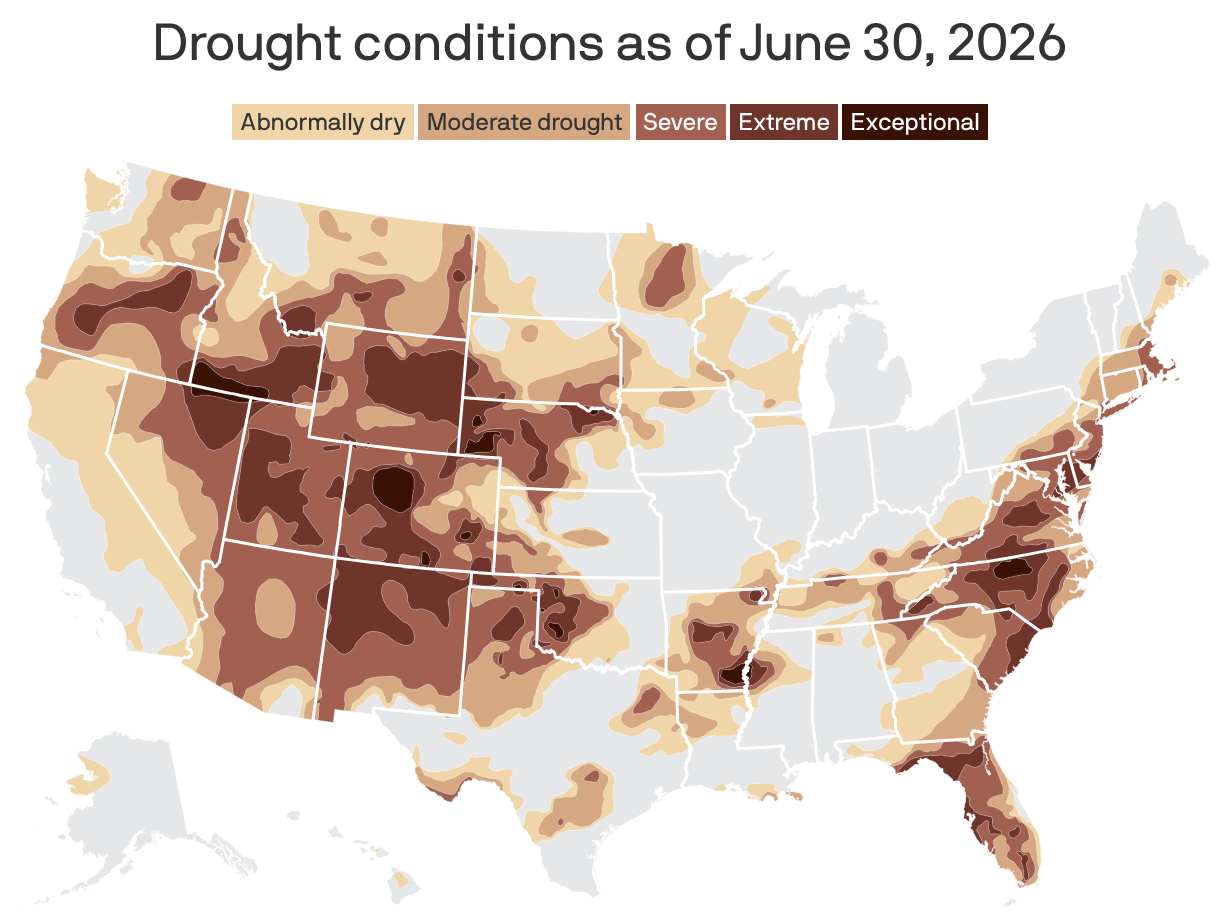
Data: U.S. Drought Monitor; Map: Erin Davis/Axios VisualsFirework associations expect a massive boom in backyard fireworks this July 4, a surge that collides with dry conditions and a blistering heatwave that could drastically increase the risk of fires.Why it matters: Climate change is increasing the likelihood and severity of wildfires, and large chunks of the U.S. are under burn bans because of severe drought.What they're saying: "It only takes one small spark landing in dry vegetation under the right conditions to start a fast-moving wildfire," April Newman, a public information officer at Cal Fire, tells Axios.Embers can smolder for over a minute, Newman says, "increasing the potential for ignition even after the visible display has ended."Even if a lawn looks green, the "eye test can be deceiving," Brian Fuchs, a climatologist at the National Drought Mitigation Center, tells Axios. Dig just a few inches into Mid-Atlantic soil, "you hit dryness again."State of play: Local governments navigating the drought created a patchwork of burn bans across the country.Colorado Springs issued a citywide burn ban earlier this week before canceling all fireworks displays — even professional ones — citing "extreme fire danger."Utah Gov. Spencer Cox suspended a state law that prevented local governments from enacting blanket bans, prompting Salt Lake County and others to outlaw fireworks.The other side: Florida has no statewide fireworks ban despite lingering droughts and nine county-level burn bans.State law includes a "fireworks holiday" giving anyone over 18 the right to set them off.By the numbers: The national landscape is dangerously primed for ignition, and tragedy is already playing out.Roughly 50% of the U.S. is currently in a drought, according to Fuchs.On July 1, the National Interagency Fire Center reported 257 new fires, and firefighters are trying to contain 51 large fires nationwide.Three firefighters died combating a major fire in western Colorado on Saturday.The intrigue: July 4 celebrations bring a massive, sudden influx of potential ignition sources.When you combine millions of flying sparks with dry vegetation, humidity and a heatwave, wildfires get the exact catalyst they need to explode, safety and climate experts say.Between the lines: Consumer demand for fireworks to commemorate America's 250th anniversary is at record levels."People look like they're going to be showing their patriotism" Ed Vasel with the National Fireworks Association, tells Axios. "We're thinking things are going to be up maybe as much as 20-25% in some areas this year."Professional pyrotechnicians follow strict distance requirements and work with on-site fire departments, but neighborhood celebrations often lack those safeguards, he says.Worth noting: Conditions for President Trump's record-breaking firework plans are better than they were weeks ago Fuchs says, but drought and sweltering heat still remain.While recent rain has provided some surface-level relief, these showers are not a complete "drought buster," Fuchs says.The bottom line: "There's a lot of angst amongst people who believe that fireworks is a right, and that it is culturally valuable, and that it is something that no one should be able to interfere with," David Barrett, executive director of The Safe Community Project, tells Axios."I appreciate and have empathy for those opinions. I do think at the same time…they recognize that the decisions they make don't affect only themselves for their personal pleasure, but those around them who they might inadvertently injure or kill."Go deeper: Trump's July Fourth event faces dangerous D.C. heat - Axios Washington D.C.
Resistance is mounting across the United States against the increasing use of surveillance tech company Flock Safety’s cameras, with a growing number of cities canceling contracts as the artificial intelligence-powered license plate readers are quietly being installed in thousands of locations nationwide.State and local police departments first used the Atlanta-based company’s automated license plate reader (ALPR) systems for standard law enforcement purposes, but they are now being employed for a much broader range of uses, including immigration-related searches and other actions supporting US Immigration and Customs Enforcement (ICE) during the Trump administration’s deadly anti-immigrant crackdown.“We have cameras that are used for everything from illegal dumping to drug houses to hotels that are just big problems,” Flock Safety engineer Kevin Cox told prospective customers during a demonstration of the company’s Condor Camera, according to a Thursday report in The Washington Times.“There are endless, endless uses for what we can do with these things,” Cox added.Those uses include spying on constitutionally protected protest activity and enforcing abortion bans by tracking pregnant people’s travel across states—even ones in which the medical procedure is legal.The ACLU—which recently launched a “Get the Flock Out” campaign to “fight creepy ALPR cameras”—says there are currently between 80,000 and 100,000 Flock devices installed nationwide that conduct more than 20 billion scans per month. More than 5,000 law enforcement agencies use the cameras, and some of them keep their locations a secret.“Flock’s ALPR cameras aren’t like your normal traffic cameras,” the ACLU explained. “This surveillance technology records and tracks every car that comes into view, and then an AI algorithm catalogs the make, model, color, license plate number, bumper stickers, and even scratches. This personal information is then uploaded into a nationwide database that any law enforcement agency with a Flock contract can search—with few regulations or oversight on how they use what they find.”The backlash against creeping state surveillance has even transcended the partisan divide.“I think our country is in a kind of uniquely anti-surveillance environment right now, which is to say that, in a time where it seems there is nothing that is not partisan, opposition to government surveillance is nonpartisan,” ACLU privacy and surveillance attorney Chad Marlow told The Washington Times on Thursday.There is growing action—both legal and otherwise—to end the use of ALPRs across the country.According to the public information project Ban Flock Cameras, 82 Flock contracts were terminated across 28 states between August 2021 and May 2026, with 39 of those cancellations occurring in the first five months of 2026 alone.Even Amazon-owned Ring announced earlier this year that it would stop doing business with Flock Safety.Susie O’Hara, a member of Santa Cruz, California’s nominally nonpartisan City Council, told WBUR earlier this year that she grew increasingly concerned about local use of eight Flock cameras last year after learning that police were sharing data gleaned from the cameras with the company’s national network without city officials’ knowledge, a violation of state laws banning the practice.O’Hara became increasingly convinced that Santa Cruz should cancel its Flock contract after an ICE agent fatally shot Renee Good, a US citizen, in Minneapolis in January.“I have goose bumps on my arms thinking about the absolute chaos that was happening in Minneapolis,” she said. “And just the absolute insanity of what we were seeing... It was totally clear to me that we should in no way consciously be in this system at all—just no way.”Less than a week after Good’s killing, the Santa Cruz City Council voted to terminate the city’s Flock contract, becoming the first municipality in California to do so.“For us, the threat to our civil liberties was greater than any benefit we could get from the flawed product,” Santa Cruz Mayor Fred Keeley told KQED at the time.Chad Kemp, who represents District 32 on the nonpartisan Dane County Board of Supervisors in Wisconsin—which in April voted to stop funding two dozen cameras leased from Flock—told The Washington Times that “there’s a public safety issue here, but there is also a privacy issue.”“There are serious concerns about individuals who can be monitored without their knowledge, or if it is even constitutional or ethical to track people without a warrant,” he added.At the national level, US Reps. Robert Garcia (D-Calif.) and Raja Krishnamoorthi (D-Ill.) last year launched an investigation into the use of Flock cameras to track pregnant people across state lines for abortion care and to conduct unauthorized immigration enforcement operations.Krishnamoorthi and Sen.
Iran’s Parliament Speaker Mohammad Bagher Qalibaf has warned of an Iranian response if the U.S. and Israel breach the interim peace deal, as Tehran prepares to bury its former supreme leader, Ayatollah Ali Khamenei. “We strongly demand full implementation of the agreements, and if the U.S. and the Zionist regime fail to fulfill their commitments, Iran…
As part of our July Fourth special broadcast, we continue our extended interview with Karen Hao, author of Empire of AI: Dreams and Nightmares in Sam Altman’s OpenAI. The book documents the rise of OpenAI and how the AI industry is leading to a new form of colonialism. “One of the things that you really have to understand about AI development today is that there are what I call quasi-religious movements that have developed within Silicon Valley,” says Hao. “The concept of artificial general intelligence is not one that’s scientifically grounded.”
The Supreme Court’s ruling in Wolford v. Lopez and its decision to take up two cases involving modern semiautomatic firearms Tuesday outline a pattern in which states […]
You may have read the article from the New York Post about the FBI enlisting a close insider to California Governor Gavin Newsom to wear a wire and record conversations within Newsom’s circle. However, did you overlay the timeline? Remember, there is no possibility this FBI wired surveillance of Gavin Newsom would take place without […]
The post Lisa Monaco and Merrick Garland Organized Wire Recording Surveillance of Gavin Newsom in June of 2024 appeared first on The Last Refuge.