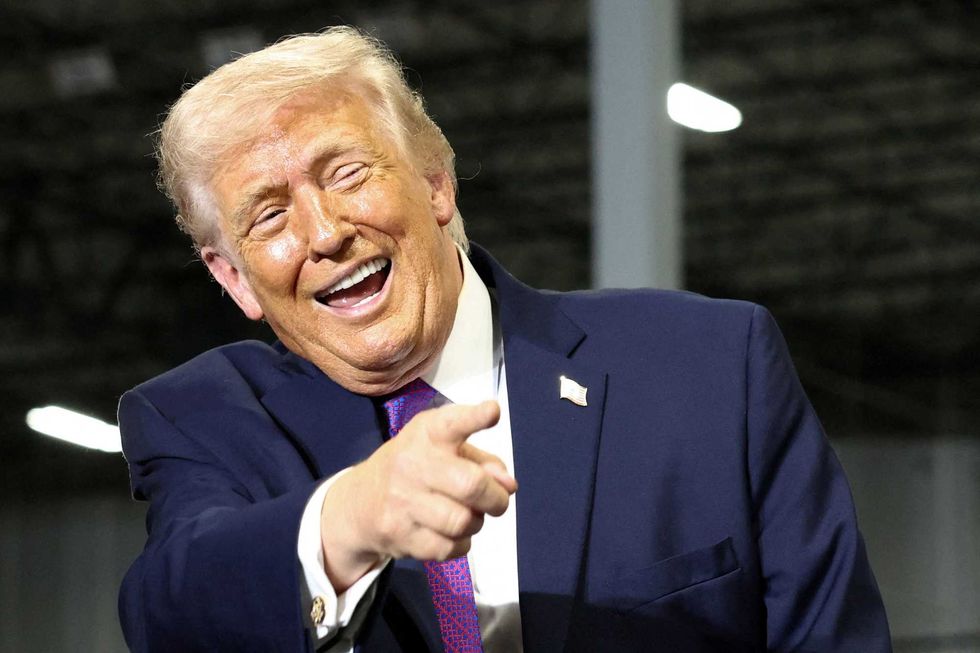
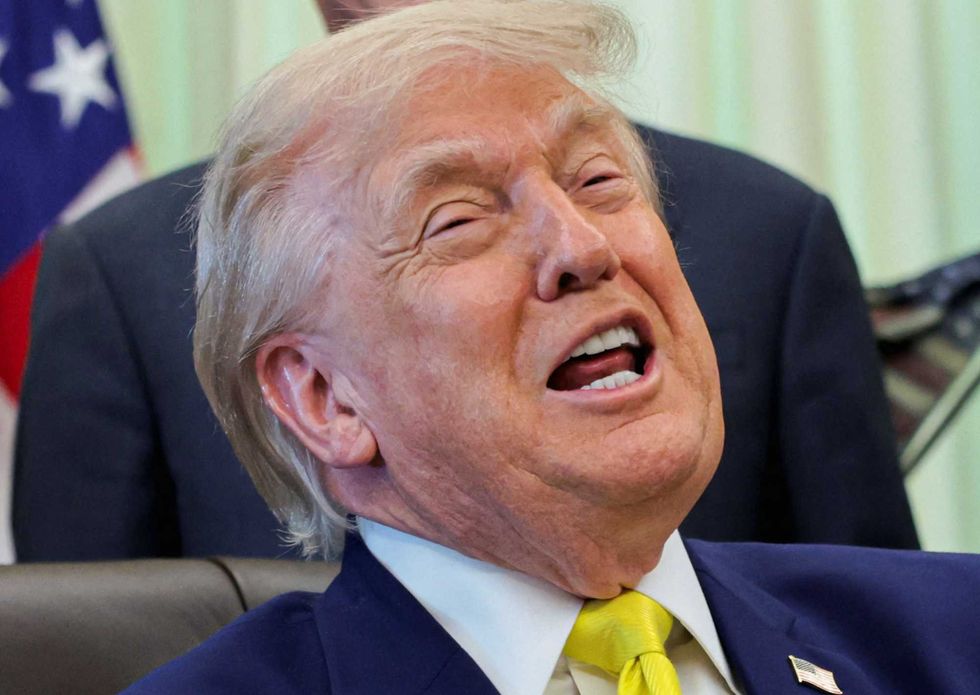
In the wake of financial disclosures showing that President Donald Trump has profited wildly off his presidency over the past year, the Newsweek editors have published a detailed analysis in which they assert that he is “raking in eye-watering sums of money from cryptocurrency gamblers, most of whom were losers in this trade, and also his supporters.”According to Newsweek, while his supporters theoretically set out to “drain the swamp” in corrupt Washington, “The truth is, MAGA always knew Trump was like this. In fact, it’s a big part of why they backed him in the first place.”As Newsweek details, “Trump’s 2025 disclosure lists CIC Digital LLC, described as wholly owned by the Donald J. Trump Revocable Trust, receiving royalties from a license agreement with Celebration Coins and reports the amount as $635,068,835. The same filing reports $236.25 million in token-sale proceeds distributed by World Liberty Financial, plus $65.6 million from the sale of equity in its holding company. Those numbers are politically explosive… because they involve a sitting president, his family business network and an industry his administration is figuring out how to, and if it should, regulate.”Critics say crypto is “a haven for criminals and scammers,” and Newsweek suggests it’s the most “Trumpian” of Trump’s grifts yet. “The $TRUMP coin launched days before Trump returned to office and surged from under $10 to as high as $74.59 before falling back, with four-fifths of its supply held by CIC Digital and an entity called Fight Fight Fight,” explains Newsweek. “The coin described itself as ‘an expression of support,’ not an investment or a security — a distinction that should have cooled anyone foolish enough to be treating it as a retirement plan.”Ultimately, “there were losses, though not for Trump. Roughly two-thirds of investors in the memecoin are underwater, according to the Wall Street Journal, and the Reuters tally put buyers’ collective losses near the family’s $2.3 billion in gains.”As Newsweek notes, “No supporter deserves to be fleeced because a favorite leader put his name on a speculative asset,” but “the naivete defense has limits.” Experts and regulators have long warned not only about the “exceptionally volatile and speculative” nature of crypto, which poses a significant risk of total loss, but about the shady nature of Trump’s dealings. With that in mind, “a voter can call Trump’s crypto dealings unseemly all they like, but a speculator who bought a president-branded token after years of such warnings has a hard time arguing the house owed him a win.”According to Newsweek, “It is easy to see the new crypto numbers as a betrayal of Trump’s voters, many of whom are struggling middle-and-working class voters who can never hope to own even a tiny fraction, if that, of what these deals alone made for him. But this is the kind of transaction many Trump supporters were primed to admire… The problem was not his instinct for aggressive self-interest, in Trump’s telling, but stupid leaders who failed to turn pursuit of self-interest into national advantage.”Whether all the crypto corruption scandal will impact Trump depends on “how his voters parse it, especially those who bought the coin and experienced losses — as personal betrayal, or as the cost of playing near power. Will the Trump supporters among the two-thirds of memecoin buyers now sitting on losses begin to defect, or simply shrug and stay with him?”
Texas Senate hopeful James Talarico not only has a long history of strange comments about trans children and a nonbinary God — he’s now campaigning with Bobby Pulido, who BlazeTV host Sara Gonzales warns is a “pedo protector.”“Bobby Pulido is not just close with James Talarico. Bobby Pulido is besties with the entire Texas Democrat team, I guess, because Bobby Pulido kicked off the entire Texas Democrat convention last week as per his own tweets,” Gonzales says, explaining that Pulido is a famous musician.“In his band, he employs an accordion player by the name of Frankie Caballero. Now, Frankie’s not a good guy. Frankie is in fact a total creep, because you see, Frankie is on the sex offender registry for sexually assaulting an 8-year-old in 2014,” she says, warning that this is the most egregious offense on his lengthy rap sheet.“Be that as it may, the offense wasn’t enough for Pulido to stop touring with him, because both before and after Caballero went to prison for this, for four years, he was touring with the band. He was part of the band,” she explains.And while the band was touring, they headlined an Axios school benefit. So Pulido headlined a school benefit with a registered sex offender.“Children were welcome and present at the event, which was held at the Flores Stadium several miles from the middle school grounds according to the promotional materials. So he’s like, ‘Hey, you just busted out of prison for doing unspeakable things to an 8-year-old child. Want to go to a middle school event with me?’” Gonzales says.“I mean, it takes just the lowest of the low person to do something like that,” she continues.It was until after 2021 that Pulido stopped touring with Caballero, which Gonzales points out was after he pled guilty to assaulting his daughter and “impeding her normal breathing.”While Pulido claimed he didn’t know about Caballero’s prior convictions, Ramon Rodriquez, a south Texas bass player, told the New York Post that he “performed with Caballero as recently as 2020 and that the child sex conviction became ‘a known fact in music circles’ in the immediate years after.”“Seems kind of weird that James Talarico and the rest of the Democrats are hanging their hat on this guy who’s associating with an actual convicted pedophile,” Gonzales says, adding, “That’s what blows my mind.”Want more from Sara Gonzales?To enjoy more of Sara's no-holds-barred takes on news and culture, subscribe to BlazeTV — the largest multi-platform network of voices who love America, defend the Constitution, and live the American dream.
Congress is planning to crack down on birth tourism after the U.S. Supreme Court’s recent ruling preserved birthright citizenship. The Supreme Court ruled 6-3 on Tuesday that […]
US President Donald Trump once called cryptocurrency a “scam”. It’s now a major moneymaker for him: his just-released annual financial disclosure shows he made more than US$1 billion from cryptocurrency last year.This news has raised the ire of Trump’s critics. Juliana Stratton, the Illinois lieutenant governor and a Democratic Senate candidate, accused Trump of using his public office “to make billions while American families struggle to afford their basic needs. His infinite greed is disgusting.” The White House denied Trump or his family has engaged in conflicts of interest. Deputy press secretary Anna Kelly said “all actions by President Trump and his administration are taken in the best interest of the American people”. But how exactly has Trump earned so much money from cryptocurrency?How does cryptocurrency work?A cryptocurrency is simply digital money. It differs from traditional money in two ways. First, traditional currencies are issued by central banks of each country, while cryptocurrencies are issued according to rules written in computer code. The computer code behind crypto may be controlled by a company. Or the code may be predefined ahead of time (for example, in a “white paper” that sets up the algorithm behind crypto) and controlled by no one at all.Second, transactions in traditional money happen via the banking system, while transactions in cryptocurrency happen on blockchains, which are databases that store information on who owns what.Bitcoin is the oldest and best-known cryptocurrency, with a decentralised structure and no single entity controlling its issuance or making profits off it.Aside from Bitcoin, there are tens of thousands of privately issued coins, which run on public blockchains such as Ethereum or Solana. But private coins, unlike Bitcoin, are issued by private companies to make money. Transactions on a blockchain can involve transferring many different versions of private crypto assets – anything that can be written into a piece of code, regardless of whether that digital asset has any value at all. What are the Trump’s crypto businesses?Trump and his family are involved in three kinds of digital assets: the $TRUMP memecoin, a governance token called WLFI, and a stablecoin called USD1.Memecoins are coins with no real business behind them. They derive their value from investor attention – a digital equivalent of buying a kid’s scribble because it’s your kid, not because the scribble has value in the outside world. Stablecoins, by contrast, are a digital equivalent of a fiat currency like USD. For example, each unit of USD1 is designed to be worth exactly US$1. To maintain this value, stablecoins are typically backed by short-term government bonds and cash. Governance tokens are yet another type of coin, which give holders voting rights over a crypto project, but no ownership over the project itself, and no claim on its profits.The $TRUMP memecoin launched three days before Trump’s inauguration in January 2025. About 80% of its supply is held by Trump-affiliated companies, which also collect a fee every time the coin changes hands.WLFI and USD1 are issued by World Liberty Financial, cofounded in 2024 by the Trump family and business partners. A Trump business entity owns about 60% of the company and is entitled to 75% of net proceeds from token sales.Trump’s annual financial disclosure shows World Liberty brought him more than $500 million last year, while the memecoin business brought in more than $600 million. Forbes now estimates Trump’s net worth at $6 billion, up from $2.3 billion in 2024.How do you make a billion dollars from tokens?Let’s start with the stablecoin, USD1. As a stablecoin issuer, you take in dollars, hand out coins, and use the dollars to buy US Treasury bonds. Then, you earn interest on Treasury bonds. The more coins you issue, the greater the amount of money you earn interest on. So the main trick is to convince someone to use your stablecoin and hand in the dollars to you, preferably in large amounts.For USD1, that someone handing in the dollars was Binance, the world’s largest crypto exchange, which had pleaded guilty to US money-laundering violations in 2023. Binance reportedly wrote the computer code underpinning USD1 and promoted it on its platform. Then, in May 2025, MGX – an Abu Dhabi state fund chaired by the United Arab Emirates’ national security adviser, Sheikh Tahnoon bin Zayed Al Nahyan – invested $2 billion in Binance and paid in USD1. This instantly created $2 billion of interest-earning reserves for the Trump venture, worth an estimated $80 million a year. Binance today holds 87% of all USD1.The Securities and Exchange Commission dropped its lawsuit against Binance days after the exchange listed USD1, and in October 2025 Trump pardoned Binance’s founder, Changpeng Zhao.
Minnesota officials, including Democrat Gov. Tim Walz, last month pardoned an illegal immigrant who was previously convicted of sexually assaulting a 10-year-old girl and who was slated to be deported.
Nobody asked us. Not me, not my teammates, not the 18-year-olds who had just arrived at the University of Pennsylvania and found themselves sharing a locker room with Lia Thomas. Nobody held a vote, nobody sent an email, nobody knocked on the door and said, "Hey, is this OK with you?" They simply instructed us that a man would be joining the women’s swim team and waited for us to get used to it. We never did.Somewhere along the way, it became the job of a bunch of college kids to fix something the adults in the room had broken.Plenty of lawyers and pundits will spend the next several weeks dissecting the Supreme Court's 6-3 ruling in West Virginia v. B.P.J. They will argue about precedent and jurisdiction, but here is what most of them are missing: They were not in that locker room. I was.Eighteen times a week for an entire season, I changed and showered alongside a male athlete. Eighteen times a week, my teammates and I were expected to act like this was normal. Voicing concerns was dubbed hateful, and the policy that created this situation in the first place was not. We had earned our spots on the team, but not one person in a position of authority at Penn, the NCAA, or USA Swimming ever pulled us aside and asked how we were handling the situation. The administration and governing bodies were not interested. The message was quiet but very clear: Your discomfort is not the problem we are trying to solve.When we tried to raise our concerns, the athletic department told us Thomas’ place on the team was nonnegotiable. Staff members offered us psychological services in an attempt to re-educate us into being comfortable undressing in front of a man. Their solution was not to protect us but to “fix” us.Somewhere along the way, it became the job of a bunch of college kids to fix something the adults in the room had broken.That is what I want people to understand when they hear about this ruling: It is not abstract to me. It is not a hypothetical or a talking point. I lived inside the policy the court just ruled states have the right to prohibit.I can tell you from experience that the "compassionate" framing the other side always reaches for has never once held up to reality. RELATED: SCOTUS sides with common sense after boys try to play sports with girls Alex WROBLEWSKI/AFP/Getty ImagesCompassion for whom? Not for the female athletes who trained their entire lives and finished one place lower than they should have. Not for the teenager in California who lost a state track title she had earned. Not for my teammates and me who were expected to smile and say nothing while the people making decisions were only concerned about the feelings of one male athlete. This ruling matters, but it does not automatically fix the issue of the governing bodies and professional organizations that spent the last several years dismantling women's protections one policy at a time. The NCAA still allows athletes to compete on an amended birth certificate in some cases, a solution you’d come up with if you were never really trying to solve the problem and never had to share a locker room with a fully grown man. And worse still, 23 states have no law protecting girls at all.The Protection of Women and Girls in Sports Act has been sitting on Capitol Hill for years. Every member of Congress who let it die in committee now has a Supreme Court majority telling them they had the authority to act and chose not to. It is time to finish the job.I have been waiting for that moment since I was 19.The court got it right. I just wish it had not taken this long for the people in charge to catch up to what I knew firsthand in my locker room.