Supreme Court deals some blows to Trump's agenda but leaves him with more expansive powers
President Trump has trumpeted his victories and sought workarounds for his losses.

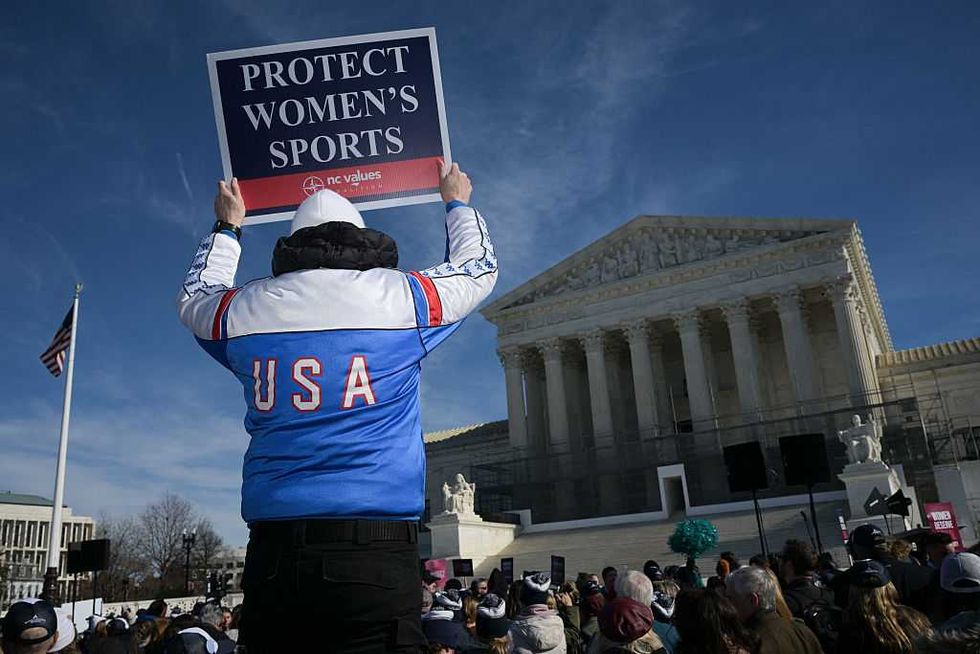
Nobody asked us. Not me, not my teammates, not the 18-year-olds who had just arrived at the University of Pennsylvania and found themselves sharing a locker room with Lia Thomas. Nobody held a vote, nobody sent an email, nobody knocked on the door and said, "Hey, is this OK with you?" They simply instructed us that a man would be joining the women’s swim team and waited for us to get used to it. We never did.Somewhere along the way, it became the job of a bunch of college kids to fix something the adults in the room had broken.Plenty of lawyers and pundits will spend the next several weeks dissecting the Supreme Court's 6-3 ruling in West Virginia v. B.P.J. They will argue about precedent and jurisdiction, but here is what most of them are missing: They were not in that locker room. I was.Eighteen times a week for an entire season, I changed and showered alongside a male athlete. Eighteen times a week, my teammates and I were expected to act like this was normal. Voicing concerns was dubbed hateful, and the policy that created this situation in the first place was not. We had earned our spots on the team, but not one person in a position of authority at Penn, the NCAA, or USA Swimming ever pulled us aside and asked how we were handling the situation. The administration and governing bodies were not interested. The message was quiet but very clear: Your discomfort is not the problem we are trying to solve.When we tried to raise our concerns, the athletic department told us Thomas’ place on the team was nonnegotiable. Staff members offered us psychological services in an attempt to re-educate us into being comfortable undressing in front of a man. Their solution was not to protect us but to “fix” us.Somewhere along the way, it became the job of a bunch of college kids to fix something the adults in the room had broken.That is what I want people to understand when they hear about this ruling: It is not abstract to me. It is not a hypothetical or a talking point. I lived inside the policy the court just ruled states have the right to prohibit.I can tell you from experience that the "compassionate" framing the other side always reaches for has never once held up to reality. RELATED: SCOTUS sides with common sense after boys try to play sports with girls Alex WROBLEWSKI/AFP/Getty ImagesCompassion for whom? Not for the female athletes who trained their entire lives and finished one place lower than they should have. Not for the teenager in California who lost a state track title she had earned. Not for my teammates and me who were expected to smile and say nothing while the people making decisions were only concerned about the feelings of one male athlete. This ruling matters, but it does not automatically fix the issue of the governing bodies and professional organizations that spent the last several years dismantling women's protections one policy at a time. The NCAA still allows athletes to compete on an amended birth certificate in some cases, a solution you’d come up with if you were never really trying to solve the problem and never had to share a locker room with a fully grown man. And worse still, 23 states have no law protecting girls at all.The Protection of Women and Girls in Sports Act has been sitting on Capitol Hill for years. Every member of Congress who let it die in committee now has a Supreme Court majority telling them they had the authority to act and chose not to. It is time to finish the job.I have been waiting for that moment since I was 19.The court got it right. I just wish it had not taken this long for the people in charge to catch up to what I knew firsthand in my locker room.
President Trump has trumpeted his victories and sought workarounds for his losses.
In a decisive ruling Tuesday, the Supreme Court has settled the most consequential legal question for women's sports in a generation — affirming what biology and fairness have always made clear: Women's sports must remain protected spaces for female athletes.The court ruled 9-0 that Title IX — the federal law that ensures equal opportunities for women in education and sports — and 6-3 that the Equal Protection Clause allow states to protect female athletes with sex-based categories in sports.Changing the culture means rejecting the lie that biology is bigotry.The decisions in Little v. Hecox and West Virginia v. B.P.J. mark a watershed. The court recognized that sex is a biological fact, not a feeling, and that it shapes athletic performance in ways no paperwork or policy can undo.Writing for the majority, Justice Brett Kavanaugh held that Title IX "cannot plausibly be interpreted to refer to anything other than biological sex."By upholding the constitutionality of state laws safeguarding sex-based categories in athletics, the court has reinforced the rights of girls and women in the 27 states that have already passed protective legislation. This is a win worth celebrating.No longer will biological males like B.P.J. dominate girls’ shot-put competitions in West Virginia next season. The ruling draws a firm line: Sex is not a feeling, and paperwork and lip gloss cannot rewrite reality.Female athletes deserve fair competition, safe locker rooms, and equal opportunity — the principles Title IX was built to protect and that reflect simple scientific truth. The majority opinion emphasizes immutable biological differences in strength, speed, and physiology and rejects the claim that gender identity can override sex in the context of physical athletics.Yet this victory, meaningful as it is, remains incomplete.In the remaining 23 states — California chief among them — business as usual persists. Biological males can still claim girls’ and women’s titles, taking podium spots from female athletes they outperform.The patchwork nature of this decision means fairness remains geographically contingent. But a girl’s right to compete on a level playing field should not depend on her zip code.We have made progress. President Trump’s 2025 executive order provided critical momentum, functioning with the force of law and prompting the NCAA to reaffirm that women’s categories are for women. The International Olympic Committee has committed to protecting the female category starting with the 2028 Los Angeles Games. Ballot initiatives in blue states like Colorado and Washington this November will let voters decide directly whether girls deserve their own sports. In Maine, fathers have mobilized to put the Protect Girls’ Sports in Maine initiative on the ballot so their daughters can have the same opportunities their mothers did.These developments are encouraging. But the challenges remain formidable.The NWSL and the WNBA still operate without meaningful sex verification. Professional leagues, private events such as the Boston Marathon, and college athletics remain fractured. Birth certificates — the only proof of sex required by the NCAA — can be changed in 44 states. Given the fungible nature of paperwork and other IDs, documents cannot substitute for actual biological testing at the highest levels of sport.Blue states continue to defy federal guidance, treating fairness as optional. Interstate competition creates impossible inconsistencies. A female athlete protected in Tennessee could still face unfair qualification scenarios against out-of-state males if she advances to national competition.How is that fair?The deeper truth is that a Supreme Court ruling can set a legal boundary, but it cannot change the culture by itself. That work falls to all of us — parents, athletes, coaches, journalists, and everyday citizens who refuse to stay silent.RELATED: Democrats can’t escape their trans problem Kirby Lee/Getty ImagesFor too long, institutions have prioritized feelings, optics, and activist pressure over the safety, dignity, and opportunity of girls and women. We saw a version of the same pattern in the gymnastics sex abuse scandals I helped expose decades ago: Adults in power looked the other way while vulnerable athletes paid the price.The Safe Sport Act now exists to protect young athletes from abuse, but the coaching culture has not changed enough, and abuse still occurs. SafeSport faces a four-year backlog of abuse reports.Changing the culture means rejecting the lie that biology is bigotry.It means parents showing up at school board meetings, statehouses, and ballot initiatives with unrelenting clarity. It means athletes — female and male — finding the courage to speak the truth even when it costs them.
The court neither asserted states’ control over elections nor blessed the slow counting of ballots.
President Donald Trump may have built the Supreme Court’s supermajority, but it was the Reagan Revolution that prevailed during the just-completed term.
A spate of rulings from the Supreme Court couldn’t be more of a mandate if they were handed down, gift-wrapped, and sealed with a kiss by God: The mass deportation of illegal aliens is legal and imperative if there’s any hope of saving this country. One ruling declared it within the president’s authority to interpret […]
The Supreme Court gutted one of President Trump's signature policies, rejecting his effort to end birthright citizenship. Jan Crawford has more details.
The Supreme Court justices weighed in on whether states can ban transgender athletes from competing in female school and college sports. Jan Crawford has more.
President Donald Trump lost big at the Supreme Court on Tuesday as a majority of the justices struck down his executive order abolishing birthright citizenship in the United States — but it's possible there's an alternate reality in which he could have won this, the conservative Wall Street Journal editorial board wrote.Specifically, they argued, Trump could have tried a much less sweeping change to America's citizenship system, and gotten a more favorable result out of it."An interesting counterfactual is how the Justices might have come out on a narrower order, if Mr. Trump had tried to end birthright citizenship for transients alone," wrote the board, which has been forecasting Trump's loss on this issue for months. But instead, "he took the advice of those who recommended an expansive constitutional challenge because he thought the issue was a political winner, and his defeat is all the greater for it."With Chief Justice John Roberts issuing an absolute judgment in favor of constitutional protections for birthright citizenship, this is no longer possible without an amendment to the Constitution.A key consequence of the ruling, noted the board, is that "today’s 'Dreamers' will give birth to citizens, rather than a second generation living in limbo" — which is for the better, the board argued. "The ability to assimilate newcomers has always been an American strength, while falling birthrates will soon make that an even greater American advantage."As for the specter of "birth tourism," the board concluded, "If [it's] as big a problem as Mr. Trump says, he can make a sustained case for a constitutional amendment."