Bondi’s Replacement is Important, But Not as Important as Perceived
Source: The Last Refuge · Bias: Far Right
Summary
In a two-week period right after the 2024 election, the most energy expended by the transition team putting a cabinet together was toward Main Justice or the Dept of Justice. As a consequence, those around Lutnick and Wiles spent an incredible amount of time thinking about the Attorney General pick. Following an insider discussion, I […]
The post Bondi’s Replacement is Important, But Not as Important as Perceived appeared first on The Last Refuge.
Bondi’s Replacement is Important, But Not as Important as Perceived
Far Right
In a two-week period right after the 2024 election, the most energy expended by the transition team putting a cabinet together was toward Main Justice or the Dept of Justice. As a consequence, those around Lutnick and Wiles spent an incredible amount of time thinking about the Attorney General pick. Following an insider discussion, I […]
The post Bondi’s Replacement is Important, But Not as Important as Perceived appeared first on The Last Refuge.
European NATO allies have mostly replaced the assets that the US has cut from its rescue plans in case of a war in Europe, Deputy Supreme Allied Commander Europe Sir John Stringer said in an interview.
The Supreme Court’s Tuesday decision on birthright citizenship comes as Americans are split on the question of whether being born in the United States is central to American identity, with stark partisan divides on the issue, according to a recent NBC News poll.
The Federal Reserve, under pressure from President Donald Trump to cut interest rates and bend to his will, just got an important assist from the U.S. Supreme Court.In Trump v. Cook, the justices took up the case involving Trump’s decision to terminate Lisa Cook, a member of the powerful policymaking Board of Governors of the Federal Reserve. On June 29, 2026, Cook and the Fed prevailed. In a 5-4 opinion written by Chief Justice John Roberts, the court upheld a lower court’s decision to keep Cook in her role while her case proceeds on whether she was terminated “for cause.” The high court also held that Trump didn’t meet the due process requirements for dismissing a board governor when he “fired” her via a social media post. Trump claimed Cook had committed mortgage fraud, even though she had not been found guilty of any wrongdoing.As a scholar of employment law, I had expected the court to side with Cook to some degree. But other recent Supreme Court cases have gone the other way, protecting the president’s authority to fire other high-level government officials at will.Same court, different opinionsThe court’s Cook decision and its constraints on presidential power stand in contrast to its rulings regarding other federal agencies. On the same day, the conservative majority sided with Trump when it ruled in Trump v. Slaughter that a “for cause” provision limiting his right to fire the head of the Federal Trade Commission was unconstitutional. In earlier rulings, the court similarly affirmed a president’s right to fire leadership at the National Labor Relations Board and the Consumer Financial Protection Bureau.As I’ve previously written, it’s important to remember that a vast majority of U.S. workers are employed at will, which means they can be fired for any reason and terminated from their jobs with no advance notice. By contrast, Cook’s position is covered by the Federal Reserve Act, which states that board members are appointed by the president to 14-year terms. They can be terminated by the president, but only for cause.The same was true, however, at the Federal Trade Commission, where agency heads can be terminated only for cause. But in the Slaughter case, the conservative majority deemed the cause provision unconstitutional. In Cook’s case, the government didn’t try to argue that the “cause” provision was unconstitutional. It waived that argument early on in the case. However, in upholding the lower court ruling in Cook, the court more or less assumed that the cause provision in the Federal Reserve Act is valid.How to make sense of this contradiction?As Justice Amy Coney Barrett noted in a dissenting opinion, the majority opinion in Cook was “in serious tension” with Slaughter. She also criticized the majority opinion for addressing “a constitutional issue” that was “outside the scope of this case.” Justice Sonia Sotomayor made a similar point in her dissent in Trump v. Slaughter, characterizing the majority’s treatment of the Fed as an “ad hoc … exception” to the court’s “totalizing” and “half-baked” interpretation of presidential power. Sotomayor noted that Slaughter creates “line-drawing” problems that were previously absent under long-standing precedent protecting FTC agency heads from dismissal.When facts matter as much as the lawIt’s difficult to reconcile the two cases based on legal reasoning alone. That doesn’t necessarily make the outcome wrong. But it does suggest it’s important to consider other factors at play – namely, what’s happening out in the real world, beyond the courthouse. This interpretation of the law is known as “legal realism.” Legal realism dates back to the 1930s, based on the commonsense critique that predictions about the law require some incorporation of the facts rather than purely abstract notions of legal rights. Legal realism extends beyond the idea that a judge’s political ideology might influence outcomes, which is today a common basis for pundits to explain court decisions. Instead, legal realism acknowledges that facts on the ground sometimes matter more than the law.Legal realism is useful here because there’s one overriding fact that makes Cook’s case distinct from the others involving presidential power over federal agencies. Simply put, the Fed is special. It preserves price stability and safeguards the economy as a whole over the long term by rescuing it in bad times and preventing it from overheating in good times. Former Fed Chair Jerome Powell described it as a “first responder in times of financial crisis.”But to do its job well, the Fed needs to be insulated from outside political forces. That’s why Wall Street and global markets more broadly were watching the decision closely. The Fed’s unique roleIn Cook, both the majority and concurring opinions frequently referred to the Fed’s vital role in the modern economy.
President Trump on Monday slammed the Supreme Court ruling allowing states to count mail-in ballots received after Election Day, arguing it is now even more important for Congress to pass the Safeguard American Voter Eligibility (SAVE America) Act. The Supreme Court upheld a Mississippi law that allows mail-in ballots sent by Election Day to be…
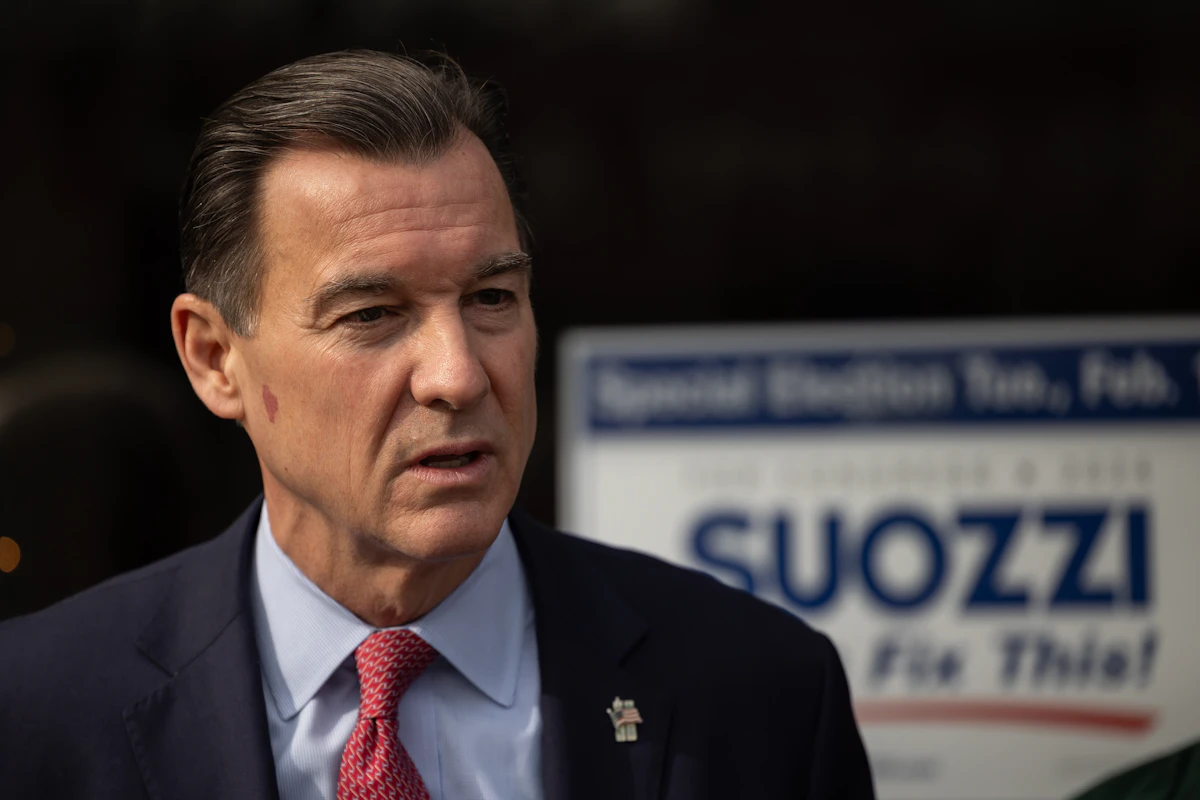
So Democratic Congressman Tom Suozzi of Long Island has come out swinging against the socialists. “We are capitalist, not socialist,” reads a letter that The New York Times reports he and 14 other legislators signed and began circulating last week. This went out Thursday, two days after three self-described democratic socialists backed by New York Mayor Zohran Mamdani won Democratic congressional primaries in the city.The letter, which is on the short and vague side, states two broad principles to which the signatories adhere. The first is “growth, competition, and broad prosperity.” “Growth” and “prosperity” are time-honored centrist buzzwords, as they’re hoisted into use to send the message that these Democrats value economic dynamism more than “fairness,” which is a word that moderates fear signals endorsement of excessive statism, although interestingly, the concept is tucked into the first sentence (“We believe in a growing, fair, and competitive economy…”). The second is “safety, security, and human dignity,” under which the letter lists four components: fiscal discipline, a government that works, free speech, and patriotism.There’s nothing wrong with these things as far as they go. But these platitudes don’t go far enough. In particular, there’s one big missing word. I’ll circle back to that, but first, let’s talk about why these democratic socialists are winning in some places. The first reason is that people are really pissed off at a system they see as totally rigged. Suozzi is roughly my age. He and I grew up in a United States in the 1960s and ’70s that Lord knows had many problems, but that was at least trying to build a robust middle class and was taxing excessive wealth appropriately.The Gini coefficient is a number that measures economic inequality. Like golf, lower scores are better, and the lowest Gini scores, invariably logged by the Scandinavian countries, are in the mid-20s. The highest is always South Africa, in the low-60s.When Suozzi and I were toddlers, the U.S. number was fairly high—around 37. Then came the Great Society—the civil rights, fair housing, and other anti-discrimination laws that first brought large numbers of Black families into the middle class, and other anti-poverty programs. The right has sold middle America on the idea that the Great Society—which I’d hope most Democrats today are proud of, but much of which was, as the word is used today, “socialism”—was a failure. But by the 1980s, right before Ronald Reagan took office, the U.S. Gini number reached its lowest point in modern history, 34.7.Then came Reagan and supply-side economics and the war on the War on Poverty. By the time Bill Clinton took office, the number was north of 40. Today it’s 42 and climbing. We’re worse than Russia and Iraq and about on par with Argentina and Mexico.People aren’t stupid. They may not know what the Gini coefficient is or who Gini was (an Italian economist), but they know what’s been happening to the country and their money in their bones. And they know how they’re being ripped off by corporate actors, as these hidden junk fees become more and more just a fact of life, especially for working-class people paying rent to private-equity landlords or trying to take their kids to a ball game. So, it’s small wonder that more people are voting for the candidates who are saying most emphatically that they’re going to try to do something about all that—specifically, fighting back against the people who’ve been cheating the middle- and lower-classes for years. The second reason socialists are winning elections is that the Democratic base has moved well to the left of where it was even just 10 years ago. Early this year, The New Republic commissioned a poll of 2,400 rank-and-file Democrats. We asked respondents to identify themselves ideologically, giving them five choices: conservative, moderate, moderate-to-liberal, liberal, and progressive. There were little descriptions of each, so it should have been clear to all that “progressive” was the left-most choice.I thought “progressive” was going to finish third. It finished first (within the margin of error): Progressive got 32 percent, liberal 31, and moderate-to-liberal 21. Moderate was way back at 12 percent. Back in the Obama days, moderates were around 35 percent of the party. Indeed, liberal overtook moderate as the top Democratic category only around 2012, according to Pew. So that’s a huge change. Now it’s true that other polls, which unlike TNR’s didn’t offer five categories, show a higher moderate share, but the overall move leftward by Democratic base voters is undeniable. They haven’t done so because they want the government to take over the means of production.
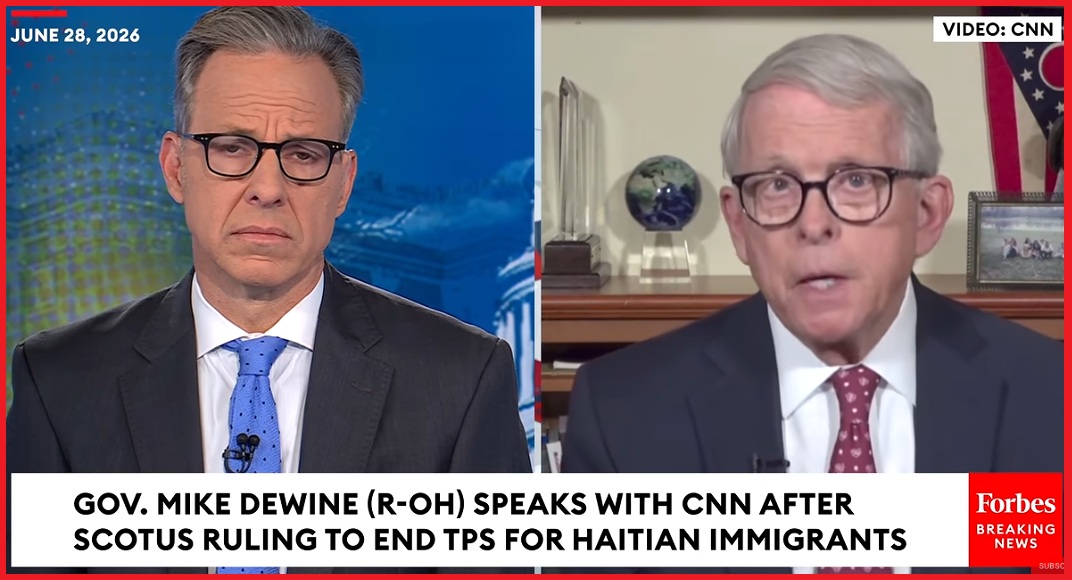
There’s a lot of interesting mask-dropping in this interview. Jake Tapper outlines his view on illegal alien migrants from Haiti by admitting he put his Mom in a nursing home and pays Haitian migrants to care for her. On a 1998 trip to Cite Soleil, a slum of Port-au-Prince, Mike and Fran DeWine met Tom Hagan, […]
The post Ohio Governor with Deep Personal Ties to “Shithole Country”, Says It’s More Important to Protect Haitians Than Americans appeared first on The Last Refuge.