Spirit Airlines’ death is entirely on the Biden administration — and specifically faux-populism
Source: New York Post · Bias: Right
Summary
Saturday’s Spirit Airlines shutdown is entirely on the Biden administration — and more specifically, on the faux-populism of its Federal Trade Commission chief, Lina Khan. On top of all the travelers left scrambling, 17,000 Americans just lost their jobs, while future travelers will have one less choice and the rest of the industry faces reduced...
Spirit Airlines’ death is entirely on the Biden administration — and specifically faux-populism
Right
Saturday’s Spirit Airlines shutdown is entirely on the Biden administration — and more specifically, on the faux-populism of its Federal Trade Commission chief, Lina Khan. On top of all the travelers left scrambling, 17,000 Americans just lost their jobs, while future travelers will have one less choice and the rest of the industry faces reduced...
The country's theocracy hopes to see millions flood the streets of the capital beginning Saturday in scenes reminiscent to the burial of the late Supreme Leader Ayatollah Ruhollah Khomeini in 1989.
In a 6-3 decision breaking on partisan lines, the Supreme Court ruled in Trump v. Slaughter that Trump can fire Federal Trade Commissioners and other federal agency directors without cause. The ruling overturns longstanding Supreme Court precedent and express statutory instruction that combined to protect the political independence and subject matter expertise of federal agencies for over 90 years.The ruling presents a novel reading of a president’s Constitutional duty to “take care that the laws be faithfully executed,” expanding that power for a rogue president hellbent on breaking laws instead of executing them. As Justice Sotomayor put it, “The Court… is elevating (Trump) above his once-coequal branches by transforming a duty to take care that the laws be faithfully executed into a license to act in defiance of those very laws.”An activist Roberts Court has now written into existence an all-powerful unitary executive despite elaborate instructions in art. I, II and III to keep the three branches of government separate and equal. Rejecting federal laws that restrict a president’s removal of agency directors to for-cause removal, SCOTUS has made the president all powerful and Congress less relevant, while arrogating scientific and technical questions to itself.Trump’s corporate donors can now choose their own regulatorsBefore republicans on the bench rewrote it this week, the Federal Trade Commission Act stated that a President could only remove a commissioner for “inefficiency, neglect of duty, or malfeasance in office.” That statute clearly and intentionally barred presidents from firing directors for partisan or corrupt reasons, and from punishing regulators who rule against a president’s corporate donor(s). Vesting a singularly authoritarian executive with unprecedented, expansive powers, the Supreme Court re-wrote federal laws to advance their own political narrative.Over two dozen federal agencies will be affected, covering everything from the financial markets, the commodities markets, and nuclear power. Agencies like the Federal Trade Commission, Federal Communications Commission, and the Securities and Exchange Commission were all Congressionally designed to be independent watchdogs, enforcers insulated from partisan whims. Now Trump can remove any commissioners who threaten to rule against his allies, assuring that his political supporters will be afforded preferential review, licensing, merger approvals and other rulings.With Trump’s new latitude to fire any agency head who threatens meaningful regulation, his corporate donors have been effectively empowered to choose their own regulators. Federal laws passed to protect human health, finance, banking, communications, workplace safety, and clean air, soil and water have been rendered functionally meaningless.Replacing science, expertise and merit with political fealtyCongressionally created and funded federal agencies serve express, statutory purposes written to safeguard the American public. The Supreme Court had protected agency autonomy and expertise dating back to 1935, ruling that some degree of autonomy was necessary for federal agencies to meet specific scientific, economic, communications, trade, health, and environmental mandates. Federal agencies were never meant to be a president’s personal toys with which to reward donors and cronies.For a president in the habit of accepting lavish gifts and cash from foreign governments, along with hundreds of millions from domestic supplicants, finding even more room for self-dealing, corruption and political favoritism must be heady. For the rest of us, it’s dangerous. We actually need competent people to run the federal government, even in its post-DOGE watered down state.If Trump declares that every home must be heated by dirty coal, the head of the Energy Commission must try to effectuate that command no matter the harm to Americans’ lungs. If Trump declares that particulate matter, fossil fuels and the widespread use of Monsanto is good for the environment, any EPA director who contradicts him with cancer and death statistics will be silenced through removal. It’s governance by full Idiocracy.A know-nothing, anti-science president can now follow his gutTo every American outside the Fox News propaganda bubble, Trump has demonstrated astonishing incompetence on all fronts. From economically illiterate tariffs to our defeat in Iran, sprinkled with comically disastrous results in between, an ignorant and arrogant “I follow my gut” Trump revels in rejecting science and expertise as Americans pay the price.The only thing saving the nation from complete chaos and disaster to date is that several federal agencies had retained some level institutional competence despite Trump (and Musk’s) best efforts to dismantle them.
The Gateway Pundit reported that Joe Biden, during a speech to Maryland Democrats at their pathetic ‘Fight Back & Win Summit and Gala,' trashed President Trump for cleaning and renovating the Lincoln Reflecting Pool.
The post Adam Carolla Destroys Joe Biden for Attacking Trump Over Reflecting Pool (Video) appeared first on The Gateway Pundit.
The Air Force has confirmed a trainee died as a result of a flu outbreak at Lackland Air Force Base in San Antonio, according to Rep. Joaquin Castro (D-Texas). Keon McDaniel was in his sixth week of basic military training when he experienced a “medical emergency” June 12. He was taken to Brooke Army Medical Center and died there on June…
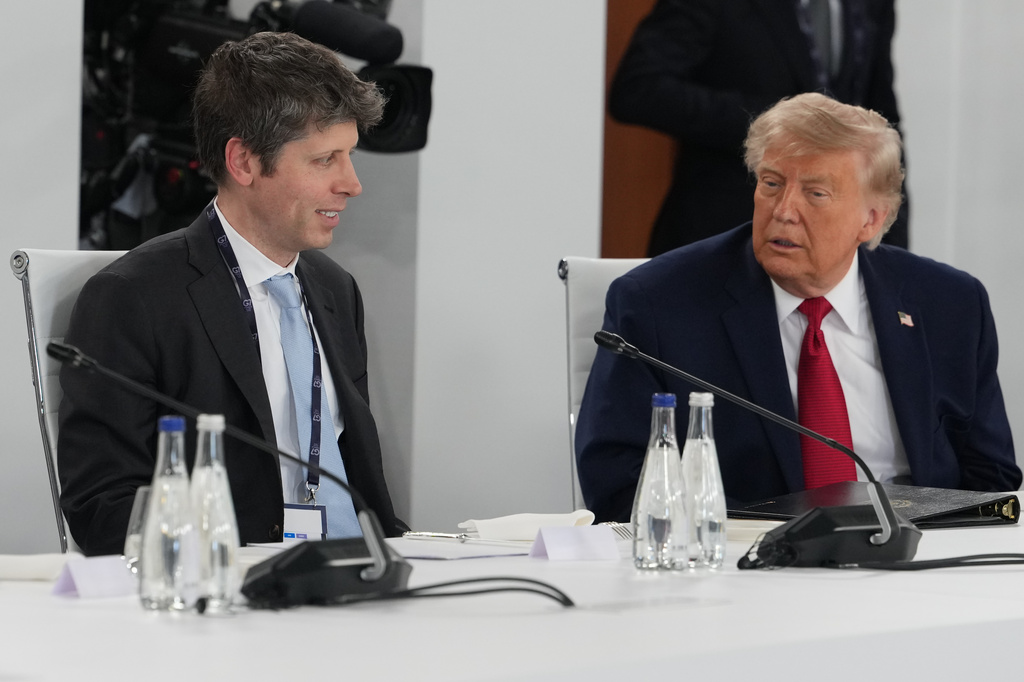
OpenAI may give the U.S. government a 5% stake in the company, per the Financial Times. The proposal is in very preliminary conversations, according to a person familiar with the matter.Why it matters: If the overture is taken up by the Trump administration, that would mean the government would have a vested interest in weighing whether or not to limit the release of an OpenAI model. Catch up quick: OpenAI views the potential government stake as a way to give the general public a share of the upside of AI, and CEO Sam Altman has previously shared with Axios his interest in some sort of public wealth fund.The goal is to include other AI labs giving over a similar stake.This could look like including shares in Trump accounts or some other vehicle that would give American households exposure to investments in AI, for example. Anthropic supported similar policies in a recent paper, arguing for "universal pre-distributive capital accounts" with "priority given" to those with jobs exposed to AI disruption. Zoom out: The potential investment comes as the White House is still deciding when OpenAI can release its most powerful models widely, through a regulatory process that Altman has said isn't quite "optimal." Altman proposed on Wednesday a U.S.-led international forum to establish AI regulatory standards, which could be a way to allow the government to invest without having as heavy a hand in regulation.Between the lines: Investors tell Axios that the idea of giving a stake reads like a PR stunt aimed at making it seem as if the public could benefit from the AI boom just as the technology threatens their jobs.Yes, but: The government's 9.9% stake in Intel, taken last August, appears to have paid off.Its shares are up nearly 400% since then, although it has also come amid a broad rally for chip stocks. Friction point: The Intel stake was acquired under the CHIPS Act. A deal with the AI labs would likely require an act of Congress.It's also unclear what a government stake would accomplish, other than giving the AI labs a closer relationship to what is currently one of their biggest hurdles: the government. An investor in Anthropic and OpenAI tells Axios that the proposal reads more like a "political move" to gain favor with the administration than something that would actually create a shared benefit for the American public. What they're saying: A government stake would be a "troubling milestone" that hurts competition between the labs, " David Sherman, AI and financial inclusion strategist at io.net, a decentralized cloud network, said via email.It "gives one AI company a government stamp of approval whilst millions of developers, researchers and businesses are locked out by skyrocketing token prices and endless GPU queues," he added, referencing the challenge in accessing AI at current costs or chips at current supply levels.It comes amid broader concern about whether the government is already curbing the competitive edge of U.S. AI labs compared with China by putting guardrails around model release timelines.And if the goal is to share the financial benefits of AI, there are other ways to do that. Some have suggested that AI companies share a percent of pre-tax income or that the government impose a tax on all tokens. Kevin Bankston, an AI governance advisor, wrote "JUST. TAX. THEM." on X.Bill Gates proposed an automated robot tax in 2017 that could slow down automation, suggesting they should be taxed the same way human employees pay income tax. The bottom line: "The labs develop the technology, but citizens and their elected representatives must make the rules," Altman wrote in the Financial Times earlier this week.