


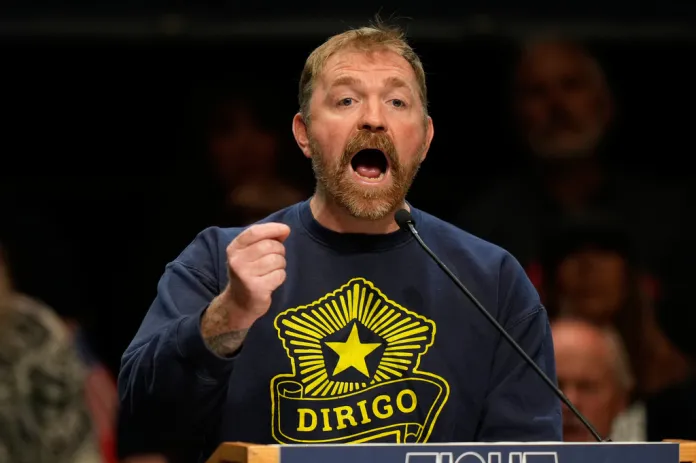
Opinion | Democrats and the Platner Standard
The Maine Democrat is the left’s equivalent of Republican Ken Paxton.

The hits keep coming for Graham Platner, the front-runner for the Democratic nomination in the race for one of Maine's U.S. Senate seats.On Monday the women of "The View" trashed Platner's campaign and said he has no business being anywhere near Congress after grappling with so many scandals.'You’ve shown me who you are, and I heard you. This man should be nowhere near Congress.'The most recent revelation that Platner, who is married, sent sexually explicit messages to at least half a dozen women in recent years is just the latest sting for his campaign."On the heels of apologizing for a tattoo associated with Nazis, the offensive posts about a wounded U.S. soldier. Now his wife, Amy Gertner, is responding to reports that she gave his campaign a heads-up about her husband sending sexually explicit texts to several different women," said Whoopi Goldberg."Horrible. There is no doubt that this guy, Platner, is flawed, flawed, flawed in many ways," added Ana Navarro. "It is disturbing, and it is horrible. And why can't we do better? Why can't we have better candidates?""This guy just seems like a guy of not very good character," said former Trump staffer Alyssa Farah Griffin. "Don't die on the hill of a guy who's going to be a headache for you for years to come."Sara Haines took special offense to Platner previously saying a U.S. soldier should have died on the battlefield."If you are capable of saying that at any time in your life, you’ve shown me who you are, and I heard you. This man should be nowhere near Congress. We’ve already got a wealth of people we need out. We’re not sending one like this in.""So he's a cheater," added Sunny Hostin. "He's an anti-Semite — because the fact that he had that tattoo for 20 years and didn't know what it was is a lie. So he's a liar, a racist, an anti-Semite; he's a homophobe. So he's all the things. And character does matter."Hostin also did not accept Platner's excuse that his racist comments were caused by post-traumatic stress disorder from his experiences in combat as a Marine."I know a lot of soldiers that have PTSD that aren't racist," she said.However, despite all of the problems they cited with Platner, Hostin went on to say they needed the victory in Maine to take control of the Senate away from Republicans. The Republican Party in Maine posted clips of the most critical comments in a video that was widely circulated on social media. RELATED: Trans-identifying 15-year-old plotted to kill classmate in order to resurrect Newtown shooter In response to the sexting scandal, Platner's wife put out a video calling the story "gossip" and trying to downplay it. Many described her video as uncomfortable to watch.Platner is presumed to be the Democratic nominee to run against incumbent Republican Sen. Susan Collins, who has been criticized by many in her own party for being moderate and centrist. Platner's main Democratic rival, Gov. Janet Mills, suspended her campaign in late April.Like Blaze News? Bypass the censors, sign up for our newsletters, and get stories like this direct to your inbox. Sign up here!
The Maine Democrat is the left’s equivalent of Republican Ken Paxton.
Nithya Raman had 115 days to make her case to Los Angeles voters.
In 2018, David Tyson Jr., an African American, sued Richardson Independent School District in Texas for violating Section 2 of the Voting Rights Act. In the district’s 164-year history, Tyson was the only person of color ever to serve on the school board. Yet, at the time of the lawsuit, white students made up less than 30 percent of the district while Black and Hispanic students made up nearly 60 percent.When Congress enacted the Voting Rights Act at the height of the Civil Rights Movement, it gave communities the tools to combat these kinds of racial harms. Section 2 of the act outlaws state and local governments from enacting voting rules that result in racial discrimination. One of the undersung aspects of the Supreme Court’s recent decision in Louisiana v. Callais—for which there has been much hue and cry over the way it’s paved the path for right-wing state governments to draw majority-minority federal districts out of existence—is that it cuts away at this protection for local governments, as well, rendering it “all but a dead letter,” as Justice Kagan laments in her dissent.While the media has focused on Callais’s impact on Congress in the 2026 midterms, its darkest mark will be on local governments. Section 2 of the Voting Rights Act has been most frequently applied to address and remedy local electoral practices, not state ones. Its use heralded diverse school boards and city councils where national minorities, by virtue of being local majorities, can govern.Through this phenomenon, diversity develops twice over. First, through representational diversity and second, through institutional diversity. Minorities can see themselves represented on school boards, county commissions, and city councils. And they can harness that representation to institute local governments that do not look like state or national government. These more representative governments are more likely to become local laboratories willing to conduct policy experiments or try alternative governance approaches that the broader polity dismisses or ignores. This is why diversity at the level of individuals and institutions cultivates a rich democracy. Callais endangers these sites of local democracy by hollowing out Section 2 protections.But back in 2018 when Tyson filed his lawsuit, Section 2 of the Voting Rights Act was still intact. We can look back in time to see its salutary effects. Tyson told a “tale of two districts,” where—unsurprisingly—a ceaselessly homogeneous school board had harmful consequences for the Richardson school district. Elementary schools where at least 70 percent of the students met grade level in two or more subjects were two-thirds white—and the vast majority were not economically disadvantaged. By contrast, the lowest-performing elementary schools were predominantly made up of Black, Latino, and economically disadvantaged students. Atop the startling peak of disparity was the 60-point achievement gap between the district’s highest-performing school, which was predominantly white, and its lowest-performing school, which was predominantly Latino.These racial inequities did not go unnoticed by the Black and Latino voters of Richardson. And yet, Richardson’s school board remained persistently white for one reason: the district’s voting practices. While white students constituted a minority in the district’s schools, white voters still comprised a majority of the district’s population. These demographics, combined with an at-large, district-wide voting scheme where every voter in the district voted in every school board election, meant that minority voters would never succeed in electing a candidate of their choice. The minority vote would always be diluted against the white vote. The school board—whether under the threat of ongoing litigation or by a genuine change of heart—agreed to end this pernicious status quo. In 2019, Richardson Independent School District settled. As part of the settlement, the district moved toward a single-member district voting model. Specifically, it instituted an electoral scheme that allows voters within a predefined border to elect a board member to represent them—similar to congressional districting. Two of the five single-member districts in Richardson were drawn to ensure that Black and Latino voters were the majority. Voters from these districts later elected Regina Harris, the first Black woman, and Debbie Rentería, the first Hispanic person, to serve on the school board.Richardson was not alone in making this kind of change. In response to immigration and changing racial demographics, the late 2010s saw a spate of lawsuits across school boards in North Texas alleging violations of Section 2 of the Voting Rights Act. Many of these districts settled and moved to electoral systems that gave voters of color greater voice in their representation.
Rep. James Walkinshaw (D-Va.), a member of the House Oversight Committee, joins Meet the Press NOW to discuss what he heard from Microsoft co-founder Bill Gates during a congressional hearing over his relationship with sex offender Jeffrey Epstein.
For a week I've watched the commentators and the party line up to tell me Graham Platner is too compromised for the United States Senate. Last night the Democrats of Maine answered them. He's on track to win his primary with about 72 percent of the vote, carrying nearly every county in the state. This is not the outcome of a candidate distrusted by the voters, it's in fact the opposite. It's a landslide.
The CEO and president of the Democratic fundraising portal ActBlue repeatedly invoked her Fifth Amendment right against self-incrimination in order to avoid answering tough questions about foreign donations.At a Committee on House Administration hearing on Wednesday, Regina Wallace-Jones was challenged on whether previous statements she made to Congress were "false and misleading," but she refused to answer and cited her constitutional right.He went on to ask why ActBlue weakened fraud prevention standards twice in 2024, and Wallace refused to confirm whether that happened.Republican Rep. Bryan Steil of Wisconsin posted his questioning of Wallace-Jones where he specifically asked about the statements that he said were "false and misleading." He focused on a letter she sent to Congress about the steps ActBlue took to prevent illegal foreign donations."Ms. Wallace-Jones, when you signed this letter to me, did you believe that this letter was false and misleading?" Steil asked."On the advice of my counsel, I respectfully decline to answer this question pursuant to my Fifth Amendment rights under the Constitution," she responded."Your letter claimed that passport information is required from donors providing an address outside the United States," Steil continued. "In November 2023 when you wrote that letter, did every ActBlue donation that provided an address outside the United States require passport information?""On the advice of counsel, I respectfully decline to answer the question pursuant to my Fifth Amendment rights under the Constitution," she replied.Steil then cited previous testimony where Wallace-Jones stated that ActBlue contacts donors to request passport information if the contribution seems to have originated from a foreign address. And if they cannot contact that person, she claimed they would return the donation."Is that correct?" he asked.She invoked her Fifth Amendment right again.He went on to ask why ActBlue weakened fraud prevention standards twice in 2024, and Wallace-Jones refused to confirm whether that happened.Steil posted video of his questioning of Wallace-Jones to social media.RELATED: ActBlue sues to block Ken Paxton lawsuit — and he fires back defiant response Wallace-Jones had written a statement published in the Washington Post explaining why she would invoke the Fifth Amendment."This is a proceeding designed to build an illegitimate criminal case against us. I cannot and will not let my words be misused in that way," she claimed.The official account for ActBlue also released a statement about the testimony."The House Administration Committee has called our President and CEO, Regina Wallace-Jones, to testify," the statement reads. "Not because ActBlue has done anything wrong, but because we are the backbone of small-dollar Democratic fundraising in America."Wallace-Jones isn't the only ActBlue official who refused to answer tough questions. In April 2026, two ActBlue employees cited the privilege against self-incrimination a stunning 146 times while testifying about alleged donor fraud."Not a single employee offered testimony that could help ensure that American elections are free, fair, and decided by Americans alone," reads a staff report from the House Administration, Oversight, and Judiciary committees.Like Blaze News? Bypass the censors, sign up for our newsletters, and get stories like this direct to your inbox. Sign up here!
"There are allegations from former girlfriends that are not — the way my colleagues reported them were not like classic abuse allegations,” Jodi Kantor said.
The NRSC warns Republicans that scandal-plagued Democrat Graham Platner remains a credible threat to Sen. Susan Collins in Maine's pivotal Senate race.