The U.S. men's national team chose to play a pair of highly-ranked, super competitive teams in the final lead-up to the World Cup: Senegal and Germany. The matches showed the U.S. is ready.
Unions are running LA into the ground. Of course workers have the right to organize, and to protect their members from poor conditions and bad management. But right now, they are choking LA. The Hollywood strikes that caused the studios to move production. The teachers’ union that keeps our schools in a dismal state. The...
The Trump administration is dismantling a $368 million deep-ocean monitoring network at the precise moment scientists say the world's oceans are behaving in alarming ways — and a Democratic congressman says the timing is not a coincidence.Rep. Mike Levin, a California Democrat and environmental attorney who represents San Diego's North County coast, posted a scathing response Saturday to CNN's reporting on the decision, arguing the move serves a hidden agenda."The same people killing the monitors want to mine the deep sea for minerals," Levin wrote. "So they are destroying the only tools that could measure what that mining does. That is not an accident. That is the point. You cannot see the damage if you break the instruments first."The system being dismantled is the Ocean Observatories Initiative, a network of more than 900 instruments positioned throughout the world's oceans that launched in 2016 with an expected 25-year lifespan. It provides continuous real-time data on ocean temperatures, carbon absorption, circulation patterns, and coastal flooding risks. The Trump administration's fiscal 2026 budget cut its funding by 80 percent, and removal of the anchored instruments began this month from sites off Oregon, North Carolina, and the Irminger Sea near Greenland.Scientists say the timing could not be worse. Ocean temperatures are breaking records. The Atlantic Meridional Overturning Circulation — the system of currents that regulates climate across the Northern Hemisphere — is showing signs of potential collapse, a scenario researchers warn could bring severe winters to Europe and accelerating sea level rise on the U.S. East Coast.The administration described the decision as a "nimbler approach" and "smart lifecycle management." Levin was unimpressed. "That is fancy nonsense for 'we shut it off and hoped nobody would ask why,'" he wrote. "There is no return-on-investment analysis. They cannot show taxpayers save a dime, because the gear is already paid for and the science it produces protects real money and real lives."His bottom line: "That is not budgeting. That is smashing the gauges while the engine is on fire and calling it efficiency."
Most of the stadiums for this year’s FIFA World Cup have achieved green building status after a push for certification in the run-up to the tournament. As the tournament opens, 13 of the 16 stadiums have earned LEED certification, the world’s most widely used green building rating system, the U.S. Green Building Council said. Ten…
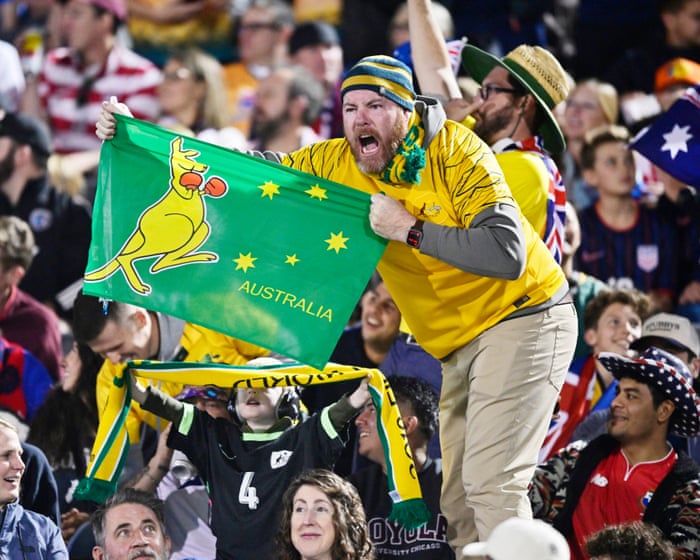
The Socceroos playing on football’s biggest stage in my adopted country would normally have me racing to book tickets. Not this year Is “USA! USA! USA!” a more fundamentally obnoxious chant than “Aussie! Aussie! Aussie! Oi! Oi! Oi!”? As an Australian who has spent most of the last 15 years living in the United States and is now a permanent resident, the Socceroos’ World Cup group match against the USA raises some questions. Has my adopted nation dethroned my homeland as the world’s foremost exponent of being unconscionably terrible to immigrants? And on a more personal level … who do I support here?Well, look, OK, there’s really only one answer to that second question. I’m not an especially patriotic type, but if anything does bring out my Australian-ness, it’s the World Cup – perhaps because it’s one of the few events at which we can still claim to be underdogs. And now, two decades after I rose at dawn to watch Australia’s dreams dashed by the intersection of Lucas Neill’s leg and Fabio Grosso’s general vicinity, I find myself living in a country hosting the tournament. Continue reading...
The 2026 World Cup promises to be the planet’s most-watched sporting event. It’s also poised to generate its fair share of controversy.Taking into account the history of corruption in FIFA, the sport’s governing body, it would be hard to blame anyone who decided to ignore this year’s competition.However, some viewers of this summer’s tournament may face an additional dilemma. Political tensions are high in the U.S., where most of the tournament’s matches will be played. The Trump administration is historically unpopular, and its critics are already concerned about sportswashing: when governments use the spectacle of athletic competition to burnish their image and distract the public.As I point out in my 2022 book, “The Ethics of Sports Fandom,” fans who are critical of their country’s behavior sometimes feel ambivalent about rooting for their national sports teams – and may even feel compelled to root against them. After all, it’s one thing to pull for your national team when patriotism feels uncomplicated. It’s quite another when you aren’t feeling very proud to be an American. The Cold War made it easy for many Americans to rally behind the 1980 U.S men’s hockey team in its victory over the Soviet Union in the “Miracle on Ice.” But what do you do when you don’t see your country as the “good guys”?Patriotism doesn’t mean blind loyaltySome fans might double down on their patriotic commitments during the tournament. They’ll use the occasion to champion America in all things, whether it’s the country’s battles in the Middle East or its national team taking on Paraguay at SoFi Stadium in Los Angeles. Sports have a way of fueling nationalistic passions, and I fully expect plenty of people who don’t care much about soccer to channel their patriotic sentiments into the tournament.However, rooting for your country’s national soccer team doesn’t mean that you endorse everything your country does, any more than wanting a friend to get a promotion at work requires you to support all of their behavior. As the philosopher Eamonn Callan has argued, a proper love of country requires citizens to be clear-eyed about its faults. The true patriot highlights problems and works to correct them, independent of how much they want the national team to win their next match.By the same token, I think a deep love of country can coexist with ambivalent feelings about how the national team performs on the field. If patriots can disapprove of their country’s military adventurism – either because they see it as flatly unjust or because it casts their country in an unfavorable light on the international stage – there is nothing fundamentally unpatriotic about not wanting the U.S. to do well in the World Cup. Other fans might invoke the mantra that it’s important to simply keep politics out of sports – that the games should be a refuge from the controversies that plague so many other aspects of civic life.But as I argue in my book, fully separating politics and sports is almost impossible. It requires fans to view athletes as nothing more than bodies who exist to perform on the field. It means team executives and owners do little more than sign paychecks. And it ignores the reality that sports are woven into the social, economic and political life of communities.Outcomes don’t change a thingFor fans who choose to watch, then, my suggestion is to view the action on the field as you would any other sporting event. Root for whomever you want to win, for more or less any reason that moves you. Because for all the political significance attached to the World Cup, the winner or loser of any given contest has essentially no broader political significance. The problems that existed before the tournament will still demand attention when it is over, no matter who happens to win. Success or failure on the pitch isn’t likely to bring about meaningful political change. After all, whether a government has the right legislative agenda or approach to foreign policy is totally divorced from its national soccer team’s ability to score goals.Viewed in this way, rooting for your country’s national soccer team doesn’t imply blind loyalty to your country or ignorance of its flaws. It simply means that you want the athletes who represent your country to win the game they are playing on that particular day.Athletes have long been able to navigate this ambivalence. You’ll regularly hear them trying to separate a love of their country and its people from support of problematic regimes. When Iranian soccer player Mehdi Taremi refused to celebrate a goal in a January 2026 Greek Super League match, he embraced precisely such a position. Thousands of people had been killed during protests of the Iranian regime, and the moment called for a different reaction.“There are problems between the people and the government,” he said.