An Australian in the US: national identity is one thing, but it’s hard to cheer for either World Cup team | Tom Hawking
Center Left
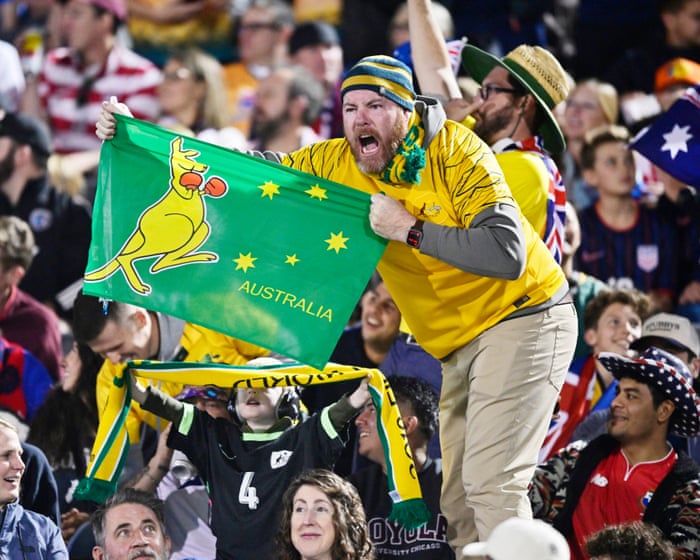
The Socceroos playing on football’s biggest stage in my adopted country would normally have me racing to book tickets. Not this year Is “USA! USA! USA!” a more fundamentally obnoxious chant than “Aussie! Aussie! Aussie! Oi! Oi! Oi!”? As an Australian who has spent most of the last 15 years living in the United States and is now a permanent resident, the Socceroos’ World Cup group match against the USA raises some questions. Has my adopted nation dethroned my homeland as the world’s foremost exponent of being unconscionably terrible to immigrants? And on a more personal level … who do I support here?Well, look, OK, there’s really only one answer to that second question. I’m not an especially patriotic type, but if anything does bring out my Australian-ness, it’s the World Cup – perhaps because it’s one of the few events at which we can still claim to be underdogs. And now, two decades after I rose at dawn to watch Australia’s dreams dashed by the intersection of Lucas Neill’s leg and Fabio Grosso’s general vicinity, I find myself living in a country hosting the tournament. Continue reading...
The United States was issued a dire threat Sunday after a wave of Israeli airstrikes pounded Lebanon’s largest city earlier the same morning with supposed backing from the Trump administration, threats that may materialize as major attacks on U.S. bases and assets in the Middle East.As Washington and Tehran continue to negotiate terms to end the ongoing Iran war, a key sticking point has been Israel’s bombardment of Lebanon, which since early March has killed more than 3,400 Lebanese and injured over 10,200. Iran has demanded that Israel halt its bombardment as a condition to end hostilities.And yet, despite multiple attempts by Trump to force Israel’s hand and end its bombardment of its northern neighbor, Israel has defied the president, and has since expanded its military siege of Lebanon, including with the reported use of white phosphorus bombs, which is a potential war crime.“The naval blockade against the Iranian nation and today's U.S. green light to the Zionist regime turn American and regime bases and assets in the region into legitimate targets,” said Iranian Parliament Speaker Mohammad-Bagher Ghalibaf on Sunday, according to Axios reporter Barak Ravid. “Our armed forces are ready as always.”Last week, Trump admitted to hurling expletives at Israeli Prime Minister Benjamin Netanyahu in a phone call over Israel’s refusal to halt its bombardment of Lebanon, telling The New York Post he was “a little bit perturbed” at Israel’s defiance.🚨Iranian speaker of parliament and chief negotiator Ghalibaf: "The naval blockade against the Iranian nation and today's U.S. green light to the Zionist regime turn American and regime bases and assets in the region into legitimate targets. Our armed forces are ready as always" https://t.co/ObwY6kTc0U— Barak Ravid (@BarakRavid) June 7, 2026
President Donald Trump, as a Republican, should theoretically support fiscal conservatism. Yet according to a report by a financial journalist, under Trump America’s national debt and deficit are ballooning to dangerous levels.“The price that the U.S. government has to pay to borrow money for 30 years has already punched through 5 percent a year, its highest level since the financial crisis of 2007,” reported The Washington Post's Matthew Lynn on Sunday. “For 10-year money, the annual price is 4.6 percent and climbing. Amid all the noise about the rise of artificial intelligence and the booming space economy, something far more significant is happening in the financial markets. The cost of borrowing is being reset.”Lynn added that this raises the possibility that American voters will care enough about deficit reduction that it can become a politically viable issue again.“The U.S. national debt has reached $39 trillion, with interest payments now exceeding $1 trillion annually, compared to the near-zero interest rate after the 2008 financial crisis,” Lynn wrote. “This could trigger a financial crisis and, even worse, modern political leaders are no longer even paying lip service to the need for deficit reduction.” As a result, “the big space in American politics will be waiting for a leader who can steadily balance the books while restoring competitiveness, keeping inflation under control and maintaining government services.”Lynn concluded, “That won’t be easy. The U.S. deficit came in at 5.8 percent of gross domestic product in 2025, and it is not likely to be any lower this year. Bringing it down will require sustained hard work, lots of patience and the ability to tell hard truths. Those are not qualities that Washington has in abundance. Even so, it would be a big prize. The only real question is whether there is a leader out there who is willing to step up and take it.”Lynn is not alone among finance experts who are concerned about America’s growing debt crisis, which has grown worse under Trump due to his tax cuts for the wealthy, war against Iran and spending cuts on programs that help low-income Americans.“Unless we change course, the debt will only get worse—fast,” Brookings Institution senior fellow William Galston wrote for The Wall Street Journal earlier this month. “The Congressional Budget Office estimates that we are on track to accumulate more than $24 trillion in debt over the next decade, for a total of $56 trillion—120 percent of estimated GDP in 2036.”He added, “These numbers are so large that it is hard to grasp what they mean. One key measure is the cost of financing this swelling debt burden. Twenty-five years ago, interest payments on the national debt were 2 percent of GDP. This year they will claim 3.3 percent; a decade from now, 4.6 percent.”Trump’s outsized impact on the budget deficit began in 2017, when he passed another series of tax cuts for the wealthy called the Tax Cuts and Jobs Act (TCJA).“The Joint Committee on Taxation and the Congressional Budget Office have published several estimates of TCJA’s expected budget impact,” the nonpartisan Tax Policy Center explains. “These estimates all show TCJA substantially reducing revenues and increasing deficits over its first decade. The specific amount varies—from about $1 trillion to $2 trillion—for three reasons.”The Tax Policy Center continued, “First, the agencies estimated budget impacts using both conventional methods (which do not account for potential changes to the overall economy) and dynamic methods (which do). Second, the agencies originally estimated the budget impacts against a budget baseline established in 2017, when the act was debated and enacted. They later published updated figures using a 2018 baseline, which included new economic and budget information. Third, official scores typically do not include any new debt service costs resulting from tax cuts or spending increases. Projections for the entire budget, however, do include debt service.”
Sunday on CNN's "State of the Union," Sen. Mark Warner (D-VA) said incoming acting Director of National Intelligence Bill Pulte was a "national security threat."
The post Warner: Bill Pulte as DNI Is a ‘National Security Threat’ appeared first on Breitbart.
Donald Trump keeps showing Americans how unserious he is about the presidency, as he obsesses over nonsense like a ballroom and the length of the reflecting pool even as the economy and world relations fall apart. Americans have shown Trump how unserious they are about him, as his approval rating continues to fall into historically…
The post The idiot has found a whole new way to screw things up appeared first on Palmer Report.
President Trump said Friday that the U.S. will unfreeze Iranian assets only after the two sides reach a peace deal. “No,” the president said on NBC’s “Meet the Press” in an interview that aired Sunday, when anchor Kristen Welker asked if he would unfreeze any Iranian assets or lift any sanctions as part of an…
The 2026 World Cup promises to be the planet’s most-watched sporting event. It’s also poised to generate its fair share of controversy.Taking into account the history of corruption in FIFA, the sport’s governing body, it would be hard to blame anyone who decided to ignore this year’s competition.However, some viewers of this summer’s tournament may face an additional dilemma. Political tensions are high in the U.S., where most of the tournament’s matches will be played. The Trump administration is historically unpopular, and its critics are already concerned about sportswashing: when governments use the spectacle of athletic competition to burnish their image and distract the public.As I point out in my 2022 book, “The Ethics of Sports Fandom,” fans who are critical of their country’s behavior sometimes feel ambivalent about rooting for their national sports teams – and may even feel compelled to root against them. After all, it’s one thing to pull for your national team when patriotism feels uncomplicated. It’s quite another when you aren’t feeling very proud to be an American. The Cold War made it easy for many Americans to rally behind the 1980 U.S men’s hockey team in its victory over the Soviet Union in the “Miracle on Ice.” But what do you do when you don’t see your country as the “good guys”?Patriotism doesn’t mean blind loyaltySome fans might double down on their patriotic commitments during the tournament. They’ll use the occasion to champion America in all things, whether it’s the country’s battles in the Middle East or its national team taking on Paraguay at SoFi Stadium in Los Angeles. Sports have a way of fueling nationalistic passions, and I fully expect plenty of people who don’t care much about soccer to channel their patriotic sentiments into the tournament.However, rooting for your country’s national soccer team doesn’t mean that you endorse everything your country does, any more than wanting a friend to get a promotion at work requires you to support all of their behavior. As the philosopher Eamonn Callan has argued, a proper love of country requires citizens to be clear-eyed about its faults. The true patriot highlights problems and works to correct them, independent of how much they want the national team to win their next match.By the same token, I think a deep love of country can coexist with ambivalent feelings about how the national team performs on the field. If patriots can disapprove of their country’s military adventurism – either because they see it as flatly unjust or because it casts their country in an unfavorable light on the international stage – there is nothing fundamentally unpatriotic about not wanting the U.S. to do well in the World Cup. Other fans might invoke the mantra that it’s important to simply keep politics out of sports – that the games should be a refuge from the controversies that plague so many other aspects of civic life.But as I argue in my book, fully separating politics and sports is almost impossible. It requires fans to view athletes as nothing more than bodies who exist to perform on the field. It means team executives and owners do little more than sign paychecks. And it ignores the reality that sports are woven into the social, economic and political life of communities.Outcomes don’t change a thingFor fans who choose to watch, then, my suggestion is to view the action on the field as you would any other sporting event. Root for whomever you want to win, for more or less any reason that moves you. Because for all the political significance attached to the World Cup, the winner or loser of any given contest has essentially no broader political significance. The problems that existed before the tournament will still demand attention when it is over, no matter who happens to win. Success or failure on the pitch isn’t likely to bring about meaningful political change. After all, whether a government has the right legislative agenda or approach to foreign policy is totally divorced from its national soccer team’s ability to score goals.Viewed in this way, rooting for your country’s national soccer team doesn’t imply blind loyalty to your country or ignorance of its flaws. It simply means that you want the athletes who represent your country to win the game they are playing on that particular day.Athletes have long been able to navigate this ambivalence. You’ll regularly hear them trying to separate a love of their country and its people from support of problematic regimes. When Iranian soccer player Mehdi Taremi refused to celebrate a goal in a January 2026 Greek Super League match, he embraced precisely such a position. Thousands of people had been killed during protests of the Iranian regime, and the moment called for a different reaction.“There are problems between the people and the government,” he said.