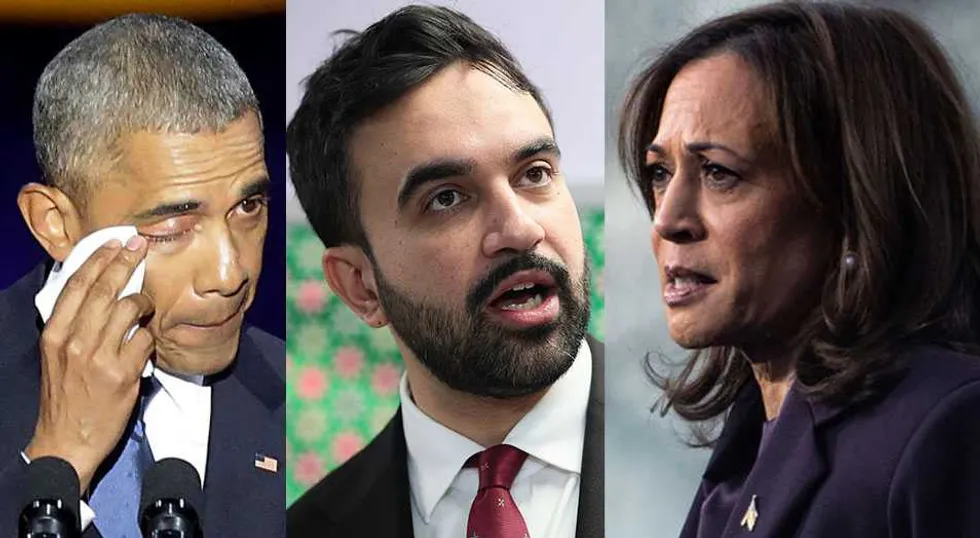
Obama, Mamdani, other Democrats throw ugly tantrums after SCOTUS strikes racial gerrymander
Source: Blaze Media · Bias: Right
Summary
Former President Barack Obama is among the many liberals who had conniptions Wednesday over the U.S. Supreme Court's rejection of an unconstitutional racial gerrymander in Louisiana.While such critics have largely spun the ruling as a setback for racial minority representation in American politics, it appears they are chiefly concerned with how the ruling might affect Democrats politically in the the midterm elections and beyond.How it startedLouisiana adopted a new congressional map in the wake of the 2020 consensus, which then-House Speaker Pro Tempore Tanner Magee (R) claimed honored "traditional boundaries."'This is one of the most consequential and devastating rulings issued by the Supreme Court in the 21st century.'Dissatisfied that only one of the Bayou State's six congressional districts had a black majority, a group of black voters sued the state, alleging that the new 2022 congressional map diluted black voting strength in violation of the Voting Rights Act of 1965.A federal judge appointed by Democrat former President Barack Obama ruled that the map likely violated the VRA and ordered the Louisiana legislature to add a second majority-black district.Pursuant to this ruling, which was upheld by the U.S. Court of Appeals for the Fifth Circuit, Louisiana created a map with a second majority-black district — this time prompting a legal challenge by "non-African American" voters who recognized the new map both as a racial gerrymander and a violation of the Equal Protection Clause of the 14th Amendment.Their case, Louisiana v. Callais, ultimately made its way to the U.S. Supreme Court, which ruled on Wednesday that "because the Voting Rights Act did not require Louisiana to create an additional majority-minority district, no compelling interest justified the State's use of race in creating SB8, and that map is an unconstitutional racial gerrymander."RELATED: 'Trump is racist' arguments seem to fall on deaf ears at SCOTUS TPS hearing about Haiti and Syria Alex Wong/Getty ImagesBeyond striking down the racial gerrymander in its 6-3 decision, the court provided some much-needed clarity on "whether compliance with the Voting Rights Act can indeed provide a compelling reason for race-based districting."Justice Samuel Alito noted in the opinion for the court, for example, that "interpreting §2 of the Voting Rights Act to outlaw a map solely because it fails to provide a sufficient number of majority-minority districts would create a right that the Amendment does not protect. And such an interpretation would run headlong into the Act’s express disclaimer against racial proportionality."Alito noted further that "§2 imposes liability only when the evidence supports a strong inference that the State intentionally drew its districts to afford minority voters less opportunity because of their race."Although the court's clarifications appear aimed at providing states with guidance on how to comply with Section 2 of the VRA without unduly discriminating on the basis of race and violating the U.S. Constitution, Justice Elena Kagan alerted fellow travelers in her dissent — which was joined by Justices Sonia Sotomayor and Ketanji Brown Jackson — that the ruling will supposedly impact "racial equality in electoral opportunity.""The consequences are likely to be far-reaching and grave. Today’s decision renders Section 2 all but a dead letter," wrote Kagan."If other States follow Louisiana’s lead, the minority citizens residing there will no longer have an equal opportunity to elect candidates of their choice. And minority representation in government institutions will sharply decline."Alito found Kagan's dissent to be "unabashedly at war with key precedents."How it's goingObama, a champion of Virginia's recent legally dubious gerrymander whose appointee's decision in 2022 unwittingly set the stage for the SCOTUS ruling, complained on social media, "Today's Supreme Court decision effectively guts a key pillar of the Voting Rights Act, freeing state legislatures to gerrymander legislative districts to systematically dilute and weaken the voting power of racial minorities — so long as they do it under the guise of 'partisanship' rather than explicit 'racial bias.'"Obama accused the Supreme Court's conservative majority of "abandoning its vital role in ensuring equal participation in our democracy and protecting the rights of minority groups against majority overreach" and hinted that the decision could affect the upcoming midterms.He added that "such setbacks can be overcome" but only if "citizens across the country who cherish our democratic ideals continue to mobilize and vote in record numbers."Twice-failed Democrat presidential candidate Kamala Harris similarly bemoaned the Supreme Court's ruling, calling it "an outrage" that "turns back the clock on the foundational promise of equality and fairness in our election systems" and that is "part of an agenda that conservatives set in place decades ago to steal...
Related Coverage
- Bannon warns the ‘old politics are gone’ amid Democrat socialist surge (Far Right — BizPac Review)
- Wes Moore on democratic socialist gains: Voters want ‘someone who is going to fight for them’ (Center — The Hill News)
- Mamdani blasts ICE agents, Elon Musk and 'supremacy' in America 250 speech ahead of July 4 weekend (Right — Latest Political News on Fox News)
- Karoline Leavitt on the ‘Full Blown Communist Revolution’ Happening Thanks to Democrats (Video) (Far Right — The Gateway Pundit)
- The Democrat Party Is Literally Communist, and the Voters Admit It! (VIDEO) (Far Right — The Gateway Pundit)
- ‘Heat for thee, but not for me’: Mamdani lets City Hall go chill as he tells residents to sweat it out (Far Right — WorldNetDaily)
- Conservative Catches CNN Host Abby Phillip in a Glaring Hypocrisy as She Defends Communist NYC Mayor Zohran Mamdani’s Absurd Demand on Air Conditioning (Video) (Far Right — The Gateway Pundit)
- NYC Mayor Mamdani discusses American exceptionalism and "forces of division" in America 250 speech (Center — Politics - CBSNews.com)
Daily Analysis
Read the full Parallax Pulse for April 30, 2026 — an AI-powered analysis of how Left and Right media covered the biggest stories this day.
More Headlines From April 30, 2026
- Louisiana suspends House primaries for May 16 elections (Center)
- Florida lawmakers approve new voting maps to favour Republicans (Center)
- Congress Passes Another Short-Term Extension of Expiring Surveillance Law (Center Left)
- Pete Hegseth tangles with Senate Democrats: Five takeaways (Center)
- Court refuses to reconsider Trump's most embarrassing conviction (Left)