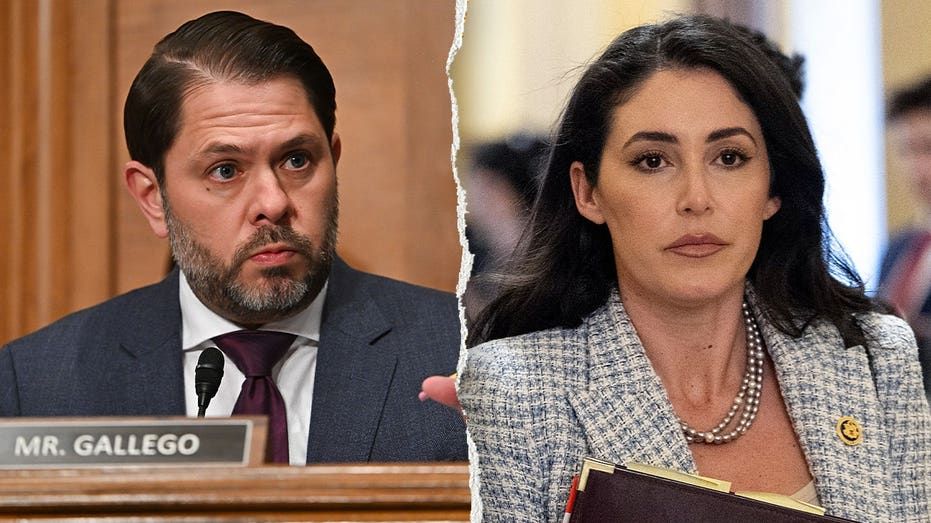
News of the investigation surfaced just hours after the Senate Ethics Committee rejected a complaint filed against the Arizona Democrat accusing him of campaign finance violations and sexual misconduct.
Natasha Sarin, Professor and Co-Founder of the Budget Lab at Yale University, and Jessica Roth, Professor at Cardozo Law School and a former federal prosecutor for the Southern District of New York, discuss the Supreme Court's rulings on President Trump's ability to fire agency heads and whether Lisa Cook can remain in her job at the Federal Reserve. They also weigh the economic and constitutional stakes of the pending birthright citizenship decision. They speak with Joe Mathieu on the late edition of Bloomberg's "Balance of Power." (Source: Bloomberg)
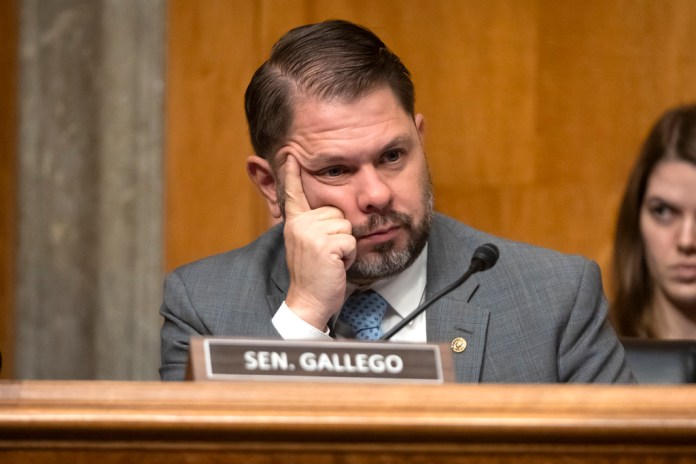
Sen. Ruben Gallego (D-AZ) is under federal investigation for suspected campaign finance violations. News of the federal investigation came the same day the Senate Ethics Committee closed its own investigation into allegations of campaign finance violations. A source familiar with the investigation confirmed the inquiry to the Washington Examiner. Axios reported that the investigation stems […]
The U.S. Supreme Court has “declared war” on American democracy, on “modern society,” and on “everything it takes to function in the 21st century,” warns Nobel laureate Paul Krugman, after the court expanded presidential powers once again. Six of the court’s members, presumably the conservative wing, “are fundamentally hostile to democracy, fundamentally hostile to the modern world and determined to put the catastrophically bad leader that we currently have sitting in the White House in charge of everything, which is a nightmare scenario on every level.”Krugman scorches the court for ruling that presidents can fire, without cause, the heads of independent federal agencies (except the Federal Reserve). In doing so, the court overturned a 91-year-old precedent. He explains that in a modern society, “the agencies that operate the U.S. government and basically run our society are supposed to be professional. They’re supposed to be following their legal mandate. They’re not supposed to be personal tools of a dictator in the White House.” Krugman says that the court has now given “essentially dictatorial powers to the occupant of the White House,” while also making it extremely difficult for the economy and for society to function.He explains that in today’s complicated world, ground rules are necessary. Offering the Food and Drug Administration (FDA) as an example, Krugman says that producers need to know that their products will be approved based on merit, and not on “spurious grounds.” “And what would cause those decisions to happen?” he asks. “Well, how about the fact that some businesses are better at the business of bribing the president and his family than others. And if you think that this is outlandish — you know, a few years ago you might have said this was outlandish, things like that wouldn’t really happen — well, as we speak, these things are happening all the time.”Ultimately, Krugman says, America cannot continue on this path — and he calls for some form of restructuring or constraining of the Supreme Court.“This is a clear argument that says we have to one way or another disempower the Supreme Court. I don’t know enough to tell you what is the best route to do that but court packing or something else is going to have to happen.” Professor of law Barb McQuade, commenting on the court’s opinion, wrote, “Today’s decision in Slaughter will destroy the independence of the Merit Systems Protection Board, which will have a cascading effect on all federal employees, who have been free from political interference for 150 years. The spoils system is back, baby!”
The committee took statements from individuals, combed through federal campaign finance filings and examined congressional financial disclosures as part of its investigation.
Iranian state media has reportedly declared that the country now has "no choice but to obtain the atomic bomb," according to a post circulating online — a statement that, if accurate, would mark a dramatic escalation amid the ongoing exchange of strikes between the U.S. and Iran.The claim was relayed by the account The Hormuz Letter, which posted what it described as a breaking statement from Iranian state media. According to that post, Iranian state media argued the country must "absolutely reach nuclear deterrence" before current negotiations can be conducted, framing the pursuit of a weapon as necessary to remove what it called "the military option for the occupation and partitioning of Iran" from the table.The reported statement seized the attention of David Pyne, an America First conservative who posts under @AmericaFirstCon and who has been sharply critical of the administration's handling of Iran. Pyne argued the development vindicated his earlier warnings about the consequences of President Donald Trump's approach."Iran is responding to Trump's continued nuclear threats against it by building more nuclear missiles just as I predicted they would do," Pyne wrote. He contended that "Trump's war on Iran hasn't reduced Iran's nuclear threat in any way" but had instead "served to greatly magnify and expand Iran's nuclear threat against the US and Israel."Pyne went further, delivering a stinging assessment of the president's broader record."Trump's disastrous foreign policy and endless unwinnable wars make Jimmy Carter look like a veritable foreign policy genius by comparison," he wrote.The reported statement also caught the attention of Michael McFaul, the former U.S. ambassador to Russia, who reacted with unease. "Ugh. Hope it's just bluster; fear it is not," McFaul wrote, sharing the same post.The reported declaration comes against the backdrop of a rapidly deteriorating ceasefire, with the U.S. carrying out repeated strikes on Iranian targets in recent days and Trump himself warning that "the Islamic Republic of Iran will no longer exist" if forced to "militarily complete the job." Trump has also continued to insist that "Iran will never have a Nuclear Weapon."The Iranian framing — that only a nuclear deterrent can forestall foreign intervention — runs directly counter to the administration's stated goal of ending Tehran's weapons ambitions, and underscores the risk that the military campaign could harden rather than halt Iran's nuclear drive.