Despite stark warnings from the Los Angeles County Office of Education (LACOE) that approving nearly $1.2 billion in labor contracts would plunge the Los Angeles Unified School District into a financial crisis, the school board approved the deals anyway, setting the stage for thousands of layoffs.
President Donald Trump's reactions at a recent awards ceremony were extremely telling about his true feelings, with one body language expert highlighting all the signs of his "anger and embarrassment" that got caught on live TV.Trump was in attendance during Friday evening's White House Correspondents' Dinner, which was rescheduled after an attempted shooting at the previous attempt to hold the annual event. During the event, CNN anchor Wolf Blitzer presented the Katharine Graham Award for Courage and Accountability to the team of Wall Street Journal reporters for their story relating to the late sex offender Jeffrey Epstein and his past connections to Trump, which included the bombshell revelations about the sexually suggestive birthday note the president sent to Epstein.Trump previously attempted to sue the outlet, owned by major conservative backer Rupert Murdoch, over the story, leading many to note his awkward and frustrated reactions during the presentation of the award.In a video shared Saturday, Dr. John Paul Garrison, a licensed clinical and forensic psychologist with expertise in body language, broke down the segment moment by moment in order to highlight all of the signs pointing to Trump's unease.Early on in the video, Garrison noted Trump's "classic look of disapproval" as Blitzer introduced the award, something he has pointed out in numerous other past examinations of the president's body language.A short time later, as Blitzer is discussing the "thousands of documents" contained in the Epstein files, Trump appeared to look away momentarily."It's because this is too intense. It's too anger-inducing," Garrison explained. "He cannot continue to look at Wolf Blitzer because it's making him mad. So, he looks away to try to get support from someone else. So, right now he's turning to face [White House Press Secretary] Karoline Leavitt."While he was looking away, Garrison noted that Trump then gave a "half smile," which appeared to reveal his "contempt, because contempt is the only emotion that's only on one side of the face." The psychologist suggested that Trump might have been attempting to hide his feelings of contempt with the smile, but it was still unmistakably there. The president then transitioned to a look of "fake confusion.""Now he's trying to appear confused. He's feeling awkward," Garrison explained. "He doesn't know how to react to something like this. So he's facing away. He's looking confused, although not really confused, but trying to feign confusion. So, at this point right here, this is everything he can do to disengage from what's going on right now because he absolutely does not want to have to sit and listen to this."Several more times, Garrison noted how Trump showed looks of disapproval as Blitzer continued to talk. When the address turned to Trump's $20 billion lawsuit against the Wall Street Journal, Trump then appeared to show a happy expression over something he felt "pride" about, but Garrison suggested that "he's not actually feeling happy right now, but he's willing to show a fake smile to draw attention to himself."When the reporters were finally brought on-stage, Trump showed various signs of faux-embarrassment and disbelief over the situations, which Garrison said were meant to convey "I can't believe this just happened to me," before he moved on to an expression of "tension.""What we saw was anger and embarrassment, but he tried to cover it by playing to the audience," Garrison concluded.
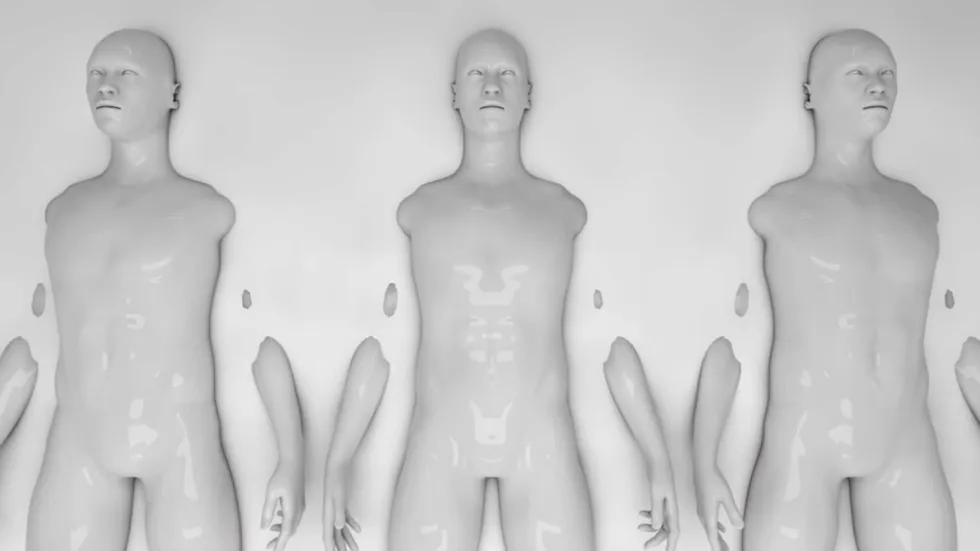
Social media's magicians spent decades perfecting the art of slicing human attention into advertising revenue. Is the next step on the corporate road map farming human tissue for spare parts?The tech is there, or almost there. The ideas have percolated for decades. All it takes, it seems, is the will.The concept of individual self-ownership becomes entirely obsolete.An early pitch deck for R3 Bio, a quiet biotech startup operating out of California, laid out a vision that makes classic horror fiction look rather mild. The company’s leadership, reports suggest, engaged in internal discussions regarding the production of brainless, nonsentient human bodies designed for the explicit purpose of organ harvesting, pharmaceutical testing, and eventual commercial deployment.They christened these biological monstrosities "organ sacks."The terminology speaks volumes to the moral framework seizing imaginations in the contemporary tech executive class. When a team of researchers and engineers looks at the human form and sees an inconveniently conscious container for marketable kidneys, the line between medical innovation and factory farming disappears completely.Executives at R3 Bio floated plans to reprogram monkey cells, cultivate complete organ systems, and engineer these living biological constructs to be intentionally primitive enough to bypass federal ethical guidelines.But this isn't some sudden Silicon Valley obsession. The ambition to redesign human biology has been gathering momentum worldwide for years.They have a dreamIn October 2022, biotech investors gathered in Zurich to debate the commercial viability of synthetic biology, openly celebrating the day human biology would be fully decoupled from traditional ideas of personhood. The attendees viewed the human body as an inefficient piece of legacy software requiring a total architectural overhaul. It was only a matter of time before the idea caught on.Scientists at R3 Bio defended their research behind the usual wall of righteous PR speak, insisting their work aims to end the chronic shortage of donor organs and cure terminal illnesses. They publicly insist that full-scale human organ fabrication remains outside their current operational scope and that their public website reflects a commitment to safe, traditional cell therapy.But the problem runs deeper than what R3 Bio says it is or isn't doing today. It's what history tells us can happen when scientific ambition outruns consent, oversight, and basic human dignity.The playbook never changes. In 1951, researchers extracted cancer cells from Henrietta Lacks without her knowledge or consent, creating the HeLa cell line that generated billions in profit for pharmaceutical giants while her family struggled to pay medical bills. The medical establishment transformed a living human being into a self-sustaining corporate product, establishing a precedent that today's biotech firms are eager to scale up to the entire human torso. There is an enormous amount of money to be made. And where the fevered dreams of high-tech immortality are concerned, human morality has a troubling habit of turning negotiable.RELATED: Anti-aging mogul's next act? He'll harvest organs from his own clone L-R: Bridget Bennett/Bloomberg/Getty Images; Aldara Zarraoa/Getty ImagesA society grounded in the belief that human life possesses inherent dignity treats the human body as an inherently sacred structure rather than a machine assembled from interchangeable parts. The secular technocracy reigning in Northern California views the human body as a collection of meat components that can be optimized, monetized, and swapped out.Death of the selfThe transition from healing the sick to manufacturing customized human vessels happened while everyone was distracted by social media algorithms. Engineers want to replace a failing heart, grow an artificial liver in a vat, construct a brainless body to house the spares, and call the whole process market efficiency. The language of human medicine was completely swallowed by the inhumane jargon of auto repair.This mechanistic worldview demands that every biological boundary be erased in the name of efficiency and infinite growth. If a brainless body exists as a legal product, the entity owning the patent exercises total property rights over a human biological shell. If a corporation can copyright the genetic sequence of a custom-grown torso, the concept of individual self-ownership becomes entirely obsolete.Tech elites frequently talk about death as a minor coding error awaiting a software upgrade. They invest billions in longevity protocols, upload schemes, and cellular rejuvenation, completely convinced that their wealth entitles them to bypass mortality itself.
Trump says Saudi Arabia must join the Abraham Accords before any civilian nuclear energy deal moves forward, insisting the condition was always understood.
DNC made move in bid to better represent views of party’s racially diverse voter base ahead of next presidential cycle Democrats moved to keep South Carolina as the first state to vote in their party’s 2028 presidential primary process, while moving up several other states, in a bid to better represent the views of the party’s racially diverse voter base.At a meeting in Washington DC of the Democratic National Committee’s (DNC) rules and bylaws committee on Friday, South Carolina received a slim majority of votes to take the first spot, scheduled for 22 January 2028, with Nevada, New Hampshire, New Mexico, Michigan and Virginia set to follow, in that order. The selections must still be confirmed by the full DNC at a meeting set for next month. Continue reading...
Ascend West Virginia is one of dozens of relocation initiatives across the country offering cash and other incentives to move to states needing an economic boost. Here's how they're working out.
President Trump on Friday blasted the European Union for fining American tech companies.
The post “The European Union will Pay a Very Big Price” – Trump Blasts European Union for Fining American Tech Companies Billions of Dollars appeared first on The Gateway Pundit.