Tennessee Republicans, having redrawn congressional maps to eliminate Democratic representation, are now targeting state legislative districts for similar partisan gerrymandering. The GOP holds veto-proof supermajorities (27-6 in Senate, 75-24 in House) but plans maps that could achieve 33-0 and 99-0 margins, completely eradicating Democrats from state government, according to reporting by Tennessee Lookout's Bruce Barry.Following the Supreme Court's Louisiana v. Callais decision permitting partisan gerrymandering, but not racial, Republicans have carved Memphis's majority-Black 9th District into three GOP-friendly districts. Republican Caucus press secretary Molly Crawford confirmed redistricting legislation is planned for next year. Using mapping software, Democrats could be eliminated from Nashville and Memphis state Senate representation entirely. The author argues that while Republicans justify moves as partisan advantage-maximization, the result threatens democratic representation for one-third of Tennessee's reliably Democratic voters."Do the one-third of Tennesseans who do not choose Republican government have a right to be represented in their elected legislature? In a functional democracy in a supposedly advanced liberal society, do the two-thirds who are calling the shots have a moral obligation to see to it the one-third are included rather than silenced?" the author writes. These are not hard questions, Barry concludes.Watch the video below. Your browser does not support the video tag.
One of the potential Republican candidates for president in 2028 isn't doing very well back home in his own state — and he's suffering considerably with female voters. Vice President JD Vance has been on shows defending President Donald Trump, but it comes at a time when he also has a new book out. CNN host John Berman said that a new political book generally means the author is running for president. Speaking to CNN, data analyst Harry Enten cited some of the prediction markets showing that numbers have changed since the beginning of the year. On Jan. 1, the chances that Vance would win the 2028 GOP nomination was about 50 percent, and Secretary of State Marco Rubio came in with a distant 11 percent. Rubio is now up to 28 percent, and Vance has fallen significantly to a 33 percent chance of becoming president again in 2028. "Look at this! The gap — it is closing. It is closing," Enten said with gusto. He noted that the thing that changed is the Iran war. Approval ratings among Republican voters are important if one of the two intends to run for president. Net approval in Vance has declined, according to the Quinnipiac University Poll. He was up 81 percent and now is closer to 69 percent approval. Rubio has increased, standing at 75 percent, and now is at 77 percent approval.Back home, things are looking worse for Vance. According to Enten, one can tell a lot by how a candidate's home state feels about them. In Vance's Ohio, his net favorability was up 5 percent, but now it's down 7 percent. Among Independents, Vance is 27 percent underwater."JD Vance, not so popular in the Buckeye State," said Enten. Berman called it "Problems at home." How about his net approval overall?Overall, Enten said that Vance is still suffering with women. A few years ago, Vance attacked single cat ladies, it didn't do much to help him with the women's vote. With women, Vance is down 26 percent and down 2 percent with men.
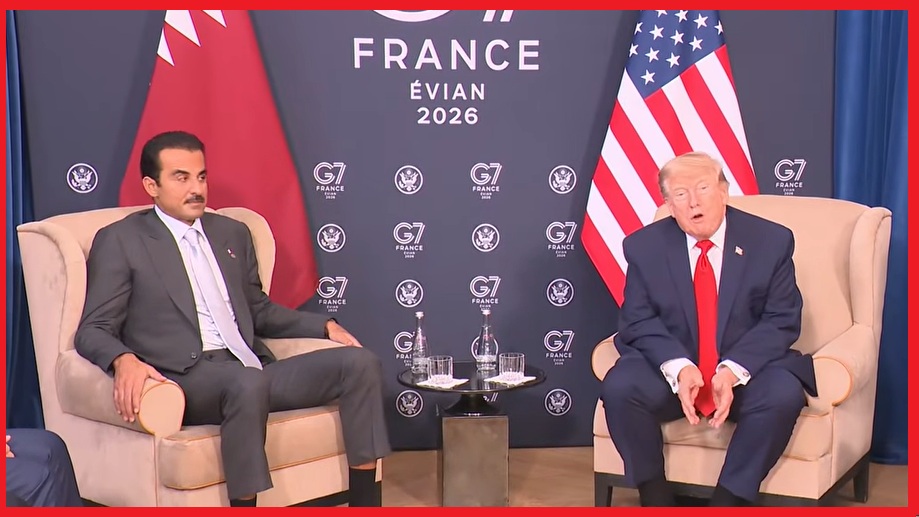
President Trump delivers remarks during a bilateral discussion with Sheikh Tamim bin Hamad Al Thani the Emir of Qatar. As previously noted, the G7 is no longer an assembly of the industrial nations. The G7 has morphed into a meeting of multiple nations unattached to the original intent. The primary discussion surrounded the current deal […]
The post President Trump Delivers Remarks During a Bilateral Meeting with the Emir of the State of Qatar appeared first on The Last Refuge.
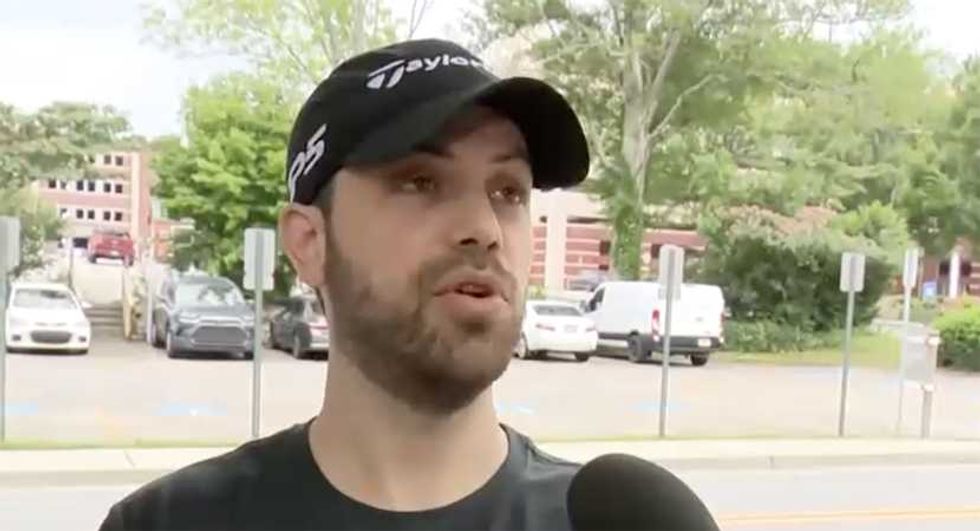
A Georgia Republican voter who showed up early to cast his ballot in Tuesday’s primary admitted that Donald Trump’s endorsement caused him to skip voting in the governor’s race.Reporting from Marietta, MS NOW’s Nnamdi Egwuonwu shared an interview with a self-identified Republican voter who gave his name as Bank W.He introduced his segment by telling host Jonathan Lemire, “It was pretty interesting. We got told by one voter here, one conservative voter here in Marietta, who laid out to us that Trump's endorsement was actually, in his view, a negative. I want to play for you portions of that conversation so you can hear why he said he decided to leave the top of the ticket blank when he voted today. Take a listen.""Can you just help me understand a little bit more?” he asked the young man. “What you mean by Trump's endorsement was actually a negative across the governor and Senate races. I think that would shock a lot of people here. Tell me for you personally, just help me understand a little bit more what you mean.”“I mean, I was never a big fan of the populism,” Banks replied. “I think that you should campaign and act on what you believe in rather than just trying to win. That means sometimes you don't win. But I don't think he followed through with a lot of the things that he said he was going to do, and there were less for me that I liked.”“But I did like very much like the, like, talking about peace and no new wars and that we don't need that. We just need diplomacy and trade. And he just went completely against it.”Turning back to Lemire, Egwuonwu commented, “So what's interesting, voters tell me the kind of Republican you would want to see. He referenced [Kentucky Rep.] Thomas Massie, so that gives you a sense of where his head is at. But what we're looking for in terms of the general election this fall is a voter like you just heard from; said he isn't going to support the Democratic ticket, he says there's too many value differences there, but he sees himself staying home. And that benefits [Democratic Sen Jon] Ossoff just as much almost as getting that vote.” - YouTube youtu.be
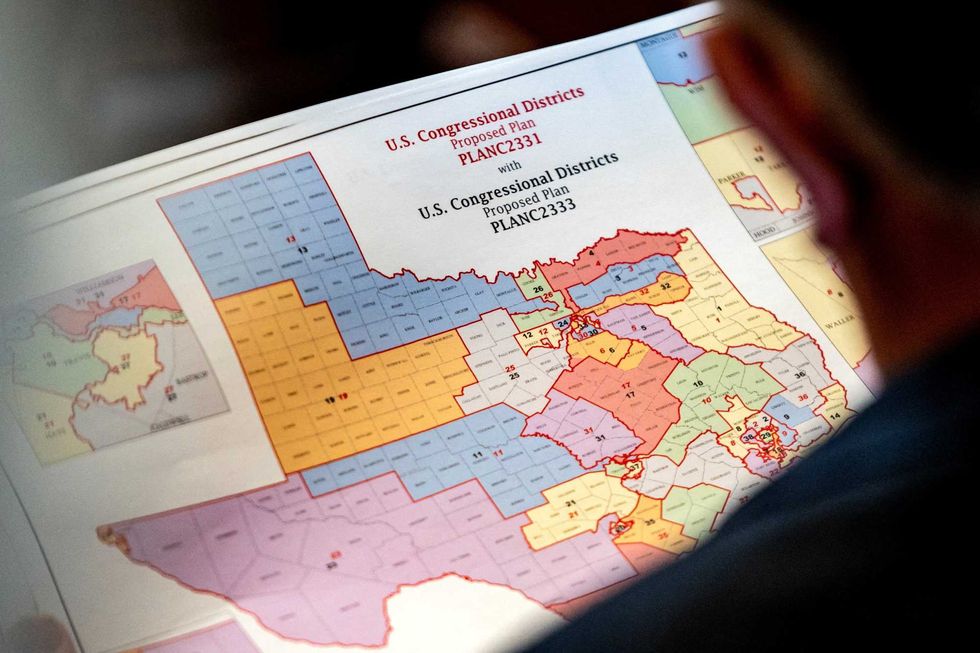
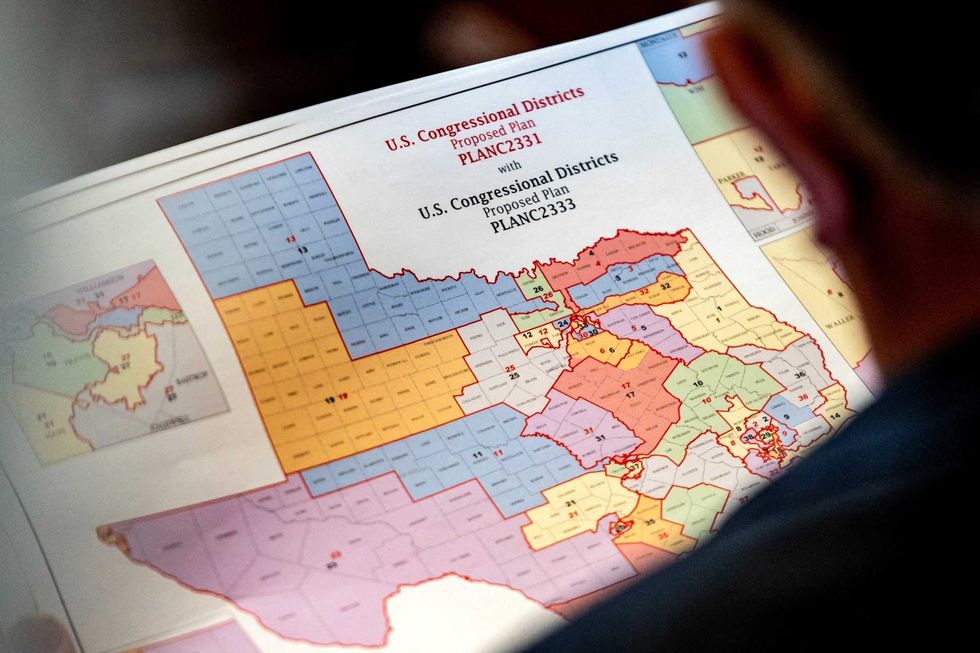
When the Republican-led Tennessee legislature in May carved up the state’s one remaining congressional district represented by a Democrat it was acting openly on a morally gruesome principle.In a state where more than a third of voters are reliably Democrats (per the last two presidential elections) Republicans find it unacceptable that the percentage of congressional House seats held by Democrats treads water at 11% — one of Tennessee’s nine seats. This cannot stand, they mouthfoamingly cogitate, so we must draw new lines that drown the enemy and make it zero.Slicing and dicing Memphis’s majority Black 9th District into three GOP-friendly majority white districts certainly felt like the kind of hasty and shameless racial gerrymander seen in several southern states following the U.S. Supreme Court’s Louisiana v. Callais decision in April.The Republicans who run Tennessee may not have much of a grasp of constitutional law, as they manage to remind us each year with bills that turn laws into lawsuits. But they did show us during the May redistricting special session that they can muster the remedial level of reading comprehension needed to decipher Supreme Court marching orders.The Court’s take in Callais was clear: race-based gerrymandering is not cool but party-based gerrymandering is totally cool. And so followed the marching orders for conservative state houses: draw new districts however you like, even in maps that intentionally dismantle minority representation; just make sure you let the maps do the talking; say nothing out loud through your piehole that would feed your opponents a viable claim about map-drawing motives that are anything but purely partisan.And so as the new congressional map was crammed through the legislature last month we were treated to the mind-numbing spectacle of endlessly parroted versions of map sponsor Sen. John Stevens’s mantra: “This is about allowing Tennessee to maximize its partisan advantage.”Funny thing is, as contrived as it was, I mostly believe it. Sure, racism (along with sexism and homophobia) abounds in the councils of state government here, and the heated fusillade of racial grievance that confronted the new congressional map was plenty justified. But even so I believe this really was about adding a red seat, not a white seat. I have no doubt that Tennessee Republicans would have sold out white Democrats just as readily as they politically dismembered Black Democrats if it would have served their true purpose: finding one more red seat in the U.S. House for their DC overlords.As the GOP adopted the new map neutering Democrats in Memphis, just as they did in Nashville in 2022, I got to thinking: Why stop there? If they can crack blue cities into blue splinters floating in red congressional districts, can they not perhaps do the same with state legislative districts? But then I thought, well, no they won’t go there — there’s no gain.The congressional redraw had concrete value, netting at most just the one seat but in a razor-thin-margin congress where every seat matters. Here In the Tennessee state capitol, on the other hand, the GOP already has veto-proof supermajorities in both houses, so what would be the point?Or so I thought until word last week that that the Tennessee GOP plans to hurl its flaming hatchet of one-party belligerence at that very target: state Senate and House district maps. According to Republican Caucus press secretary Molly Crawford, we can expect legislation proposing new maps as early as next year. The point, I guess, is this: Why settle for margins of 27-6 in the Senate and 75-24 in the House when with some crafty line drawing it can be 33-0 and 99-0. Why, indeed, should there be a single Democrat in Tennessee state government?With map-drawing software it’s a simple matter to ponder the possibilities for this sort of political mayhem. I spent a little quality time the other day with a platform well known to political mapping nerds called Dave’s Redistricting. It took me under an hour to carve Middle Tennessee into senate districts all with populations close to where a senate district should be and each having a Republican partisan edge (based on 2020 presidential voting data). As you can see in my map below I pulled this off by slicing Nashville into slivers of Davidson County that extend way out into the hinterlands (as our congressional districts already do).An election with this map, if the partisan leans held, would cut Nashville’s Democratic representation in the state Senate from three to zero. Performing similar district surgery in Memphis could cut theirs from three to zero. Together that would completely eradicate the Democratic Party from the state Senate —the 33-0 nightmare. Purging the 99-member House of all Democrats would be a bit more challenging, requiring thinner slices and wackier looking districts in more parts of the state.
Five Michigan Democratic lawmakers, led by Rep. Haley Stevens, sent a letter Thursday to Department of Homeland Security Secretary Markwayne Mullin opposing a planned Immigration and Customs Enforcement detention facility in Romulus, Michigan. The bipartisan opposition includes Stevens, Debbie Dingell, Hillary Scholten, Kristen McDonald Rivet, and Shri Thanedar, joining Rep. Rashida Tlaib's efforts against the facility. The letter challenges ICE's claim that community impact studies and due diligence were completed before purchase, noting that local officials were never consulted, reports Michigan Advance. It also lists environmental concerns, including floodplain and wetlands regulations.The opposition is bolstered by Michigan Attorney General Dana Nessel and the City of Romulus, filing federal lawsuits to stop development. Representatives cited conditions at Michigan's existing North Lake Processing Center in Baldwin, where detainee Nenko Gantchev died in December 2025, and ongoing hunger strikes and documented conditions for detainees. U.S. Sens. Elissa Slotkin and Gary Peters received no response to their February letter raising similar concerns.Watch the video below. Your browser does not support the video tag.
Five Democratic U.S. Representatives from Michigan sent a letter on Thursday to Secretary of Homeland Security Markwayne Mullin to oppose the development of a planned ICE detention facility in Romulus.Rep. Haley Stevens of Birmingham led the letter and was joined by Reps. Debbie Dingell of Ann Arbor, Hillary Scholten of Grand Rapids, Kristen McDonald Rivet of Bay City, and Shri Thanedar of Detroit — almost the entire Democratic delegation to the U.S. House from Michigan, except for Rep. Rashida Tlaib, who has also been actively fighting against the detention center’s opening. The detention center is in Thanedar’s district.The letter lays out a number of arguments that have been well-worn against the detention center — including local opposition and zoning concerns and environmental regulations for the area’s floodplain and wetlands.“In response to initial press inquiries, an ICE spokesperson stated that new detention ‘sites will undergo community impact studies and rigorous due diligence process to make sure there is no hardship on local utilities or infrastructure prior to purchase’,” the representatives wrote. “No local officials were consulted about any such study or due diligence, raising questions about whether the analysis was completed before the purchase of the facility and, if it did occur, the accuracy of the work.”“Given these dynamics, it is clear DHS must not move forward with the planned Romulus detention facility,” the letter continues, noting that Michigan Attorney General Dana Nessel and the City of Romulus have already sued in federal court to stop or slow the detention center’s development.GET THE MORNING HEADLINES. SUBSCRIBEStevens and Scholten have also been vocally opposed to the major ICE detention facility in Michigan that is currently operating, the North Lake Processing Center in Baldwin, a facility privately owned by GEO Group and contracted as an ICE detention center, especially in the wake of the December 2025 death of Nenko Gantchev at the Baldwin facility.A hunger strike at that facility and concerns about the conditions for detainees were further cited as reasons not to open a second major detention facility, this time owned by ICE, in Michigan.Both U.S. Senators from Michigan, Elissa Slotkin and Gary Peters, sent a similar letter to then-Homeland Security Secretary Kristi Noem in February with a series of questions on planned capacity, staffing levels, and environmental or economic impact analysis.Thursday’s letter noted that Slotkin and Peters received no response to that letter and re-emphasized their questions, but also added new questions about the scope and timeline for reviewing DHS contracts and the property acquisition process for the purchase of the Romulus property.The letter also comes as a group of local advocates and organizers has been heavily criticizing Gov. Gretchen Whitmer for her relative silence on the development of the detention center, with Nessel and federal elected officials taking a much more vocal and active stance against it.