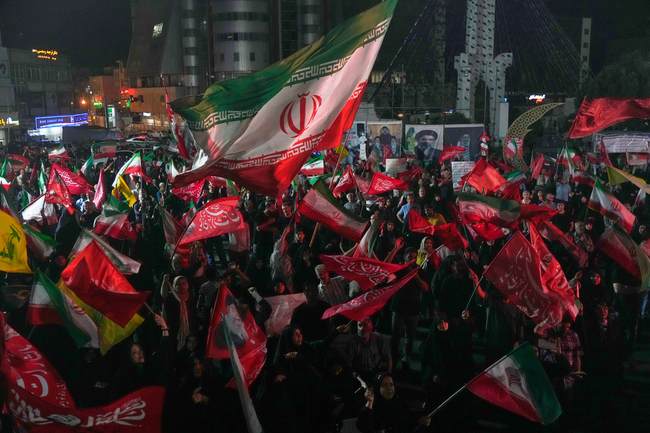
Iran war flares up again after ‘surprise’ attack on US forces in Jordan
Source: Washington Examiner · Bias: Center Right
Summary
US THWARTS SURPRISE ATTACK: Just when it seemed that efforts of Middle East mediators to resuscitate negotiations between Iran and the United States were making progress, Iran’s Islamic Revolutionary Guard Corps broke a null in the fighting to attack U.S. troops at a base in Jordan. In a post on X, the U.S. Central Command […]
Iran war flares up again after ‘surprise’ attack on US forces in Jordan
Center Right
US THWARTS SURPRISE ATTACK: Just when it seemed that efforts of Middle East mediators to resuscitate negotiations between Iran and the United States were making progress, Iran’s Islamic Revolutionary Guard Corps broke a null in the fighting to attack U.S. troops at a base in Jordan. In a post on X, the U.S. Central Command […]
WASHINGTON -- President Trump vowed Wednesday to "beat the f—ing s— out of" Iran in response to a surprise missile attack by the Islamic Republic targeting US troops stationed in Jordan.
Dr.
The post WATCH LIVE: Dr. Tony Fauci to Testify Before US Senate Homeland Security Governmental Affairs Committee at 8:30 ET appeared first on The Gateway Pundit.
Veteran medical adviser likely to face questions over disputed ‘lab leak’ theory in investigation seen by scientists as ‘vilification and harassment’ of 85-year-oldSign up for US Breaking News emailFormer president Joe Biden’s presidential pardon does not cover Anthony Fauci’s awaited hearing at Capitol Hill, the House Oversight Committee chairman has said.Republican James Comer told Fox News Digital:Americans are still reaping the consequences of Dr Fauci’s actions.Biden’s pardon doesn’t cover Dr Fauci’s testimony this week and if he continues to lie, he must be held accountable. Continue reading...
The following is a lightly edited transcript of the July 29 episode of the Daily Blast podcast. Listen to it here.Greg Sargent: This is The Daily Blast from The New Republic, produced and presented by the DSR Network. I’m your host, Greg Sargent.Donald Trump just unleashed a barrage of unhinged threats toward Iran in a new interview with Fox News. He threatened to bomb all Iran’s bridges and power plants, and said explicitly that the entire population of Iran might soon be without electric power.There’s a temptation to dismiss moments like these as bluster. But we can’t let ourselves lose sight of what exactly he’s threatening to do, just how sociopathic these threats really are, and just how terrible it is that the media is now largely numb to them. This all comes as some MAGA figures are warning against escalation in some surprising new ways as well.So we’re trying to make sense of it all with former State Department official Emily Horne. Emily, always good to have you on.Emily Horne: Thanks, Greg, for having me.Sargent: OK, so we’re in this weird holding pattern where Trump has held off on escalating and he just keeps making all these threats, and he keeps saying Iran is desperate to talk to him. Yet at the same time, the reporting indicates that in reality the Iranians are not in any rush to talk to Trump at all. Emily, can you sum up the situation as of now?Horne: The TLDR on that, to use bureaucratic terms, is that Iran has all of the leverage and all of the momentum at this moment in the conflict. I think they’ve shown that there’s a real willingness on their end to pass the cost of this war to the Iranian people, which, as terrible as that is, is a major asset for them. They are not particularly troubled by their own people’s suffering. And that, plus their control of the Strait of Hormuz, gives them a lot of incentives to maintain the status quo, and a lot of leverage over the status of negotiations.They also continue to have a nuclear program, because Trump walked away from the JCPOA in his first term. So no matter what Trump has said at various points in Trump II about obliterating Iran’s nuclear program, again, that is something that Iran has as a bargaining chip, and they have been very clear that they’re going to control the direction of the conversation moving forward.Sargent: Why is it that they don’t seem to fear Trump escalating, exactly?Horne: I think part of it is that, again, they have the leverage here. As you and I have talked about before, this is an existential conflict for the IRGC. Many of them have lost family members, have already suffered greatly; they have already inflicted a great deal of suffering on the Iranian people. And so there’s a tremendous sunk cost that has already been absorbed by the IRGC in this conflict. And from their perspective, maintenance of the status quo is fine by them—as much as that continues to put Trump in an impossible position, because again, he just doesn’t have a lot of leverage at this point.But also, their strategy has been working for them. They don’t just control the strait, they are able to inflict a great deal of pain on the broader Middle East region, including by attacking tech infrastructure like data centers, attacking desalinization plants in Kuwait and other Gulf countries, attacking civilian infrastructure across the Middle East. And that again sends a signal that it is Iran’s momentum at this point in the conflict, not the U.S.’s.Sargent: Well, in that context, let’s check out something Trump just said on Fox News. He starts by saying, I could knock out all the power plants, then it keeps going from there. Listen to this.Donald Trump (voiceover): I could knock out the power plants within one day. All of their power plants would be gone. And I let ‘em know that, you know, with negotiations. They say, look—people want me to do that. I think about 91 million people without power, without bridges, with that to live. And it’s a very, very delicate balance. So I think we have a very strong position right now. They know I’m going to do that if they don’t make a deal. The bridges are going to be gone. Literally, in less than a—I would say in two hours, most of the bridges, the major bridges, will all be gone. And the power plants in one day.Sargent: Emily, I could be wrong, but I think this might be the first time that Trump has explicitly said not only that he’d knock out all the power plants, but also clarified that he really means knocking out electricity for all of Iran’s 91 million people. He said that. And that would be like a humanitarian catastrophe of unthinkable proportions. What would actually happen if he did that?Horne: So if Trump were to follow through on his threats to attack Iranian civilian infrastructure like power plants en masse, then you would likely see an immediate and mass humanitarian crisis that would affect at minimum tens of millions of people.
Minnesota lawmakers enacted a statewide ban on prediction market in May. The first-of-its-kind law had been scheduled to go into effect on August 1. Now, that ban is on hold after the top two prediction markets, as well as the federal agency tasking with regulating them, persuaded a federal judge to temporarily block the law on Monday.Judge Katherine Menendez granted the preliminary injunction after concluding that Minnesota’s ban was likely pre-empted by the CFTC’s exclusive regulatory authority, a position that the agency had forcefully advanced in the lawsuit alongside the two best-known brands in the nascent industry, Kalshi and Polymarket. While Menendez noted that at least some of the contracts offered by the companies fall outside the CFTC’s jurisdiction, she opted for a broad injunction for now and emphasized that the final judgment may be different.Monday’s ruling is not the end of the legal battles surrounding prediction markets. Other jurisdictions have had some success in regulating or restricting Kalshi, Polymarket, and similar companies. But it is a striking testament to the prediction market industry’s success in regulatory capture—and the need for more concrete restrictions from Congress.Kalshi, for its part, took a victory lap after the ruling. “Minnesota was the first state to pass a law banning prediction markets, and a court prevented it from being enforced less than two months later,” a company spokesman told reporters yesterday. “Today’s decision makes it clear: States cannot ban things that they don’t have jurisdiction over.”Their celebratory defiance is par for the course these days. The modern age of gambling began in 2018 after the Supreme Court struck down a federal ban on sports betting on Tenth Amendment grounds. Sportsbooks like DraftKings and FanDuel are largely regulated at the state level, following the longstanding tradition of regulating gambling as a public-health matter. More than two dozen states now allow betting on sports in some capacity.Prediction markets also allow customers to wager money on the outcome of future events. Instead of placing a more traditional wager against a sportsbook’s odds, customers at a prediction market effectively bet against one another. In practical terms, they buy an “event contract” that predicts a binary outcome for an event—say, for example, that the Los Angeles Dodgers will win the 2026 World Series—within a certain period of time.If the Dodgers secure a threepeat this October, the contract’s seller would pay the buyer the amount specified in the contract. If the Chicago White Sox win the Fall Classic instead, the contract’s buyer gets nothing. Contracts can be bought and sold on prediction markets, with prices fluctuating depending on the market’s perception of an event’s likelihood. In that sense, prediction markets can somewhat resemble derivatives markets for publicly traded stocks.Prediction markets justify their existence in a number of ways. One is by claiming to offer some otherwise unobtainable insight into the future. “Our markets reflect accurate, unbiased, and real-time probabilities for the events that matter most to you,” Polymarket class on its website. “Markets seek truth.” Kalshi, for example, claims that its “inflation and federal [interest] rate forecasts have been more accurate than economists, pundits, and traditional news outlets over the past year.” Another increasingly common justification for a prediction market’s existence is that it allows customers to “hedge” their futures on specific outcomes. “For example, if you have student debt and are worried about relief not passing, you can purchase a contract and get a payout even if it doesn’t pass,” Kalshi claims on its website. “If you’re worried about the economic fallout of the government shutting down, you can place a trade to hedge against it.” This resembles the role that derivatives often play in financial markets: allowing large funds to “hedge” their stock purchases.For that reason, prediction markets are currently regulated by the Commodity Futures Trading Commission, a federal agency that oversees the nation’s derivatives markets. The Biden-era CFTC sought use its rulemaking power to broadly forbid prediction markets from taking bets on sports-related events, but the change in administration produced a much friendlier regulatory landscape.Michael Selig, the CFTC’s current chairman, is a Trump appointee who previously worked for crypto companies and prediction markets. He wields immense power over the regulatory process as the commission’s sole member at the moment; Trump has declined to put forward nominees for the other vacancies.
As the shooting war with Iran enters its sixth month, the United States continues to smash Iran’s military — and lose the information war in Iran, at home, and around the world.American forces can strike targets across Iran and hit Tehran’s regional allies, especially the Houthis in Yemen. By every conventional military measure, Iran is taking severe losses. Yet a growing domestic and international audience believes Tehran is fighting the United States to a standstill.The Iranian officials would earn an A in my information-warfare seminar. Too many American officials would earn an FIt is not. But Iran is winning the argument over what the war means.Too many senior American officials still treat television — whether broadcast or streamed — as a record of an event rather than a battlefield in its own right. The War Department approaches global visual media as if it were still 1991 and Desert Storm. That must change.U.S. military planners still tend to think in Clausewitzian terms: War is politics conducted through the controlled application of violence. That formulation reflected the technology of the early 19th century. It does not account for an information age in which images cross the globe in milliseconds and political effects can precede, outweigh, or even replace battlefield effects.I call this form of conflict SOFTWAR: the hostile use of global visual media to shape another society’s will by changing its view of reality. Three colleagues and I have taught this form of warfare to generations of students at U.S. war, staff, and intelligence colleges since the early 1990s. Too few American institutions adapted.Iran did. Its military and intelligence apparatus has embraced the concept since at least 2003 and even adopted the American-coined term in its own publications and influence operations.That helps explain why the United States has spent billions of dollars over five months while Iranian drone and missile attacks — and Tehran’s televised defiance — continue. Washington is using Cold War systems and industrial-age doctrine against an asymmetric enemy organized for the infosphere.Iran’s theocratic dictatorship is fighting a four-dimensional guerrilla war across land, sea, air, and information. Its military losses have limited its ability to retaliate directly against U.S. forces. Its remaining attacks are therefore chosen less for battlefield effect than for global media impact.Oil tankers and cargo ships in the Strait of Hormuz, a desalination plant and power station in Kuwait, Saudi Arabia’s state-owned oil hub, a liquefied natural gas facility in Qatar, a U.S. communications center in Jordan, and American naval facilities in Bahrain all produce frightening images and headlines.RELATED: The only Iran plan that doesn’t end with a 20-year hangover Marcin Golba/NurPhoto/Getty ImagesIran times its scattered counterattacks for its own early-morning hours so the images arrive during the American prime-time news cycle. The objective is not merely to damage a target. It is to shape the story told about the war here, there, and everywhere.The United States helps Tehran by concentrating almost exclusively on visible military targets while leaving the regime’s domestic television system intact. Islamic Republic of Iran Broadcasting continues to push the mullahs’ account across dozens of television channels and through its official news operation.Washington destroys weapons and commanders but fails to contest the information environment that gives those losses political meaning. It has not destroyed the transmitters and replaced the regime’s message with one aimed directly at the Iranian people.Those people are the regime’s real engine: a population that has endured repression and the reported killing of tens of thousands of anti-government demonstrators. Outside the relatively small number of Iranians with access to Starlink, the United States has no coherent way to speak to them at scale.America does not lack the technology. The military weakened its own capacity. In 2024, it retired the EC-130J aircraft of the 193rd Special Operations Wing, the only U.S. airborne radio and television broadcast platform. The aircraft were judged too vulnerable for modern combat, but no announced drone replacement has taken over the mission.The result is overwhelming kinetic power without a direct means of reaching the Iranian public. It is the doctrine of a mechanic who responds to an engine-warning light by cutting the wire to the bulb. The warning disappears. The engine keeps failing.Meanwhile, Iranian propagandists study the American audience, especially younger people hostile to the Trump administration, and target them with AI-generated Lego-character videos.
U.S. and Saudi forces launched strikes on Iranian proxies in Iraq overnight, spiking energy prices and fueling fears of a wider war as the war with Iran hits the five-month mark. Saudi Arabia responded to a streak of drone strikes from Iran-backed militias that targeted its Aramco’s Abqaiq oil processing facility. It is the world’s…
On Fox News, Donald Trump threatened to bomb all of Iran’s bridges and all of its power plants. Making this worse, Trump declared that his threat could leave all of Iran’s 91 million people without power. That may be the first time Trump has explicitly said this threat could apply to Iran’s entire population, which would constitute an extraordinary atrocity. Though Trump presented this as something he’d be reluctant to do, the key is he still confirmed it’s under consideration. Meanwhile, many MAGA figures are very upset about Trump’s new meeting with Benjamin Netanyahu, fearing it portends an escalation: As Steve Bannon put it, this is a “disaster for America First.” MAGA doesn’t care much about Iranians, but Trump’s escalation threats do rattle them for other reasons. We talked to former State Department official Emily Horne, author of the Spin Class Substack. We discuss the humanitarian horrors Trump is actually hinting at, what MAGA pressure on Trump means, and why the logic of the trap ensnaring Trump could lead to a terrible ending. Listen to this episode here.