Florida Supreme Court paves way for GOP-backed congressional map
Source: Washington Examiner · Bias: Center Right
Summary
The Florida Supreme Court declined to block the newly enacted congressional map that could net Republicans up to four seats in the Sunshine State. In a 6-1 ruling, the state’s high court ruled it lacks the jurisdiction to rule on a case currently being litigated in a lower court. The ruling does not end the […]
Florida Supreme Court paves way for GOP-backed congressional map
Center Right
The Florida Supreme Court declined to block the newly enacted congressional map that could net Republicans up to four seats in the Sunshine State. In a 6-1 ruling, the state’s high court ruled it lacks the jurisdiction to rule on a case currently being litigated in a lower court. The ruling does not end the […]
Two outgoing GOP senators previously burned by President Donald Trump are threatening to sink a White House priority as a critical committee vote nears Thursday, Punchbowl News reported Tuesday.Acting Attorney General Todd Blanche, whom Trump nominated last month for the permanent role after firing Pam Bondi, is scheduled to appear before the Senate Judiciary Committee on Thursday for his confirmation vote, just 48 hours away as of Tuesday morning. But Sens. John Cornyn (R-TX) and Thom Tillis (R-NC) – both leaving Congress after pressure from Trump – are “holding firm” against confirming Blanche without getting something in return.“Both senators, whose votes are needed for Blanche to advance to the Senate floor, are demanding that the Justice Department formally eliminate the ‘anti-weaponization’ fund and curtail an audit immunity deal for President Donald Trump,” Punchbowl News’ report reads.“Both senators seem comfortable holding out to force DOJ’s hand, threatening a delay of Blanche’s committee vote that could stifle GOP leaders’ plans to confirm Blanche on the floor before the August recess.”Tillis told Punchbowl News that an agreement had yet to be reached on eliminating the Justice Department’s anti-weaponization fund, a taxpayer-funded $1.7 billion fund dedicated to awarding payouts to those who’ve claimed to have been unfairly targeted by the Biden Administration. He also said no deal had been reached on curtailing Trump and his family’s newfound immunity from tax audits.Tillis warned that, unless his and Cornyn’s demands were met, they’d “just have to delay” Blanche's confirmation.Both senators are part of a growing list of GOP “apostates” – Republican lawmakers ousted by Trump for various reasons – who’ve gone on to become well-positioned to undercut the White House’s agenda without fear of repercussions. Others include Sen. Bill Cassidy (R-LA), who lost his primary race after voting to rein in the president’s war powers, and Rep. Thomas Massie (R-KY), defeated by a Trump-backed opponent after spearheading the Epstein Files Transparency Act, much to the chagrin of the president.
A “mystery” super political action committee (PAC) formed “only recently” has been exposed for dumping hundreds of thousands of dollars into a competitive Michigan Democratic primary, Punchbowl News reported Tuesday, employing tactics similar to other dark money groups later discovered to be tied to Republican operatives.The group, Michigan Sunrise PAC, has poured close to $600,000 into the race during its final stretch, and in support of progressive congressional candidate William Lawrence, while also hitting Lawrence’s Democratic opponent Matt Maasdam.“The group began airing a TV ad over the weekend slamming Maasdam as a ‘Florida Republican’ who was bankrolled by MAGA billionaires,” Punchbowl News reported. “Digital ads touted Lawrence as the best candidate to stop President Donald Trump while highlighting his endorsements from Sen. Bernie Sanders (I-Vt) and Senate candidate Abdul El-Sayed.”The group’s late involvement in the race, which Punchbowl News described as “meddling,” bore hallmarks of other dark money PACs that “meddled” in other recent Democratic primary elections, PACs that ultimately admitted to being tied to Republican operatives.“Michigan Sunrise PAC only recently filed with the FEC and won’t have to reveal its donors until after the Aug. 4 primary,” Punchbowl News’ report reads. “The group has gone to great lengths to hide its funders and operators.”In Nebraska, Maine, New Jersey, Pennsylvania and Texas, Lead Left PAC and Real Change PAC dumped around $4.4 million in May to influence Democratic primaries, and much like Michigan Sunrise PAC, “took great effort to hide their leadership and partisan affiliations,” Punchbowl News previously reported. Lead Left PAC and Real Change PAC were later discovered to have been funded by Conservative Americans PAC, a group funded by American Prosperity Alliance, a GOP-aligned nonprofit organization tied to former House Speaker Kevin McCarthy (R-CA) that advocates for conservative policies. American Prosperity Alliance made more than $22.5 million in contributions during the 2024 election cycle to various GOP-aligned PACs, according to OpenSecrets.
Justice Elena Kagan offered a notable defense of her colleagues on the Supreme Court last week by rejecting claims that the justices were simply doing Trump’s bidding. “I don’t see this as a court that is just like, ‘We’re just going to rubber-stamp what the current administration does.’ You know, quite the opposite,” Kagan told an audience last week in Washington state, according to Politico. “I think that that is a bad rap.”Kagan is generally correct, with a few notable exceptions. It is important to understand why she is correct to better appreciate what the second half of Trump’s term will look like, and what the playing field will look like for the next Democratic administration. It is true that Trump has scored a number of major victories at the Supreme Court in his second term. But they have largely been on matters in which the court’s six-justice conservative majority would have supported any Republican president. “You just have to deal with the fact that there’s a conservative court doing things that conservative jurists have long thought it appropriate to do, and I can really dislike that,” Kagan explained last week. “But it has nothing to do, I think, with becoming the arm of this current administration.”In Trump v. Slaughter, for example, the Supreme Court ruled that Trump could fire commissioners of the Federal Trade Commission, giving him de facto control over multiple federal regulatory agencies that Congress had designed to be independent. The obvious beneficiary of that ruling is Trump. But legal conservatives have been gunning to overturn Humphrey’s Executor v. United States—the 1935 case that upheld for-cause removal protections—for decades.On voting rights and campaign finance laws, Trump also has very strong views on the matter. The president has been an enthusiastic champion of partisan gerrymanders over the past 18 months in a desperate attempt to maintain GOP control of Congress. He also welcomed efforts by Elon Musk and other Silicon Valley billionaires to bail out his struggling presidential campaign in the summer of 2024 with large cash infusions into friendly super PACs, abandoning his past calls to overturn Citizens United.The court’s recent rulings in this direction have nothing to do with Trump. The Supreme Court’s current hostility toward the Voting Rights Act of 1965 dates back to a 2009 case when the justices hinted that certain portions might no longer be constitutional. That ruling not only predates the Trump administration itself by eight years but also predates Trump himself becoming a major presence in American politics by roughly a year. The high court’s war on campaign finance laws also began in earnest with the Citizens United decision one year later in 2010.Every administration faces tough decisions about whether to appeal certain cases to the Supreme Court. A temporary defeat in the lower courts might ultimately be preferable to a permanent nationwide defeat from the justices. The second Trump administration has shown itself to be highly adept at predicting which cases are worth running up this particular flagpole, so to speak.In the first few months of his second term, for example, Trump accrued a deeply lopsided margin of defeats in the lower courts. One analysis estimated that his administration had lost in 96 percent of rulings at the federal district court level. Rather than appeal most of those decision to the Supreme Court level, the administration quietly took the losses unless it strongly believed that the six conservatives would back it with a reversal.This selective approach resulted in a lopsided margin of victory at the Supreme Court. By last September, Trump had prevailed in more than 20 different cases on the high court’s shadow docket, according to a Courthouse News analysis. His administration only faced substantive defeats in two interim cases during that span: the Kilmar Abrego Garcia case and one involving frozen USAID funds for work already completed.By only bringing cases before the high court that appear to be surefire winners, the Trump administration has greatly inflated its overall winning percentage at the high court. Naturally, none of this means that the Supreme Court is actually more liberal than it appears. Trump and his Justice Department team simply seem to have a good read on what the high court will and won’t allow.The Trump administration’s worst losses have come when it tried to force the issue upon the justices. In Learning Resources v. Trump, the high court rejected his efforts to use a Cold War–era law to levy hundreds of billions of dollars in tariffs on American businesses and customers who buy overseas goods. This was essentially the centerpiece of the president’s economic agenda, and Trump appeared to take an unusually personal interest in orchestrating what he saw as a blank check to impose tariffs for any reason or virtually none at all.Nonetheless, the Supreme Court happily struck it down in a 6–3 margin last fall.
Rob Schneider, a Hollywood star who has grown controversial in recent years for his ties to the MAGA movement, is publicly opposing the Texas GOP.The bizarre reason is that he believes they have let Islamic law take over the Lone Star State.Schneider, a notorious conspiracy theorist who has long pushed crank medical misinformation and quack cures for illnesses, took to X on Monday to outline his case against senior Republican officials in Texas, including Gov. Greg Abbott, and attorney general turned Senate candidate Ken Paxton."I never thought I would watch the Islamic and Marxist threat seize large parts of our great nation," wrote Schneider. "For years we have seen the damage this alliance has done to Europe, and now we are witnessing the same damage unfolding in the blue states. What I never fully understood until recently is how deeply this threat is already embedded — and how rapidly it is gaining power —inside red states."Schneider then went on to list what he saw as the evidence Texas is under siege by an Islamic takeover."Organizations with terror ties receive nonprofit status and political access while most elected officials either pander or look the other way," wrote Schneider, accusing Texas of being complicit through taxpayer funding of "madrasas." "Does anyone even care what is happening to the children trapped inside these abusive training schools that pump out imams? Your state has Sharia courts, Sharia judges, and Sharia patrols — and not one has been shut down.""I will keep speaking until every Texas politician takes this transformation seriously and understands the threat that every Texas citizen is up against — because this threat is advancing," wrote Schneider, before slamming the GOP for "the protective circle around their most powerful elected leaders — Ken Paxton, Greg Abbott, and Dan Patrick."Conspiracy theories about Islamic takeovers of Texas have propagated for years, spread by pointing to immigrant communities that have taken root in the state. Recently, a moral panic erupted over an Islamic event planned at a water park in North Texas.
Following a combative vote last week to allow controversial U.N.
The post Ambassador Mike Waltz Hits Back After France Attacks US on Social Media appeared first on The Gateway Pundit.
Lawyers trying to mount a class action lawsuit against Elon Musk and America PAC, a super PAC he funded to support President Donald Trump and other conservatives, say the defendants aren’t cooperating in turning over key documents.“We’re getting the run-around,” said attorney Shannon Liss-Riordan, who is based in Massachusetts. “We’ve been delayed in getting discovery.”The cases against Musk and America PAC stem from a promise to pay $47 for every successful referral of a registered swing state voter to sign a petition in favor of “free speech and the right to bear arms.” The amount was later raised to $100 per signature.“Easy money,” Musk posted on the social media site X, which he owns, in October 2024.One proposed class action case was brought by an anonymous plaintiff who says, while working as an hourly canvasser for America PAC, he was encouraged to refer people to sign the petition for additional pay. The plaintiff, listed as John Doe, says he’s owed more than $20,000 and is aware of others in similar situations.Another case was brought by Lancaster man Anthony Maglietta and two other swing state voters who say they were never paid for signing the petition or referring others.Liss-Riordan, the attorney for both cases, is trying to get them approved as a class action. They’re moving forward together in the U.S. District Court in the Eastern District of Pennsylvania.She says she’s heard from dozens of people who could qualify if the court allows it.“These are generally people who are followers of Elon Musk, and believed in what he was doing and are aligned politically with a goal here,” she told the Capital-Star. “The fact that they weren’t even paid what they were told they would be paid — I don’t know if it’s surprising or not, but it’s very disappointing.”The Capital-Star reached out to lawyers for Musk and America PAC, an email associated with Musk’s family office, and a public relations firm that employs a spokesperson for America PAC. None responded.America PAC’s website says, “America PAC has already mailed the overwhelming majority of checks owed to eligible referrers and petition signers. If you haven’t received payment yet, that does not necessarily mean you won’t … We continue to review and process outstanding payments that have been flagged for mismatched information or require additional action.”Musk is reported to have spent around $290 million helping Trump and Republicans get elected in 2024, making him the largest single political donor of the election cycle. Following the election, he was made a special government employee by the Trump administration, serving as the de facto head of the Department of Government Efficiency (DOGE).“Going in circles”In a letter to U.S. District Court Judge Wendy Beetlestone, Liss-Riordan explained that her clients requested documents from the defendants in December 2025, part of the discovery process.She said her team was told by America PAC that they did not have the documents, and should seek them from third-party vendors they’d contracted. But when they went to those vendors, they were told that America PAC had them.“Plaintiffs are frustrated that they have been going in circles to obtain the discovery that is essential to their case – with Defendants claiming the vendors have the documents and the vendors claiming Defendants have the documents – and neither agreeing to produce them,” Liss-Riordan wrote.Moreover, she alleges that some of the vendors may not be as independent as they seem. She says, for example, United States of America Inc. and Group America, LLC were established by Musk. And other vendors she sought documents from had principal members who were also high-ups at America PAC.A conference has been set up between Eastern District Judge Wendy Beetlestone and lawyers for both parties on Tuesday, but it will not be streamed to the public.Both parties have requested an extension of the deadline to certify a class action case from July 31 to November 30. It would mark the third such extension.According to Liss-Riordan, class certification can’t be done until more documents are turned over in discovery.Musk and America PAC are also being sued in a Texas U.S. District Court over an alleged $1 million giveaway to swing state voters who signed a petition to support the U.S. Constitution. Plaintiffs allege that Musk and America PAC misled voters into thinking winners would be chosen randomly, but were actually predetermined.The bipartisan Wisconsin Elections Commission also agreed in a 5-1 vote in July to refer two complaints against Musk to the Brown County district attorney’s office, finding probable cause that he violated the state’s election bribery statute with another million dollar giveaway during the state’s 2025 state supreme court election.
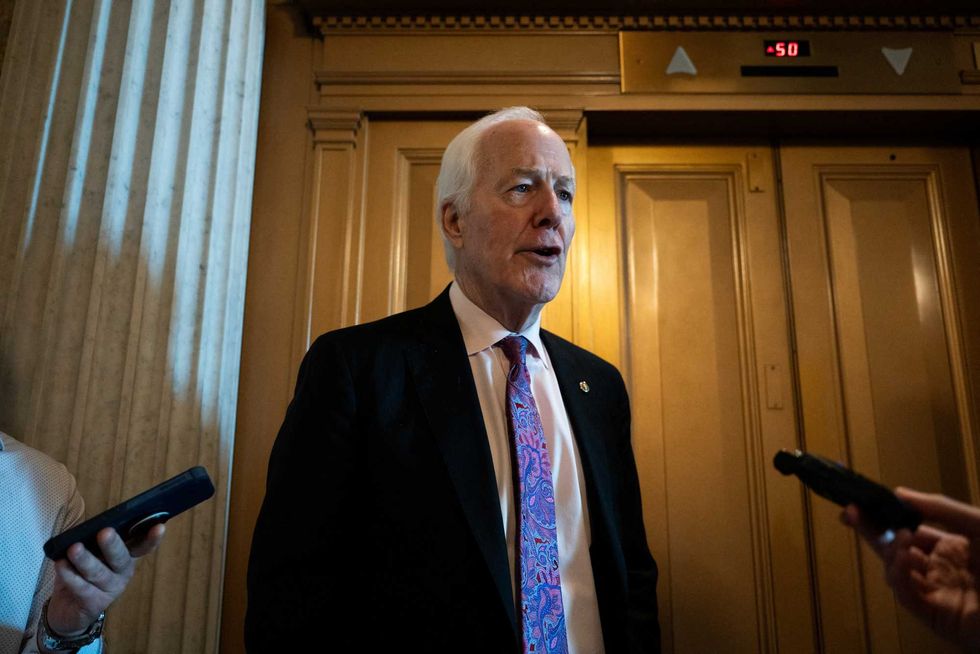
Sen. John Cornyn (R-TX) slammed President Donald Trump's demand for the Senate not to take a recess until the SAVE America Act is passed.On Monday, the senator, who was recently ousted from the Texas Republican primary runoff following Trump's endorsement of his opponent, Ken Paxton, called this whole plan an "act of futility," NOTUS' Igor Bobic reported.“Unfortunately, with the assistance of some senators, he's raising expectations among Republican voters," said Cornyn. "They're bound to end up being disappointed, which strikes me as a bad approach 99 days before the midterms.”Trump has been obsessed with passing the SAVE America Act for months. The legislation would impose draconian nationwide restrictions on voting rights, including proof-of-citizenship and voter ID requirements so strict that even REAL ID driver's licenses wouldn't be acceptable in most states.The passage of the bill was a significant flash point in the Texas Senate primary, even though both Cornyn and Paxton supported the legislation; Paxton vowed to drop out of the race if Congress passed the legislation before the date it was held, as a ploy to pin its failure to pass on Cornyn as the incumbent.Senate Majority Leader John Thune (R-SD), for his part, has also poured cold water on the scheme to hold back the Senate from recess, reminding Trump and the general public that the votes just aren't there to change Senate rules to stop a Democratic filibuster.