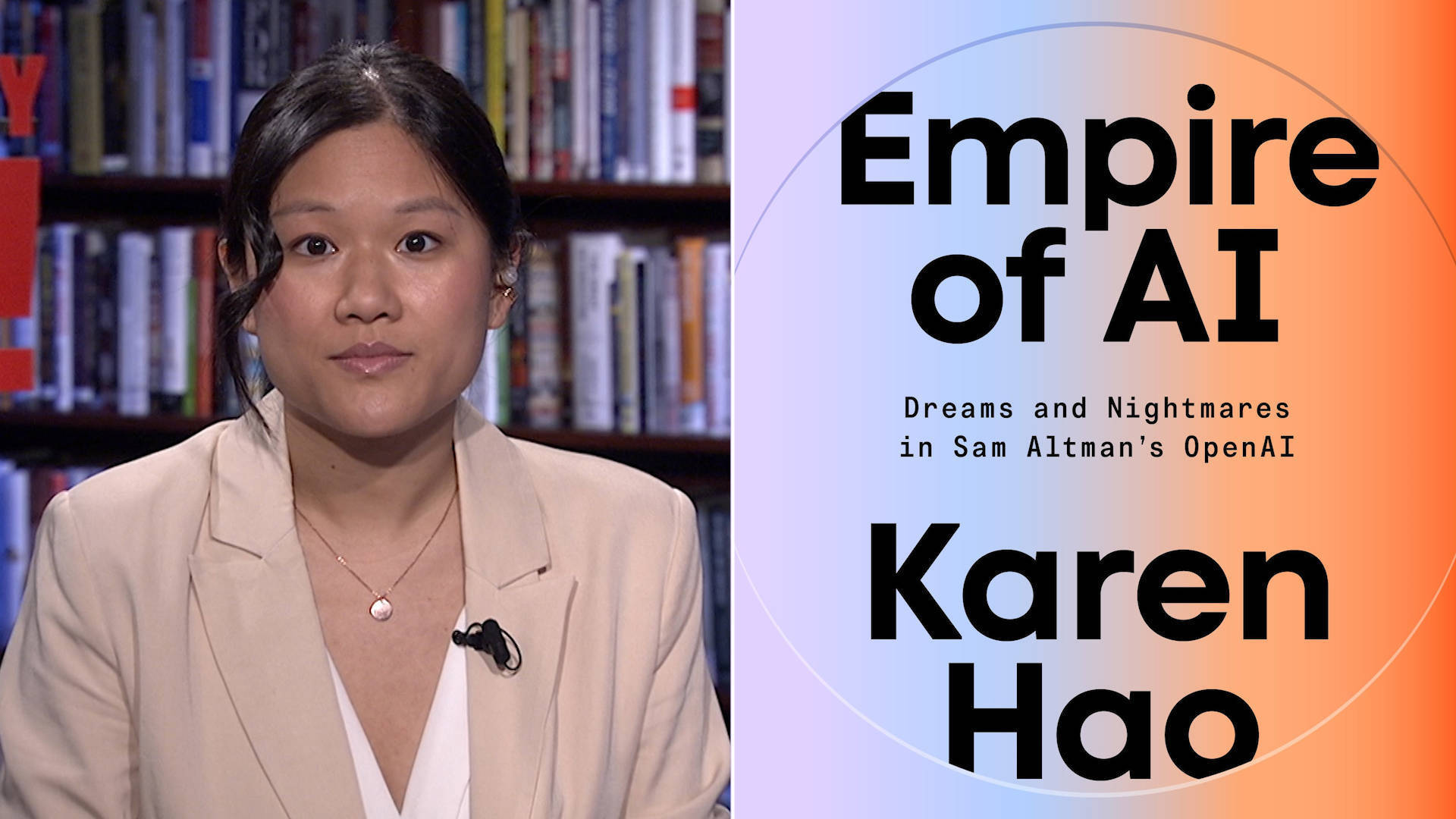
The White House released a new framework for national AI legislation Friday morning, focusing on protections for children and boosting America’s AI industry.
The White House released a new framework for national AI legislation Friday morning, focusing on protections for children and boosting America’s AI industry.
A Pennsylvania state representative is calling out Democrats after he was kicked off the House floor for wearing patriotic clothes. Rep. Eric Davanzo showed up to work […]
President Donald Trump's controversial new intelligence chief is clearing house, and career officers warn the man swinging the axe doesn't know what he's cutting.Bill Pulte, Trump's loyal acting director of national intelligence, began notifying dozens of intelligence officials of their terminations Thursday, part of a downsizing Trump ordered when he installed Pulte at the office two weeks ago, MS NOW reported Friday. An intelligence official, who spoke anonymously citing fear of reprisal, told the outlet that leadership is targeting workers it believes are "deep state" and accused them of failing to hand up a complete picture of available intelligence.But former officials aren't buying his rationale. Several told MS NOW they had never heard of intelligence officers withholding information from their superiors. "The premise is absurd," one said. Another questioned how Pulte, who ran the federal housing agency and has no intelligence background, could reach such a conclusion within days of arriving.“I have a real question of how he would know this. This isn’t a guy who is familiar with intelligence,” a former official told the outlet. “How is he going to get to the bottom of this and rely on any information with a matter of fidelity? It would be like me taking over a hospital and firing dozens of surgeons in a matter of days.”The cuts follow Pulte's earlier removal of six political appointees who served under his predecessor, Tulsi Gabbard. His arrival has drawn alarm across party lines: he took the post without ever holding a security clearance, and he can stay in the acting role past November's midterms under federal vacancy rules. Critics note his office doesn't collect intelligence of its own, relying instead on the CIA, the NSA and more than a dozen other agencies to supply it.Democrats and some Republicans fear the purge is less about efficiency than about clearing out analysts who might resist Trump's election claims. The ODNI says it is providing "elite, apolitical intelligence that keeps America safe."
MS NOW reports voters appear to be mindful of President Donald Trump raking in millions of dollars this summer while their own air-conditioning bills are creeping out of reach of their monthly home budget.Across much of the country, the 4th of July weekend is bringing more than just fireworks. It's also bringing dangerous and potentially record-breaking heat from the Midwest all the way to the northeast with heat indexes potentially climbing well above 100 degrees.More than 160 million people in 30 states are currently under extreme heat warnings this holiday weekend, with little sign of relief from either Mother Nature or the Trump economy. In places like New York, for example, humidity can make a 100-degree day feels like 110, 115 degrees. And it is, of course, considerably more humid in many Southern red states.MS NOW reporter Moses Small marched out into the street and talked to voters fleeing high home utility bills at city cooling centers.“Yeah, it's stressful,” said New York resident Daniela Crespo. “I've been anticipating looking at the forecast, thinking about, how many days am I going to run the AC? What temperature am I going to set it at? What is this going to cost me? It definitely has been on my mind.”Crespa added, however, that even as her own monthly electric bill blows up in her face and she struggles to control it by adjusting her AC to the tip of tolerance she is markedly aware of the extreme wealth pooling out of the White House and the Trump family’s bank accounts.“I mean, I think it really distills the kind of moment we're in with the level of corruption that we're seeing at the very highest levels of government,” Crespa told Snow, speaking on Trump making $2 billion in White House related monetization schemes and crypto machinations since returning to the White House.“When it gets to this hot, families tell me they really do think about the utility bills and their bank accounts,” said Snow, “especially with the Bureau of Labor Statistics reporting inflation up 4.2 percent in the past year — but within that, a 23.5 percent jump on energy costs.”Snow added that a CNBC analysis claims Americans, on average, have spent an extra almost $450 in gas and electric prices alone since Trump unilaterally kicked off his war in Iraq. Meanwhile, the money the Trump family is making while occupying the White House appears to smell with enough corruption to make Democrats competitive even in some of the reddest farm states this November. - YouTube youtu.be
The Justice Department (DOJ) declined on Thursday to release additional unredacted records from its investigation into convicted sex offender Jeffrey Epstein, telling a federal judge that it has already adequately complied with the law. The DOJ’s response came in the final hours of a court-ordered deadline to remove redactions in at least a dozen documents…
The fight that scrubbed the world's most powerful AI models from the internet featured personality clashes, industry confusion, and international backlash.Why it matters: Anthropic's models are back online, but the impact of its 20-day showdown with the Trump administration will be long lasting.Behind the scenes: It began when Amazon, Anthropic's partner and investor, sounded an alarm that was later disputed by cybersecurity experts.It warned about a "jailbreaking" issue it found with the AI lab's latest models, Mythos and Fable — meaning a technical flaw that could have caused a failure of their guardrails.Amazon flagged its concerns to the administration, triggering sweeping export controls. A U.S. official said the government conducted its own tests once it became apparent that the issue needed to be addressed.Cybersecurity experts, however, later wrote in an open letter to the administration that other leading AI models have the same issue Amazon warned about with Anthropic.On June 12, Commerce Secretary Howard Lutnick, at the direction of President Trump, called Anthropic CEO Dario Amodei. Lutnick made clear to Amodei the issue needed to be resolved fast and alerted the CEO that the company would be receiving a letter imposing sweeping export controls, the U.S. official said.Amodei called Lutnick back that night after receiving the letter, realizing it effectively meant the models would have to be taken offline — to which Lutnick responded that was indeed the goal.That decision led to a three-week, multi-agency crash course in AI safety.Anthropic deployed engineers to Washington D.C. According to a U.S. official, the company wanted to prove everything was already resolved and further changes were being fine tuned.But the federal Center for AI Standards and Innovation and the National Security Agency said those changes weren't good enough, prompting further fixes, according to the U.S. official.Gradually, various agency heads approved of the changes, and on July 1 the models were released, the official said.Out of all of the administration officials Amazon's Andy Jassy could have called, it was Treasury Secretary Scott Bessent who first heard about the jailbreaking issue found in the company report, according to a separate source familiar.Bessent was early to sound the alarm on Mythos, work with White House Chief of Staff Susie Wiles to re-engage the embattled company, and help get a cybersecurity executive order across the finish line.While technical discussions to address the jailbreaking issue took place in D.C., it was Bessent who stood next to President Trump during the G7 where allies called for global cooperation on safety standards.At the center of the showdown was Commerce Secretary Howard Lutnick, who also flanked Trump at the G7 meeting while his department's teams led technical discussions.National cyber director Sean Cairncross, the White House Office of Science and Technology Policy, Treasury Department chief information officer Sam Corcos, and the NSA also all participated in technical discussions, according to various sources.Washington mobilized faster to hold scores of meetings and pulled in far more agencies than one would expect for a single technical issue, one source said.The tension spiraled amid personality clashes and poor communication.Anthropic eventually understood that in order to be successful they needed to be on the same side as the government, the U.S. official said.As discussions turned more technical, Anthropic policy chief Sarah Heck and Anthropic co-founder Tom Brown got more involved. Brown also had multiple conversations with Lutnick and Cairncross the weekend of June 12.There was never a moment where Dario stepped offstage and someone else replaced him, one source said, adding that Brown's technical expertise allowed him to sit in a room with government specialists and go line‑by‑line through how models behave under stress.Between the lines: It remains uncertain when and how Anthropic's models will be released to ally countries around the world — which proponents say is key to beating China — or how other labs from OpenAI to Google will release their latest models.OpenAI, whose latest model GPT-5.6 is on hold, did not have visibility into discussions between Anthropic and the White House and is engaged in daily technical discussions on the release of its own model, a source said.The bottom line: There's a lot of work left to be done on a framework for approving future models with a clear inclusive process that has transparency standards and timelines, sources familiar said.