Trump says the U.S. will work with Iran to destroy its uranium if they can make a deal
Center Left
President Donald Trump said the U.S. will work with Iran to retrieve and destroy its highly enriched uranium if he is able to cut a deal with Tehran to end the war.
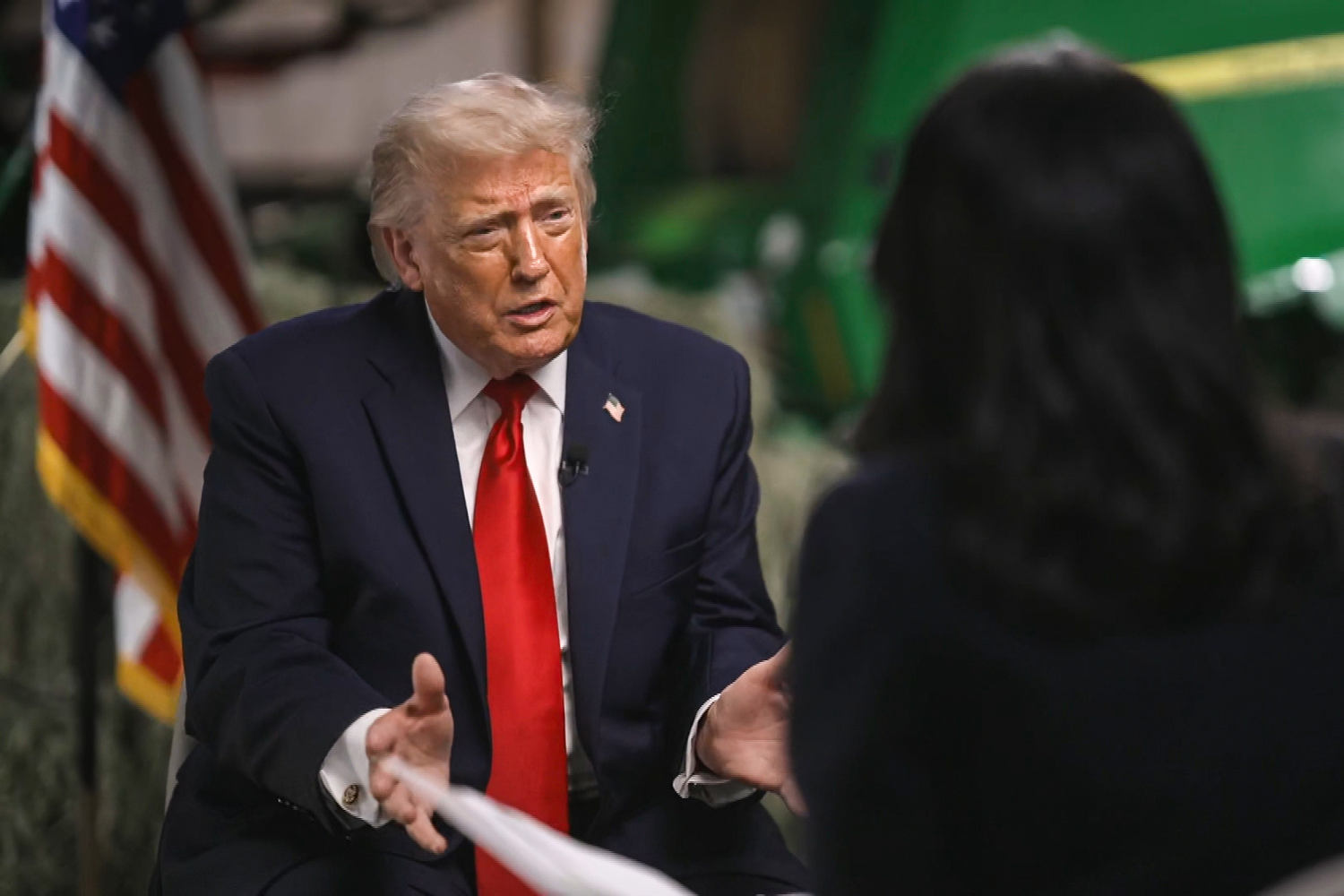
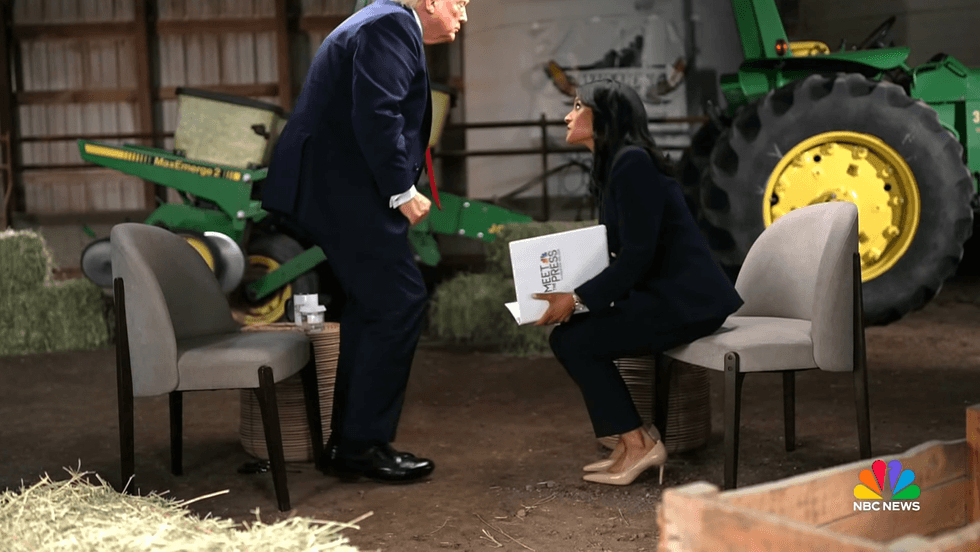
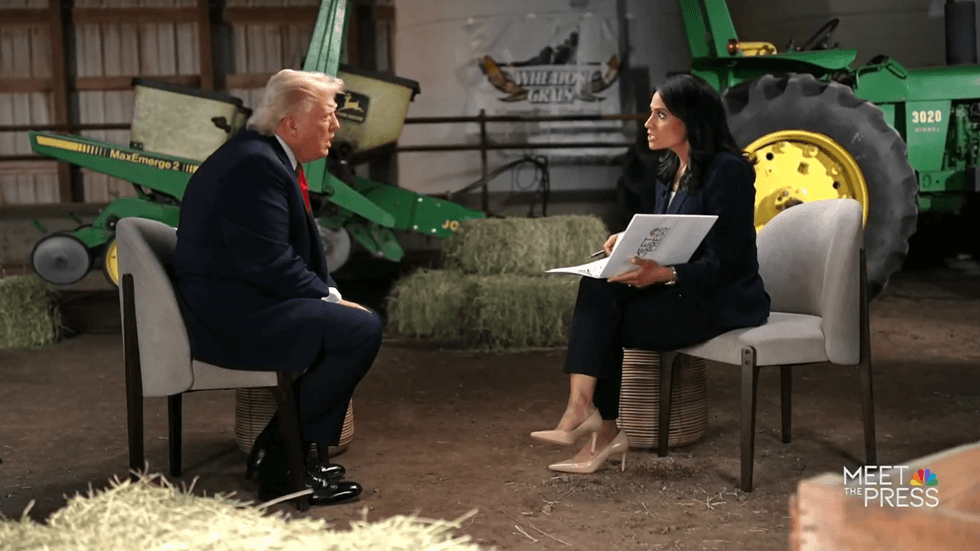
President Donald Trump stormed out of an interview with NBC’s Kristen Welker after ripping the interview for being “crooked” and ranting about “rigged” elections. The president’s interview aired Sunday on Meet the Press but was filmed on Friday while Trump was in Wisconsin for an agricultural roundtable. The interview was filmed inside a metal barn, […]
President Donald Trump, as a Republican, should theoretically support fiscal conservatism. Yet according to a report by a financial journalist, under Trump America’s national debt and deficit are ballooning to dangerous levels.“The price that the U.S. government has to pay to borrow money for 30 years has already punched through 5 percent a year, its highest level since the financial crisis of 2007,” reported The Washington Post's Matthew Lynn on Sunday. “For 10-year money, the annual price is 4.6 percent and climbing. Amid all the noise about the rise of artificial intelligence and the booming space economy, something far more significant is happening in the financial markets. The cost of borrowing is being reset.”Lynn added that this raises the possibility that American voters will care enough about deficit reduction that it can become a politically viable issue again.“The U.S. national debt has reached $39 trillion, with interest payments now exceeding $1 trillion annually, compared to the near-zero interest rate after the 2008 financial crisis,” Lynn wrote. “This could trigger a financial crisis and, even worse, modern political leaders are no longer even paying lip service to the need for deficit reduction.” As a result, “the big space in American politics will be waiting for a leader who can steadily balance the books while restoring competitiveness, keeping inflation under control and maintaining government services.”Lynn concluded, “That won’t be easy. The U.S. deficit came in at 5.8 percent of gross domestic product in 2025, and it is not likely to be any lower this year. Bringing it down will require sustained hard work, lots of patience and the ability to tell hard truths. Those are not qualities that Washington has in abundance. Even so, it would be a big prize. The only real question is whether there is a leader out there who is willing to step up and take it.”Lynn is not alone among finance experts who are concerned about America’s growing debt crisis, which has grown worse under Trump due to his tax cuts for the wealthy, war against Iran and spending cuts on programs that help low-income Americans.“Unless we change course, the debt will only get worse—fast,” Brookings Institution senior fellow William Galston wrote for The Wall Street Journal earlier this month. “The Congressional Budget Office estimates that we are on track to accumulate more than $24 trillion in debt over the next decade, for a total of $56 trillion—120 percent of estimated GDP in 2036.”He added, “These numbers are so large that it is hard to grasp what they mean. One key measure is the cost of financing this swelling debt burden. Twenty-five years ago, interest payments on the national debt were 2 percent of GDP. This year they will claim 3.3 percent; a decade from now, 4.6 percent.”Trump’s outsized impact on the budget deficit began in 2017, when he passed another series of tax cuts for the wealthy called the Tax Cuts and Jobs Act (TCJA).“The Joint Committee on Taxation and the Congressional Budget Office have published several estimates of TCJA’s expected budget impact,” the nonpartisan Tax Policy Center explains. “These estimates all show TCJA substantially reducing revenues and increasing deficits over its first decade. The specific amount varies—from about $1 trillion to $2 trillion—for three reasons.”The Tax Policy Center continued, “First, the agencies estimated budget impacts using both conventional methods (which do not account for potential changes to the overall economy) and dynamic methods (which do). Second, the agencies originally estimated the budget impacts against a budget baseline established in 2017, when the act was debated and enacted. They later published updated figures using a 2018 baseline, which included new economic and budget information. Third, official scores typically do not include any new debt service costs resulting from tax cuts or spending increases. Projections for the entire budget, however, do include debt service.”
The Socceroos playing on football’s biggest stage in my adopted country would normally have me racing to book tickets. Not this year Is “USA! USA! USA!” a more fundamentally obnoxious chant than “Aussie! Aussie! Aussie! Oi! Oi! Oi!”? As an Australian who has spent most of the last 15 years living in the United States and is now a permanent resident, the Socceroos’ World Cup group match against the USA raises some questions. Has my adopted nation dethroned my homeland as the world’s foremost exponent of being unconscionably terrible to immigrants? And on a more personal level … who do I support here?Well, look, OK, there’s really only one answer to that second question. I’m not an especially patriotic type, but if anything does bring out my Australian-ness, it’s the World Cup – perhaps because it’s one of the few events at which we can still claim to be underdogs. And now, two decades after I rose at dawn to watch Australia’s dreams dashed by the intersection of Lucas Neill’s leg and Fabio Grosso’s general vicinity, I find myself living in a country hosting the tournament. Continue reading...
In a pre-recorded interview between President Donald Trump and NBC News’ Kristen Welker that aired on Sunday, a severe downpour of rain disrupted discussions multiple times in what one independent journalist characterized as a form of divine intervention. Trump was mid-sentence discussing "tractors" and "digging mechanisms" when an audible downpour outside the building drew his attention away from the interview, held at Custer Farms in Wisconsin. “Is that wind, or what?” Trump asked, abruptly pivoting from his remarks. “What is that?”A voice off camera – presumably a staffer at NBC News – confirmed the sound was due to rain.“This would be the first of multiple interruptions due to the weather,” Welker said in a narration recorded after the interview concluded. “Rain, hitting the metal roof, making it difficult for both of us to hear each other.”Independent journalist Aaron Rupar, who’s been labeled by The Times as “the man who watches Trump all day, every day,” characterized the multiple disruptions as a potential message from beyond.“The big guy upstairs wasn't pleased with this interview,” Rupar wrote in a social media post on X to his more than 1.1 million followers.After the disruption, Welker moved to get the interview back on track.“So as we’re having this conversation we can hear a little bit of rain,” she said.“No, a lot of rain!” Trump quipped as he began to smile.the big guy upstairs wasn't pleased with this interview:TRUMP: Is that wind, or what?WELKER: Is that rain?TRUMP: What is that?SOMEONE OFF CAMERA: Rain pic.twitter.com/acXzHBDZxz— Aaron Rupar (@atrupar) June 7, 2026
In an exclusive interview with Meet the Press, President Trump addresses the economy amid the war with Iran and says Federal Reserve Chair Kevin Warsh is “fantastic,” adding, “I want him to do whatever he wants” when it comes to setting interest rates.
Robert F. Kennedy Jr. reportedly arrives at the Department of Health and Human Services around 10 a.m., leaves by 4 p.m., spends staff meetings scrolling on his phone, and once apologized to colleagues for his "dysfunctional self" — and that's just the management style. The vacancies are a separate problem.A sweeping New York Times investigation published Sunday by reporter Sheryl Gay Stolberg, based on accounts from a dozen people with direct contact with Kennedy, paints a portrait of a health secretary deeply disengaged from the department he runs while an Ebola outbreak spreads and critical positions sit empty.When the World Health Organization declared the Ebola outbreak in Africa a public health emergency — with six Americans already exposed — a reporter asked Kennedy if he was worried. "Yeah, we're working on it," he said. He has made no public comments about the outbreak in the nearly three weeks since. He has received very few briefings from CDC scientists about the virus, according to the Times.The report notes that the department's leadership vacuum is stark. There is no surgeon general. Around half of the 27 institutes and centers at the National Institutes of Health are run by acting directors. The acting chief of the National Institute for Allergy and Infectious Diseases was recently fired. The FDA commissioner quit last month. The CDC director Kennedy fired last August is now run on an acting basis by Jay Bhattacharya — a health economist with no prior public health experience who simultaneously holds the enormous job of NIH director. The nation's pandemic preparedness office is run by a former Los Angeles firefighter who founded an anti-vaccine mandate group during COVID.Kennedy didn't even know the FDA's top drug regulator had been fired until after it happened, according to three people familiar with the events."You would never accept a major corporation operating this way," said Michael Osterholm, director of the University of Minnesota Center for Infectious Disease Research and Policy, who has advised health secretaries of both parties. "If the C.E.O. lacked deep expertise in the company's business and the leaders of its most important divisions were missing, investors would revolt. Here, the stakes are much higher."The Times found that Kennedy has surrounded himself with a tight circle of loyalists, chief among them longtime adviser Stefanie Spear, through whom all decisions and meeting requests are routed. When Kennedy is asked a question, his frequent response is "just run that by Stefanie." Her control has slowed department operations, colleagues say, and fueled departures — Kennedy is on his third top spokesman and has run through two chiefs of staff.When a gunman opened fire on CDC headquarters last August, Kennedy was fishing in Alaska. A statement to the media was held up for hours while Spear sought White House approval.Kennedy reportedly attends a weekly Tuesday briefing with the department's 13 division chiefs about once a month. When he does show up, multiple attendees described him as "checked out" and said he spends the time scrolling on his phone.Reactions came quickly.Political commentator Molly Jong-Fast summarized the reaction succinctly after the piece dropped: "We're cooked, I tell you.""RFK jr is working hard … at the gym but not at his job," she further added.Dick Cheney's former doctor, Jonathan Reiner, chimed in, "For all intents and purposes, Chris Klomp is the Sec of HHS."
President Donald Trump abruptly ended his interview with NBC News’ Kristen Welker that aired on Sunday after being pressed on his false claims that the 2020 election had been “rigged,” removing his microphone and leaving the set in a rage.“You’re a one-sided, crooked network!” Trump shouted at Welker after being told no evidence existed to support his false claims of widespread election fraud. “Let’s call it quits because I’ve had enough! Thank you, darling, have a good time!”Trump then removed what appears to be a microphone clipped on his suit jacket before Welker pleaded with him to finish the interview.“Mr. President, please, I traveled all the way to Wisconsin,” Welker said.“I’ve sat in the rain with you for an hour, on and off in the rain and I’ve given you enough time!” Trump said. “You ought to straighten out your press! Come on, let’s go.”WOW -- Trump crashes out and cuts his interview with Welker short as she presses him on his lack of evidence for claiming elections are rigged"You're either crooked or you're stupid. Let's call it quits. Because I've had enough. Thank you darling," he tells her.""I traveled… pic.twitter.com/qQaNIDnX4y— Aaron Rupar (@atrupar) June 7, 2026
President Donald Trump told NBC News’ Kristen Welker in an interview that aired Sunday that she would be blown up should his administration fail to achieve its stated war objective.In an episode of “Meet the Press,” Trump was being pressed on his deeply unpopular war against Iran, which, despite the president having claimed it would be resolved in a matter of weeks, has dragged on for well over three months.“Remember, you were in Vietnam 19 years because stupid people, you were in so many different countries, every war you were in for years, look at Iraq!” Trump said. “You were there for years!”Among Trump’s most prominent campaign pledges was to “end the endless wars.” During his acceptance speech in 2024, Trump explicitly said: “I’m not going to start a war.”And yet, Trump not only authorized the unprecedented attack on Venezuela back in January, but launched Operation Epic Fury in late February, kicking off the largest-scale U.S. military conflict since the U.S. invasion of Iraq.The stakes, however, were great, Trump warned Welker, who he said would be blown up should his administration fail to achieve its goal of preventing Iran from acquiring a nuclear weapon.“Listen, Kristen, we're there for a few months and the threat is largely over – soon it will be over – but you cannot let Iran have a nuclear weapon or they will blow you up,” Trump said. “There will be no Kristen, there will be no NBC, there will be no 'Meet the Press,' you will end the 'Meet the Press' string.”Trump: You cannot let Iran have a nuclear weapon or they will blow you up. There will be no Kristen, there will be no NBC, there will be no 'Meet the Press.' pic.twitter.com/T3LLa1AvAD— Alexander Willis (@ReporterWillis) June 7, 2026