A Fox News host uncorked a bizarre on-air tirade against Democratic Senate candidate James Talarico, calling him a "demon in human skin."Emily Compagno appeared to lose her composure on Friday's edition of "Outnumbered" while discussing Talarico, a 37-year-old state representative now in a statistical tie with embattled Republican nominee Ken Paxton. Compagno was reacting to a conservative PAC attack ad featuring Talarico calling the American flag a "complicated" symbol for many Americans."Every single voter [in Texas] needs to understand exactly who they would vote into office, which is an anti-business, anti-commerce, anti-capitalist, anti-Texas Texan," Compagno railed.She then escalated sharply."This person is a demon in human skin, and they need to make sure he does not go anywhere — to the nation's capital, where he can actually do some real damage other than his horrible words that he keeps spewing," she said.A Talarico spokesman responded that the campaign could confirm the candidate is "in fact a human, and not a demon in human skin."The outburst lands as the race tightens into a genuine toss-up. A New York Times/Siena survey released Monday found Paxton and Talarico deadlocked at 47 percent among likely voters, with Talarico leading 58-31 among independents and 61-29 among Hispanic voters.Paxton defeated four-term Sen. John Cornyn in a May 26 primary runoff after President Donald Trump threw his backing to the state's scandal-plagued attorney general. Paxton was impeached by the Texas House in 2023 before being acquitted by the state Senate, and he has faced years of criminal securities fraud allegations and accusations of abusing his office.Trump himself has appeared unsettled by Talarico's rise. In a Truth Social post after the runoff, the president refused to use the Democrat's name, instead branding him "Alfred E. Neuman" and "the worst TEXAS candidate I have ever seen."On "Outnumbered," Compagno added that Talarico's past remarks were "patently disqualifying for any American senator."Compagno on Talarico: This person is a demon in human skin pic.twitter.com/BM5nohCvxT— Acyn (@Acyn) July 3, 2026
Small towns hoping to put on celebrations for America’s 250th anniversary have had to cancel or scale back their plans after the Trump administration cut their funding.NOTUS reports that Elon Musk’s Department of Government Efficiency slashed funding for humanities nonprofit councils in states and territories across the country, many of which planned to use those federal funds on history projects for the upcoming semiquincentennial. These official nonprofits were created by Congress to help make history and literature accessible to the American public.Humanities councils in Ohio, West Virginia, Alabama, and Washington state all had to axe or scale back their anniversary plans, their leaders told NOTUS, and it had a ripple effect down to local historical organizations.Musk’s DOGE initiative left these state organizations with just enough money to stay afloat last year. President Trump shifted millions from DOGE cuts toward his “triumphal arch” and “Garden of American Heroes,” preventing further funds from going toward local 250th anniversary projects.Congress tried to remedy the shortfall by restoring funding for the state humanities councils to their normal levels for the 2026 fiscal year. But the Trump administration has refused to disburse that money, giving the councils less than half of what was appropriated, and told them not to expect any more.That’s having a real impact in towns across America.“It means that we are not able to do things that are extra, things that are bigger projects. A lot of humanities organizations would have had some incredible projects that none of us have been able to complete,” said Jessica Cyders, the executive director of the Southeast Ohio History Center. Her organization could have been a candidate for a 250th anniversary grant from Ohio Humanities, which distributes federal grants to the state’s local historical societies and community groups.“There’s not really a lot of cultural infrastructure in West Virginia. Where most of the cultural work is done is in regional centers, community centers, small museums, county historical associations. So the people who really got hurt were those small organizations across the state,” Eric Waggoner, the head of the West Virginia Humanities Council, told NOTUS. They had planned to send their 250th anniversary funding to West Virginia University, local libraries, and small museums.“I’m sad to say we had to scrap it,” Waggoner said. “Since we’re the only organization that does this kind of grant-making in West Virginia, without us, there’s really not much.”“This is a pretty significant national event,” Cyders said. “Look, I’m probably not going to be alive for the 300th anniversary.”Trump also took funding from America 250, the federal bipartisan organization that was supposed to be planning the semiquincentennial celebrations, and redirected it toward his own pet Freedom 250 projects. The president seems to have ruined what could have been amazing celebrations for the entire country with his ego, and who knows what could have been going on at the National Mall instead of a tacky “Great American State Fair.”
As reporting increasingly suggests that the U.S. federal aid cuts spearheaded by trillionaire Elon Musk last year have led to preventable deaths abroad – and potentially millions by 2030 – the Tesla CEO issued his critics a challenge to “cite a single name of someone who died,” but grew notably silent after being given countless examples.“They cannot cite a single name of someone who died out of the ‘millions’ they falsely claim have died,” Musk wrote Sunday on his social media platform X. “Not a single name!”Musk’s online post was immediately hit with thousands of replies, many of them citing the names of individuals as young as three years old whose deaths had been attributed to a disruption in U.S. foreign aid. Among the most notable responses came from New York Times opinion columnist Nicholas Kristof, who’s extensively reported on the impact from U.S. foreign aid cuts spearheaded by Musk.“Elon, I can give you many, many names of people who have died because of your aid cuts,” Kristof wrote, listing several individuals who died over the past year due to U.S. foreign aid cuts – people whose families or caretakers he had personally spoken with.Despite Musk publishing countless social media posts since Kristof’s response, he ultimately did not respond, and instead authored posts related to other topics such as immigration, including a post published Monday morning advocating to “deal with traitors first, then the invaders.”“Odd. No response from Elon Musk,” noted political commentator Tom Santos in a social media post to their nearly 40,000 followers. “Actually, not odd at all. Elon tends not to engage when actual facts are introduced to the bull--- he spews.”Even Musk’s own generative artificial intelligence chatbot Grok refuted Musk’s claim of there not being a “single” death attributable to U.S. foreign aid cuts, with former MSNBC host Mehdi Hasan sharing the chatbot’s response in a social media post on X.“Musk lies like the rest of us breathe. Here's what Grok says,” Hasan wrote, posting a screengrab of Grok’s response listing names of those whose deaths were linked to U.S. foreign aid disruptions.Musk lies like the rest of us breathe. Here's what Grok says: https://t.co/CgZfceTGig pic.twitter.com/ynVVUkbDXm— Mehdi Hasan (@mehdirhasan) June 28, 2026
Sen. Bill Cassidy (R-La.) in a Sunday interview sought to explain his controversial vote to confirm Health and Human Services (HHS) Secretary Robert F. Kennedy Jr., as he said Kennedy is dug in on his views toward vaccinations despite public opinion. Cassidy, the first physician to serve as the chair of the Senate Health, Education,…
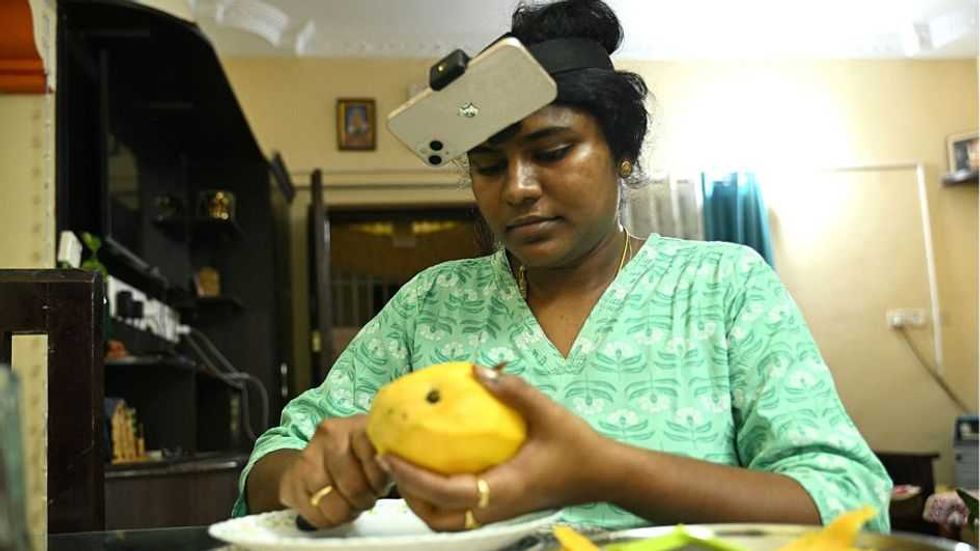
If you want to glimpse the future of artificial intelligence, don't start in Silicon Valley. Start in a South Korean factory.According to the International Federation of Robotics, South Korea now has 1,012 industrial robots for every 10,000 manufacturing workers — the highest robot density in the world. Put another way, roughly one in every 10 manufacturing "workers" is now a robot.For now, however, even the world's most advanced humanoid robots still struggle with tasks that young children perform effortlessly.That startling figure is one piece of a much larger story stretching from American AI labs to South Korean factories, Chinese assembly lines, and Indian garment workshops.For most Americans, the AI revolution is something that happens on a screen. We think of ChatGPT writing emails, Claude summarizing reports, or Google Gemini answering questions. The race appears to revolve around Silicon Valley companies building ever more capable language models.But the next phase of artificial intelligence is becoming much more physical.Instead of asking how machines can write like humans, researchers are asking how they can move like humans — how they grasp a coffee mug, fold a shirt, stitch a collar, or crack an egg without crushing it.That challenge has created an unexpected global division of labor: America builds the brains, South Korea builds the bodies, China provides the classroom, while India supplies the teachers.Together, they're revealing something surprising: the future of artificial intelligence depends on ordinary human beings.South Korea: Building the bodiesIf robotics has an epicenter, it may well be South Korea.The country's dominance in robotics didn't emerge from nowhere. It grew out of decades spent building some of the world's most advanced automobiles.The same expertise that allows South Korean companies to manufacture electric motors, precision steering systems, sensors, braking technology, and other high-performance automotive components translates remarkably well to humanoid robots. Goldman Sachs Research estimates Korean companies could account for roughly 30% of global humanoid robot production by 2035, either by manufacturing robots directly or supplying the critical components that allow them to move.Yet South Korea's embrace of automation has also exposed its tensions.This week, Hyundai workers overwhelmingly voted to authorize strike action after contract negotiations stalled, with robots emerging as a central issue for the first time.The union isn't simply demanding higher wages.It wants guarantees over how artificial intelligence and humanoid robots will be introduced onto factory floors, arguing that workers deserve a voice before machines begin performing jobs currently done by people.The dispute centers on Atlas, the humanoid robot developed by Hyundai-owned Boston Dynamics.While company executives describe Atlas as a way to perform dangerous, repetitive, and physically demanding work, union leaders see a machine that could eventually replace the people who build Hyundai's cars.The disagreement captures the paradox facing much of the developed world.Countries like South Korea desperately need automation. It has one of the world's fastest-aging populations and one of its lowest birth rates, creating labor shortages that robots may eventually help fill.Yet the workers whose jobs are most vulnerable understandably want assurances that they won't become casualties of the technological transition.Child's playFor now, however, even the world's most advanced humanoid robots still struggle with tasks that young children perform effortlessly.Finding a coffee pot, identifying its handle, lifting it correctly and pouring without spilling remains astonishingly difficult for a machine.The bottleneck is no longer the body or the brain. It is experience.Engineers can now build remarkably capable robot bodies and increasingly sophisticated AI models. What they can't manufacture is the accumulated experience that allows humans to navigate the physical world almost without thinking. Like a child learning to walk — or an apprentice learning a trade — robots improve only through repeated interaction with the real world.RELATED: Your child’s new best friend might be a Chinese surveillance device akinbostanci/Getty ImagesChina: Generating the experienceSouth Korea may lead the world in robot density, but China wins on sheer scale.According to the International Federation of Robotics, China had 2.027 million industrial robots operating in its factories in 2024. It installed another 295,000 robots that year alone, accounting for 54% of global robot demand.That scale gives Beijing an enormous advantage in the next phase of AI.Unlike ChatGPT, which learned from enormous quantities of text on the internet, humanoid robots must learn by interacting with the real world.