Congress wants to tie the United States to Israel with new piece of legislation. It’s a trap | Eli Clifton and Ian Lustick
Center Left
Israel and its lobby will use section 224 of the National Defense Authorization Act to bind the US to a state that has gone rogueCongress is considering legislation that would embed Israel’s military deeply within the US military-industrial complex. Stunned by the cratering of public support for Israeli policies in Gaza, Lebanon and the West Bank and towards Iran, Israel’s advocates are frantically seeking to preserve and even escalate US support for the Jewish state in ways that do not rely on defense of its policies or permit scrutiny of the manipulations involved.Politically, this means avoiding public discussion of Israeli policies in Gaza, Lebanon, the West Bank or Iran and disguising the sources of massive amounts of money pouring into election races to defeat candidates raising questions about US support for Israel. The proposed legislation shows what this means bureaucratically. Continue reading...
Two members of Congress resigned on April 13, 2026, after being accused of abusing their power to prey on women staff, prompting a bipartisan effort to improve the reporting process for sexual misconduct in Congress.
President Donald Trump is desperate to maintain his hold on the Republican-dominated House, so he’s personally fighting for plenty of embattled seats. But some seats are going to be a much harder sell for him and his Republican Party."The Republicans are just in absolutely huge trouble in Wisconsin. I think that more so than any of the polls would say … the fact that all those Republicans are leaving the state Legislature, they're sort of telling us with their actions what they expect," said Kyle Kondik, managing editor of Sabato's Crystal Ball, a nonpartisan political newsletter at the University of Virginia's Center for Politics.Trump is making his first trip to the Badger State since he won here nearly two years ago, visiting one of the nation's few battleground congressional districts, but the Milwaukee Journal Sentinel says he’s coming at a time “when his approval among Wisconsin voters is at an all-time low.“The visit comes at a time when the president's tariffs and recent attacks on Iran have produced gale-force headwinds for Republicans in their effort to preserve their power in Congress and in state government in Wisconsin, an effort made more complicated by the retirements of the Legislature's two GOP leaders and key members of both houses,” reports the Journal.Nevertheless, Trump is planning to discuss agricultural issues during a Friday roundtable event at a farm in Chippewa Falls, which lies in the 3rd Congressional District − a swing district held by Republican incumbent Rep. Derrick Van Orden. Van Orden's district is one of just 18 congressional districts considered a toss-up in the upcoming midterm election, and the Trump administration heavily focused upon it. The paper reports Trump's visit comes days after U.S. Health and Human Services Secretary Robert F. Kennedy Jr. held an earlier event with Van Orden.Van Orden won the district twice, but he defeated his opponent by about 3 points two years ago. Now one of those opponents, Democrats Rebecca Cooke, will be on his heels again this year, if she surpasses Democrat Emily Berge in the primaries.“But the political environment this year favors Democrats, who have won governor races and special elections in other parts of the country since Trump took office,” reports the Sentinel. “In Wisconsin, liberals won a seat on the state Supreme Court in April by a stunning 20-point margin. Republicans did not even bother to field a candidate in another election for a court that the GOP dominated just a handful of years ago.This is a hard fall for a state that voted for Trump in 2024.The Sentinel reports Trump's influence “remains strong among Republican voters – 71 percent said they would vote for a 2026 primary candidate endorsed by Trump. However, it also notes that a nationwide Marquette University Law School poll released two days before Trump's visit to western Wisconsin found his approval rating dropped to 38 percent, the lowest point so far in his second term.
President Trump, a native New Yorker and self-described Knicks fan, said he was invited to attend a Knicks playoff game by the team's owner James Dolan, who has donated to his political campaigns.
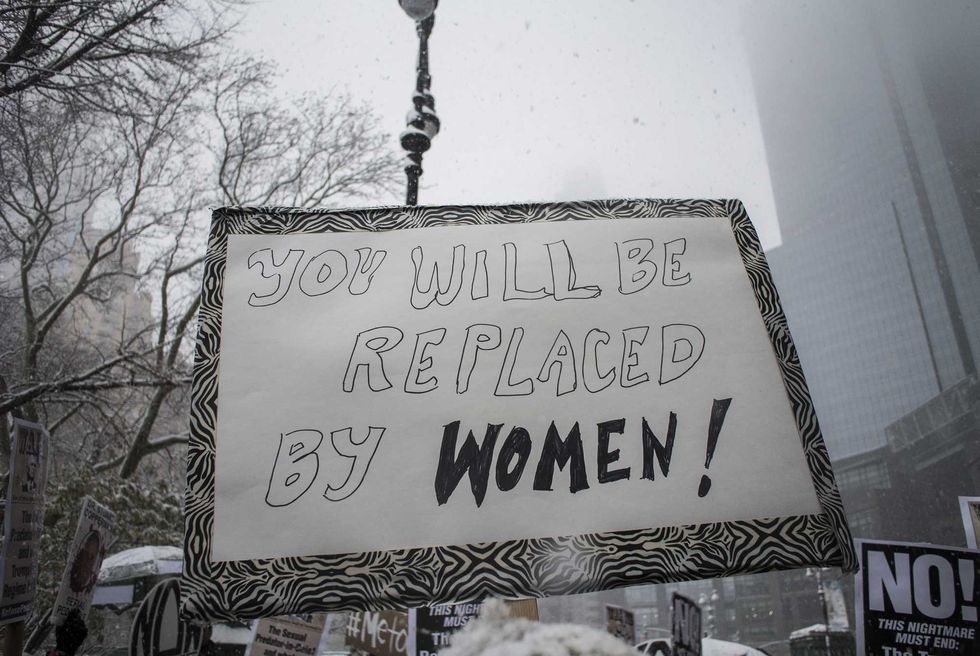
President Donald Trump celebrated the jobs report published on Friday by the U.S. Bureau of Labor Statistics, which shows that American employers added jobs for the third consecutive month.The report, which Trump called "great," says the U.S. economy added 172,000 jobs last month; the unemployment rate remained unchanged at 4.3%; the number of unemployed people, 7.3 million, "changed little over the month"; and the labor force participation rate held at 61.8%.'Bodes ill for the country.'Total employment growth for the months of March and April were revised up by 29,000 and 64,000, respectively."This is a labor market that is stronger than it was last year and is looking pretty darn solid, despite high energy prices and higher inflation generally," Gus Faucher, chief economist at PNC, told CNBC. "There's no indication that the labor market needs support."While the labor market is purportedly healthy, there are a pair of potentially destabilizing trends under way behind the scenes: the overwhelming majority of new payroll jobs are going to women, and a staggering number of men have given up on finding a job.Jason Riley, a senior fellow at the Manhattan Institute, recently highlighted that "the share of American men in the labor force has dipped to record lows." Labor Department data revealed last month that one in three men were neither working nor looking for a job.RELATED: Steelworkers need a future, not another merger war Keystone-France/Gamma-Keystone/Getty ImagesThe male labor-force participation rate has declined significantly in recent years, to say nothing of the precipitous decline that has taken place over the past century. The male LFP rate was 87% in 1948, 75% in 2000, and — according to the latest jobs report — 67.2% in May."The premature absence of millions of able-bodied men from our workforce, combined with the continuing retirement of the Baby Boomers and significant reductions in immigration, bodes ill for the country," wrote Riley. While there are multiple factors at play — Baby Boomers are, for instance, retiring en masse; young men are dropping off to study; there is diminished demand for non-college male labor; and prime-age men are falling to the wayside because of illness and disabilities — the Washington Post recently pointed out that:the labor market has weakened since early 2025, with most job opportunities concentrated in areas typically dominated by women, including health care and private education. At the same time, several male-dominated industries, including manufacturing, transportation, and mining have shed jobs, leaving a mismatch between typical skill sets and job opportunities for men.It's evidently a new day for female labor.Whereas in the mid-1970s, women held roughly 40% of jobs in the U.S. — not including agricultural work or self-employment — they now hold the majority of jobs in the country.NPR's "Morning Edition" reported that of the roughly 369,000 jobs created between the beginning of Trump's second term and April, 348,000 jobs went to women and 21,000 jobs went to men. In other words, 94% of the jobs went to women and only 6% to men.Courtney Parella, a spokeswoman for the Labor Department, stressed to "Morning Edition" that raw job counts provided a "misleading snapshot" of the labor market, adding that "both men and women are benefiting from a strong economy."Women have picked up the supermajority of net new payroll jobs in part because of the growth in female-dominated sectors, namely health care — where women hold roughly 80% of the jobs — and social assistance.Like Blaze News? Bypass the censors, sign up for our newsletters, and get stories like this direct to your inbox. Sign up here!