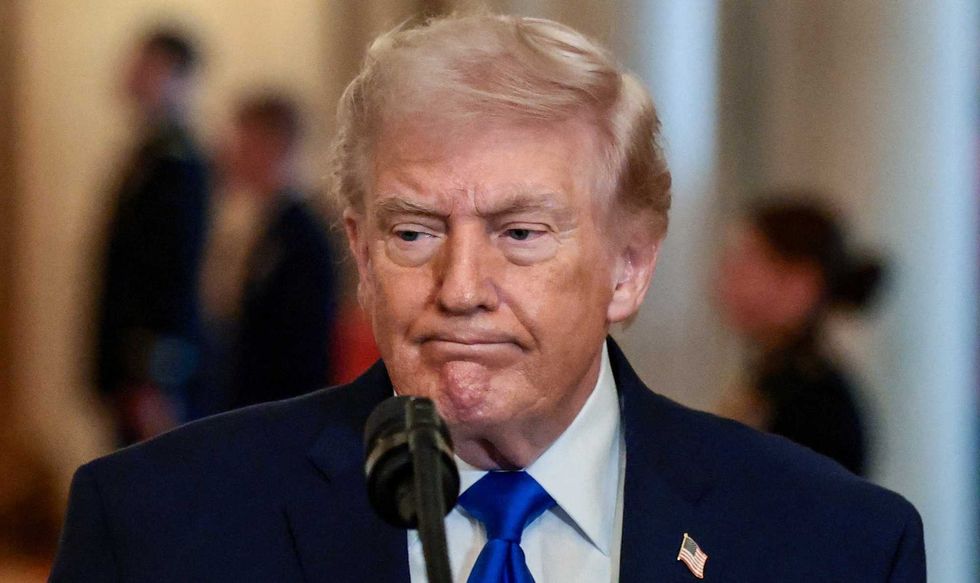
Trump plans to attend NBA Finals in New York City
President Trump, a native New Yorker and self-described Knicks fan, said he was invited to attend a Knicks playoff game by the team's owner James Dolan, who has donated to his political campaigns.

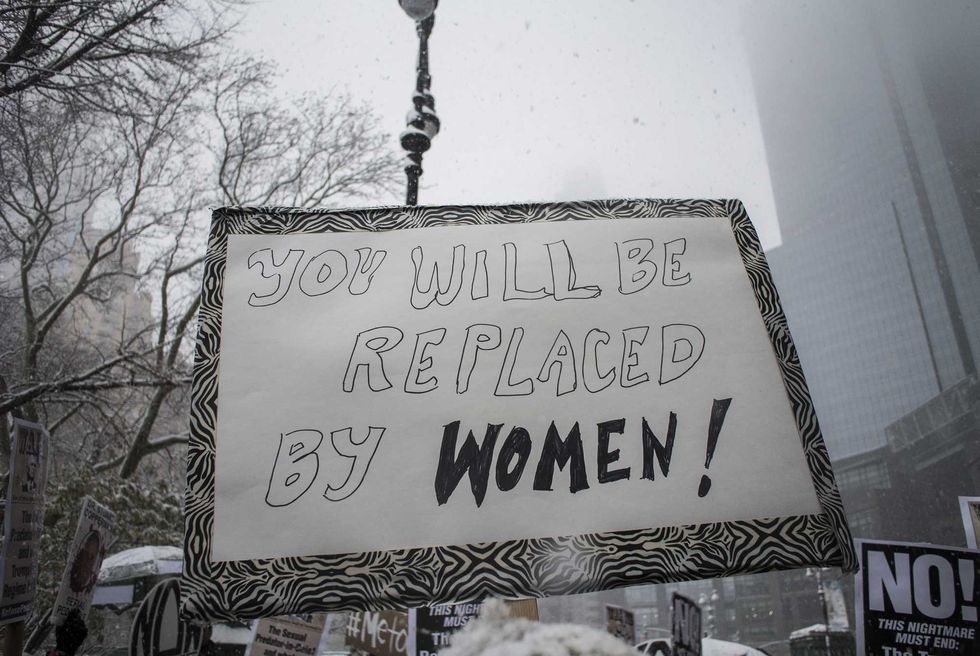
President Donald Trump celebrated the jobs report published on Friday by the U.S. Bureau of Labor Statistics, which shows that American employers added jobs for the third consecutive month.The report, which Trump called "great," says the U.S. economy added 172,000 jobs last month; the unemployment rate remained unchanged at 4.3%; the number of unemployed people, 7.3 million, "changed little over the month"; and the labor force participation rate held at 61.8%.'Bodes ill for the country.'Total employment growth for the months of March and April were revised up by 29,000 and 64,000, respectively."This is a labor market that is stronger than it was last year and is looking pretty darn solid, despite high energy prices and higher inflation generally," Gus Faucher, chief economist at PNC, told CNBC. "There's no indication that the labor market needs support."While the labor market is purportedly healthy, there are a pair of potentially destabilizing trends under way behind the scenes: the overwhelming majority of new payroll jobs are going to women, and a staggering number of men have given up on finding a job.Jason Riley, a senior fellow at the Manhattan Institute, recently highlighted that "the share of American men in the labor force has dipped to record lows." Labor Department data revealed last month that one in three men were neither working nor looking for a job.RELATED: Steelworkers need a future, not another merger war Keystone-France/Gamma-Keystone/Getty ImagesThe male labor-force participation rate has declined significantly in recent years, to say nothing of the precipitous decline that has taken place over the past century. The male LFP rate was 87% in 1948, 75% in 2000, and — according to the latest jobs report — 67.2% in May."The premature absence of millions of able-bodied men from our workforce, combined with the continuing retirement of the Baby Boomers and significant reductions in immigration, bodes ill for the country," wrote Riley. While there are multiple factors at play — Baby Boomers are, for instance, retiring en masse; young men are dropping off to study; there is diminished demand for non-college male labor; and prime-age men are falling to the wayside because of illness and disabilities — the Washington Post recently pointed out that:the labor market has weakened since early 2025, with most job opportunities concentrated in areas typically dominated by women, including health care and private education. At the same time, several male-dominated industries, including manufacturing, transportation, and mining have shed jobs, leaving a mismatch between typical skill sets and job opportunities for men.It's evidently a new day for female labor.Whereas in the mid-1970s, women held roughly 40% of jobs in the U.S. — not including agricultural work or self-employment — they now hold the majority of jobs in the country.NPR's "Morning Edition" reported that of the roughly 369,000 jobs created between the beginning of Trump's second term and April, 348,000 jobs went to women and 21,000 jobs went to men. In other words, 94% of the jobs went to women and only 6% to men.Courtney Parella, a spokeswoman for the Labor Department, stressed to "Morning Edition" that raw job counts provided a "misleading snapshot" of the labor market, adding that "both men and women are benefiting from a strong economy."Women have picked up the supermajority of net new payroll jobs in part because of the growth in female-dominated sectors, namely health care — where women hold roughly 80% of the jobs — and social assistance.Like Blaze News? Bypass the censors, sign up for our newsletters, and get stories like this direct to your inbox. Sign up here!
President Trump, a native New Yorker and self-described Knicks fan, said he was invited to attend a Knicks playoff game by the team's owner James Dolan, who has donated to his political campaigns.
Thursday on "The Alex Marlow Show," Sen. Tommy Tuberville (R-AL) called for an end to the filibuster to pass the SAVE America Act. The post Exclusive: Tuberville Warns ‘We’re Going to Lose the Damn Country’ if We Don’t Bust Filibuster, Pass SAVE America Act appeared first on Breitbart.
The House passed a spending bill Thursday night that included $141 million in cuts to a federal food assistance program focused on supporting women and children – a bill that would not have passed without the support of four House Democrats, who in turn drew scrutiny for their “puzzling” decision, The New Republic reported Friday.The spending bill would allocate funding for the Department of Agriculture and other federal agencies, and was passed by the House with a narrow vote of 213-210. The Supplemental Food Assistance Program, or SNAP, operates through the Agriculture Department, and a program within SNAP – referred to as WIC – specifically provides fruit and vegetable assistance to women, infants and children.The four Democratic lawmakers in question are Reps. Donald Davis (D-NC), Adam Gray (D-CA), Vicente Gonzalez (D-TX), and Marie Glusenkamp Perez (D-WA). As to why they joined Republicans in helping advance a bill that could reduce food assistance for mothers, children and infants, The New Republic’s Hafiz Rashid was left puzzled.“Three of the Democrats who voted for the cuts, Gray, Gonzalez, and Perez, are members of the conservative Blue Dog Coalition, and Perez has a reputation for often voting against her party,” Rashid wrote. “But it’s puzzling why fruit and vegetable assistance for mothers and children was deemed acceptable to cut, especially during an economic crunch. It’s highly likely that WIC enrollment will go up in the coming months, and now, fruits and vegetables will be more expensive.”
Gen Z isn't looking for sparks on every date — sometimes they're just working on their game.
On Friday, the Trump administration celebrated a better-than-expected jobs report, which showed the U.S. gained 172,000 jobs in May. But while President Donald Trump may be patting himself on the back, one respected economist warns that the good news misses a “clear paint point” that shows the economy is shakier than the job numbers suggest. “This is the clear pain point in the economy,” posted Heather Long, chief economist at Navy Federal. “Wage growth in May was the lowest in 5 years. May wage gains: 3.4 percent (for past year). May inflation: Likely to be ~4 percent.”That’s bad math for the economy, meaning that inflation is outpacing wage gains. Or as Long puts it, “It's easier to get a job now, but it's hard to find a job where your pay will keep up with current inflation.” What’s more, Long notes that wage gains have hit their lowest point in five years, since May 2021, when the pandemic was still wreaking havoc on the global economy. Other experts have agreed with Long’s not-so-fast assessment of Friday’s positive job report.According to Bankrate Senior Economic Analyst Mark Hamrick, “It's very likely, given recent trends, that real wages will continue to fall and workers and their families will find it increasingly difficult to make ends meet.” Hamrick also argues that affordability challenges have reduced job mobility, and that what job growth there has been is limited to a few sectors, which doesn’t bode well for economic strength overall. At the same time, he suggests that a strong labor market makes it less likely that the Fed will cut the interest rate, resulting in higher borrowing costs and slower business expansion. And as U.S. economic policy expert and former chief economist for the GOP Ways and Means Committee, Donald Schneider, noted, there is an interesting correlation between the rising job numbers and the removal of a key Trump policy: tariffs. Schneider shared a chart that plots both the effective tariff rate and job growth, saying, “These things might be related.”The chart indicates that as Trump’s tariffs began to fall at the end of last year, the plunging job growth rate started leveling off. Then tariffs plummeted after the Supreme Court slapped them down in February, and lo and behold, that’s precisely when the job numbers began racing upwards. So as Scheider points out, there appears to be a direct link between the two trends. Trump has announced his intentions to reintroduce tariffs.Europac chief economist Pete Schiff noted another issue with the job news, posting, “Unfortunately, all of those jobs were either in leisure and hospitality, or in government or government-related services. That drives demand for imported goods, increasing trade deficits and goods prices.”As one of his respondents explained, “We are subsidizing consumer demand without creating the domestic goods to match. Pumping government payrolls and service wages gives consumers cash to spend, but since the U.S. isn't producing physical goods, that liquidity immediately leaks out of the country to buy foreign imports.”“Exactly,” Schiff agreed.
The New York Times doubled down on its reporting after an ex-girlfriend of Maine Democrat Graham Platner ripped the liberal outlet for watering down its story on her accusations that Platner treated her abusively during their relationship. Lyndsey Fifield, who dated Platner from 2013 to 2015, said that the Times convinced her to come forward ...
President Trump wants his new director of national intelligence to fire more people. Trump told The Wall Street Journal Friday that he told Bill Pulte, whom he named acting director of the Office of the Director of National Intelligence, that he thought the office was “unnecessary” or “too big.” “I’d like to see it smaller. I think there are a lot of people in there that shouldn’t be there,” Trump said, referring specifically to people hired in the Obama and Biden administrations. He said he wanted Pulte to “start the process.” Reducing the size of the ODNI, created after the 9/11 attacks to streamline information sharing between intelligence agencies, is a concerning move for intelligence officials in the government, and suggests that Trump is trying to restrict its staff to loyalists. Trump believes that naming Pulte as acting director, which doesn’t require Senate confirmation, gives him more flexibility to clean house before a permanent director is named. “You’re less shackled,” Trump said in the interview. “It sort of gives you more power, you know, for a somewhat limited period of time.”“Frankly, it might be good for him to shake it up before people come,” he added. “Because, if [Pulte] reduced the size, in conjunction with me … and in conjunction with possibly the person coming in … he can do a lot of the hard work and we wouldn’t have to saddle somebody that goes in.”Pulte used his authority as head of the Federal Housing Finance Agency (which includes the financial institutions Fannie Mae and Freddie Mac) to go after Trump’s enemies with accusations of mortgage fraud. In his new position, he now has intelligence assets, and Trump wants him to get rid of the people who might have a lot of inside information about the president.