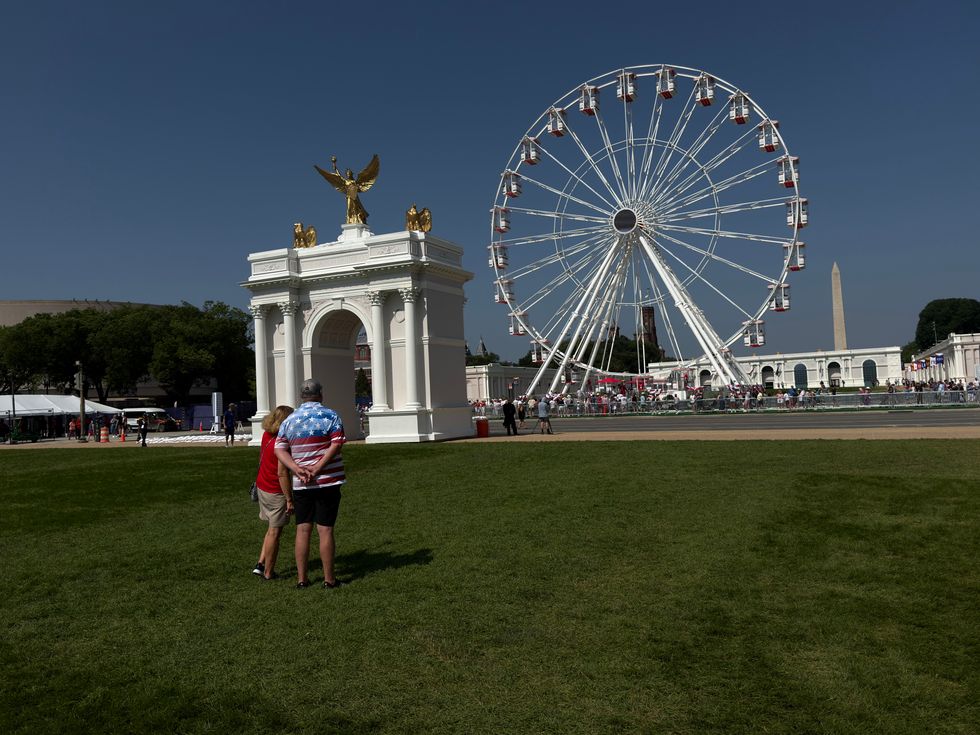
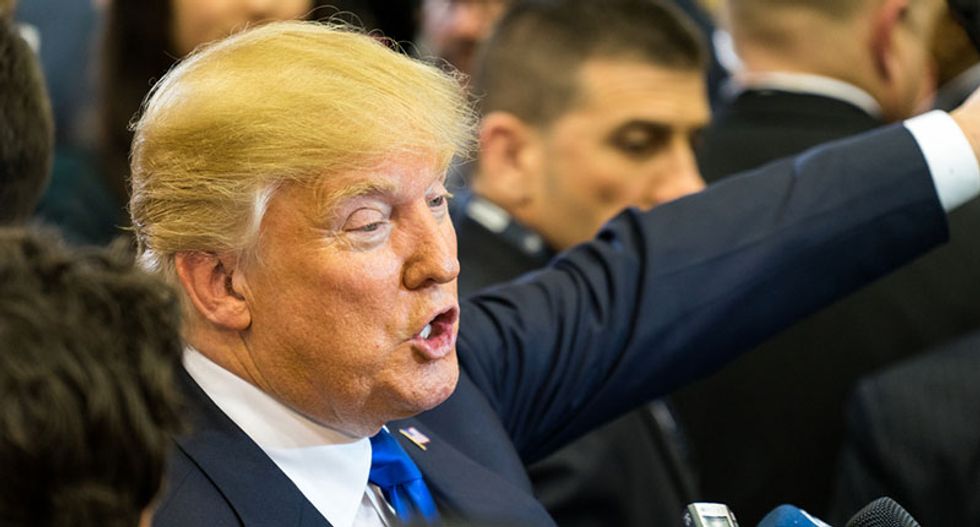
President Donald Trump has struggled to get decent turnout at his celebration of America’s 250th birthday, which has focused on promoting Trump himself rather than American history. Between that and his increasingly desperate efforts to stop Democrats from voting in the upcoming midterm elections, many political experts believe Trump and the Republican Party could be headed toward a political wipeout.According to one of the most respected political analysts in America, Trump could actually help himself politically through the United States’ semiquincentennial — but he is squandering that opportunity.“There was perhaps a world in which President Trump might have used the looming semiquincentennial to bolster his, and his party’s, fortunes for the fall,” wrote Kyle Kondik, the managing editor of the University of Virginia Center for Politics’ nonpartisan polling and elections newsletter Sabato’s Crystal Ball, in an in-depth analysis on Thursday. “Or at least tried to, perhaps by presenting himself as something other than a hard partisan figure.”Kondik contrasted Trump with another Republican politician, President Gerald Ford, who served in office during America’s bicentennial celebration in 1976. Unlike Trump’s polarizing approach, which emphasized promoting himself and bashing Democrats, Ford focused on a nonpartisan approach that was proactively positive about American history and the nation’s future. This was “exemplified by a campaign song, ‘I’m Feeling Good About America.’ (That’s also the name of our Center for Politics documentary about the 1976 campaign, free to watch on YouTube). Ford still lost [to Democratic nominee Jimmy Carter], but it ended up being a very close election,” much closer than experts had predicted during the bicentennial celebrations that summer.“It may be that Republicans find a way to dig out of their current political hole, but a sunny, optimistic president rallying the country over the course of a happy, celebratory summer doesn’t seem to be in the cards,” Kondik explained. “This president cannot even countenance helping his party achieve an easy win, as he has both denigrated and thus far declined to sign a bipartisan housing bill, a matter of national concern in an election whose major theme is ‘affordability.’”He added that “events marking the 250th anniversary of the signing of the Declaration of Independence have turned into yet another partisan event, with the president apparently planning to hold what amounts to a campaign rally on the Fourth itself. The World Cup, hosted partially by the United States, has excited international visitors and provided that rarest of all things on social media: organically heartwarming content. But that’s not really a story that involves the president.”Kondik clarified that, while Trump has not helped himself politically, it does not seem that he has hurt himself either. Yet with an approval rating stubbornly stuck in the 30s, “if Democrats actually win the Senate this year—they’re still underdogs to do so—Trump’s numbers being worse than they were in 2018 [during his last midterm elections] would likely be a big explanation why.”Because polls sample different groups of voters, Kondik predicted that Trump’s numbers may fluctuate a little between now and Election Day, but that the safest bet is that they will remain where they are unless he makes drastic changes in his behavior.“As is often the case with modern presidential approval ratings, expecting little-to-no change is a better bet than expecting big change,” Kondik wrote. “Particularly as the president doesn’t change much himself.”Speaking exclusively to AlterNet about his article, Kondik elaborated on the differences between Ford and Trump in terms of celebrating a big American birthday.“It is to some degree an apples to oranges comparison, because Ford was on the ballot and Trump is not, and the country was also a lot different,” Kondik told AlterNet. “But I do think in the midst of a trying decade, Ford's positive messaging helped cut through the negativity and capitalized on good feelings about the bicentennial. But there were many other reasons Ford came back, including uncertainty about whether Carter was up to the task of being president.”When asked if Trump’s explicitly partisan approach to celebrating America’s 250th birthday will be remembered as a missed political opportunity for him, Kondik said that “if Trump is as weak as he is now or weaker at the time of the election, and Republicans have a poor showing (losing the House and losing the Senate or at least losing one or more races in red states), it'll be easy to point to Trump's standing as a driving force in those results.”He added, “If that does happen, there will have been many missed opportunities for Trump, and perhaps how he handled the Fourth would be one of those (although in all likelihood other things would have been more important, like the decision to attack Iran and the subsequent impact on gas prices...