Will Trump v. Barbara End the Birthright Citizenship Debate? (UPDATED)
The Court may have ruled on birthright citizenship, but the debate over birthright citizenship and the Fourteenth Amendment is likely to continue.

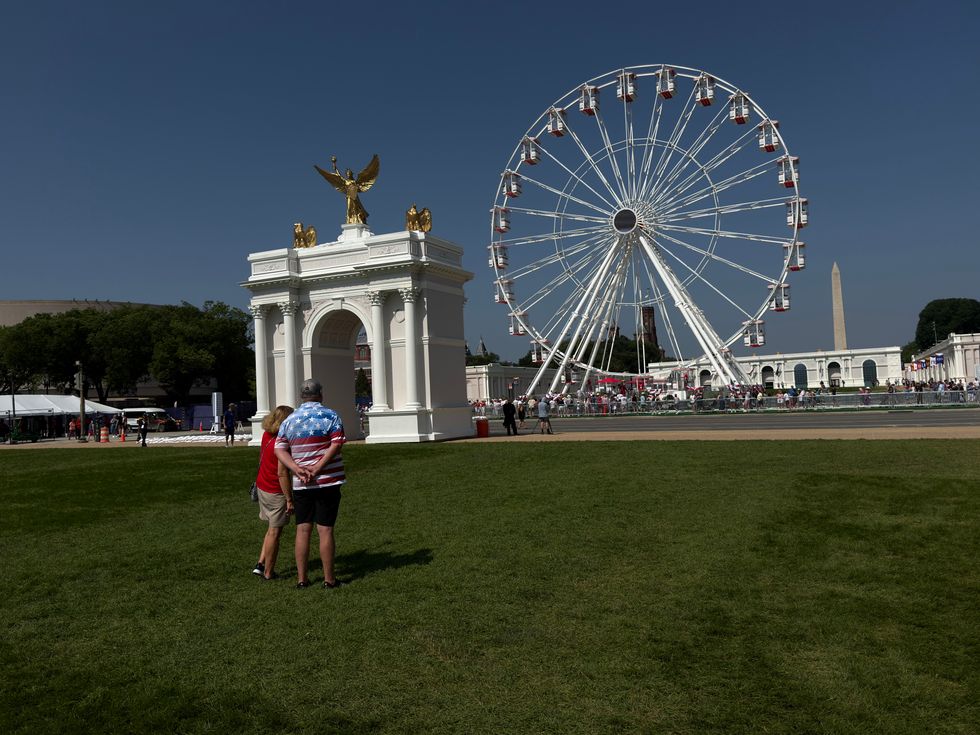
WASHINGTON — Ever throw a party only to have no one show up? Awkward. Lonely. Embarrassing.Welcome to President Donald Trump’s Great American State Fair, where even the baptism pool was empty in Friday’s 100-degree heat as two men waved large flags to a crowd of two and a half — a little boy danced to soulless piano playing to the massive “revival” tent’s eight rows of empty chairs.America may be back according to MAGA bumper stickers, but if Trump’s fair is any barometer, the nation’s surely seen better days.At this lightly attended spectacle, even hologram Abraham Lincoln was left addressing an audience of one in the air-conditioned Illinois exhibit.But it was not just dead presidents getting a cool reception. Even America’s living U.S. trade representative Ambassador Jamison Greer’s panel commemorating Horespower of America — Thursday’s official theme at this state fair — was only attracting a crowd some 15 people when Raw Story visited, not including his three-person, suit-donning security detail and a handful of event staff.It seems pigs are more popular than politicians, though.Thursday morning’s youth livestock exhibition featured pigs. The live display attracted a rotating cast of some 20 people on one grandstand — even as the other rodeo stand remained empty throughout the porky presentation — which was far more interest than Trump’s trade rep garnered.“I guess, technically, that’s a rodeo,” an older man told his unimpressed partner as they passed the day’s sparsely attended youth livestock show (Thursday’s afternoon “rodeo” was later canceled, apparently due to the heat).In the stifling temperatures, grumblings were heard amongst attendees when they reached exhibits, only to be turned away by event staff, like the temporarily shuttered Virginia and Texas exhibits.“Oh no,” one lady exclaimed. “I just wanted to get out of the heat.”Other makeshift fan-waving visitors peeked their heads into exhibits just for a second as they hunted for hydration that was cooler than the lukewarm-to-hot bottles of water passed out for free.“There’s no water,” one female scout yelled to her small group huddled outside the Maryland exhibit.Other visitors were surprised to see their home state’s packed like sardines in exhibit halls, like the one small temporary building dedicated to Rhode Island, Vermont and — because they have so much in common — Kentucky.“I don’t know why they have Vermont and Rhode Island in here, too,” one man complained through a southern drawl.“Kinda weird,” his female companion agreed.One of the more popular exhibits seemed to be the South Carolina one, as older visitors found respite in the state’s six large white rocking chairs.Another popular exhibit was Florida’s, but folks waiting in the 40-some-odd-people-long line weren’t quite sure why there was a line, let alone why they were waiting in it.“Is this the line for Florida?” Raw Story asked as Lynyrd Skynyrd's “Free Bird” wailed over the loudspeakers. “What’s in there that’s so good?”“Yeah,” a family at the end of the line said just about in unison.“We were wondering the same thing,” a lady chimed in.“A little puppy,” an Asian tourist mimed with her hands.“Oh, okay,” the lady replied. “Like a little stuffed animal.”While there was some MAGA gear spotted throughout the crowd, one visitor’ proudly wore an “all of us are immigrants” shirt.“Sometimes the possibilities of good trouble present themselves,” Bob, who was in town with his wife from Pennsylvania, told Raw Story. “I’m a provocateur.”Though Bob gave credit where credit was due.“It’s also a Steve Earle song called ‘City of Immigrants,’” Bob went out of his way to confess to Raw Story later in the afternoon.While the administration has refused calls to publicly disclose all of the fair’s financial backers, corporate logos are prominent in Trump’s America.What’s more American than the military-industrial complex? To the chagrin of former President Dwight D. Eisenhower, everywhere you looked throughout the fair you could spot a logo of Lockheed Martin, Northrop Grumman, SpaceX, GE Aerospace and other contractors.The Pentagon and other agencies also got in on the action, as they turned their exhibition space into recruiting centers as Air Force Thunderbirds buzzed the National Mall outside.The Department of Homeland Security even passed out FEMA-emblazoned crayons, coloring books and Pedro the Penguin maps of hazards across all 50 states for kids to color.\Silicon Valley’s finest also flexed their corporate might throughout the event, including Oracle, Uber, Micron Technologies, Mosaic, and Chime.Signs for Phorm Energy — a caffeine-spiked drink company co-owned by UFC president Dana White and Anheuser-Busch — were also hard to miss.Traditional American companies like Wrangler, Tractor Supply and Scott’s Miracle-Gro are also sponsors.
The Court may have ruled on birthright citizenship, but the debate over birthright citizenship and the Fourteenth Amendment is likely to continue.
In Hawaii, provisions strengthening the state’s existing shield laws also take effect July 1.
If you’re feeling that the celebration of the 250th anniversary of the United States has been hijacked by a narcissistic, political hack, you’re not alone. Instead of a joyous event for all Americans, our holiday has been plagued by vicious attacks on those who haven’t drunk the Make America Great Again Kool-Aid. And the results are proof positive that we, the people, are not going for it.Not one bit.One of the primary “celebrations” was the Great American State Fair held on the National Mall this week. Supposedly showcasing the history of the 50 states, a whopping 20 states decided to skip the event entirely. Not because they’re not proud of their state or didn’t want to tell the wonderful tales about the vast diversity and beauty of this place we call home, but because President Donald Trump turned it into a political rally for himself instead of a birthday party for all Americans.Most of the musicians and entertainers who were booked cancelled as it morphed into a staged event for Trump. Those few that didn’t cancel had very sparse crowds sprinkled over the lawn in one of the most embarrassing displays of just how historically unpopular our current president and his attempts to divide, not unite, Americans are with the populace.Despite Trump claiming a crowd of 45,000 people, about 1,000 showed up. Of course this is totally in line with his self-aggrandizing exaggerations across the board since he lives in a fantasy world where he is worshipped and adored.But the stunning failure of the Great American State Fair isn’t alone in demonstrating the fact that Americans have grown very tired of this particular reality TV show clown. Consider these events of the last week:The Supreme Court ruled against Trump’s executive order attempting to overturn the Constitution’s guarantee of birthright citizenship. It’s not where we came from, it’s where we are; and those born here are Americans. The president’s former attorney, Ty Cobb, reflecting on the financial declaration showing the president and his sons have garnered more than a billion dollars from sketchy crypto sources called it “the greatest onslaught of corruption in the history of mankind” adding “he creates policies that can only enrich himself and his family, is something that I think the average American should be staggered by.”A federal judge blocked Trump’s executive order that the U.S. Postal Service could not deliver mail ballots in states that had not surrendered their voter role information to the federal government, thus halting one of his most obvious and odious attempts to rig the coming elections in which his MAGA allies are predicted to lose badly. Even the Social Security Administration’s latest list of popular baby names puts “Donald” at its lowest point since the 1880s.The takeaway is clear — Americans are not happy that our nation’s birthday has been hijacked and degraded. We are not happy with being intentionally divided instead of united in celebration of our history. We are not happy that those who fought and died to establish this nation — and all those who have struggled to keep democracy alive since then — have been shoved to the side by a gilded grifter.Trump is not who we are as Americans and Montanans. We are the nation of “all men are created equal” and on this 250th celebration of our founding the great challenge is to live up to that promise, to be the united, not the divided, states — and to continue to forcefully reject these self-serving, despicable efforts to drive us apart.
President Donald Trump has struggled to get decent turnout at his celebration of America’s 250th birthday, which has focused on promoting Trump himself rather than American history. Between that and his increasingly desperate efforts to stop Democrats from voting in the upcoming midterm elections, many political experts believe Trump and the Republican Party could be headed toward a political wipeout.According to one of the most respected political analysts in America, Trump could actually help himself politically through the United States’ semiquincentennial — but he is squandering that opportunity.“There was perhaps a world in which President Trump might have used the looming semiquincentennial to bolster his, and his party’s, fortunes for the fall,” wrote Kyle Kondik, the managing editor of the University of Virginia Center for Politics’ nonpartisan polling and elections newsletter Sabato’s Crystal Ball, in an in-depth analysis on Thursday. “Or at least tried to, perhaps by presenting himself as something other than a hard partisan figure.”Kondik contrasted Trump with another Republican politician, President Gerald Ford, who served in office during America’s bicentennial celebration in 1976. Unlike Trump’s polarizing approach, which emphasized promoting himself and bashing Democrats, Ford focused on a nonpartisan approach that was proactively positive about American history and the nation’s future. This was “exemplified by a campaign song, ‘I’m Feeling Good About America.’ (That’s also the name of our Center for Politics documentary about the 1976 campaign, free to watch on YouTube). Ford still lost [to Democratic nominee Jimmy Carter], but it ended up being a very close election,” much closer than experts had predicted during the bicentennial celebrations that summer.“It may be that Republicans find a way to dig out of their current political hole, but a sunny, optimistic president rallying the country over the course of a happy, celebratory summer doesn’t seem to be in the cards,” Kondik explained. “This president cannot even countenance helping his party achieve an easy win, as he has both denigrated and thus far declined to sign a bipartisan housing bill, a matter of national concern in an election whose major theme is ‘affordability.’”He added that “events marking the 250th anniversary of the signing of the Declaration of Independence have turned into yet another partisan event, with the president apparently planning to hold what amounts to a campaign rally on the Fourth itself. The World Cup, hosted partially by the United States, has excited international visitors and provided that rarest of all things on social media: organically heartwarming content. But that’s not really a story that involves the president.”Kondik clarified that, while Trump has not helped himself politically, it does not seem that he has hurt himself either. Yet with an approval rating stubbornly stuck in the 30s, “if Democrats actually win the Senate this year—they’re still underdogs to do so—Trump’s numbers being worse than they were in 2018 [during his last midterm elections] would likely be a big explanation why.”Because polls sample different groups of voters, Kondik predicted that Trump’s numbers may fluctuate a little between now and Election Day, but that the safest bet is that they will remain where they are unless he makes drastic changes in his behavior.“As is often the case with modern presidential approval ratings, expecting little-to-no change is a better bet than expecting big change,” Kondik wrote. “Particularly as the president doesn’t change much himself.”Speaking exclusively to AlterNet about his article, Kondik elaborated on the differences between Ford and Trump in terms of celebrating a big American birthday.“It is to some degree an apples to oranges comparison, because Ford was on the ballot and Trump is not, and the country was also a lot different,” Kondik told AlterNet. “But I do think in the midst of a trying decade, Ford's positive messaging helped cut through the negativity and capitalized on good feelings about the bicentennial. But there were many other reasons Ford came back, including uncertainty about whether Carter was up to the task of being president.”When asked if Trump’s explicitly partisan approach to celebrating America’s 250th birthday will be remembered as a missed political opportunity for him, Kondik said that “if Trump is as weak as he is now or weaker at the time of the election, and Republicans have a poor showing (losing the House and losing the Senate or at least losing one or more races in red states), it'll be easy to point to Trump's standing as a driving force in those results.”He added, “If that does happen, there will have been many missed opportunities for Trump, and perhaps how he handled the Fourth would be one of those (although in all likelihood other things would have been more important, like the decision to attack Iran and the subsequent impact on gas prices...
Record-breaking heat is having an impact on one of the biggest celebrations for the United States’ 250th birthday, with organizers of the Freedom 250 Salute to America are delaying the event’s start time from 1pm to 5pm because of the expect triple-digit heat in Washington. It comes as President Donald Trump prepares to visit Mount Rushmore ahead of July 4 celebrations. NBC’s Gabe Gutierrez reports for TODAY.
President Donald Trump is drawing a great deal of criticism from a combination of Democrats and Never Trump conservatives for mixing the federal government with his private business ventures — which, detractors say, is a blatant conflict of interest. And a CNN panel went off the rails on Thursday night when Trump supporter Ben Ferguson went out of his way to defend the president.Ferguson argued, "We have a president that was really wealthy when he came in, and keeps doing business with his family. There's nothing wrong with it."But host Abby Phillip and others on the panel pushed back against Ferguson's argument.Phillip told Ferguson, "You would have been fine with the so-called Biden crime family if Biden had just been transparent — if Hunter Biden had just been transparent? If he had just been transparent and said, 'I'm using my dad's name to make money,' you would have said, 'Totally above board?'"Ferguson, however, doubled down on his defense of Trump, saying that "Burisma was massive corruption" and insisting that Hunter Biden's business activities couldn't be compared to those of President Trump or his son Donald Trump Jr. Ferguson also mentioned stock trades made by former House Speaker Nancy Pelosi (D-California). But when CNN's Bakari Sellers jump into, he argued that Ferguson was jumping through hoops to defend the Trumps while making a point of demonizing Democrats.Sellers told Ferguson, "You ask, what did he do that was unethical or illegal? And I wanted to answer that plain and simply. I take…. yoga, and I feel like you're doing a little yoga too for that pretzel that you got yourself into…. To utilize your phrase, the president makes $400,000 a year. This quarter, he's made over $1 billion — $1.2 to $1.4 billion — on crypto alone…. What I want to tell you that's unethical is the fact that when you make 3500 trades in one year, and you go up and you invest in a company, and then you sit in the Oval Office and you tell people, 'Wow, this company is great. This company is going to do X, Y, Z' or you ease regulations on this company and you trade and purchase stock in that company. That fundamentally is unethical. You can call it what you want."
Trump administration officials reportedly believed that the Israeli government intended to assassinate Iran’s top negotiators—including the country’s foreign minister—during peace talks with the US in an effort to sabotage diplomatic progress.The New York Times reported Thursday that “American concerns about the targeting of two particular Iranian officials—Abbas Araghchi, Iran’s foreign minister, and Mohammad Bagher Ghalibaf, the speaker of the Parliament—spiked during delicate ceasefire negotiations that began in April.” In response, the US “went so far as to ask other countries in the region to warn Iran about the possibility Israel could target the two officials,” according to the Times, which cited unnamed current and former American officials.The US and Israel have killed dozens of top Iranian officials since launching their illegal joint war in late February. But the allied countries reportedly removed Araghchi and Ghalibaf from their target list in late March, opening the possibility of high-level negotiations to end the war.But Israel remained bent on targeting the negotiators, according to the Times, whose reporting was later corroborated by The Washington Post.The Times detailed one dramatic incident in April, when Ghalibaf was planning to travel to Pakistan’s capital to meet with US Vice President JD Vance:Pakistani fighter jets escorted the Iranian airplanes carrying a delegation of more than 70 Iranians from the border of Iran to Islamabad and back again when the session was over.But on the way back to Tehran, an Israeli security threat emerged.Iran’s security forces notified the plane carrying Mr. Ghalibaf back to Tehran that they had picked up intelligence that Israel planned to attack the plane and that two Israeli fighter jets had entered Iran’s airspace from its western border near Iraq, the two officials said.Mahdi Mohammadi, a senior adviser for Mr. Ghalibaf, who accompanied him to Islamabad, confirmed this account on his social media page. The plane made an emergency landing in the city of Mashhad, Iran’s closest airport to the Pakistani border, and the Iranian delegation traveled some eight hours by land back to Tehran, Mr. Mohammadi and the two officials said.The Post reported that “cracks emerged” between the US and Israeli approaches to the war following Israel’s assassination of top Iranian national security official Ali Larijani in March.“They’ve wiped out everybody,” Trump told reporters in late March, suggesting Israel’s assassination campaign was making it difficult to find potential negotiating partners.Trita Parsi, executive vice president of the Quincy Institute for Responsible Statecraft, wrote in response to the new reporting that “Israel is a state that, on paper, is a US partner, but in reality is so extreme in its obsession to undermine US diplomacy that it even tries to assassinate those the US engages with in crucial negotiations.”“I can’t recall a government as terrified of peace as the one running Israel,” Parsi added.At present, the Israeli government—led by Prime Minister Benjamin Netanyahu—is endangering tenuous US-Iran peace talks with its continued occupation of and assault on Lebanon, which Iran has highlighted as a key factor in the negotiations.Visiting occupied southern Lebanon earlier this week, Netanyahu declared to Israeli troops that “our insistence is that we will not leave... until the threat is removed.”Parsi wrote earlier this week that “beyond his long-standing desire to use American force to subjugate Iran to Israeli domination and achieve a regional balance favorable to Israel,” Netanyahu “now also has stark political and personal reasons to restart the war” with Iran.“The [US and Iran’s memorandum of understanding] has come at a steep political cost for Netanyahu,” wrote Parsi. “His prospects for reelection in October are weaker than they have been in months. Once seen as the Israeli leader uniquely capable of delivering President Trump, he now confronts the prospect that both the war and the ensuing diplomacy will leave Israel in a strategically weaker position—undermining the very case he has made for his leadership.”“And of course,” Parsi added, “if he loses the elections, he will likely spend the next few years in jail, as he will lose his immunity as prime minister and face trial over corruption charges.”The story was published in partnership with Common Dreams, read the original here.
The Trump administration is asking a federal judge to quickly lift her recent ruling against major provisions of a presidential executive order on elections, arguing in an appeal that the court’s action will effectively prevent the government from putting new voting restrictions in place before the November election.This article was originally published by Votebeat, a nonprofit news organization covering local election administration and voting access.Last week, U.S. District Judge Indira Talwani halted President Donald Trump’s efforts to create centralized lists of adult citizens and give the U.S. Postal Service unprecedented authority over who can vote by mail. Her 37-page ruling concluded that the president did not have the constitutional authority to regulate state elections, as his March executive order tried to do.The executive order directed the U.S. Department of Homeland Security and Social Security Administration to create a nationwide list of verified U.S. citizens over 18, and thus presumably eligible to vote in federal elections. It also called on the U.S. Postal Service to create a system to handle and accept mail-in ballots only from voters on preapproved lists.Talwani’s order prevents the federal government from enforcing those provisions of the order against the 24 jurisdictions (23 states and the District of Columbia) whose attorneys general and governors brought the lawsuit in federal court in Massachusetts. The list includes most Democratic-led and swing states, including Arizona, California, Michigan, Nevada, New York, North Carolina, Pennsylvania, and Wisconsin.This week, the Trump administration appealed Talwani’s ruling to the First Circuit Court of Appeals and said it is still proceeding with its efforts to set up the new system for the rest of the states. But it warned that the judge’s order will make it impossible for the U.S. Postal Service to create a bifurcated system for the November election, even if the administration ultimately prevails on appeal. Government attorneys asked Talwani to lift her ban by Monday.The request for a quick decision suggests that the Trump administration may be trying to speed things up so the case reaches the U.S. Supreme Court as soon as possible.“Operationally, it would not be possible for us to put a two-tiered system in place where one set of rules apply to the ballot mail of the Plaintiff States, and another applies to the remaining states,” Steven Monteith, the Postal Service’s chief customer and marketing officer and executive vice president, said in a court filing. “Doing so would cause operational confusion and significantly increase the complexity and efficiency of implementing any final rule.”But the Trump administration’s nationwide efforts to use the Postal Service to regulate who gets ballots also hit a separate legal roadblock this week when another federal judge in Washington, D.C., ruled that the executive order violates a years-old agreement requiring the federal government to ensure voters who request mail-in ballots get them in time to ensure they can be counted.U.S. District Judge Emmet Sullivan concluded that the Trump administration’s plans to send ballots only to voters on preapproved lists breached a 2021 agreement between the Postal Service and the NAACP meant to ensure that the agency prioritized ballot delivery. In contrast to Talwani’s ruling, Sullivan’s decision applies nationwide.“These proposed rules directly undermine commitments that the Postal Service made to ensure mail-in ballots are delivered and counted,” said Anthony Ashton, senior associate general counsel for the NAACP, in a statement.The U.S. Postal Service and Department of Homeland Security did not respond to requests for comment.Dion Nissenbaum is Votebeat’s senior national reporter and is based in Houston. Contact Dion at dnissenbaum@votebeat.org. Votebeat is a nonprofit news organization covering local election integrity and voting access. Sign up for their newsletters here.