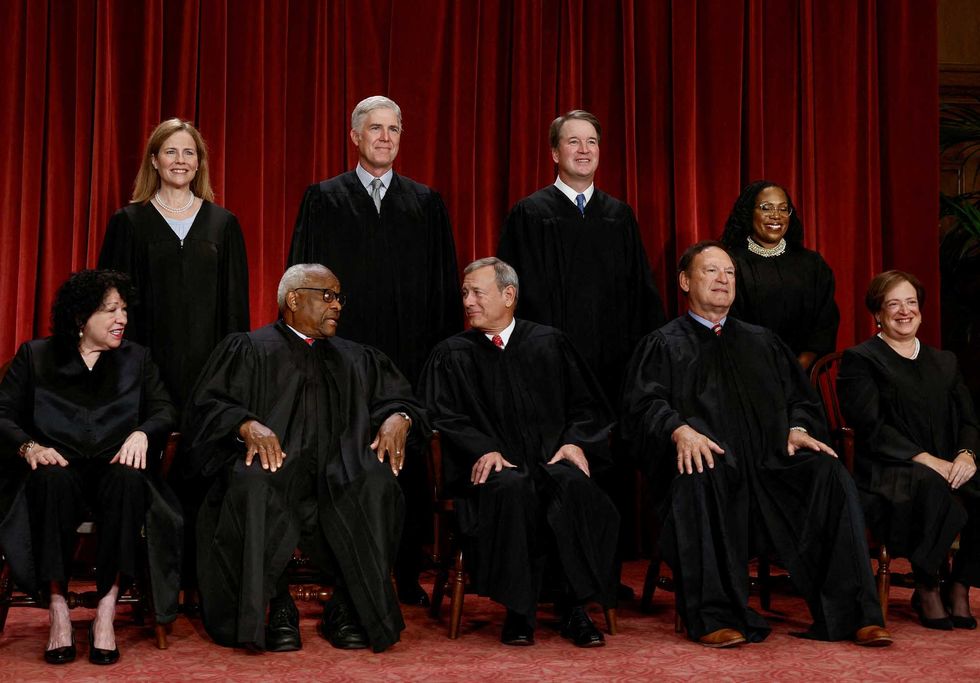
Supreme Court weighs how far police investigations can go in using cellphone location data
Source: Raw Story · Bias: Far Left
Summary
The U.S. Supreme Court on Monday appeared likely to allow law enforcement to continue seeking warrants for the location history of cellphones near crime scenes, even as the justices wrestled with how far the government must go to protect Americans’ privacy.Some of the justices appeared to be searching for a middle ground during oral arguments in a case out of Virginia challenging what is known as a geofence warrant that was used to catch a bank robber. Several justices asked skeptical questions of both sides, though no one voiced explicit support for prohibiting such warrants altogether.As smartphones have become ubiquitous, along with apps that track users’ movements, the high court is once again wading into how the 4th Amendment to the U.S. Constitution, which prohibits unreasonable searches and seizures, applies in the digital era. The justices’ decision, of tremendous interest to state attorneys general, will shape how easy or difficult it is for investigators to sweep up location data.Over the past two decades, geofence warrants have become a major tool of law enforcement. At a basic level, they allow police to identify phones within a geographic area for a certain period of time.The data can be tremendously valuable to investigators, offering a way to develop suspects in crimes where their identities aren’t otherwise known. Underscoring their importance, a broad bipartisan coalition of states has urged the justices to uphold the warrants.But civil liberties advocates say geofence warrants ensnare people in digital dragnets, handing the government data on anyone who happens to be in the wrong place at the wrong time. They argue that accessing data on anyone within a certain area — the geofence — amounts to a general warrant prohibited by the Constitution.Summing up the high court’s uncertainty in Monday’s arguments, Justice Amy Coney Barrett told U.S. Deputy Solicitor General Eric Feigin, who was arguing in favor of law enforcement access to location data, that while he had described his opponent’s position as maximalist, “there’s a risk of the government’s position being maximalist the other way.”“I was just going to say this seems very complicated from the user’s point of view, frankly,” Barrett said at a different portion of the argument.Credit union robberyThe case before the Supreme Court, Chatrie v. United States, arises from a 2019 robbery of a federal credit union in Midlothian, Virginia. Okello Chatrie was convicted of armed robbery after surveillance footage showed the robber using a cellphone. A detective then obtained a geofence warrant directed at Google for devices within 150 meters of the credit union within an hour of the robbery.Google initially provided anonymized data in response to the warrant. The detective then requested and received additional location data on nine users. Finally, the detective received de-anonymized information on three users, without obtaining an additional warrant.While Google has since changed the way it stores location history data to limit geofence warrants, other apps and tech firms collect the data. Lawyers for Chatrie argue that geofence warrants open the door to the authorities requesting information on everyone at a sensitive location — perhaps an abortion clinic or a political convention — at a particular time.“The warrant authorized the government to direct Google to search every single person’s account to find those people who were within the geofence. That is a general warrant,” Adam Unikowsky, a lawyer for Chatrie, told the court.4th Amendment debateThe Supreme Court’s last major decision on 4th Amendment rights and phones came in 2018, when the justices ruled that law enforcement generally needs a warrant for location data derived from when phones connect to a cell site. That data is generated by just having a cellphone, and the justices found that a phone is now a basic element of participating in society.By contrast, the Trump administration argues location history data isn’t protected by the 4th Amendment because users voluntarily share it with Google and other tech firms by turning on location tracking on their phones. Because the information was turned over with their consent, users have no reasonable expectation of privacy.“Petitioner here is asking for an unprecedented transformation of the 4th Amendment into an impregnable fortress around records of his public movements that he affirmatively consented to allow Google to create, maintain and use,” Feigin said.Justice Sonia Sotomayor, one of the court’s three liberal justices, argued that if the government can access location data without a warrant because Chatrie consented to sharing it with Google, then the government could obtain all sorts of other data shared with the company, such as photos and calendar entries.“If this is consent, that means the government can seek those documents for any reason, not just the commission of a crime — or no reason, correct?” Sotomayor said.“Correct.
Related Coverage
- Sources: Trump likely to pardon pollution violators; weighing clemency for Diddy (Center — Politics - CBSNews.com)
- Trump Scores Appeals Court Victory in Battle Over National Park Historical Displays (Right — RedState)
- Trump may weigh pardon for Diddy while granting clemency to pollution violators (Center — The Hill News)
- Wes Moore on democratic socialist gains: Voters want ‘someone who is going to fight for them’ (Center — The Hill News)
- Lawfare: Kangaroo court picks fight with state’s conservative attorney general (Far Right — WorldNetDaily)
- UPDATE: Louisiana Supreme Court Temporarily Blocks Politically Motivated Indictment Against AG Liz Murrill (Far Right — The Gateway Pundit)
- Luka Doncic weighs in on new-look Lakers roster amid heavy criticism (Right — New York Post)
- ‘Heat for thee, but not for me’: Mamdani lets City Hall go chill as he tells residents to sweat it out (Far Right — WorldNetDaily)
Daily Analysis
Read the full Parallax Pulse for April 27, 2026 — an AI-powered analysis of how Left and Right media covered the biggest stories this day.
More Headlines From April 27, 2026
- ‘Sense of disbelief’: how the White House press dinner attack unfolded - The Latest (Center Left)
- CNN delays anti-Trump documentary after gunman attempts to assassinate president (Far Right)
- Congressional Republicans are split on using taxpayer funds to build Trump's ballroom (Center Left)
- Oz Pearlman on return to White House correspondents’ dinner: ‘100 percent’ (Center)
- Justice Department urges group to drop Trump ballroom lawsuit after WHCA dinner shooting (Center)