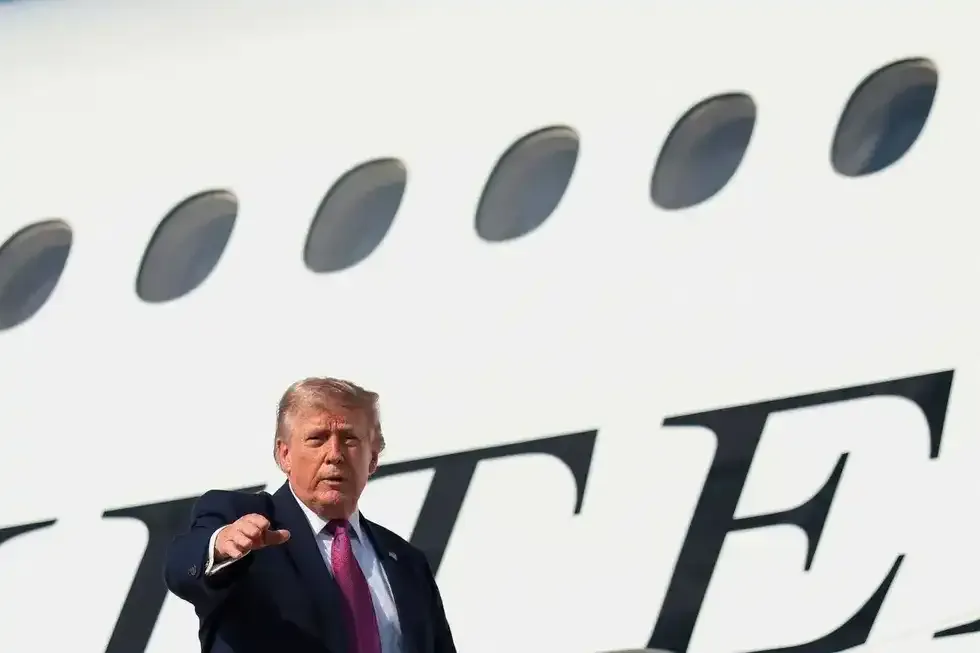
Severe weather threatened to put a damper on Friday on President Donald Trump's plans to speak near Mount Rushmore in South Dakota, prompting amusement from internet critics who said it seemingly indicated "god is angry."Trump was flying to South Dakota as part of a broader July 4 and America-250 trip, planning to visit the iconic American landmark for an Independence Day fireworks celebration. But Mother Nature, it seems, had other plans. A severe thunderstorm warning was in effect until 7:30 p.m. Eastern Time for the area, with quarter size hail that could damage vehicles reported by the National Weather Service. "Seek shelter inside a well-built structure and stay away from windows. This storm is capable of producing large hail," an alert on the weather service read.The weather alert forced Fox News to scramble, with host Bret Baier telling viewers they had breaking news."They just said there is severe weather on the way. In fact, they said hail could be coming, and they are urging everybody to get inside," said Baier, adding: "We're going to get to shelter."The setback prompted mockery from onlookers, with Ron Filipkowski, editor-in-chief of the progressive MeidasTouch news outlet, quipping on X, "God is angry."Dan Koh, a Massachusetts Democrat running for Congress, chimed in on X, "Considering Trump wants to cut the National Park Service budget by 40% and Mount Rushmore has a $57m repair backlog, you better run."The progressive influencer account known as Polly Sigh added: "Calamitous weather seems to follow Trump around these days. Mother Nature is so over him."Writer Joe Flood joked, "damn antifa!"Trump has had mixed luck with weather in recent weeks, with scorching temperatures and rain derailing his Great American State Fair.Fox at Mount Rushmore: They just said there is severe weather on the way. In fact, they said hail could be coming and they are urging everybody to get inside. We're going to get to shelter. pic.twitter.com/hyfc0nPghU— Acyn (@Acyn) July 3, 2026
President Trump prepares to travel to Mount Rushmore to deliver remarks for the United States’ 250th birthday. NBC News correspondents Gabe Gutierrez and Julie Tsirkin join Meet the Press NOW to discuss what to expect from the President’s upcoming addresses and July Fourth celebrations.
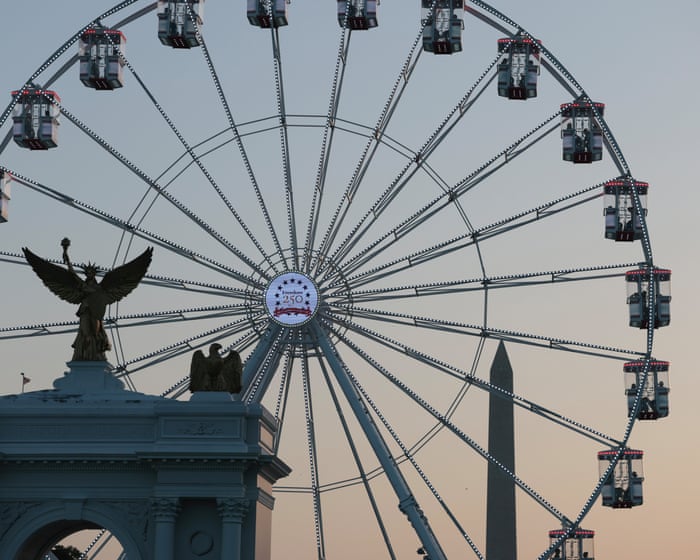
Attendance had been thin to Trump’s ‘unbelievable’ event before an increase on Friday – and then the high temperatures swept inEven by Trumpian standards, the event was promoted with intense hyperbole: nothing short, the US president suggested, of the “the most unforgettable birthday party any country has ever seen”.“It’s gonna be great,” Donald Trump proclaimed on the opening night of the Great American State Fair, the centerpiece of the US 250th anniversary celebrations. “It’s gonna be unbelievable.” Continue reading...
Resistance is mounting across the United States against the increasing use of surveillance tech company Flock Safety’s cameras, with a growing number of cities canceling contracts as the artificial intelligence-powered license plate readers are quietly being installed in thousands of locations nationwide.State and local police departments first used the Atlanta-based company’s automated license plate reader (ALPR) systems for standard law enforcement purposes, but they are now being employed for a much broader range of uses, including immigration-related searches and other actions supporting US Immigration and Customs Enforcement (ICE) during the Trump administration’s deadly anti-immigrant crackdown.“We have cameras that are used for everything from illegal dumping to drug houses to hotels that are just big problems,” Flock Safety engineer Kevin Cox told prospective customers during a demonstration of the company’s Condor Camera, according to a Thursday report in The Washington Times.“There are endless, endless uses for what we can do with these things,” Cox added.Those uses include spying on constitutionally protected protest activity and enforcing abortion bans by tracking pregnant people’s travel across states—even ones in which the medical procedure is legal.The ACLU—which recently launched a “Get the Flock Out” campaign to “fight creepy ALPR cameras”—says there are currently between 80,000 and 100,000 Flock devices installed nationwide that conduct more than 20 billion scans per month. More than 5,000 law enforcement agencies use the cameras, and some of them keep their locations a secret.“Flock’s ALPR cameras aren’t like your normal traffic cameras,” the ACLU explained. “This surveillance technology records and tracks every car that comes into view, and then an AI algorithm catalogs the make, model, color, license plate number, bumper stickers, and even scratches. This personal information is then uploaded into a nationwide database that any law enforcement agency with a Flock contract can search—with few regulations or oversight on how they use what they find.”The backlash against creeping state surveillance has even transcended the partisan divide.“I think our country is in a kind of uniquely anti-surveillance environment right now, which is to say that, in a time where it seems there is nothing that is not partisan, opposition to government surveillance is nonpartisan,” ACLU privacy and surveillance attorney Chad Marlow told The Washington Times on Thursday.There is growing action—both legal and otherwise—to end the use of ALPRs across the country.According to the public information project Ban Flock Cameras, 82 Flock contracts were terminated across 28 states between August 2021 and May 2026, with 39 of those cancellations occurring in the first five months of 2026 alone.Even Amazon-owned Ring announced earlier this year that it would stop doing business with Flock Safety.Susie O’Hara, a member of Santa Cruz, California’s nominally nonpartisan City Council, told WBUR earlier this year that she grew increasingly concerned about local use of eight Flock cameras last year after learning that police were sharing data gleaned from the cameras with the company’s national network without city officials’ knowledge, a violation of state laws banning the practice.O’Hara became increasingly convinced that Santa Cruz should cancel its Flock contract after an ICE agent fatally shot Renee Good, a US citizen, in Minneapolis in January.“I have goose bumps on my arms thinking about the absolute chaos that was happening in Minneapolis,” she said. “And just the absolute insanity of what we were seeing... It was totally clear to me that we should in no way consciously be in this system at all—just no way.”Less than a week after Good’s killing, the Santa Cruz City Council voted to terminate the city’s Flock contract, becoming the first municipality in California to do so.“For us, the threat to our civil liberties was greater than any benefit we could get from the flawed product,” Santa Cruz Mayor Fred Keeley told KQED at the time.Chad Kemp, who represents District 32 on the nonpartisan Dane County Board of Supervisors in Wisconsin—which in April voted to stop funding two dozen cameras leased from Flock—told The Washington Times that “there’s a public safety issue here, but there is also a privacy issue.”“There are serious concerns about individuals who can be monitored without their knowledge, or if it is even constitutional or ethical to track people without a warrant,” he added.At the national level, US Reps. Robert Garcia (D-Calif.) and Raja Krishnamoorthi (D-Ill.) last year launched an investigation into the use of Flock cameras to track pregnant people across state lines for abortion care and to conduct unauthorized immigration enforcement operations.Krishnamoorthi and Sen.