"AI Resist List": Karen Hao on Data Center Resistance, Tech Billionaires, "Empire of AI" & More
Source: Democracy Now! · Bias: Far Left
Summary
We speak with journalist Karen Hao, author of Empire of AI, about the Trump administration’s alliance with tech billionaires, efforts to regulate artificial intelligence technology, and rising local opposition to data centers across the United States.
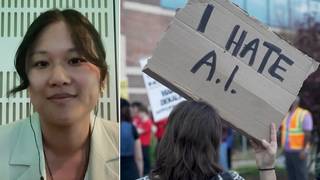
“In 2025, these data center protests successfully stalled over $100 billion worth of these facilities,” says Hao. “It really does cut across political lines.”
Hao recently launched The AI Resist List with a group of fellow journalists, researchers and technologists. It’s a collaborative project to track and reshape how artificial intelligence is deployed around the world.
"AI Resist List": Karen Hao on Data Center Resistance, Tech Billionaires, "Empire of AI" & More
Far Left
We speak with journalist Karen Hao, author of Empire of AI, about the Trump administration’s alliance with tech billionaires, efforts to regulate artificial intelligence technology, and rising local opposition to data centers across the United States.
“In 2025, these data center protests successfully stalled over $100 billion worth of these facilities,” says Hao. “It really does cut across political lines.”
Hao recently launched The AI Resist List with a group of fellow journalists, researchers and technologists. It’s a collaborative project to track and reshape how artificial intelligence is deployed around the world.
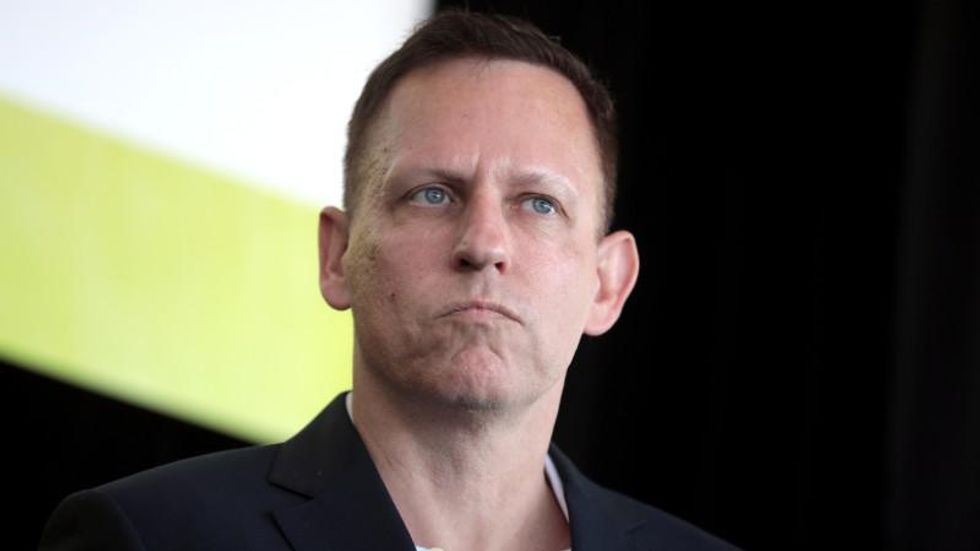
Billionaire technology Peter Thiel warned that AI company Anthropic could use its technological advantage to influence the 2028 presidential election in favor of Democrats.
The post Billionaire Tech Mogul Peter Thiel Warns Woke AI Company Anthropic Could Rig 2028 Election for Democrats appeared first on The Gateway Pundit.
Ken Griffin, the billionaire founder of hedge fund Citadel, urged business leaders to resist the socialism of New York City Democratic Mayor Zohran Mamdani, warning that the Big Apple's business environment will otherwise be destroyed.
The post Business Leader Calls on New York City to Resist Mamdani appeared first on The Gateway Pundit.
Right-wing tech billionaire Peter Thiel is accusing Pope Leo XIV of doing the work of the Chinese Communist Party with his criticisms of artificial intelligence.According to a Thursday report from CNN, Thiel told the Aspen Ideas Festival in Colorado on Tuesday that the pope was inadvertently serving as a “Chinese communist agent” when he released a 42,000-word encyclical that called for strict regulation of AI, a technology that the pontiff said heightens the “risk of dehumanization” throughout the world.Thiel argued that this sort of thinking was dangerous, CNN reported, because it could result in the US losing the “race” to build more advanced AI to China. Because of this, Thiel continued, the pope is essentially “working for the Chinese communists” by trying to tap the brakes on AI development.Thiel, a co-founder of PayPal and Palantir, has long decried AI critics in harsh terms. Over the last year, he has been delivering a series of lectures in which he has said that opponents of AI development are working as agents for the Antichrist.Journalist Christopher Hale, who writes the Letters From Leo newsletter, noted on Friday that Thiel in the past has even speculated that Pope Leo could be “a manifestation of the Antichrist.”Thiel has said that he instructed Vice President JD Vance, a longtime political ally who received major funding from the tech billionaire for his 2022 Senate campaign, to ignore the pope’s moral guidance despite influencing Vance to convert to Catholicism, Hale added.“Thiel seeded the vice president’s Catholic faith,” Hale wrote, “and he now tells wealthy festival audiences that the leader of that faith works for a communist government.”In addition to his attacks on the pope, Thiel also warned about “a democratic-socialist takeover of the Democratic Party,” pointing to recent victories in New York and Colorado of candidates backed by the Democratic Socialists of America.Thiel said that this “takeover” would doom the US, arguing that “when the Democratic Party goes, this country is over,” according to CNN.The New York Times reported in May that Thiel has grown so concerned about the political situation in the US that he’s created a “foothold” for himself in Argentina, which is currently being governed by ideologically likeminded libertarian President Javier Milei.“Thiel, who has a history of collecting backup countries as he hedges his bets against the United States, is considering making Argentina another Plan B,” the Times reported. “Born in Germany and raised in the United States, he received citizenship in New Zealand in 2011, and applied for a passport in Malta in 2022.”
The fight that scrubbed the world's most powerful AI models from the internet featured personality clashes, industry confusion, and international backlash.Why it matters: Anthropic's models are back online, but the impact of its 20-day showdown with the Trump administration will be long lasting.Behind the scenes: It began when Amazon, Anthropic's partner and investor, sounded an alarm that was later disputed by cybersecurity experts.It warned about a "jailbreaking" issue it found with the AI lab's latest models, Mythos and Fable — meaning a technical flaw that could have caused a failure of their guardrails.Amazon flagged its concerns to the administration, triggering sweeping export controls. A U.S. official said the government conducted its own tests once it became apparent that the issue needed to be addressed.Cybersecurity experts, however, later wrote in an open letter to the administration that other leading AI models have the same issue Amazon warned about with Anthropic.On June 12, Commerce Secretary Howard Lutnick, at the direction of President Trump, called Anthropic CEO Dario Amodei. Lutnick made clear to Amodei the issue needed to be resolved fast and alerted the CEO that the company would be receiving a letter imposing sweeping export controls, the U.S. official said.Amodei called Lutnick back that night after receiving the letter, realizing it effectively meant the models would have to be taken offline — to which Lutnick responded that was indeed the goal.That decision led to a three-week, multi-agency crash course in AI safety.Anthropic deployed engineers to Washington D.C. According to a U.S. official, the company wanted to prove everything was already resolved and further changes were being fine tuned.But the federal Center for AI Standards and Innovation and the National Security Agency said those changes weren't good enough, prompting further fixes, according to the U.S. official.Gradually, various agency heads approved of the changes, and on July 1 the models were released, the official said.Out of all of the administration officials Amazon's Andy Jassy could have called, it was Treasury Secretary Scott Bessent who first heard about the jailbreaking issue found in the company report, according to a separate source familiar.Bessent was early to sound the alarm on Mythos, work with White House Chief of Staff Susie Wiles to re-engage the embattled company, and help get a cybersecurity executive order across the finish line.While technical discussions to address the jailbreaking issue took place in D.C., it was Bessent who stood next to President Trump during the G7 where allies called for global cooperation on safety standards.At the center of the showdown was Commerce Secretary Howard Lutnick, who also flanked Trump at the G7 meeting while his department's teams led technical discussions.National cyber director Sean Cairncross, the White House Office of Science and Technology Policy, Treasury Department chief information officer Sam Corcos, and the NSA also all participated in technical discussions, according to various sources.Washington mobilized faster to hold scores of meetings and pulled in far more agencies than one would expect for a single technical issue, one source said.The tension spiraled amid personality clashes and poor communication.Anthropic eventually understood that in order to be successful they needed to be on the same side as the government, the U.S. official said.As discussions turned more technical, Anthropic policy chief Sarah Heck and Anthropic co-founder Tom Brown got more involved. Brown also had multiple conversations with Lutnick and Cairncross the weekend of June 12.There was never a moment where Dario stepped offstage and someone else replaced him, one source said, adding that Brown's technical expertise allowed him to sit in a room with government specialists and go line‑by‑line through how models behave under stress.Between the lines: It remains uncertain when and how Anthropic's models will be released to ally countries around the world — which proponents say is key to beating China — or how other labs from OpenAI to Google will release their latest models.OpenAI, whose latest model GPT-5.6 is on hold, did not have visibility into discussions between Anthropic and the White House and is engaged in daily technical discussions on the release of its own model, a source said.The bottom line: There's a lot of work left to be done on a framework for approving future models with a clear inclusive process that has transparency standards and timelines, sources familiar said.
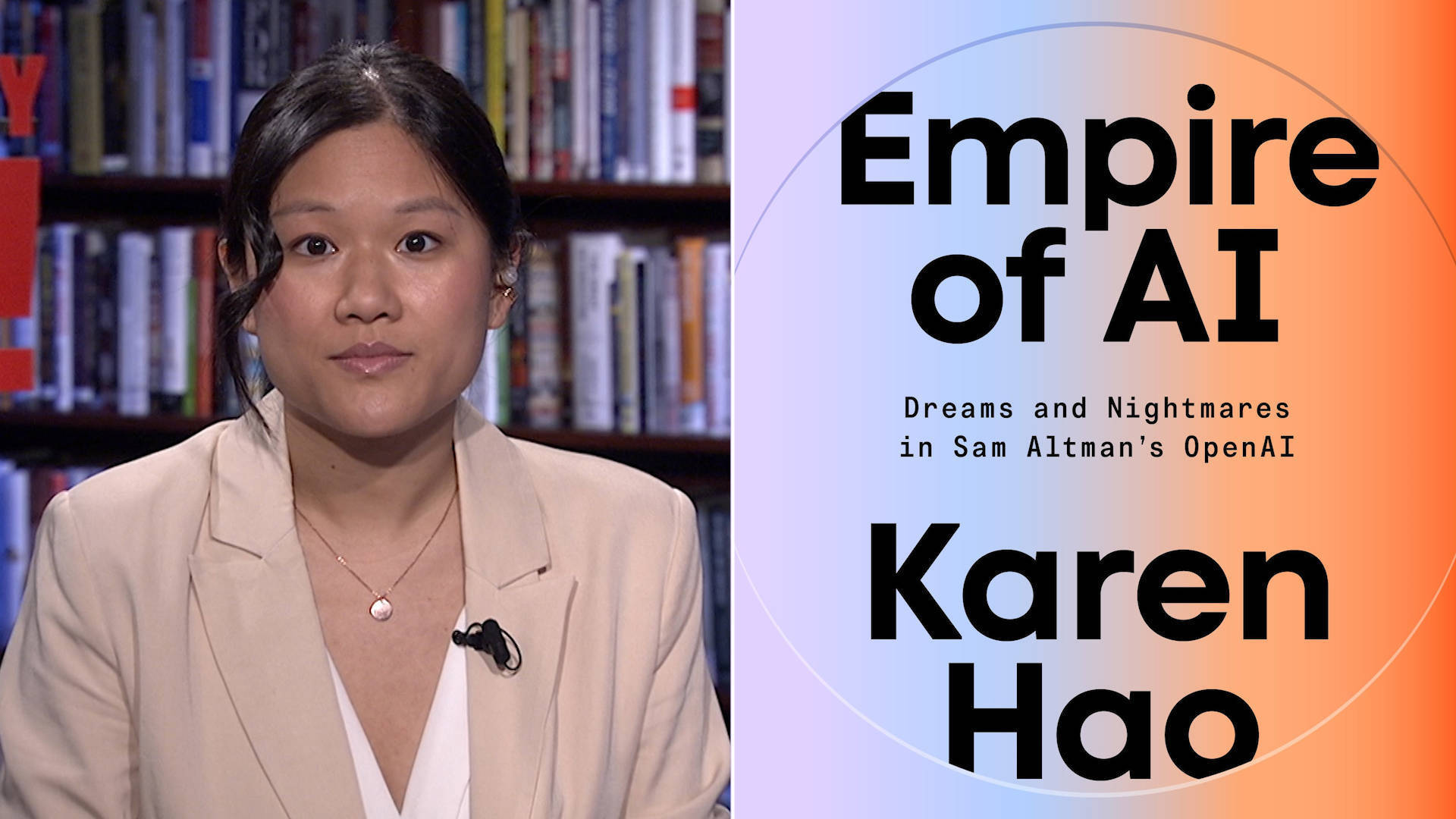
In our July Fourth special broadcast, we revisit our interview with longtime technology reporter Karen Hao, author of Empire of AI, which unveils the accruing political and economic power of artificial intelligence companies — especially Sam Altman’s OpenAI. Her reporting uncovered the exploitation of workers in Kenya, attempts to take massive amounts of freshwater from communities in Chile, along with numerous accounts of the technology’s detrimental impact on the environment. “This is an extraordinary type of AI development that is causing a lot of social, labor and environmental harms,” says Hao in an extended interview.
As part of our July Fourth special broadcast, we continue our extended interview with Karen Hao, author of Empire of AI: Dreams and Nightmares in Sam Altman’s OpenAI. The book documents the rise of OpenAI and how the AI industry is leading to a new form of colonialism. “One of the things that you really have to understand about AI development today is that there are what I call quasi-religious movements that have developed within Silicon Valley,” says Hao. “The concept of artificial general intelligence is not one that’s scientifically grounded.”
As triple-digit temperatures engulf much of the United States, the Trump administration wants grid managers to require the use of backup power that often goes unused.