The F.B.I. Support Network offers legal, mental health and job search services to current agency employees. Its founders say the work force is incredibly strained under Kash Patel.
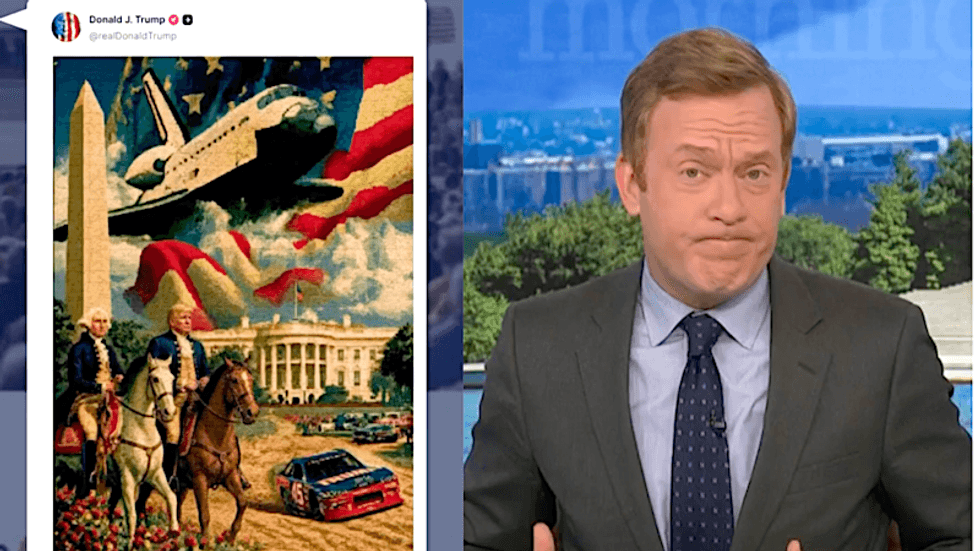
MS NOW's Jonathan Lemire struggled to make sense of President Donald Trump's latest weekend social media posting spree.The 79-year-old president posted dozens of times across more than 12 hours Saturday, including a lengthy tirade against a federal judge and numerous AI-generated memes celebrating himself in fantastical scenarios, and the "Morning Joe" host attempted to describe the posts to viewers."Right now, we want to turn to President Trump, who spent most of his Saturday posting on his Truth Social platform," Lemire said. "Again, the president's first post at 11:50 a.m. was a more than 700-word rant about a federal judge who on Friday ruled that the Kennedy Center must remove Trump's name from the building. Over the next 14 hours, Trump posted more than 60 times, finally ending at just after 1 a.m. Sunday morning.""His social media spree included political memes attacking his perceived political rivals, memes about crime under his administration compared to former President Biden, multiple AI-generated pictures, including two separate posts of Trump on Mount Rushmore and at least three posts with George Washington, one of which was the two men on horses near a Trump-branded NASCAR vehicle with the Washington Monument and the White House in the background, and, for good measure, a space shuttle flying over them," Lemire added. "You know, this is not going to help the accusations that President Trump is focused solely on himself and his own priorities."The posts offer a window into the president's thinking, agreed co-host Katty Kay, and she said the view wasn't particularly appealing. "It's pretty clear where the president's head is at at the moment," she said. "He's had this long-running war with Iran, long by his standards, not long, of course, by international standards, that is not going well. He's deeply frustrated by that. When he hits a roadblock in the pet things that he is really focused on, and that he feels a part of his legacy, like the Kennedy Center then and like the reflecting pool, then he gets peeved, and when he gets peeved, he reaches for his phone, and no matter how many people around him say it would be better to take the president's phone away from him during the course of particularly weekend nights, he doesn't want to do that." - YouTube youtu.be
President Donald Trump has solidified his control over the Republican Party by successfully pushing out GOPers who criticize him in party primaries. Yet in the process, according to a recent analysis, he may cost himself the 2026 midterm elections.“It’s far from clear that Mr. Trump’s winning streak in the Republican primaries will translate into victory in November, when the party will need the support of voters outside of Mr. Trump’s base — many of whom are deeply dissatisfied with the economy and the Iran war,” reported The New York Times’ Zolan Kanno-Youngs on Sunday. “Already, there are signs that his hold over Republicans in Washington may be slipping.”Kanno-Youngs reported that Senate Republicans blocked both Trump’s proposed $1 billion ballroom and his proposed $1.8 billion fund for Trump supporters and Trump-linked institutions that claim to have been persecuted by Democrats.“The split-screen illustrates an emerging paradox of the Trump presidency,” Kanno-Youngs added, after mentioning Trump’s recent string of legal defeats. “He has an iron grip on his most loyal supporters, even as his overall popularity slips.”One former GOP party official warned that Trump’s ability to control the Republican Party and then steer it in any direction he chooses is endangering their long-time political prospects.“The challenge of the administration right now, is the issues that they bring up, that Trump brings up, are not where voters are,” Douglas Heye, a former communications director for the Republican National Committee, told Kanno-Youngs. “They don’t need a ballroom, they don’t need a weaponization fund, they need lettuce to be affordable.”Despite Trump traditionally having near-unanimous support among Republican voters, a recent Quinnipiac survey found that only 73 percent of Republican voters still widely approve of the job Mr. Trump is doing. His overall approval rating has been stuck in the 30s, with most voters opposing Trump’s war with Iran and blaming him for America’s ongoing economic woes. Even worse, Trump has publicly expressed indifference to voters’ concerns.“When it comes to Iran, he said he does not think about the economic hardship of Americans — ‘not even a little bit’ — and that he does not care about the midterms,” Kanno-Youngs reported.Since the start of his second term, Trump has successfully primaried out Republicans considered to be stronger in the general election in favor of potentially weaker ones who he perceived as more supportive of him. The targeted incumbents include Sen. Bill Cassidy (R-LA), Sen. John Cornyn (R-TX), Rep. Thomas Masie (R-KY) and a group of Indiana state legislators who opposed his gerrymandering plans."He is one of the least popular presidents in modern polling history, and simultaneously, the most dominant force in the Republican Party,” journalist Colby Hall, the founder of Mediaite, recently wrote in a column for his ColbyHall.com website. “Neither fact is canceling out the other. His approval numbers are collapsing again. Depending on the poll, they are now approaching the lows he hit after January 6. He is underwater on inflation, cost of living, immigration, and now Iran. The broader electorate is plainly exhausted by him, the still very high price of a gallon of gas, and the bread and eggs he promised to make cheaper on Day 1 of his second term."Hall added, "At the exact same moment, Trump casually ended Sen. John Cornyn's political career with a single endorsement of the far more MAGA-coded Attorney General Ken Paxton in Texas. Ironically, Trump helping Paxton win the primary delivers his MAGA faithful a short-term win while putting the seat itself in real jeopardy. Democratic nominee James Talarico is a much more plausible threat to Paxton than he would have been to Cornyn, and a Republican Senate majority that looked safe a week ago no longer does."
James Talarico got the opponent he – and the Democratic party – wanted, but flipping Texas blue means winning blue-collar voters, not blue-blooded donorsTexas could become the hottest battleground state in the country, if the results of both Republican and Democratic primaries are anything to go by.Democrat James Talarico, a progressive Presbyterian seminarian, will face off against Trump’s favored candidate, the scandal-plagued attorney general, Ken Paxton. The matchup has liberals salivating. Paxton, dogged by corruption charges, impeachment hearings and an affair that left his marriage in tatters, is considered by some in his own party as “the worst possible top-of-the-ticket” candidate. Meanwhile, Talarico, a fresh-faced, clean-cut millennial, who quotes scripture to justify his progressive beliefs, seems like the perfect foil, at least according to Democratic party leaders. Continue reading...