Justice Samuel Alito Delivers Impromptu Response to Sonia Sotomayor After She Reads Her Stupid Dissent From the Bench in Landmark Asylum-Seeker Case
Far Right
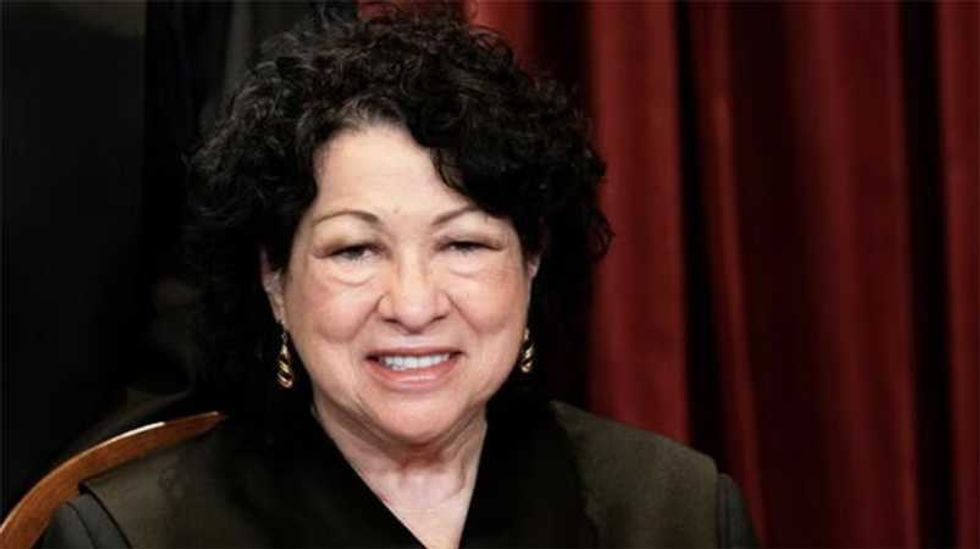
Justice Samuel Alito smacked down his leftist colleague Sonia Sotomayor following today's landmark ruling on asylum in a move that is surprising court observers.
The post Justice Samuel Alito Delivers Impromptu Response to Sonia Sotomayor After She Reads Her Stupid Dissent From the Bench in Landmark Asylum-Seeker Case appeared first on The Gateway Pundit.
Justice Sonia Sotomayor delivered a blistering dissent from the bench Thursday after the Supreme Court opened the door for the Trump administration to revive an immigration policy that allows border officials to block asylum seekers who do not physically cross the southern border from entering the country. Sotomayor, the most senior liberal justice on the high court,…
A bitter clash among Supreme Court justices came into view Thursday through a pair of immigration rulings, in which Justice Samuel Alito accused his liberal colleagues of blindsiding him.The friction emerged when Alito announced the court's decision in an asylum case, adopting a narrow interpretation of what it means for a migrant to have "arrived" in the United States under federal law — a reading that makes it significantly harder for asylum seekers who traveled through Mexico and South America to qualify unless they physically set foot on U.S. soil, reported CNN's Joan Biskupic."The tension really hit a climax, and it came when Justice Samuel Alito read three different opinions from the bench, the first one fairly routine, but the second two having to do with immigration and refugee rights," Biskupic reported from outside the court. "What happened in the courtroom showed not just the division but the anger between the two sides, and Justice Alito, right there from the bench, accused his liberal colleague, Sonia Sotomayor of blindsiding him, in effect, when she started to read her dissent from the bench.""Typically, it's the justice who is reading the majority opinion who's the only one who speaks," she added. "If somebody reads a dissent in this case, from the liberals really protesting what has happened in this refugee case."Over roughly 10 minutes, Sotomayor invoked the 1939 voyage of more than 900 Jewish refugees turned away from Cuba and the United States, most of whom later perished in the Holocaust, and tied that history to international treaties protecting people fleeing persecution. She argued the ruling betrayed that legacy and detailed the violence and extortion facing migrants stranded near the border. Justices Elena Kagan and Ketanji Brown Jackson joined her."Then Justice Alito, who's going to read another opinion, he stops and he says, 'If I had known that the dissent was going to deliver that opinion from the bench, I would have said more, I would have said more about why we ruled the way we did,'" Biskupic said. "It was a very bitter response to what we had just heard."Alito then pressed forward, announcing a second 6-3 ruling restricting the federal government's use of Temporary Protected Status for migrants from Haiti and Syria — another significant win for the administration.The TPS decision could have immediate consequences for refugees who have lived in the U.S. legally for months or years. Biskupic said whether individuals can now be removed depends on their specific status and where they stood in the application process, but the ruling clears a path for the administration to revoke protections it has long sought to end. - YouTube youtu.be
A decision by Justice Sonia Sotomayor to take 12 minutes of the court’s time on Thursday to read her dissent in a 6-3 ruling that makes it significantly harder for asylum seekers who traveled through Mexico and South America to enter the US provoked Justice Sam Alito to take an unseemly potshot at her, which stunned court regulars.According to MS NOW legal analyst Lisa Rubin, arch-conservative Alito sat and listened to a very “calm” Sotomayor read her dissent, with Rubin pointing out, “That is certainly not unusual.”“But here there was a moment of tension between Justices Sotomayor, with her dissent and Justice Alito, who wrote the majority opinion here,” she elaborated. “Producer Peggy Helman, who is in the court for the reading of all of these decisions, said that Justice Alito said in response out loud, ‘There's much I would have added if I had known a dissent would be read from the bench.’”“She [Helman] said that people in the Supreme Court, in the gallery gasped when he said that because this is a group of people that, for all of their differences in terms of legal, interpretive methodology or even the outcome of cases, they like to make it seem as if they get a long; that they are all just rowing in the same direction, trying to do their job to uphold the rule of law” Rubin reported. “Even when their conceptions of what the rule of law is differs, that very obvious public fracture between the two of them was one that was surprising even to the most veteran court watchers in the room today,” she added. - YouTube youtu.be
By a 6-3 vote, the high court ruled that federal law allows the government to stop asylum seekers from physically setting foot in the United States, effectively keeping them from applying for asylum.
The U.S. Supreme Court sided with the Trump administration on Thursday in a dispute over an immigration policy critical to combating migrant surges at America’s southern border. The decision was 6-3, with Justices Sonia Sotomayor, Elena Kagan, and Ketanji Brown Jackson in the dissent. Known as Mullin v. Alt Otro Lado, the case centers around […]
After years of legal setbacks that have cost billions of dollars over its top-selling Roundup weedkiller, Bayer AG finally got a resounding win in the biggest court of all.
The Supreme Court has ruled in favor of Homeland Security Secretary Markwayne Mullin and the Trump administration regarding when asylum-seekers officially "arrive" in the U.S.In a 6-3 decision split along ideological lines, the Court held that aliens seeking asylum do not “arrive in the United States” until they physically cross the border into the country and therefore are not entitled to inspection by border officials until they have entered onto U.S. soil.'An alien "arrives in the United States" only when he crosses the border.'The case stems from the federal government’s “metering” policy — first adopted in 2016 amid a surge of migrants at the southern border — that limited the number of aliens whom Customs and Border Patrol agents would inspect each day for asylum. When a port of entry reached capacity, officials physically prevented additional aliens from entering until capacity became available again. In 2017, asylum-seekers and Al Otro Lado, an immigration advocacy organization, brought forward a class-action lawsuit arguing that the federal government was unlawfully denying aliens access to asylum procedures. The federal district court in Southern California granted summary judgment in favor of the noncitizens and declared the government’s policy unlawful. The metering policy was then discontinued in November 2021, though the second Trump administration has attempted to revive it. A divided Ninth Circuit panel affirmed the summary judgment, ruling that an alien “arrives in the United States” when said alien — even while standing on the Mexico side of the border — encounters a U.S. official and thus must be inspected for asylum claims. Writing for the majority, Justice Samuel Alito reversed the lower court’s ruling. The court held that the meaning of “arrives in the United States” requires physically entering the country. Therefore, under the Immigration and Nationality Act of 1952, an alien standing on the Mexico side of the border is not entitled to inspection by a U.S. official. “We hold that an alien who is standing in Mexico does not ‘arriv[e] in the United States’ by attempting, and failing, to set foot in this country. An alien ‘arrives in the United States’ only when he crosses the border,” Alito wrote.RELATED: Ketanji Brown Jackson melts down over SCOTUS ruling against Hawaii gun law: 'The court's objective is protecting guns' U.S. Supreme Court Associate Justices Samuel Alito (L) and Clarence Thomas (R).Chip Somodevilla/POOL/AFP/Getty ImagesThe court highlighted the text of other INA provisions and subsequent amendments to the statute to indicate that Congress intended asylum and inspection rights to apply only after an alien enters the country. “That Congress amended §1158(a) in IIRIRA to replace ‘at a land border or port of entry’ with ‘arrives in the United States’ suggests that we should not read those phrases — which carry different ordinary meanings — to have the same meaning.”Justice Sonia Sotomayor, joined by Justices Elena Kagan and Ketanji Brown Jackson, dissented, arguing that Congress intended border officials to inspect and process all aliens who present themselves at ports of entry, regardless of whether they have physically stepped into the U.S. The dissent contended that the majority’s decision “ignores the statutory context and history” of the INA and weakens the asylum protections Congress created for people fleeing persecution. "The Court today holds that the Executive Branch may circumvent all these mandatory procedures by having U.S. immigration officers stand at the border and physically block noncitizens from setting a foot onto U.S. soil.” Sotomayor added, "The Court's illogical interpretation is driven almost entirely by a fixation on a single word: 'in.'"Like Blaze News? Bypass the censors, sign up for our newsletters, and get stories like this direct to your inbox. Sign up here!