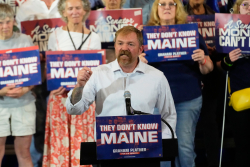
Two major polls of the Maine Senate race dropped this week, and they told the same story: The race is incredibly close, and Democrat Graham Platner has real work to do among the working class. He's running an aggressively left-populist, anti-establishment campaign targeting the billionaire class-and boasts lots of blue-collar appeal-but GOP Senator Susan Collins is way ahead among those voters. Why?
The Trump administration is asking a federal judge to quickly lift her recent ruling against major provisions of a presidential executive order on elections, arguing in an appeal that the court’s action will effectively prevent the government from putting new voting restrictions in place before the November election.This article was originally published by Votebeat, a nonprofit news organization covering local election administration and voting access.Last week, U.S. District Judge Indira Talwani halted President Donald Trump’s efforts to create centralized lists of adult citizens and give the U.S. Postal Service unprecedented authority over who can vote by mail. Her 37-page ruling concluded that the president did not have the constitutional authority to regulate state elections, as his March executive order tried to do.The executive order directed the U.S. Department of Homeland Security and Social Security Administration to create a nationwide list of verified U.S. citizens over 18, and thus presumably eligible to vote in federal elections. It also called on the U.S. Postal Service to create a system to handle and accept mail-in ballots only from voters on preapproved lists.Talwani’s order prevents the federal government from enforcing those provisions of the order against the 24 jurisdictions (23 states and the District of Columbia) whose attorneys general and governors brought the lawsuit in federal court in Massachusetts. The list includes most Democratic-led and swing states, including Arizona, California, Michigan, Nevada, New York, North Carolina, Pennsylvania, and Wisconsin.This week, the Trump administration appealed Talwani’s ruling to the First Circuit Court of Appeals and said it is still proceeding with its efforts to set up the new system for the rest of the states. But it warned that the judge’s order will make it impossible for the U.S. Postal Service to create a bifurcated system for the November election, even if the administration ultimately prevails on appeal. Government attorneys asked Talwani to lift her ban by Monday.The request for a quick decision suggests that the Trump administration may be trying to speed things up so the case reaches the U.S. Supreme Court as soon as possible.“Operationally, it would not be possible for us to put a two-tiered system in place where one set of rules apply to the ballot mail of the Plaintiff States, and another applies to the remaining states,” Steven Monteith, the Postal Service’s chief customer and marketing officer and executive vice president, said in a court filing. “Doing so would cause operational confusion and significantly increase the complexity and efficiency of implementing any final rule.”But the Trump administration’s nationwide efforts to use the Postal Service to regulate who gets ballots also hit a separate legal roadblock this week when another federal judge in Washington, D.C., ruled that the executive order violates a years-old agreement requiring the federal government to ensure voters who request mail-in ballots get them in time to ensure they can be counted.U.S. District Judge Emmet Sullivan concluded that the Trump administration’s plans to send ballots only to voters on preapproved lists breached a 2021 agreement between the Postal Service and the NAACP meant to ensure that the agency prioritized ballot delivery. In contrast to Talwani’s ruling, Sullivan’s decision applies nationwide.“These proposed rules directly undermine commitments that the Postal Service made to ensure mail-in ballots are delivered and counted,” said Anthony Ashton, senior associate general counsel for the NAACP, in a statement.The U.S. Postal Service and Department of Homeland Security did not respond to requests for comment.Dion Nissenbaum is Votebeat’s senior national reporter and is based in Houston. Contact Dion at dnissenbaum@votebeat.org. Votebeat is a nonprofit news organization covering local election integrity and voting access. Sign up for their newsletters here.
An ex-GOP operative flagged how Trump is killing what he once touted as his "best" deal at the expense of his supporters.During an episode of The Bulwark Podcast, Tim Miller described Trump's plans concerning the United States-Mexico-Canada Agreement, which Trump negotiated and boasted about during his first term."The Trump administration decided not to renew the USMCA," Miller noted. "Which is pretty interesting because Donald Trump said that was the best agreement we've ever made, the best trade deal of all time."While "it's strange that they would not renew the best trade deal of all time," Miller explained, "They're now going to do yearly reviews where Trump shakes down the leaders of Mexico and Canada...not great."According to Miller, Trump will ditch the USMCA in favor of an arrangement where the U.S. conducts annual reviews of trade with Mexico and Canada. He predicted that the new arrangement would likely hurt American farmers, who supported Trump."The farmers, it's one hit after another for the farmers, who, it seems like, every Trump policy is like it's almost like an elaborate plot to see how much he can p— off the farmers and still run up the numbers in rural America," Miller said.Miller's guest on the show, New Yorker writer Susan Glasser, agreed."As far as the farmers go, Donald Trump loves to provide evidence that his ride or die supporters will be there no matter how much he humiliates them," Glasser said. "No matter how much he backs away from policies that would support him, no matter how much he fails to deliver the things that he said he would deliver. That to Trump, that's the ultimate sort of political own, and he loves that move."
In a 6-3 decision breaking on partisan lines, the Supreme Court ruled in Trump v. Slaughter that Trump can fire Federal Trade Commissioners and other federal agency directors without cause. The ruling overturns longstanding Supreme Court precedent and express statutory instruction that combined to protect the political independence and subject matter expertise of federal agencies for over 90 years.The ruling presents a novel reading of a president’s Constitutional duty to “take care that the laws be faithfully executed,” expanding that power for a rogue president hellbent on breaking laws instead of executing them. As Justice Sotomayor put it, “The Court… is elevating (Trump) above his once-coequal branches by transforming a duty to take care that the laws be faithfully executed into a license to act in defiance of those very laws.”An activist Roberts Court has now written into existence an all-powerful unitary executive despite elaborate instructions in art. I, II and III to keep the three branches of government separate and equal. Rejecting federal laws that restrict a president’s removal of agency directors to for-cause removal, SCOTUS has made the president all powerful and Congress less relevant, while arrogating scientific and technical questions to itself.Trump’s corporate donors can now choose their own regulatorsBefore republicans on the bench rewrote it this week, the Federal Trade Commission Act stated that a President could only remove a commissioner for “inefficiency, neglect of duty, or malfeasance in office.” That statute clearly and intentionally barred presidents from firing directors for partisan or corrupt reasons, and from punishing regulators who rule against a president’s corporate donor(s). Vesting a singularly authoritarian executive with unprecedented, expansive powers, the Supreme Court re-wrote federal laws to advance their own political narrative.Over two dozen federal agencies will be affected, covering everything from the financial markets, the commodities markets, and nuclear power. Agencies like the Federal Trade Commission, Federal Communications Commission, and the Securities and Exchange Commission were all Congressionally designed to be independent watchdogs, enforcers insulated from partisan whims. Now Trump can remove any commissioners who threaten to rule against his allies, assuring that his political supporters will be afforded preferential review, licensing, merger approvals and other rulings.With Trump’s new latitude to fire any agency head who threatens meaningful regulation, his corporate donors have been effectively empowered to choose their own regulators. Federal laws passed to protect human health, finance, banking, communications, workplace safety, and clean air, soil and water have been rendered functionally meaningless.Replacing science, expertise and merit with political fealtyCongressionally created and funded federal agencies serve express, statutory purposes written to safeguard the American public. The Supreme Court had protected agency autonomy and expertise dating back to 1935, ruling that some degree of autonomy was necessary for federal agencies to meet specific scientific, economic, communications, trade, health, and environmental mandates. Federal agencies were never meant to be a president’s personal toys with which to reward donors and cronies.For a president in the habit of accepting lavish gifts and cash from foreign governments, along with hundreds of millions from domestic supplicants, finding even more room for self-dealing, corruption and political favoritism must be heady. For the rest of us, it’s dangerous. We actually need competent people to run the federal government, even in its post-DOGE watered down state.If Trump declares that every home must be heated by dirty coal, the head of the Energy Commission must try to effectuate that command no matter the harm to Americans’ lungs. If Trump declares that particulate matter, fossil fuels and the widespread use of Monsanto is good for the environment, any EPA director who contradicts him with cancer and death statistics will be silenced through removal. It’s governance by full Idiocracy.A know-nothing, anti-science president can now follow his gutTo every American outside the Fox News propaganda bubble, Trump has demonstrated astonishing incompetence on all fronts. From economically illiterate tariffs to our defeat in Iran, sprinkled with comically disastrous results in between, an ignorant and arrogant “I follow my gut” Trump revels in rejecting science and expertise as Americans pay the price.The only thing saving the nation from complete chaos and disaster to date is that several federal agencies had retained some level institutional competence despite Trump (and Musk’s) best efforts to dismantle them.