California U.S. Attorney Office Pretends Not to Know Specifics or Origin of California Voter Fraud
Far Right
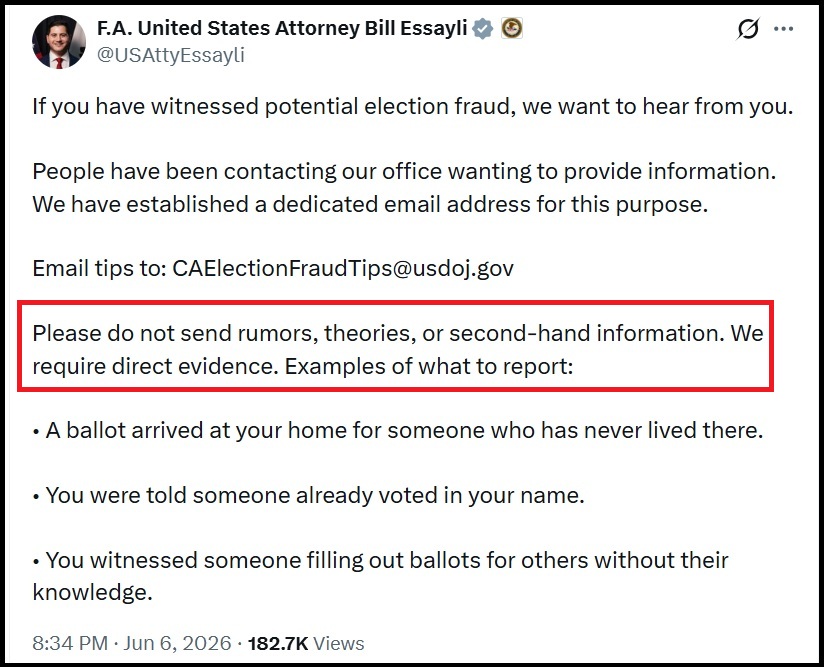
California ballot counting will continue until the key republicans in each race are pushed into 3rd place. That’s when ballot counting will conclude. At a certain point, the pretending gets ridiculous. This X message from the First Asst U.S. Attorney for the Middle District of California is a case study in pretending not to know […]
The post California U.S. Attorney Office Pretends Not to Know Specifics or Origin of California Voter Fraud appeared first on The Last Refuge.
As always, the media says Republicans are spreading conspiracy theories about the California primaries.
The post The Facts About the California Primary and Its Lack of Integrity appeared first on The Gateway Pundit.
The 2026 World Cup promises to be the planet’s most-watched sporting event. It’s also poised to generate its fair share of controversy.Taking into account the history of corruption in FIFA, the sport’s governing body, it would be hard to blame anyone who decided to ignore this year’s competition.However, some viewers of this summer’s tournament may face an additional dilemma. Political tensions are high in the U.S., where most of the tournament’s matches will be played. The Trump administration is historically unpopular, and its critics are already concerned about sportswashing: when governments use the spectacle of athletic competition to burnish their image and distract the public.As I point out in my 2022 book, “The Ethics of Sports Fandom,” fans who are critical of their country’s behavior sometimes feel ambivalent about rooting for their national sports teams – and may even feel compelled to root against them. After all, it’s one thing to pull for your national team when patriotism feels uncomplicated. It’s quite another when you aren’t feeling very proud to be an American. The Cold War made it easy for many Americans to rally behind the 1980 U.S men’s hockey team in its victory over the Soviet Union in the “Miracle on Ice.” But what do you do when you don’t see your country as the “good guys”?Patriotism doesn’t mean blind loyaltySome fans might double down on their patriotic commitments during the tournament. They’ll use the occasion to champion America in all things, whether it’s the country’s battles in the Middle East or its national team taking on Paraguay at SoFi Stadium in Los Angeles. Sports have a way of fueling nationalistic passions, and I fully expect plenty of people who don’t care much about soccer to channel their patriotic sentiments into the tournament.However, rooting for your country’s national soccer team doesn’t mean that you endorse everything your country does, any more than wanting a friend to get a promotion at work requires you to support all of their behavior. As the philosopher Eamonn Callan has argued, a proper love of country requires citizens to be clear-eyed about its faults. The true patriot highlights problems and works to correct them, independent of how much they want the national team to win their next match.By the same token, I think a deep love of country can coexist with ambivalent feelings about how the national team performs on the field. If patriots can disapprove of their country’s military adventurism – either because they see it as flatly unjust or because it casts their country in an unfavorable light on the international stage – there is nothing fundamentally unpatriotic about not wanting the U.S. to do well in the World Cup. Other fans might invoke the mantra that it’s important to simply keep politics out of sports – that the games should be a refuge from the controversies that plague so many other aspects of civic life.But as I argue in my book, fully separating politics and sports is almost impossible. It requires fans to view athletes as nothing more than bodies who exist to perform on the field. It means team executives and owners do little more than sign paychecks. And it ignores the reality that sports are woven into the social, economic and political life of communities.Outcomes don’t change a thingFor fans who choose to watch, then, my suggestion is to view the action on the field as you would any other sporting event. Root for whomever you want to win, for more or less any reason that moves you. Because for all the political significance attached to the World Cup, the winner or loser of any given contest has essentially no broader political significance. The problems that existed before the tournament will still demand attention when it is over, no matter who happens to win. Success or failure on the pitch isn’t likely to bring about meaningful political change. After all, whether a government has the right legislative agenda or approach to foreign policy is totally divorced from its national soccer team’s ability to score goals.Viewed in this way, rooting for your country’s national soccer team doesn’t imply blind loyalty to your country or ignorance of its flaws. It simply means that you want the athletes who represent your country to win the game they are playing on that particular day.Athletes have long been able to navigate this ambivalence. You’ll regularly hear them trying to separate a love of their country and its people from support of problematic regimes. When Iranian soccer player Mehdi Taremi refused to celebrate a goal in a January 2026 Greek Super League match, he embraced precisely such a position. Thousands of people had been killed during protests of the Iranian regime, and the moment called for a different reaction.“There are problems between the people and the government,” he said.
Pollsters are finding that swing voters are increasingly worried about a trending issue that's being overlooked.Sarah Longwell, a Republican pollster and the publisher of The Bulwark, revealed in a podcast that swing voters are sharing a long list of concerns about AI data centers with pollsters.The issue is "flying under the radar as a big picture issue for folks in D.C., but I hear it coming up all the time in focus groups," Longwell said. "I know some people are paying attention to this, but I mean, the voters talk about it all the time."She played audio from a focus group interview with a Georgia small-town voter who described the impact of AI data centers as "devastating" and explained why she's bothered."I'm in the middle of a huge countywide fight against data centers," one voter said. "People are showing up about their water already, and about 40 people are being pushed out of their homes. It's just very personal."The voter added that the fight against AI data centers "took the cake for me on whether or not I might vote. The only reason I'm going to is because maybe when I go to heaven, it'll count for something."Another voter from Pittsburgh said that data centers are replacing "old mill sites," and "people are saying, 'We don't want them! We don't want them! We don't want them!'" Pittsburgh residents are opposed to the water consumption and pollution created by data centers, "but they just keep coming," he went on."It doesn't matter who the governor is, who the mayor is," he said. "They're all on board because it's job creation."Longwell predicted, "Does this become a 2028 issue?" referring to the next presidential election. "I suspect it does."
Look at Los Angeles. Saturday’s batch of 58,558 late-counted votes in the mayor’s race broke 40.2% for Nithya Raman, 33% for Karen Bass and a mere 17.6% for Spencer Pratt — no doubt a reflection of late-voting Democrats in a city where only about 16% of voters are registered Republican. Pratt’s lead for the second...
Friends,Today is the 82nd anniversary of D-Day — the Allied invasion of Normandy on June 6, 1944. It’s referred to as “D-Day” after the military term for a day when a secret combat attack or operation is planned.It was the largest seaborne invasion in history. It began the Western Allied effort to liberate western Europe from Nazi Germany.Over 2,500 American soldiers, sailors, and airmen were killed during the initial amphibious assaults and airborne operations. All told, there were 4,414 confirmed Allied deaths on the first day of the invasion, which also included troops from the United Kingdom and Canada.At the time of the invasion, my father was 30 years old, in a tank battalion readying to go to Europe. My mother was 25, working in a factory producing gas masks for the war. Some of their friends participated in the invasion. A few were paratroopers. Others were pilots. Others were soldiers.As a small boy, I remember trying to talk with my father and my mother about D-Day. I wanted stories. The little I’d heard about it made it seem romantic and exciting. But they were reluctant to talk about it. They answered my questions in short sentences. Their voices were hurried. It was as if I was trying to open a door they’d rather keep closed. They had lost friends, relatives. D-Day, and the war it helped end, had left deep scars.Eventually they and their generation were called America’s “greatest generation” for their valor and sacrifice. They had fought fascism and won.Now, 82 years later, we have home-grown fascism. An entire political party seems to have given up on democracy. They’re supporting an ego-maniacal “strong man” who cares only about enlarging his own (and his family’s) wealth and power.His regime is marked by a degree of corruption, cruelty, and criminality never before witnessed in America’s national government.Trump’s and his “war” secretary, Pete Hegseth’s firing of so many top brass can be seen as a way to guarantee the loyalty of other officers to Trump rather than to America. Trump’s proposal to increase the U.S. military budget by nearly 50 percent can be understood as a bribe to officers. He wants them to side with him, if and when he tries to stay in power indefinitely.He has already tried to turn much of America into a police state.Public support for him is waning, and the federal courts have fought back. But it is startling and saddening how far Trump and his regime have gotten.What happened to the bravery and dedication of the greatest generation? What became of the sacrifices my parents and their peers made so that this nation could be free?How and why did so many Americans succumb to neofascism?I think it has to do with the anger so many Americans have felt that they and their children haven’t been able to get ahead, no matter how hard they work. Trump and other neofascists have channeled that anger toward immigrants, gays, transgendered people, Muslims, and Black people.Democrats and progressives should be channeling that anger toward the real culprits — a wealthy elite that’s used their money to gain political power and rig the economy to their benefit and against everyone else.Another reason so many have succumbed to Trumpian neofascism is the passage of time. Eighty-two years is long enough for a nation to forget, especially a nation whose collective memory is short to begin with. Very few living Americans remember the terror and heroism of our fight against Nazi fascism. The greatest generation has mostly died off.But we must not forget. Fascism is being born again, in America and in Europe. This time it’s masquerading as white Christian nationalism, but it’s as dangerous as ever.The best way to remember and honor the men and women who risked everything for us is to fight neofascism — fight for a stronger democracy, fight for the rule of law and social justice, fight against bigotry.Robert Reich is an emeritus professor of public policy at Berkeley and former secretary of labor. His writings can be found at https://robertreich.substack.com/. His new memoir, Coming Up Short, can be found wherever you buy books. You can also support local bookstores nationally by ordering the book at bookshop.org
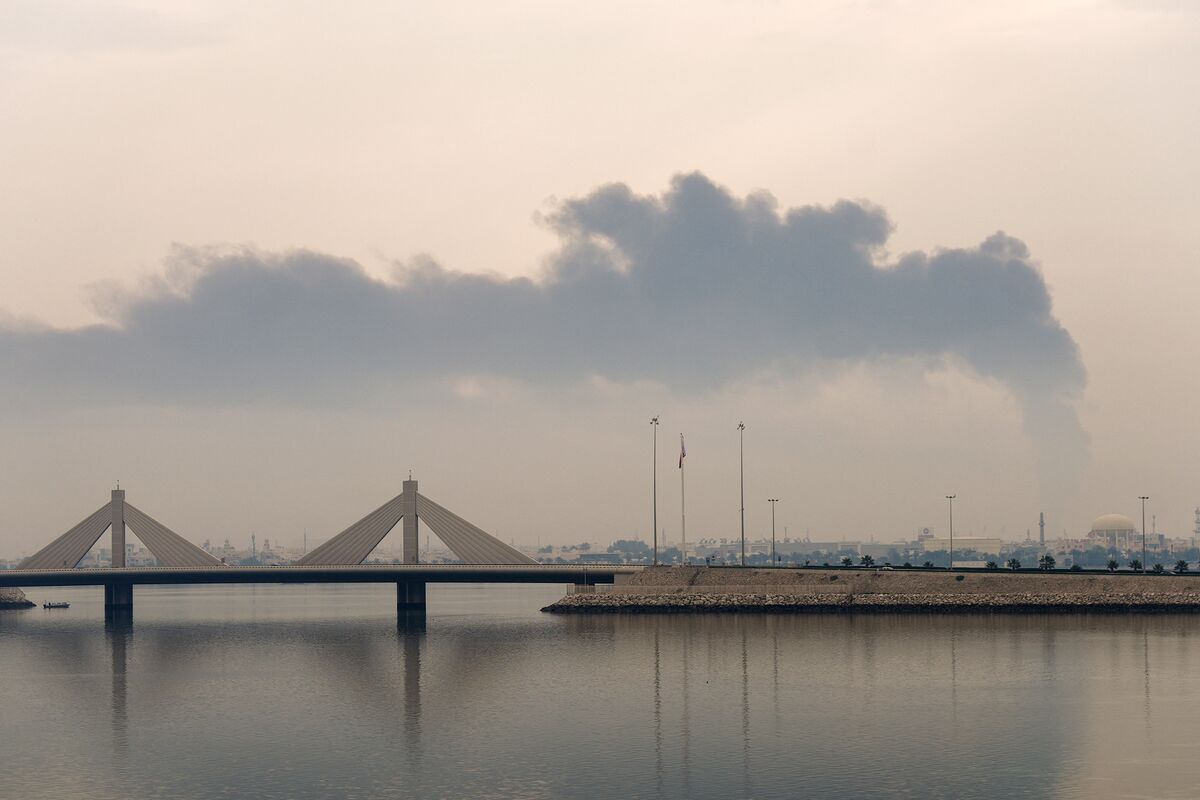
The Trump administration is seeking to steer Iranian assets toward helping US allies in the Persian Gulf rebuild from damage inflicted by Tehran, and to repair any future destruction.