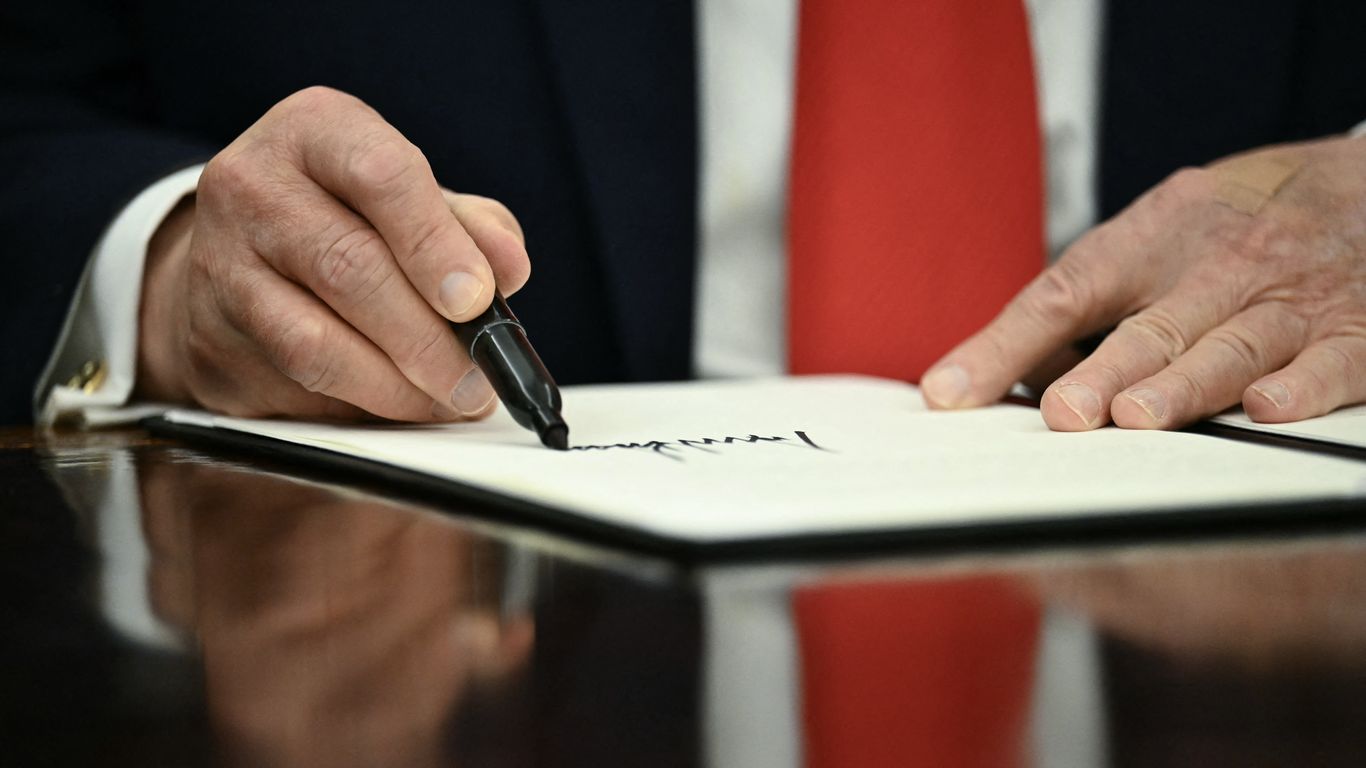
Vice President JD Vance said a 60-day preliminary ceasefire extension between Iran and the United States was signed digitally ahead of in-person meetings to sign the deal in Europe later this week. “We already signed the deal digitally yesterday,” Vance told ABC’s Good Morning America on Monday about the memorandum of understanding. “And there’s been […]
Crude oil prices fell to a three-month low Monday after President Donald Trump announced that the United States and Iran had reached a deal, which resumed tanker traffic through the Strait of Hormuz. Benchmark crude fell nearly 5% to around $83 per barrel, while U.S. West Texas Intermediate crude dropped below $81 per barrel for […]
A military expert shredded President Donald Trump's agreement to end his war with Iran as nothing short of capitulation.The 80-year-old president claims to have reached an agreement confirmed by Iranian officials, but retired U.S. Naval War College professor Tom Nichols published an article for The Atlantic analyzing the details that have been reported so far."The details of the agreement remain unconfirmed, but the president, of course, is eager to spin the outcome as a victory," Nichols wrote. "Trump was in a hurry to sign the deal on his birthday; the Iranians, who now seem to be in charge of this whole business, instead said they will send someone to a meeting in Switzerland on Friday. But even before we have the details, it is clear that Trump has failed to achieve every one of the goals he put forward for this war of choice, and now he is determined to sign, seal, and deliver America’s capitulation as quickly as possible."Nichols wasn't so sure the war had ended in defeat for the U.S., saying Iran had taken significant damage from the military operation, but he said the regime remained intact and in control of the Strait of Hormuz – which he said were Tehran's key strategic aims."Indeed, the United States has perhaps done worse than gaining nothing," Nichols wrote. "Iran, while temporarily weakened, is now an even more powerful political actor: The regime in Tehran stood up to a massive U.S. onslaught, survived, and then inflicted pain on various states in the Gulf as punishment for going along with Trump’s war."The Strait of Hormuz will reopen when the agreement is signed, but Nichols said Iran held a stronger hold over the crucial waterway than before Trump launched the attack, and he said the president had agreed to give the regime $24 billion over the next two months and another $300 billion for reconstruction."The war leaves Iran battered, but more powerful and with more cash at its disposal, while it leaves America weaker, with important stocks of weapons depleted, and with its consumers paying the price for the war at the gas pump," Nichols wrote."Trump began this war by promising the Iranian people that they would be able to seize their government from the theocratic tyrants who oppress them, and he repeatedly said he would settle for nothing less than 'unconditional surrender,'" Nichols concluded. "Had Trump toppled the regime in Tehran, he would have had the thanks of most of the world — and congratulations from even his most dedicated critics. Instead, the United States has been defeated."
Vice President JD Vance denied that Iran will receive "billions of dollars of assets" as part of a the U.S.-Iran deal that was announced Sunday and is set to be signed later this week.
Deal of SortsIt's a deal to negotiate a deal with a terrorist regime that suppresses its own people and seeks to dominate against little and big satan. The President pulled back from historic and impressive military superiority once the Iranians captured the Strait and held
A former national security official during President Donald Trump's first term sharply criticized his agreement with Iran to end hostilities.Miles Taylor, who served as National Security Council chief of staff in the first Trump administration, told MS NOW's Stephanie Ruhle that none of the terms the 80-year-old president had reached with Iran improved the situation from before he decided to launch the war in February."I'm going to go out there on a limb and say that I think this is on track to be the worst deal in American diplomatic history," Taylor said. "We don't have the text yet, but it's very, very hard to imagine there is a deal here that's any better than the deal we already had. In fact, if the initial reporting is to be believed, the Iranians think that they're on a pathway to get $24 billion in assets unfrozen, that would be more than 10 times what the Obama administration effectively helped unlock for the Iranians.""So put it another way we're paying 10 times, potentially paying 10 times what we did before to get the same promise from the Iranians, and in international law, there's nothing that you can say about their commitment to not pursue nuclear weapons," he added. "That's stronger than a promise. There is no global police force to require the Iranians to not pursue a bomb. So all we could get, the best we could get is a promise from the Iranians, a promise we already had and once."Taylor had a front-row seat to a decision that Trump made in his first term that set the war in motion."Donald Trump threw out [the Joint Comprehensive Plan of Action] in the first administration, when I was there," Taylor said. "I can remember the frustration of staff when Donald Trump did not have any plan to replace the Obama deal with tore it up, and now here we are again, potentially on the pathway to unlocking 10 times as much money for the Iranian regime to get the same agreement that we had previously.""Now, again, the devil will be in the details," he added, "but I have a feeling we're going to see the devil." - YouTube youtu.be
The Trump administration has approved media conglomerate Paramount’s $111 billion bid to acquire Warner Bros., one year after Paramount and Skydance Media signed a similar merger that placed Paramount’s movie studio, streaming service and broadcast network CBS under the control of the multibillionaire Ellison family, founders of Skydance and close allies of Donald Trump. The Warner Bros. merger, if completed, would bring an even larger slice of the industry’s market share into Ellison control. It’s been contested for months as a likely violation of antitrust laws amid a wider trend of corporate consolidation in the media and entertainment industry. “This has been one of the most shallow and corrupt merger review processes we’ve ever seen,” says Craig Aaron, co-CEO of the advocacy organizations Free Press and Free Press Action (not to be confused with Paramount Skydance’s conservative news outlet The Free Press), about the Justice Department’s greenlighting of the merger.
The deal will place two of the largest U.S. broadcast news networks — CBS News and CNN — under the control of a single company that “has shown it is willing to warp and manipulate news coverage to please the president,” Aaron says. He warns that the many violations of press freedom committed by CBS News since its acquisition last year could soon be seen at CNN, including “getting rid of independent journalists asking hard questions [and] spiking stories about crimes being committed by the Trump administration.” In a consolidated media landscape, he adds, “we get fewer and fewer choices, and we get more and more of the same kind of cookie-cutter content produced.”