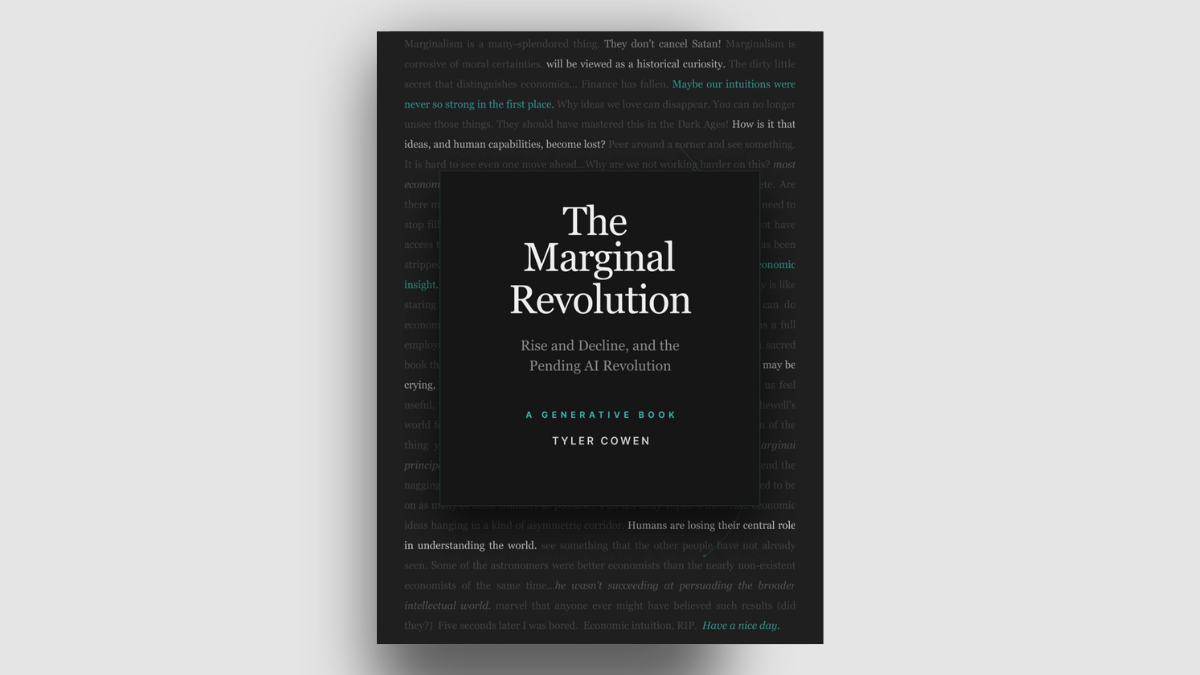
Tyler Cowen’s latest work, The Marginal Revolution: Rise and Decline, and the Pending AI Revolution, is a surprisingly critical look at one of the foundational ideas of modern economics.
Tyler Cowen’s latest work, The Marginal Revolution: Rise and Decline, and the Pending AI Revolution, is a surprisingly critical look at one of the foundational ideas of modern economics.
Major American corporations that benefited from tax cuts enacted last year by President Donald Trump and congressional Republicans are donating to the campaigns of GOP lawmakers who made the windfall possible.A report published Friday by Unrig Our Economy spotlights seven House Republicans who voted for the sprawling and unpopular GOP budget package, which extended tax breaks for corporations and wealthy Americans while inflicting unprecedented cuts on Medicaid and federal nutrition assistance—with disastrous consequences for millions of low-income families across the country.Rep. Mariannette Miller-Meeks (R-Iowa), one of the lawmakers featured in the new report, has received campaign donations from corporate PACs representing 3M, Amazon, Walmart, AT&T, and other companies that collectively received billions of dollars in tax breaks from the Republican law, which restored a provision allowing businesses to immediately write off new investments.Amazon saw its US income taxes fall by more than half last year due to the GOP law, even as the company’s profits grew. Unrig Our Economy noted that Amazon, whose PAC donated thousands to the Republicans spotlighted in the new report, has an effective federal tax rate of 1.37% following enactment of the budget law.Miller-Meeks, who has received at least $57,000 in donations from the PACs of companies that benefited from the 2025 law, issued a statement Thursday bragging about supporting “the largest tax cuts in American history,” not mentioning that the benefits will disproportionately flow to profitable corporations and the richest people in the country.“Thanks to the Republican tax law, corporations are receiving tax breaks, House Republicans are getting campaign cash, and working families are getting stuck with the bill,” the report states.Another Republican lawmaker featured in the report, Rob Bresnahan of Pennsylvania, received $2,500 in campaign donations from the PAC of FirstEnergy, which reaped $500 million in depreciation deductions thanks to the GOP tax law.“Bresnahan voted to give FirstEnergy hundreds of millions in tax breaks even after the company raised utility prices for his constituents,” Unrig Our Economy’s report observes.The report also points out that Bresnahan “owned stock in every single one” of the companies who contributed PAC money to his campaign following passage of the Republican budget package last summer.“This comes after Bresnahan has already faced scrutiny for dumping stock in Medicaid providers and selling off bonds in Pennsylvania hospitals before voting to slash Medicaid and put rural hospitals at risk,” the report notes.Leor Tal, Unrig Our Economy’s campaign director, said in a statement that “one year ago, House Republicans ripped away healthcare and food assistance from millions of Americans, so that corporations could get massive tax breaks.”“Now, many of those companies are dishing out PAC money to the Republicans listed in this report,” said Tal. “Republicans in Congress sold out many of their own constituents to help corporations get even richer. It’s time that House Republicans step up, do the right thing, and start fighting for working Americans—not giant corporations.”
The fight that scrubbed the world's most powerful AI models from the internet featured personality clashes, industry confusion, and international backlash.Why it matters: Anthropic's models are back online, but the impact of its 20-day showdown with the Trump administration will be long lasting.Behind the scenes: It began when Amazon, Anthropic's partner and investor, sounded an alarm that was later disputed by cybersecurity experts.It warned about a "jailbreaking" issue it found with the AI lab's latest models, Mythos and Fable — meaning a technical flaw that could have caused a failure of their guardrails.Amazon flagged its concerns to the administration, triggering sweeping export controls. A U.S. official said the government conducted its own tests once it became apparent that the issue needed to be addressed.Cybersecurity experts, however, later wrote in an open letter to the administration that other leading AI models have the same issue Amazon warned about with Anthropic.On June 12, Commerce Secretary Howard Lutnick, at the direction of President Trump, called Anthropic CEO Dario Amodei. Lutnick made clear to Amodei the issue needed to be resolved fast and alerted the CEO that the company would be receiving a letter imposing sweeping export controls, the U.S. official said.Amodei called Lutnick back that night after receiving the letter, realizing it effectively meant the models would have to be taken offline — to which Lutnick responded that was indeed the goal.That decision led to a three-week, multi-agency crash course in AI safety.Anthropic deployed engineers to Washington D.C. According to a U.S. official, the company wanted to prove everything was already resolved and further changes were being fine tuned.But the federal Center for AI Standards and Innovation and the National Security Agency said those changes weren't good enough, prompting further fixes, according to the U.S. official.Gradually, various agency heads approved of the changes, and on July 1 the models were released, the official said.Out of all of the administration officials Amazon's Andy Jassy could have called, it was Treasury Secretary Scott Bessent who first heard about the jailbreaking issue found in the company report, according to a separate source familiar.Bessent was early to sound the alarm on Mythos, work with White House Chief of Staff Susie Wiles to re-engage the embattled company, and help get a cybersecurity executive order across the finish line.While technical discussions to address the jailbreaking issue took place in D.C., it was Bessent who stood next to President Trump during the G7 where allies called for global cooperation on safety standards.At the center of the showdown was Commerce Secretary Howard Lutnick, who also flanked Trump at the G7 meeting while his department's teams led technical discussions.National cyber director Sean Cairncross, the White House Office of Science and Technology Policy, Treasury Department chief information officer Sam Corcos, and the NSA also all participated in technical discussions, according to various sources.Washington mobilized faster to hold scores of meetings and pulled in far more agencies than one would expect for a single technical issue, one source said.The tension spiraled amid personality clashes and poor communication.Anthropic eventually understood that in order to be successful they needed to be on the same side as the government, the U.S. official said.As discussions turned more technical, Anthropic policy chief Sarah Heck and Anthropic co-founder Tom Brown got more involved. Brown also had multiple conversations with Lutnick and Cairncross the weekend of June 12.There was never a moment where Dario stepped offstage and someone else replaced him, one source said, adding that Brown's technical expertise allowed him to sit in a room with government specialists and go line‑by‑line through how models behave under stress.Between the lines: It remains uncertain when and how Anthropic's models will be released to ally countries around the world — which proponents say is key to beating China — or how other labs from OpenAI to Google will release their latest models.OpenAI, whose latest model GPT-5.6 is on hold, did not have visibility into discussions between Anthropic and the White House and is engaged in daily technical discussions on the release of its own model, a source said.The bottom line: There's a lot of work left to be done on a framework for approving future models with a clear inclusive process that has transparency standards and timelines, sources familiar said.
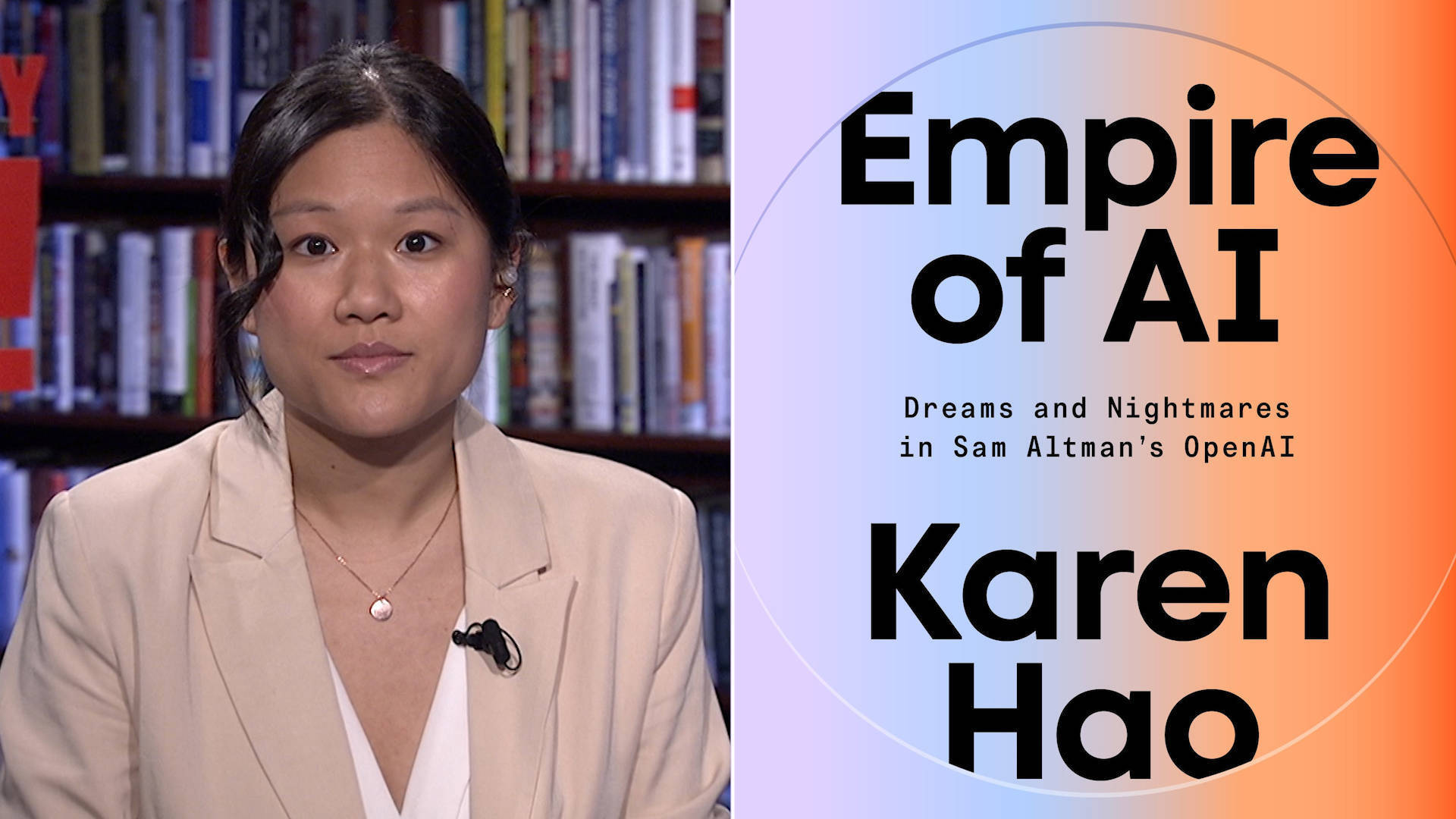
In our July Fourth special broadcast, we revisit our interview with longtime technology reporter Karen Hao, author of Empire of AI, which unveils the accruing political and economic power of artificial intelligence companies — especially Sam Altman’s OpenAI. Her reporting uncovered the exploitation of workers in Kenya, attempts to take massive amounts of freshwater from communities in Chile, along with numerous accounts of the technology’s detrimental impact on the environment. “This is an extraordinary type of AI development that is causing a lot of social, labor and environmental harms,” says Hao in an extended interview.
President, in latest AI-generated social media post, targets prominent celebrities who have spoken out against himDonald Trump on Thursday posted an AI-generated social media video portraying himself as a doctor who claims to have cured some of his most prominent celebrity critics – including Rosie O’Donnell – of the fictional condition “Trump derangement syndrome”.Outside the AI fantasy, O’Donnell said her assessment of the president remained unchanged. In a statement, she offered her own diagnosis: “He’s quite ill-and getting worse daily. The 25th amendment exists for exactly this reason. Remove. Impeach. Convict.” Continue reading...
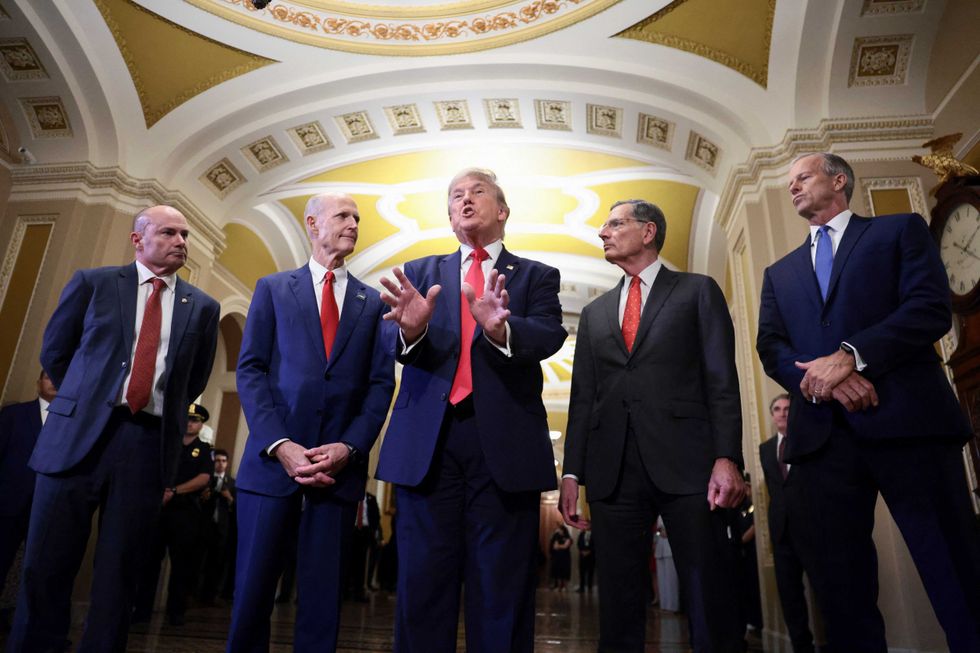
President Donald Trump said he sees the need for some standards on artificial intelligence technology, but wants to avoid burdensome restrictions that may hamper American companies competing with China.
President Trump is redefining what it means to be a U.S. ally in the AI era.Why it matters: For the White House, it's now about how partners can help the U.S. win the AI race.For decades, shared values and security interests have underpinned alliances with Europe and other partners around the world. Under Trump, that's no longer enough.As AI becomes central to economic and military power, frontier AI models, chips and infrastructure are turning into new instruments of American influence.Driving the news: The Trump administration is blocking allies from accessing the world's most powerful models, playing it close to the vest and criticizing Europe for not having its own robust AI industry.With export controls on Fable and Mythos lifted on Tuesday, Anthropic and the Trump administration are continuing Project Glasswing efforts, which the company previously said would give access to Mythos to 150 more organizations across more than 15 countries.Fable is also back.Commerce retains the power to pull back access when it deems appropriate. "The problem we have is that we are leading everybody by a lot," Trump said in a recent interview with "The Axios Show." "Europe has to be very careful. They're losing their way entrepreneurially."Trump pointed to the U.K. not tapping into energy sources in the North Sea because of environmental concerns: "It's crazy." Between the lines: The Trump administration's AI restrictions are part of a broader transactional approach to alliances.Catch up quick: Vice President JD Vance's speech last year at the Paris AI Summit set the stage for a confrontational relationship with the European Union.The U.S. was quick to rebuke the EU's focus on safety over innovation with Trump entering his second term laser-focused on deregulation. But the president now finds himself behind an ad hoc licensing regime that's creating its own regulatory uncertainty, both domestically and abroad.OpenAI's GPT-5.6 was forced into a staggered rollout last month due to government concerns.What they're saying: European Commission spokesperson Thomas Regnier on Wednesday said the bloc is looking forward to "intensifying" discussions with Anthropic to gain access to Mythos through Project Glasswing and that, in the meantime, it has access to GPT-5.5-Cyber.The EU has a delegation in the U.S. to determine the scope of a future tech dialogue, the frequency of meetings and the level at which they'll be held.The dialogue is expected to include frontier AI models, chip supply chains and cybersecurity."But we have one clear line," Regnier said, "which is that our sovereign legislation is not up for negotiation."Omran Sharaf, the United Arab Emirates' assistant foreign minister for advanced science and technology, told Axios "it's very important that trusted partners and strategic partners are included in the process."That way it is "synchronized and we're applying similar standards in controlling such technologies, rather than having something that gets imposed."The big picture: AI is changing what the White House wants in its alliances.Just last week, the EU and several European governments signed onto Pax Silica, the U.S.-led effort to secure AI supply chains and critical minerals, even as the White House restricts their access to frontier AI models.For the U.S., Europe is all of the above: a restraint, an indispensable partner and a competitor.The administration is simultaneously rejecting Europe's AI rules, inking deals with the region to secure supply chains and blocking access to cutting-edge technology.The bottom line: With the most advanced AI, allies will have to adjust to being considered trusted U.S. partners only in some cases."The conclusion that governments are coming to is: We'll be part of Pax Silica, yes. We'll work with the U.S. ecosystem where we can. We'll build around what we can't," A.J. Bhadelia, Cohere's head of global government affairs and external affairs, told Axios.