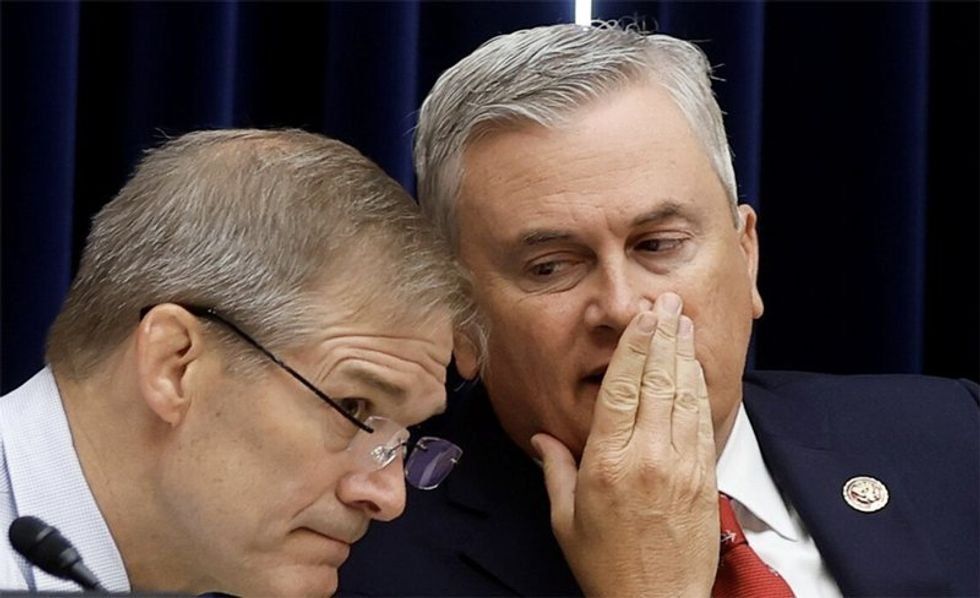
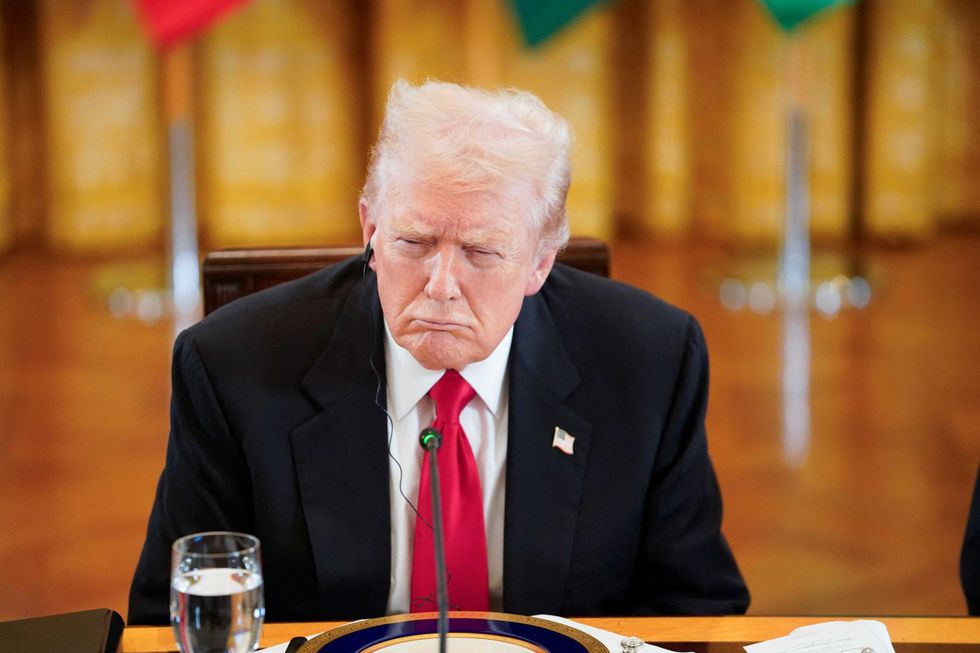
Democrats are expected to take back Congress in the midterm elections and Republicans are already plotting a preemptive strike ahead of that takeover to protect the White House.President Donald Trump's scandals are stacking up, from the files related to the Jeffrey Epstein investigation, the push for a $1.8 billion slush fund, the bulldozing of the East Wing of the White House, the funding for the East Wing of the White House, the Kennedy Center debacle and a slew of other money-making schemes. Semafor reported Thursday that one way Republicans could hit back is by conducting their own parallel investigations. "Doing so would amount to an unusual assertion of power from the House minority, which historically has almost no ability to enforce any of its own investigative requests," reporter Nicholas Wu conceded. James Mandolfo, a law firm partner who handled the GOP's investigation of then-President Joe Biden's family said, “If the Democrats take the House in November, the Republican minority will be among the strongest in history because they likely will have the Trump administration backing them on core issues that they remain aligned on." Normally, the committees would have no power to enforce subpoenas or make demands to cooperate with a private GOP investigation. Mandolfo suggested Trump get his Justice Department involved and use the power of the federal government to go after anyone who refuses to do what he wants. "The Trump administration could take action against those companies/institutions that don’t comply with any requests from the minority," said Mandolfo. It's unclear what would happen if such individuals fought back in court.Semafor explained that such a plan doesn't solve a problem Republicans could continue to face: division within their own party. "There was friction between some Oversight Committee Republicans and the Justice Department earlier this Congress, after the GOP-controlled panel voted to subpoena then-Attorney General Pam Bondi in the Jeffrey Epstein investigation," the report said. The Democratic investigations will likely be conducted within each congressional committee, but there could also be special investigative committees, similar to the Jan. 6 committee.
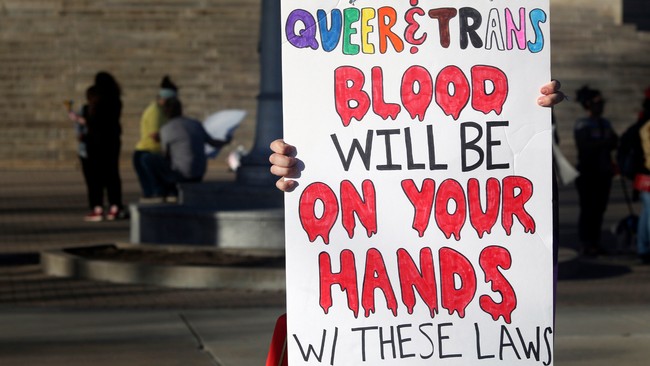
“In New York, they don’t say ‘I love you,’ they say ‘NYPD suck my d**k’ and I think that’s beautiful.”“A world without borders — just like a world without prisons or police — is possible, necessary, and the only moral way forward.”Voters judge political parties by what they do, not by what they call themselves.“Trick question — Israel doesn’t exist.”Those are social media posts or reposts from Darializa Avila Chevalier, the Democratic Socialists of America-backed candidate who won the 2026 Democratic primary for New York’s 13th Congressional District.Many Democrats still insist the Democratic Socialists of America remain a fringe movement with little influence over the party. Rep. Josh Gottheimer (D-N.J.), for example, recently promised that “common-sense Democrats will fight back” against the socialist agenda.The evidence suggests otherwise.The DSA’s influence no longer depends on how many members it elects to Congress. Its influence comes from how many of its priorities have become mainstream Democrat positions.Approximately 250 DSA members held public office in 2025, with roughly 90% elected after 2019. Only two currently serve in Congress, but the movement’s real strength lies elsewhere: dozens of state legislators and nearly 150 local officials, including mayors, city council members, county commissioners, and school board members. Another 35 DSA-backed candidates advanced through this year's primaries and appear positioned to win office.Increasingly, the DSA shapes the Democratic Party from the ground up.Consider the issues. The DSA openly advocates sweeping changes on immigration, policing, transgender policy, censorship, and the Israeli-Palestinian conflict.The DSA has long called for expanding the Supreme Court to reduce conservative influence. Democrat leaders have moved in the same direction. Former Vice President Kamala Harris endorsed Supreme Court reform, while Senator Ed Markey (D-Mass.) introduced legislation in 2024 to expand the court to 13 justices, joined by Sen. Adam Schiff (D-Calif.).On gender policy, the DSA advocates taxpayer-funded transgender procedures, including for minors, and has threatened hospitals that refuse to provide them.Former New Jersey Attorney General Matthew Platkin (D) argued that schools should be permitted to withhold information from parents when a child socially transitions at school. Whatever differences may exist around the edges, the underlying assumption is similar: Parents should not always have the final say.RELATED: Yet another establishment Democrat taken out by a Mamdani-like socialist from a foreign land Michael Ciaglo/Getty ImagesImmigration presents another point of convergence.The DSA opposes meaningful immigration enforcement and has labeled Immigration and Customs Enforcement itself an instrument of “state violence.” Democrat officials have likewise resisted federal immigration enforcement in a variety of ways.Sen. Andy Kim (D-N.J.) publicly aligned himself with anti-ICE activists, while New Jersey Gov. Mikie Sherrill (D) has limited state cooperation with federal immigration authorities and expanded state funding for immigrant legal defense.The rhetoric differs. The practical effect often does not.The same pattern appears on free speech.After Elon Musk purchased Twitter and restored numerous previously restricted conservative accounts, the New York City DSA launched a dedicated “Stop Musk” campaign.Democrat officials have repeatedly criticized Musk’s moderation policies and supported efforts, both here and abroad, to pressure X over the speech it permits.Again, the methods differ. The destinations look remarkably similar.The DSA also embraced the “Free Palestine” movement immediately after Hamas’ October 7, 2023, terrorist attack, issuing a statement calling for an end to the Israeli regime.Many of the Democratic Party’s most prominent progressive members have likewise become leading voices in the pro-Palestinian movement. Reps. Rashida Tlaib (D-Mich.), Ilhan Omar (D-Minn.), Ayanna Pressley (D-Mass.), and Pramila Jayapal (D-Wash.) have all championed that cause, while several have also supported reducing police funding or sharply limiting law enforcement.No, today's Democratic Party is not formally controlled by the DSA. But it increasingly advances many of the same priorities. That is why Democrat leaders spend so much energy insisting they are not socialists. They understand the label remains politically damaging.The problem is that voters judge political parties by what they do, not by what they call themselves. When the Democratic Party repeatedly adopts positions first championed by the Democratic Socialists of America, the distinction becomes more difficult to see.Democrats may not like the comparison.
Former Democrat-turned-Independent Senator Joe Manchin is urging Sen. Fetterman to follow in his footsteps as his former party lurches left. Manchin bucked the Democratic Party in 2024 […]
As President Donald Trump rages over his party’s inability to pass his much-demanded SAVE America Act, Politico reports that congressional Republicans have a “dirty little secret”: many of them don’t want to pass it at all. According to insiders, the “inconvenient truth” is that “it can’t even pass the House — at least not the version Trump is pushing.”According to Politico, “Speaker Mike Johnson acknowledged as much this week, appearing to concede he does not have the votes to move forward with a drastic crackdown on mailed ballots that Trump has repeatedly demanded this year.” Instead, GOP House leaders are reverting to an older version of the bill that focuses on proof of citizenship while otherwise letting states more or less run elections as they please. “We all do” want to give Trump what he wants, said Johnson, but a ban on mail-in ballots “is a very difficult thing to regulate at the federal level, because different states do it differently.” “I’m going to do everything I can with the vote tallies that we have,” he added.Hardline conservatives have pushed for an expanded version of the bill, which in addition to the mailed ballot ban would include Trump’s demand for provisions banning transgender people from playing women’s sports, as well as a prohibition on gender-affirming surgery for minors. But Johnson has continued to press a narrower version he thinks is more likely to pass.As Politico explains, “The lack of widespread GOP support for upending the voting systems in states like Arizona, Florida and Alaska is an open secret on Capitol Hill, where many Republicans credit mailed ballots with helping them win tight races.”“Listen, absentee ballots are not a bad thing historically as long as you put some kind of structure on it,” said Representative Mark Amodei (R-NV). “Just have some commonsensical safeguards for when it has to be postmarked by.” Last week, after the Supreme Court struck down Trump’s attempt to limit mail-in ballots via executive order, Amodei said he was happy with the outcome, asserting, “It says mail-in voting in and of itself is not evil. There ought to be some mechanism for you to do that.”Outspoken SAVE Act supporter Representative Julie Fedorchak (R-ND) wants the bill to pass in some form, but worries how a ban on mail-in ballots would affect states with limited polling places, saying, “We’re a rural state. I understand the concerns about mail-in voting… but I think the solution that I’m in favor of is restricting it and creating these commonsense reforms for it.” Johnson seconded her concerns about rural voters, admitting that in some states it can be “very difficult to get to a ballot box, and so they use mail-in ballots very effectively, and I think securely, and that’s something that has to be contended with.”Unsurprisingly, he tailored his criticism of mail-in ballots to target a few states in particular, claiming, “There are other states that do it well, and without a problem. Our concerns are with the handful, five or six blue states, who abuse this, and California is the avatar for this, because it is so ridiculous.”Critics of the president’s attacks on mail-in voting and his demands for other electoral restrictions argue that the SAVE Act will disenfranchise millions of voters. What’s more, as a number of GOP insiders have pointed out, the bill could backfire for Republicans, as conservative voters are less likely to have the appropriate ID and more likely to depend on mail-in ballots.