
The Hill News
What the Epstein files say about former UK ambassador to US Lord Peter Mandelson
In July 2009, Epstein wrote to Mandelson on the day he was released from jail, “Free and home.”
Center

In a 6-3 decision, the court said a legal defense called foreign sovereign immunity, which generally prohibits US lawsuits against foreign governments and their agents, is not available in cases like the Exxon's against CIMEX under the Helms-Burton Act.
In July 2009, Epstein wrote to Mandelson on the day he was released from jail, “Free and home.”
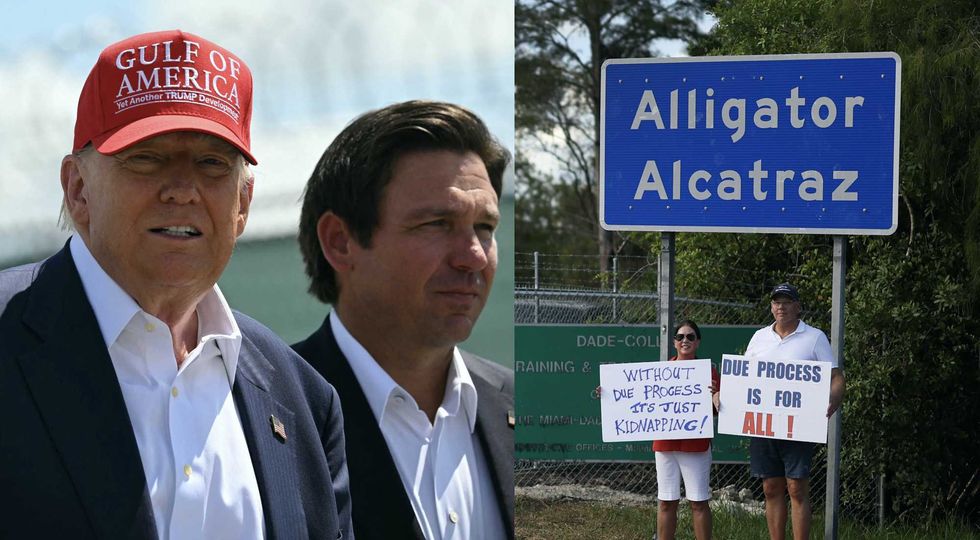
The controversial immigration detention facility known colloquially as "Alligator Alcatraz" has reportedly received some news about its future.The facility is shutting down permanently, according to sources that confirmed vendors have been told to demobilize.'Clearly from a security perspective, if someone escapes, there’s a lot of alligators you’re going to have to contend [with].'Republican Florida Gov. Ron DeSantis hinted in recent months that the facility might be shut down when he said it has already served its purpose by cycling about 22,000 migrants.CBS News reported that four sources confirmed the facility vendors were told that the "demobilization" clause in their contracts had been triggered, meaning they would be paid for shutting down."All vendors got the notice," said one source. The facility has been plagued by legal challenges that prevented federal funding from reimbursing Florida for the reported $1.2 billion price tag that ballooned from the initial $450 million annual estimate. On Wednesday, Department of Homeland Security spokesperson Lauren Bis said that all of the detainees at the facility had been moved to other locations, but she claimed it was a response to hurricane season.The facility opened up in July 2025 on an 11,000 foot abandoned airport runway in the Florida Everglades. Critics have claimed the facility puts migrants in dangerous and cruel conditions including lack of bathroom facilities, rotten food, and little to no access to the outside world, including their immigration attorneys. "The state and federal government must permanently close this facility and commit to never detaining people there again," said Amy Godshall of the American Civil Liberties Union, which has sued the facility. WFOR-TV reported in its news video that there was no sign yet that the facility was being dismantled.RELATED: Dem. congressman claims he forced ICE to back off from arresting man outside courtroom The facility was designed to hold about 3,000 detainees to ease the housing burden on immigration officials. "Clearly from a security perspective, if someone escapes, there’s a lot of alligators you’re going to have to contend [with]," DeSantis said about the facility in July 2025. "No one is going anywhere once you do that. It’s as safe and secure as you can be." He also stressed at the time that the facility was temporary. Like Blaze News? Bypass the censors, sign up for our newsletters, and get stories like this direct to your inbox. Sign up here!

WHAT’S HAPPENING TODAY: Good afternoon and happy Tuesday, readers! The Trump administration has announced plans to offer nearly $17.5 billion in loans to support the construction of 10 new large nuclear power reactors, with operations aimed to begin by the mid-2030s. ☢️ In other news, traffic in the Strait of Hormuz is increasing. Keep reading […]

The US F-15 pilot shot down by Iran in April has a very strange supernatural story about his flight.
It’s one of the Supreme Court’s most palpable fears: Somewhere, somehow, a government official might one day be held personally accountable in some way for their official conduct—or, more accurately, their misconduct. A new case at the court will likely be the latest demonstration of the court’s pro-impunity mindset.The justices agreed on Monday to hear Nielsen v. Watanabe in the upcoming term, which starts next October. The case will give the court an opportunity to further narrow what are known as Bivens claims, which allow for people to sue federal officials for damages under increasingly narrow circumstances.The plaintiff in the case, Ketei Watanabe, was a prisoner at a federal prison in Honolulu in 2021. During that time, he was “brutally assaulted” in a “gang-related fight,” according to his brief for the justices. After the fight, he told multiple prison officials, including nurse Francis Nielsen, that he had suffered significant injuries and was in a great deal of pain.Nielsen and other officials declined to obtain specialist treatment for Watanabe or to transport him to a local hospital for treatment. Instead, his filings said, Nielsen gave him over-the-counter pain medication. “Several months after the attack, Watanabe finally received an x-ray: It showed that he had a fractured coccyx and that bone chips had migrated to surrounding soft tissue areas,” his brief explained to the court. Even after this diagnosis, Watanabe alleged, Nielsen and other officials refused to provide him with outside medical treatment and he did not obtain proper medical care until his release from prison three years after the initial fight. The Supreme Court has previously held that prisons have a duty to provide medical care for prisoners under the Eighth Amendment. Accordingly, Watanabe sued the officials in federal court for their alleged mistreatment.What happens when a government official violates your constitutional rights in some way? If they are a state or local official, like a police officer in a major city, you might file a Section 1983 lawsuit in federal court for damages. That Reconstruction-era law allows people to sue state and local officials in federal court in their personal capacity for violating a federal constitutional right. (More on this later.)If a federal official violates your constitutional rights, on the other hand, there are very few ways to hold that official personally accountable. Congress has not enacted a Section 1983–style law for suing federal officials, though there have occasionally been proposals to do so. Nor do other congressionally enacted remedies, like the Federal Tort Claims Act, allow people to pursue damages against specific officials who violate their constitutional rights.Watanabe instead relied upon an implied cause of action rather than an explicitly created one. This approach became more common after the 1971 case Bivens v. Six Unknown Named Agents of the Federal Bureau of Narcotics. Most people just call the case Bivens for short. In Bivens, federal agents searched the home of a New York man without a warrant and arrested him on drug-related charges. Bivens sued the agents in question in federal court for violating his Fourth Amendment right to be free from unconstitutional searches and seizures.The narcotics agents argued that they could not be sued in their personal capacity because Congress had not created a cause of action to do so. The Supreme Court, led by Justice William Brennan, sided with Bivens. While Brennan acknowledged that the Fourth Amendment “does not in so many words provide for its enforcement by an award of money damages for the consequences of its violation,” he concluded that Bivens could rely upon an implied cause of action instead to vindicate his violated rights.Between 1971 and 1980, the Supreme Court applied that reasoning to two other contexts: gender-discrimination lawsuits by congressional staff under the Fifth Amendment and, as relevant for Watanabe’s case, prisoner lawsuits over improper medical care by prison officials under the Eighth Amendment. The latter is grounded in the 1980 case Carlson v. Green. In Carlson, prison officials effectively killed an asthmatic prisoner by holding him in conditions over doctors’ protests, denying him treatment for an asthma attack for roughly eight hours, and then giving him substandard care until he died.Since Carlson, the Supreme Court’s increasingly conservative majority has gone out of its way to clip the wings of Bivens claims. Justices ranging from Warren Burger to Neil Gorsuch have argued that, under the Constitution’s separation of powers, it is Congress’s responsibility to create causes of actions to vindicate constitutional rights, not the judiciary’s. To that end, they have effectively refused to extend Bivens to new contexts, while also—for reasons known only to the justices—declining to overturn Bivens altogether.In the 2017 case Ziglar v.
The Supreme Court ruled 6-3 Tuesday that border officials do not need “clear and convincing evidence” that a lawful permanent resident committed a disqualifying crime before treating that person as an applicant for admission rather than someone already admitted to the United States. The decision was split along ideological lines.'Border officers did not have the burden to establish by clear and convincing evidence that Lau had committed a crime involving moral turpitude.'The case involved Muk Choi Lau, a Chinese national and green card holder who was charged in 2012 with selling counterfeit clothing. After briefly traveling to China while the charge was pending, Lau was paroled into the U.S. rather than admitted when he returned. He later pleaded guilty to trademark counterfeiting.During oral arguments in April, the government argued that the Immigration and Nationality Act does not require immigration officers at the border to possess clear and convincing evidence that a lawful permanent resident committed a crime involving moral turpitude — an act driven by dishonesty or immorality. Instead, government attorney Sopan Joshi argued that any burden is satisfied later during the individual's removal hearings.Writing for the majority, Justice Clarence Thomas agreed. The court held that the INA allows the government to regard a lawful permanent resident as seeking admission if he has committed a qualifying offense and that nothing in the statute imposes a requirement of clear and convincing evidence on border officers making "quick judgments on the spot."“Border officers did not have the burden to establish by clear and convincing evidence that Lau had committed a crime involving moral turpitude,” Thomas wrote.The ruling reverses the Second Circuit's decision, which had sided with Lau and held that immigration officials needed clear and convincing evidence that he had actually committed the crime before treating him as an applicant for entry rather than a person already admitted.RELATED: ‘Shall not be infringed’ — even if you're high, Supreme Court rules Chip Somodevilla/Getty Images/Bloomberg/Getty ImagesJustice Ketanji Brown Jackson, joined by Justices Sonia Sotomayor and Elena Kagan, dissented, arguing that the government must determine whether an exception applies under the INA before stripping a green card holder of admitted status. She warned that the majority's approach gives the government broad authority to parole lawful permanent residents and justify the decision later.“But today the Court allows the Government to deem an LPR to be ‘seeking an admission’ first and justify the applicability of an exception later — undermining the statutory scheme as well as the benefits and security that come with having a green card,” Jackson asserted.The court did not decide whether Lau's trademark counterfeiting conviction qualifies as a crime involving moral turpitude, sending the case back to the Second Circuit for further proceedings.Like Blaze News? Bypass the censors, sign up for our newsletters, and get stories like this direct to your inbox. Sign up here!

The Supreme Court rejected a former Louisiana inmate's effort to sue state prison officials after they shaved his dreadlocks in violation of his religious beliefs.

Iran will be allowed into US 48 hours before crucial gameTeam Melli have complained about travel conditionsThe US Department of Homeland Security (DHS) says it will grant Iran extra time to prepare for their World Cup match against Egypt on Friday.The team had planned to lodge an official complaint with Fifa about the “restrictions imposed by the organisers” at the World Cup. Iran have been training in Mexico and were only allowed to enter the United States 24 hours before their first two matches. Continue reading...