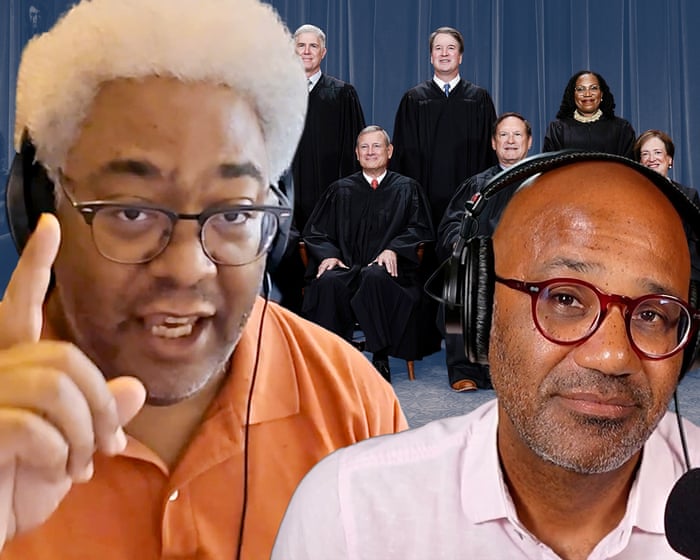
Chief Justice John Roberts begins the Supreme Court’s birthright citizenship opinion in Westminster in 1608 with Calvin’s Case and the English law of royal subjectship.I would begin in Philadelphia in 1776.English law rested upon allegiance to the Crown. The American Republic would rest upon the consent of a self-governing people.Between those two places — and those two moments — lies the American Revolution. And the Revolution changed more than who governed America. It changed the very foundation of political membership.That is the central problem with the Supreme Court’s decision in Trump v. Barbara. The court’s opinion is learned, careful, and historically rich. Chief Justice Roberts traces the English doctrine of jus soli through Calvin’s Case, Blackstone, a substantial body of antebellum American authorities, and finally United States v. Wong Kim Ark. It may well become the definitive defense of the conventional understanding of the 14th Amendment’s Citizenship Clause. But it answers the wrong question.The issue is not whether America inherited English legal language. It plainly did. The issue is whether America also inherited England’s understanding of political membership.The majority assumes that the American Revolution left the English understanding of political membership largely intact. The dissents argue that the Revolution rejected that understanding and replaced it with an American conception of citizenship grounded in the consent of the governed. That is the real disagreement in this case.A new creedUnder English common law, nearly everyone born within the king’s dominions became a natural-born subject. Birth within the sovereign’s territory created permanent allegiance to the Crown because the child was born under the king’s protection. That doctrine made sense in a monarchy. It reflected a world of subjects, sovereigns, dominions, and perpetual allegiance.But the United States is not a monarchy.The Declaration of Independence did more than announce separation from Great Britain. It rejected the political philosophy upon which English subjectship rested. Jefferson’s words — that governments derive “their just powers from the consent of the governed” — were not mere rhetorical flourishes. They announced a new theory of political legitimacy. The Declaration’s closing words made the rejection of perpetual allegiance explicit: The new states were “absolved from all allegiance to the British Crown.”English law rested upon allegiance to the Crown. The American Republic would rest upon the consent of a self-governing people.That revolutionary transformation should have been central to the Court’s interpretation of the 14th Amendment.Instead, the majority largely assumes that English subjectship and American citizenship belong to the same constitutional lineage. Roberts proves an important proposition: England recognized birthright subjectship. But he does not prove the decisive one: that Americans who had repudiated monarchy intended, less than a century later, to constitutionalize the English law of royal subjectship as the definition of citizenship in a republic.Mere obedience to law is not the same thing as complete political allegiance.Justice Joseph Story helps explain why that distinction matters. Story was steeped in English law, but he was not merely Blackstone with an American accent. His great constitutional project was to explain how inherited English legal concepts had been adapted to the institutions and principles of an American republic. He stands as a bridge between the common-law inheritance and American constitutionalism.That is the bridge missing from the majority’s account. Roberts reads the inherited legal tradition largely as a line of continuity from Calvin’s Case to Wong Kim Ark. But the American constitutional genealogy runs along a different path: the Declaration of Independence, Story’s adaptation of inherited law to republican constitutionalism, Lincoln’s reaffirmation of the Declaration as the nation’s first principle, the Civil Rights Act of 1866, and the 14th Amendment.Abraham Lincoln understood this better than anyone. He did not treat the Declaration as a mere political manifesto. Lincoln treated it as the nation’s statement of principle. In his famous meditation on the Constitution and the Union, Lincoln described the Declaration’s principle of liberty as the “apple of gold,” with the Constitution as the “picture of silver” framed around it. The frame was made not to conceal or destroy the apple, but to preserve it.That is precisely the point here. The Constitution must be read as law. But it is American law, not English law. And the 14th Amendment must be read as part of the Constitution’s effort to vindicate the principles of the Declaration after the catastrophe of slavery and Dred Scott.Preserving the cornerstoneThe Reconstruction Congress was not attempting to preserve English constitutionalism.