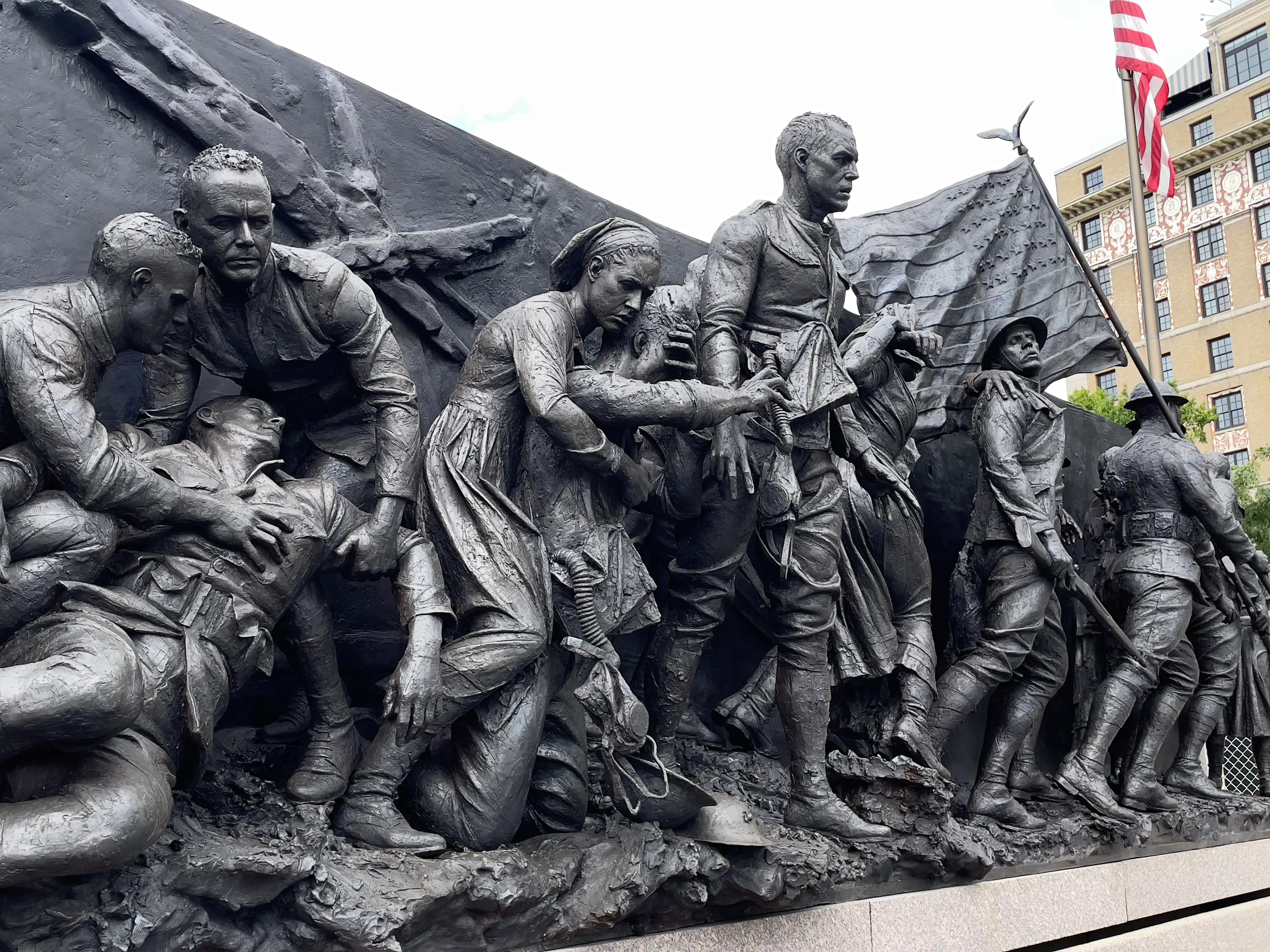
The Hidden Message Inside America’s New WWI Memorial
Right
This article is part of Upstream, The Daily Wire’s new home for culture and lifestyle. Real human insight and human stories — from our featured writers to you. *** There are many famous memorials within walking distance of each other in our nation’s capital, but perhaps none so imposing as the World War I Memorial just steps ...
Freedom 250 is holding a candlelight tribute on Memorial Day to honor the sacrifices of fallen U.S. military service members who fought to secure and defend American freedom and recount their stories. The non-partisan organization, founded to celebrate the United States’s 250th birthday, will highlight the lives of late veterans Captain Humber “Rocky” Versace (a […]
The fallout from Louisiana v. Callais has been nothing short of tragic, with terrible echoes of the past. As Reconstruction ended in 1877, states in the South either killed, expelled, or used other means to force out Black legislators. Over the last two weeks, freed from abiding by Section 2 of the 1965 Voting Rights Act, Southern states have rushed to redraw their district lines to ensure that members of Congress elected by Black voters can’t win reelection. We are in a new era of American democracy, particularly for Black Americans. The Republican Party now views Democratic Party electoral wins and policy success as an existential crisis that it must prevent by any means necessary. Crushing Black political power is therefore essential to the GOP, since African Americans overwhelmingly support the Democratic Party. And the current Supreme Court, more than any in decades, has not only removed virtually all constraints on policies that might negatively affect African Americans but actively looks to outlaw any public policy that might benefit Blacks. This era demands a new framework for Black politics—fresh strategies, tactics, leaders, and goals. We need a “Double Front” approach. And we should be clear-eyed: Even before Callais, the existing models of Black politics were growing stale. It’s worth explaining when and how Black politics lost its effectiveness. There has never been a singular Black political movement or African American ideology. Booker T. Washington and W.E.B. Du Bois famously quarreled. Du Bois’s own views shifted over the course of his life. The reality of the civil rights activism of the 1950s and ’60s was more complicated and messy than beautiful Martin Luther King speeches and smartly organized boycotts. But after the civil rights victories of the 1960s, a clear Black politics emerged and predominated for five decades. Aspiring Black leaders, who had earlier led from the pulpit or protests, sought and won political office, most commonly becoming either mayor or member of Congress in heavily Black areas. A network of Black organizations, such as the National Urban League and the NAACP, focused less on the mass protests of the civil rights era and more on behind-the-scenes lobbying and collaborating with those Black officials in office. Though they varied considerably, these organizations often became synonymous with a single famous leader, such as Jesse Jackson and Al Sharpton. And these leaders were often treated by the media and politicians as spokespeople for the entire Black population. These politicians, groups, and leaders aligned tightly with the Democratic Party, viewing it as the only vehicle to advance Black political goals. The results of this approach have been uneven. On the one hand, African American politicians became increasingly powerful within the Democratic Party, gaining committee chairmanships, the mayor’s office in some of America’s largest cities, Cabinet and judicial appointments, and finally, in Barack Obama, the party’s presidential nomination. These elected officials delivered major policy victories to Black Americans and the country as a whole, from local economic empowerment of Black communities to the Affordable Care Act. On the other hand, African Americans became a “captured minority,” the term invoked by Princeton political scientist Paul Frymer. Democratic Party officials knew that Black voters would back them no matter what, so they had little incentive to push hard for policies and programs that would help African Americans in particular. Electoral pressures led the Democratic Party to set an agenda that would appeal to swing voters in swing states—a very non-Black constituency.As the Democratic Party became increasingly concerned that advancing Black concerns turned off white voters, Black Democratic politicians and prominent activists faced a choice: advance in the party by downplaying and sidelining Black concerns, or advocate Black interests at the expense of their careers. Many chose the former. Contrary to conservative pundits who claim that he stoked racial conflict, Obama actually spoke far less about racial issues than his Democratic predecessors. Prominent activists shifted from pressuring Democratic politicians to being very defensive of them. Sharpton and others negotiated with mayors, presidents, and corporations, but grew unaccountable to Black America at large—operating more like celebrities than community activists. Over time it became difficult to distinguish the policies of Black and white mayors, as both were beholden to the police and corporations in their cities and thereby unwilling (and often lacking any real power) to advance policies to help rank-and-file Black Americans. The Congressional Black Caucus for a time earned its self-given moniker, the “Conscience of the Congress,” pushing the U.S. in radical directions, whether on enforcing civil rights or in the fight against apartheid in South Africa.
We come from different parties and have walked different paths, but we share something few Americans do: we have held the weight of this country’s security in our hands. On Sept. 11, 2001, parties and titles didn’t matter. We were Americans, and that was enough. We have stood at the intersection of crisis and consequence. […]
Is the United States headed for a second Civil War? According to a survey of likely midterm voters published by the Leadership Conference on Civil and Human Rights, 57% of Americans believe it is. Sixty-nine percent say democracy is under serious threat; and an equal percentage of non-white voters say they fear rising white supremacy.While President Donald Trump and his MAGA movement deserve the lion’s share of blame for such findings, the Supreme Court has done its part. Under the stewardship of Chief Justice John Roberts, the court has issued a blistering succession of dangerously polarizing rulings, ranging from presidential immunity, union organizing, the death penalty, environmental protection, and gun control to affirmative action and abortion rights. The resulting jurisprudential carnage has accelerated the nation’s rupture into irreconcilable belligerent tribes and prompted speculation that we are headed for another existential conflict.The Roberts Court has taken a particularly malevolent interest in destroying the Voting Rights Act (VRA) of 1965. Last month’s decision in Louisiana v. Callais gutted Section 2 of the landmark legislation, which was amended in 1982 to permit the Justice Department and private citizens to challenge election laws that have the effect of diluting minority voting power.The court’s 6-3 majority opinion by Justice Samuel Alito invalidated Louisiana’s 2024 congressional map that created a second majority-Black congressional district to operate alongside the state’s five white-majority districts, roughly reflecting the size of Louisiana’s Black population. The ruling handed a victory to the lead plaintiff in the case, Phillip “Bert” Callais, an election denier and alleged conspiracy theorist who had attended the January 6, 2021 “Stop the Steal” rally on the White House Ellipse that eventually snowballed into the insurrection at the Capitol. Barely concealing their racial animus, Callais and his co-plaintiffs described themselves in court filings as “non-African American voters” who were the victims of reverse discrimination. Louisiana has since moved to redraw its voting maps.With the demise of the “effects test,” future Section 2 plaintiffs will have to meet the nearly impossible burden of proving that redistricting maps were created with overt discriminatory intent rather than for political purposes. And as the court held in a 2019 opinion written by Roberts in Rucho v. Common Cause, political gerrymandering claims cannot be brought in federal courts because, as the Republican majority sees it, they present nonjusticiable “political questions.”Both Callais and Rucho built upon Roberts’ 2013 majority opinion in Shelby County v. Alabama gutting two other sections of the VRA that required state and local jurisdictions with histories of egregious voter discrimination to obtain advance federal approval—known as preclearance—before making changes to their election procedures. Like Alito in Callais, Roberts declared in Shelby that racial discrimination in voting was a thing of the past and thus special protections for minorities were no longer necessary.The combined effects of Shelby and Rucho have led to a proliferation of voting roll purges, onerous photo ID laws, and limitations on mail-in ballots in red states across the country. Now, with Callais, election law experts predict that as many as 19 Democratic congressional seats in Tennessee, Alabama, Mississippi, South Carolina, Florida, and Louisiana could be eliminated, returning the former states of the Confederacy to one-party rule.The court’s handiwork has sparked outrage and alarm. Rep. Bennie Thompson, the only Democrat in Mississippi’s congressional delegation, who will likely lose his seat to gerrymandering, has condemned Callais as “equivalent to a second Civil War.” Other observers have compared the current moment in the US to the 1850s, when debates over the future of slavery eventually led to secession and war.Chief Justice Roberts has also drawn comparisons to Chief Justice Roger Taney, whose 1857 majority opinion in Dred Scott v. Sandford held that Black Americans had “no rights that the white man was bound to respect.” The Dred Scott decision helped precipitate the Civil War, and is widely considered the most infamous in the court’s history.The parallels between Taney and Roberts are beyond hyperbole. Both men began their legal careers as zealous partisan political advocates. Before ascending to the Supreme Court in 1836, Taney was elected to the General Assembly of Maryland, and later served as a loyal foot soldier to President Andrew Jackson, first as secretary of war and then as attorney general, in which capacity he penned an advisory opinion that prefigured his Dred Scott ruling, arguing that the Constitution and the Bill of Rights were inapplicable to Black people, even those living in free states.Similarly, the young Roberts established himself as a dependable right-wing operative, clerking for Chief...